

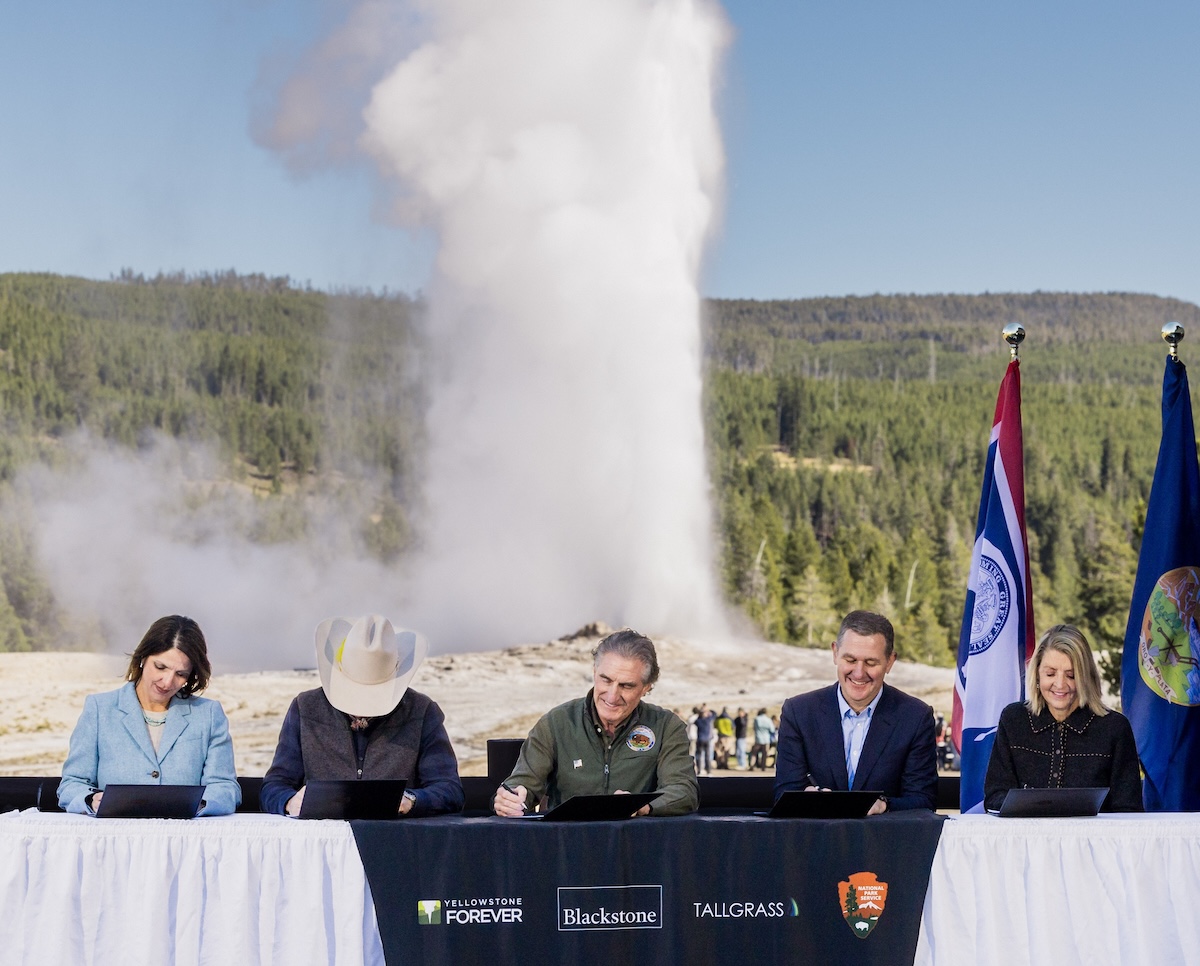
Yellowstone National Park and Tallgrass, a Colorado company building an AI power hub near Cheyenne, have launched a $105 million conservation and stewardship fund for the country’s first national park, calling it the largest single private gift in the agency’s history.
The park announced creation of the fund this morning in conjunction with its nonprofit conservation partner, Yellowstone Forever, and Tallgrass, a Blackstone Infrastructure portfolio company. The fund will establish a permanent source of support for long-term stewardship, the groups said.
Among the projects the effort will fund is a $35 million visitor center at Norris Geyser Basin, Steven Davidson, senior vice president at Tallgrass said in an interview with WyoFile.
“There’s no place for you to sit and engage with a ranger directly,” he said of the sprawling basin. The center will offer opportunities for experiences that are “a bit more interactive,” he said.
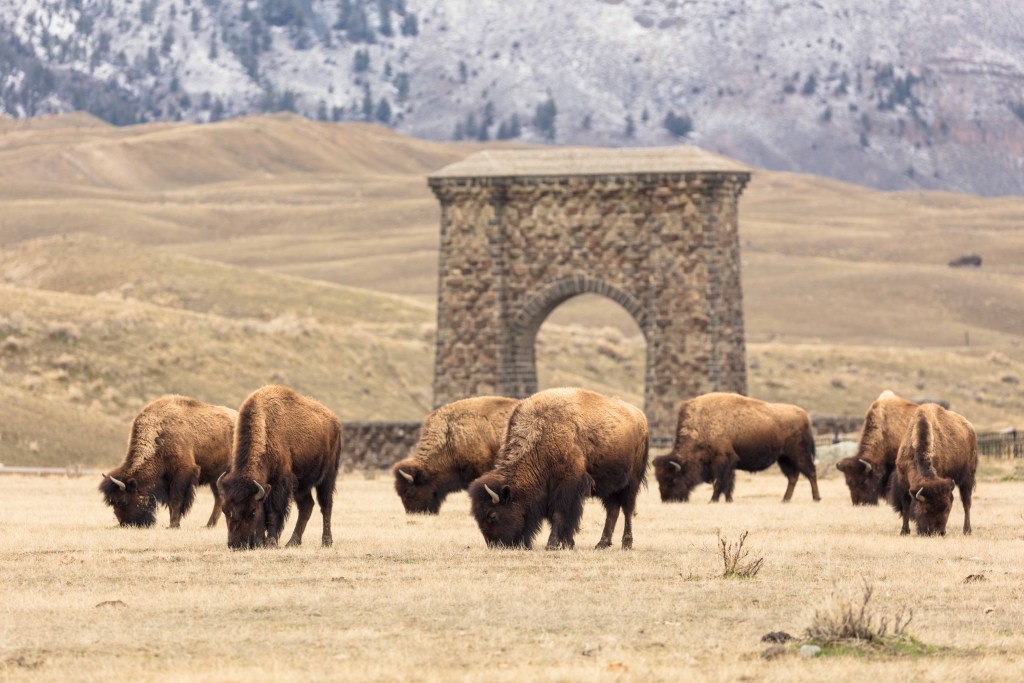
The fund will advance conservation and research, invest in infrastructure and expand opportunities for Wyoming residents and students to visit the 2.2 million-acre reserve. The groups said the donation will establish the Tallgrass WYld Yellowstone Initiative, named for the company that’s been operating in Wyoming for more than a decade.
“The focus is for Wyoming,” Davidson said. “If you are a Wyoming kid, family, we are going to target these programs for you. Let’s be proud and selfish for Wyoming kids.”
Gov. Gordon called the gift “extraordinary” and said it will help Wyoming students better connect with Yellowstone.
“Ninety-three percent of the park is in Wyoming, and so few of our school kids in Wyoming really know what a remarkable place that is,” he said in an interview. That’s because people in Wyoming who love the outdoors “already all have favorite places.”
“We’re blessed with beautiful mountains almost everywhere, and so unless you have a sort of a sense of the history and [of] some of the remarkable stuff about Yellowstone, why would you skip over the Winds or the Absarokas?”
Learning about the migration routes of Yellowstone wildlife puts the park in context with the rest of the state, he said. The education and access elements of the initiative “gives us an opportunity to really talk about the connectivity with all the other great parts of Wyoming,” he said.
At Norris, more interpretation provided at a visitor center would allow visitors to talk about “more than just: You came and saw,” he said. “Talking about the uniqueness of that area is a valuable thing for visitors at the park generally.”
Interior Secretary Doug Burgum called the investment “historic,” and said in a statement it brings together “the best of American enterprise and conservation.”
“We’re grateful to Blackstone, Tallgrass and Yellowstone Forever for their partnership and extraordinary commitment,” his statement reads.
For Blackstone, the gift “reflects our belief that infrastructure investment can and should be a force for good, helping us invest in Yellowstone’s future and the growth of the communities that surround it,” Sean Klimczak, the company’s global head of infrastructure said in a statement.

Lisa Diekmann, president and CEO of Yellowstone Forever, called the gift a transformational investment. “It gives us the ability to meet urgent needs today while building enduring support for the research, education, stewardship and visitor infrastructure that will protect this park for generations to come.”
The gift comes at a time of change and challenge for Yellowstone, the country’s first national park. The Park Service estimates $1.2 billion in deferred maintenance and repairs. Barclay Trimble just assumed duties as Acting Superintendent of Yellowstone National Park. He replaced Cam Sholly, who left his post after eight years.
Tallgrass, a “multi-commodity infrastructure” company based in Colorado, operates more than 10,000 miles of pipelines. Early this year it received approval to build an AI data center south of Cheyenne. Google will be Tallgrass’ partner, according to Measured AI, a recent switch from original partner Cruso.
Tallgrass is building the gas-fired Cheyenne Power Hub for the 1.8 gigawatt project. Tallgrass’ $7 billion project is located on more than 1,000 acres in the Switchgrass industrial park south of Cheyenne. The data center will occupy more than 700 acres, according to plans. The data center has faced pushback from rural neighbors in Laramie County concerned about lost views and potential water contamination.
On Monday, Tallgrass President and CEO Crystal Heter said, in a statement announcing the donation to Yellowstone, that the company is proud to strengthen the park’s connection with the next generation.
This story was updated at 4 p.m. Monday to include an interview with Gov. Mark Gordon — Ed.

This is blatant dirty money. Yellowstone Forever is nothing more than a prostitute taking a bribe.
Well said Amanda. History has shown.
Yellowstone Receives $105 Million. What About Southeastern Wyoming? Tallgrass Energy and Blackstone have announced an extraordinary $105 million conservation and stewardship fund for Yellowstone National Park. This is welcome news for one of Wyoming’s most treasured landscapes.
But WyoFile also reports that Tallgrass is developing a $7 billion energy and data center project south of Cheyenne, where neighboring landowners have raised concerns about water, views, and industrial impacts.
This raises a question worth asking:Will the same commitment to long-term environmental stewardship extend to the working landscapes and communities of southeastern Wyoming?
Our Wyoming Wind Wall concerns involve multiple overlapping industrial projects and their cumulative effects on water, wildlife, roads, public safety, and neighboring property owners.
We should be asking for independently verified baseline environmental studies, public monitoring, developer-funded infrastructure improvements, and enforceable protections before construction—not simply assurances that impacts will be addressed later.
Protecting Yellowstone is important. So is protecting the ranchlands, wildlife corridors, rural communities, and property investments that define southeastern Wyoming.
Corporate stewardship should be measured not only by what companies voluntarily contribute, but also by how responsibly they manage the impacts of their own developments.
I’ve visited Yellowstone a lot. I’m not convinced an expense visitor center at Norris is wise. It’s already super overcrowded during the summer months with people parking along the road, similar to the Grand Prismatic pool. I know a Yellowstone Ranger who talks about Old Faithful in the summer as a Walmart parking lot with all the congestion. Norris will be like that too. Yellowstone Forever supports this???
I have to agree with this completely. Yellowstone does not need more building infrastructure. I did go to a YTCC meeting yesterday that said that there would be EV charging in the park, and less pollutants is a good thing, but we don’t need a visitors center in Norris.
Some how, some way I’m sure the money will end up in trump’s pocket as a kick back.
This should be understood as part of the larger effort to sell and privatize public lands. The National Park Service wouldn’t have so much deferred maintenance if DOGE and other cuts hadn’t gutted their staff and budgets. As this land and other public lands become more and more degraded, especially by other executive orders mandating expedited mining, logging, and grazing, the argument that “the government can’t care for these lands” and “private companies are the only ones who can” starts to make more and more sense to the public.
This is also a company in a near-universally despised business trying to cheaply buy goodwill with the public while destroying other ecosystems.
We shouldn‘t allow them to buy our compliance. $105 million is pocket change to them. We should look to the past as a warning, when railroad and mining barons, acting as “philanthropists”, were building libraries and universities, while making generational fortunes off taking Indigenous lands and machine-gunning striking workers.
May we understand that this “donation” is not altruism. This is an investment in a future where only the ultra-wealthy have access to beautiful places like Yellowstone, after they have already destroyed our wetlands, sacred sites, waters, and wilderness areas, and made life for the rest of us on this planet unlivable.
Absolutely. I fear any donations for maintenance, conservation of public lands will somehow be used to cut down forests to build build golf courses. The very presence of Interior Secretary Doug Burgum on that dais is a chilling reminder of the damage being done to public lands by the Trump administration.
Well said. I fully agree.
Agreed. You should not trust this administration or his minions. They are ‘wolves in sheep’s clothing.
I wholeheartedly agree with your take on this “gift.” Capitalism makes investments, not altruistic gifts. This is pocket change for Blackstone, likely far less than their tax break from the big beautiful bill.
Add another agreement to this comment. I pittance for what the park actually needs, for something it doesn’t need.