
A company behind Wyoming’s artificial intelligence data-center boom has launched a $105 million fund for Yellowstone National Park. In a Monday announcement, officials touted the donation as the largest private gift in National Park Service history. But the contribution is also raising questions about the role of private philanthropy as data-center development transforms the rural West.
Funneled through the official nonprofit partner of the park, Yellowstone Forever, the donation from energy giant Tallgrass, a Blackstone Inc. portfolio company, is intended to fund research and conservation; develop a new visitor education center at Norris Geyser Basin; and expand opportunities for students and families to experience and learn about Yellowstone, according to Yellowstone Forever CEO and President Lisa Diekmann.
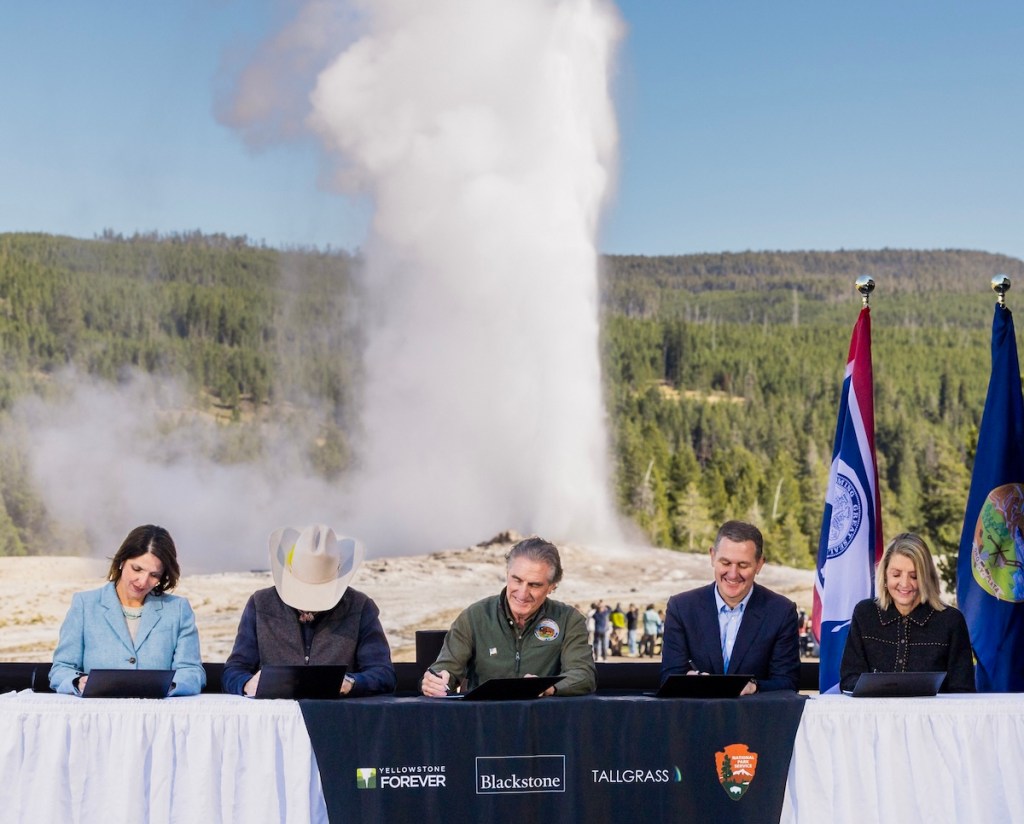
As U.S. Interior Secretary Doug Burgum posed for pictures at Yellowstone’s Old Faithful Inn on Oct. 16 alongside Wyoming Gov. Mark Gordon and representatives of Tallgrass and Blackstone, officials didn’t discuss the environmental impact of AI data centers. Instead, they touted what the donation would do for the park.
“More than 120 years ago, President Theodore Roosevelt laid the cornerstone of Yellowstone’s iconic gateway, enshrining the promise that our National Parks exist for the benefit and enjoyment of the American people,” Burgum said in a press release. “This historic $105 million investment honors that legacy, bringing together the best of American enterprise and conservation to expand access to Yellowstone and inspire the next generation to experience America’s great outdoors.”
But across the country, only about 11% of Americans support the construction of an AI data center in their communities, according to recent polling from the University of Massachusetts Amherst.
Brian Childers lives about three-and-a-half miles from a Microsoft AI data center south of Cheyenne — near the separate Tallgrass facility that’s under construction. He’s hard of hearing, he says, but he still can’t escape a constant, overwhelming hum. Birds have left his property, he said, and at night the sky never quite gets dark. He said the gift to Yellowstone feels like the companies are trying to buy goodwill from politicians and the public.
“I’m glad (the park) got the money, but if these things are going to impact the people around southeast Wyoming, (the corporations) need to be paying a premium on the electricity they use so that the people don’t have to pay extra,” Childers told Mountain Journal in an interview.
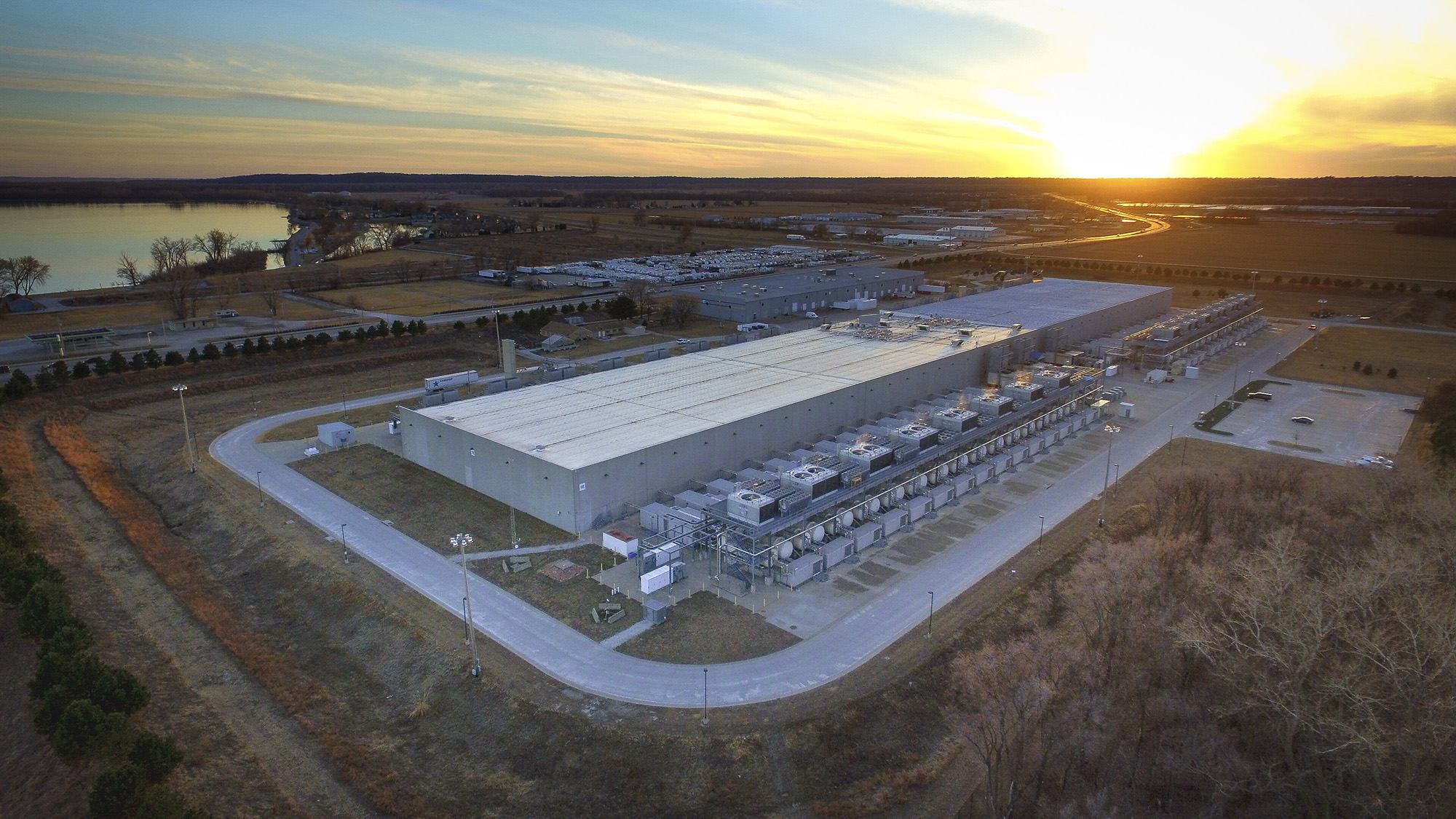
Colorado-based Tallgrass manages more than 10,000 miles of pipelines and, with Google as a partner, is developing a 2.7 gigawatt AI data center near Cheyenne, Wyoming. Matt Sheehy, brother of Montana Republican U.S. Sen. Tim Sheehy, led the company from 2019 until earlier this year. Tallgrass is also a subsidiary of Blackstone, the largest financier of data centers in the world and major financial backer of Tim Sheehy’s former company Bridger Aerospace.
The National Parks Conservation Association, Park County Environmental Council, Wild Montana and the Greater Yellowstone Coalition all declined to comment on the donation.
On social media, however, an uproar ensued.
“Putting the wolves in charge of the sheep,” one person commented on Yellowstone’s Instagram post, joining a slew of detractors.
Tax dollars only cover the basics of Yellowstone National Park’s operations, according to Yellowstone Forever’s Diekmann, who said she hopes the gift will inspire further donations. America’s first national park still has a large need, she added: Yellowstone has a $1.2 billion backlog of maintenance that this donation will not address.
In an interview, Mountain Journal asked Diekmann about how closely Yellowstone Forever examined the public pushback to data centers and their ecological consequences elsewhere in Wyoming and across the country in their decision to move forward with the donation.
“We are focused on mission-aligned programs,” she said. “I think that the business of Blackstone and Tallgrass and their commitment to the communities in which they work is very important. And this is reflected in this donation.”
Tallgrass officials declined an interview. But in an emailed statement, the company touted its contributions to the Wyoming economy, including some of the nation’s largest carbon sequestration technology.
“We’ve always believed that energy from Wyoming should create opportunities for Wyoming, and that means more than the jobs we provide and the taxes we pay,” the company said. “It means being a force for good across the entire state, not just in the specific communities where we operate. Our investment in Yellowstone is one way we’re acting on that belief.”
Blackstone also declined to comment. In the Yellowstone press release, however, the company lauded its donation.
“This historic gift reflects our belief that infrastructure investment can and should be a force for good, helping us invest in Yellowstone’s future and the growth of the communities that surround it,” Sean Klimczak, global head of infrastructure for Blackstone, said in the statement.
Experts say there might be more at play.
“This falls right into that category of philanthropy designed to win over stakeholders who might be unhappy with you,” Thomas Lyon, a professor of business and sustainability at the University of Michigan who focuses on greenwashing, told Mountain Journal.
Donations from data centers across the country are increasingly common, according to reporting from Spotlight PA. They often run in the millions of dollars. In one instance, locals pushed back on a proposal to give every household in Hazle Township, Pennsylvania, $10,000 if officials approve an Amazon data center. Some called it a bribe.
Southeast Wyoming, like Phoenix and Northern Virginia, is rapidly becoming a hub of data-center development. As of May 2026, the area is home to at least 10 up-and-running data centers, according to the city government. At least five more are under construction and another nine are in the planning phase.
In the case of Blackstone, Lyon pointed specifically to Stephen Schwarzmann, the company’s CEO. According to OpenSecrets, an organization that tracks money in U.S. politics, Schwarzmann was the 12th largest donor in the country during the 2024 election cycle. Nearly all of his $40 million in contributions went to Republican candidates.
“I’d like to see those kinds of contributions expanded to directly support the counties, cities and towns where these facilities are located.”
Rick Keslar, ranch owner near Cheyenne, Wyoming
Last year, Lyon said, many of those same candidates voted to cut $267 million of NPS funding in the One Big Beautiful Bill Act. At the same time, the agency has lost about 24% of its permanent workforce since January 2025, according to the National Parks Conservation Association. The Trump administration’s 2027 budget proposes cutting the agency’s budget by 32%.
“Here’s the guy pouring his personal cash into electing people that will systematically undermine the national parks,” Lyon said of Schwarzmann. “And then he wants to turn around and give money to Yellowstone to look like a good guy.”
Philanthropic gifts are a common tactic for companies that want to curry political favor or shift public sentiment away from a negative track record, according to Lyon. Up against the ropes from federal cuts, Lyon said the park was likely forced into an awkward position when Blackstone and Tallgrass offered the donation.
Aaron Murphy, a former Yellowstone ranger now with the Bozeman, Montana-based conservation group American Hunters and Anglers, expressed concern about the companies’ motives.
“One of the world’s largest private equity firms stepping in to fill the gaps is a pathetic solution to something that should have never been a problem,” Murphy said, referencing the park’s need for more funding. “This particular ‘gift’ raises all sorts of questions about the motives of the billionaires behind it, and who’s really going to owe who in the future.”
Around Cheyenne, Childers and his neighbors want to see developers do more for the community. Rick Keslar, who lives near a large historic ranch west of Cheyenne that was annexed for a separate data-center campus, was supportive of Tallgrass making the donation to Yellowstone. But he says that alone isn’t enough.
“I’d like to see those kinds of contributions expanded to directly support the counties, cities and towns where these facilities are located,” he said.
Childers feels differently. Along with the disturbance at his home, he’s worried about water use and pollution, utility bills and the imbalance of power between people and the corporations behind the developments.
“I’d like to see them stop building the damn things,” Childers said. “My concern is once they’re all built here and they figure out it’s messing up the environment, it’s going to be too late.”