

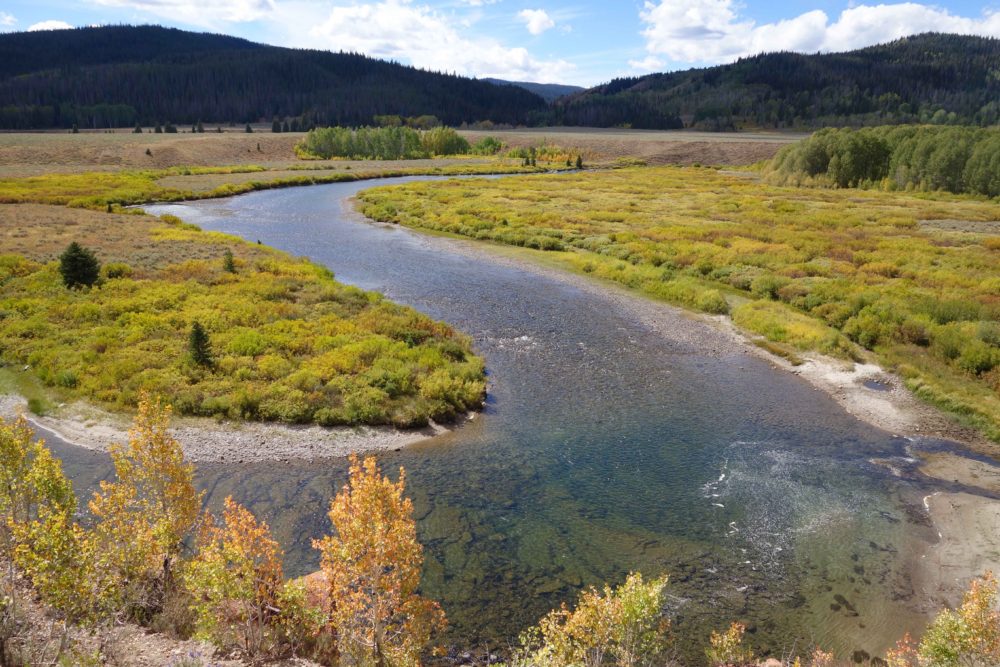
On the half-century anniversary of the Wild and Scenic Rivers Act, advocacy groups are pushing for portions of Wyoming’s upper Green and Encampment Rivers to receive protections.
A stretch of the Green River runs through Wyoming’s largest wetland complex. Those 174,000 acres of wetlands are twice as large as the next biggest in Wyoming and foster myriad species of fish and wildlife, said Scott Bosse, the Northern Rockies director for American Rivers.
There is a “full complement of species along the upper Green,” an assortment not found many places in the Lower 48, he said. There are elk, mule deer, moose, pronghorn, grizzly bears and wolves in the area. There are birds — especially an abundance of waterfowl. In Bosse’s mind, the resource deserves the protection of the Wild and Scenic Rivers Act.
“We’re not advocates just because it’s a pretty place,” he said. “It’s an incredibly important place in terms of fish and wildlife as well.”
A wild and scenic designation for a river is similar to a wilderness designation on land — both are granted legislatively and afford federal protections. The National Wild and Scenic Rivers System was meant to preserve rivers with outstanding natural, cultural and recreational values in a free-flowing condition, Bosse said.
The designation safeguards clean water, prohibits activities that would harm the river’s character, bans new dams and protects about a quarter-mile of public land along the river banks.
Wyoming contains more than 400 miles of Wild and Scenic rivers among the Clarks Fork, the Snake and Hoback rivers. But more qualifying river mileage remains unprotected in the state, Bosse said, particularly on the upper Green.
New dams were considered for the upper Green River as recently as 2015 as an outgrowth of Gov. Mead’s 10-in-10 water development initiative. People mobilized across the country and more than 10,000 submitted comments on the idea, specifically several potential dams, Bosse said.
Any time a river faces that kind of threat, it’s a reminder of how vulnerable they are without legal protections, he said.
Bosse has approached local officials and other stakeholders with the idea of designating 39 miles of the upper Green that flows through U.S. Forest Service and Bureau of Land Management land. The stretch has already been deemed eligible for wild and scenic status, but no legislative path forward is immediately evident. The problem, Bosse said, is more apathy than opposition. The public attention, legislative engagement and political will required to achieve a designation is currently occupied by the Wyoming Public Lands Initiative which seeks, instead, to resolve the status of wilderness study areas.
Not everyone favors wild and scenic status for rivers. The Wyoming Stock Growers Association has a policy to oppose any wild and scenic designations in the state, said Jim Magagna, the group’s executive vice president. Magagna said his organization isn’t opposed to the protections the designation affords a river.
“I think we all recognize those values,” he said.
His organization’s concern is how designation could impact adjacent lands, including what structures could be built on private property. Buildings that don’t threaten the river could be restricted to protect the viewshed, he said.
His view isn’t shared by federal agencies that administer the act. “Designation neither prohibits development nor gives the federal government control over private property,” the BLM, Forest Service, National Park Service and U.S. Fish and Wildlife Service say on a Wild and Scenic web page. “Recreation, agricultural practices, residential development, and other uses may continue.”
Even if the law doesn’t preclude activities like livestock grazing or irrigation, sometimes the public’s expectations change with labels.
“The public might have a new image of wild and scenic or wilderness and what it should be and how it should be used and that could impact us,” Magagna said.
Act’s history is bipartisan
Fifty years ago, famed bear researchers and conservationists John and Frank Craighead came up with the idea for the Wild and Scenic Rivers Act. The brothers led the fight against a dam near Glacier National Park in Montana. It made them think about ways to protect other rivers, Bosse said.
“They knew the Wilderness Act would protect rock and ice in high elevations, but they knew they needed a system of low-elevation protection for wildlife corridors,” Bosse said. “The Wild and Scenic Rivers Act is aimed at protecting wildlife, not just wild rivers.”
The Wild and Scenic Rivers Act passed the Senate unanimously and the House with little opposition in 1968. The original bill included eight rivers. It was near the end of the modern dam building area in the United States, Bosse said. At that point there were about 80,000 dams across the country.
“People started to realize that wild rivers were a really rare and precious resource and we shouldn’t sacrifice every last one,” he said. “If it weren’t for the passage of the Wild and Scenic Rivers Act in 1968, there probably wouldn’t be any wild rivers left in the Lower 48.”
The Clark’s Fork in Wyoming was added in 1990. The last big addition to the system came in 2009 and included the Snake River Headwaters Legacy Act, Bosse said. There’s been few additions since and none in Wyoming. It’s a different political climate today but the need for the protection the designation affords is still there, he said.
The act was meant to balance hydropower and preserving wild rivers, Bosse said. Today there are 12,754 miles of streams in the United States protected as Wild and Scenic Rivers. That’s less than a quarter of 1 percent of rivers in the U.S., Bosse said.
“That balance hasn’t been struck,” he said. “Looking at the big picture in the long run, we need to increase the size of our wild and scenic rivers by at least 10 times.”
Yet momentum for protection stalled and in recent years there’s been a rash of new dam proposals nationwide — including in Wyoming on the upper Green and elsewhere.
Protecting rivers is becoming more important with climate change and growing urban populations in the West, Bosse said.
“The demand for new dams and water storages [is] only increasing,” he said.
But there is also growing demand for protecting rivers, he said
“Wild, free flowing rivers are becoming increasingly rare,” he said. “As resources become more rare, they become more valuable. I think our appreciation as a nation for wild rivers is only increasing over time.”
American Rivers has set a goal of 5,000 new wild and scenic river miles nationally in honor of the 50th anniversary.
Subscribe for free.
While Bosse has been focused on the upper Green, a 15-mile stretch of the Encampment River starting on the Colorado state line and flowing north into the upper North Platte River valley might be the most likely candidate to receive protection, said Jeff Streeter, the North Platte River water project manager for Trout Unlimited.
Part of that section of river already flows through a wilderness study area. Streeter proposed making the stretch of river wild and scenic during the Carbon County Wyoming Public Lands Initiative, which brought together stakeholders to make recommendations on the future of wilderness study areas.
“If we have wilderness and then wild and scenic on top of it, we’ve done a great service to the Encampment River,” Streeter said.
“That river is a treasure,” Streeter said. “And that protection could really make a difference.”

Excellent article. Thank you. Preserve the Encampment!