


The Joint Judiciary Committee voted Aug. 15 in favor of a proposal that would move child representation out of the Office of State Public Defenders and establish a standalone Wyoming Guardian Ad Litem office, but moved to hear more discussion on the creation of a similar Office of Parent Counsel at the next committee meeting.
The budget-neutral ask would eliminate the conflict of interest in the GAL program being housed by the public defender’s office, which must sometimes also represent parents in criminal proceedings. Several individuals at the recent hearings spoke to the conflict of interest and the increasing friction between the public defenders and guardian ad litems. A parallel proposal to establish a parent defender office was tabled for further discussion.
“The primary purpose of moving it out of the public defender’s office is to avoid conflicts of interest that occur when attorneys represent children and public defenders often represent their parents in related criminal cases,” said Wyoming Supreme Court Justice Kate Fox, who also serves as the chair of the Children’s Justice Project. “The guardian ad litems don’t belong in the public defender’s office. They have two very different missions and what has happened is that when there are budget cuts or other resource limitations, it’s the guardian ad litem office that tends to suffer because that’s not the public defender’s primary mission.”

The proposal easily passed through the committee with a 12-2 vote and will be filed and assigned a bill number in preparation for the next legislative session.
A second proposal that would create a similar Office of Parent Counsel to represent parents whose children are placed in foster care was met with more discussion. The Office of Parent Counsel would require $5.4 million per biennium with 75% of the funding provided by the state and 25% by the county.
Fox led the presentation of the proposal stating: “In the family context, the outcomes with foster care are often poor and the costs are very high. We think having effective parent counsel available across the state can really help to shift that. No matter how we may think that certain parents are not doing their job as well as we would like, often the case is removal of a child from the family is the biggest trauma that they will experience in their lives.”
Whitney Agopian, the state’s children’s justice project coordinator, presented on the benefits to children whose parents have legal representation and the savings to the Wyoming’s Department of Family Services. Citing recent studies from Washington and New York, Agopian highlighted the reduced time in foster care and faster permanency outcomes that come with adequate representation.

“Preventing trauma and keeping our families together makes our state better,” Agopian said. “Most importantly, I believe that parents in our state are entitled to quality representation regardless of where they live.”
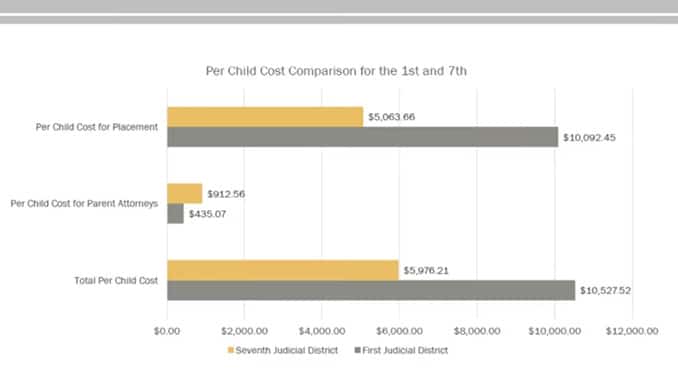
She went on to compare costs and permanency data from two Wyoming counties — Natrona County with a strong parent representation model with five experienced attorneys on contract and Laramie County with just one attorney contracted to represent parents. Analyzing data from April 2017 to March 2019, Laramie County with 553 foster cases spent $10,092 per child for placement while Natrona County with 656 children spent $5,064 per child for placement. The length of stay in those counties also differed drastically with a nine-month average for Laramie County and just four months in Natrona.
“Mandated implementation of best practice through a state administered system with oversight and training requirements would shorten the length of stay and result in cost savings,” Agopian said.
While Agopian and the state’s child welfare director Korin Schmidt agreed that there could be significant cost savings and potential better outcomes for children from a stronger parent legal representation program, the Wyoming Liberty Group and Wyoming County Commissioners Association raised budget and government growth concerns.
And while Agopian touted Natrona as the proof of concept for the benefits of better representation, two attorneys representing Natrona parents recommended increased training efforts instead of a new state agency. The attorneys expressed concern about unintentional impacts to flexibility in being able to assist parents outside the scope of child welfare, including divorce decrees and custody agreements.
Support in-depth policy coverage with a tax-deductible donation today
“I also applaud the attempt to better parent representation,” said Robert Casteel, a Natrona County attorney. “However, I’m not sure this bill is in a position to do that merely because I believe the same effect can be had by increasing some Children’s Justice Project funding for parents’ [representation] training for all the counties to make sure all the attorneys had similar training … We could do it with the Children’s Justice Project and not necessarily need an independent state agency to do the same thing and get similar results with possibly less costs.”
However, the state’s Children’s Justice Project trainer Lisa Finkey testified that attendance at current trainings offered in counties across the state is low, stating “parents’ attorneys are not going to attend training unless you make them mandatory.”
Ultimately, the committee was reluctant to move forward with the proposal without additional information and discussion, voting to hear more on the proposal at the next hearing Oct. 31 and Nov. 1 in Cheyenne.
Both proposals involve the potential use of new federally available funds to help pay for increased access to counsel. In late 2018, the Department of Health and Human Services amended its policy on the Title IV-E child welfare entitlement to permit states to receive a match on legal fees to parents and children.
This story first appeared in the Chronicle of Social Change and is reprinted here with permission.
