

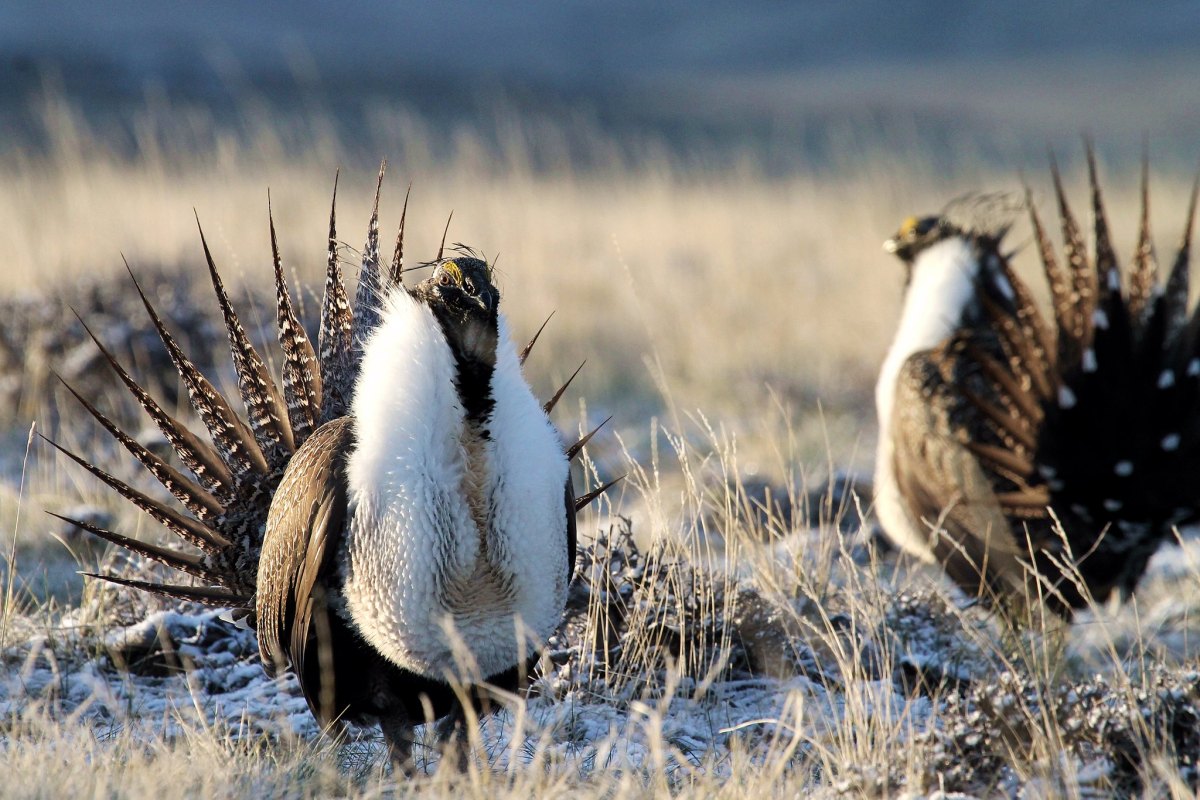
The sage grouse lek in south central Wyoming had effectively died, though the older males remained undeterred. Females had long since stopped appearing. They likely decided the new compressor station and other assorted nearby development were too disruptive for nests. But the same male sage grouse returned, fewer each year as they died out.
By the end, only one male remained, fanning his tail and dancing at a lonely disco to an audience of none, said Chris Kirol, a Sheridan-based sage grouse ecologist who watched the lek’s eventual demise.
Researchers still don’t know all the reasons why females abandon a lek. The known deterrents are, among other things, noisy areas, powerlines and high-density roads. And older males, apparently not getting the memo, keep coming back as the younger ones go elsewhere in search of a mate.
Biologists do know, however, that Wyoming and the West’s sage grouse populations are determined by the number of birds who flock to those leks each spring, and while the number of attendees grew this year, overall, sage grouse are on a downward trend. And the recent House Draw Fire in northeast Wyoming won’t help.
“Right now, Wyoming can say it’s only lost about 10% of its historic range of sage grouse, which is pretty good compared to other states that have lost half or more,” said Kirol. “But what worries me are subpopulations in northeast Wyoming. If the birds here are extirpated, we will lose about 30% of our historic range.”
What sage grouse ultimately need, experts say, are wide, unfragmented chunks of sagebrush habitat, an increasingly rare commodity in a West fractured by energy development, subdivisions, fires and drought.
Trends versus cycles
Each spring, as the sun begins its slow return, male sage grouse gather in open spots intermixed throughout the sagebrush steppe. While “lek” may sound like a complicated ecological term, it really just describes the dance club where male grouse come to fan their tail feathers and flaunt their white and green air sacs.
Female grouse generally gather somewhere in the vicinity, listening for the “bloops” emitted from the male grouse. Eventually, they wander into the lek to feign indifference before settling on a mate.

All males really need is an open spot to parade around, Kirol said. But females need to be near healthy sagebrush both to conceal their nests and to provide food for themselves and their young. A nest without sagebrush is destined to be robbed by myriad predators from skunks and coyotes to eagles and hawks.
Outside of breeding season, sage grouse live far-flung lives scattered throughout a perfectly camouflaged environment. So decades ago, biologists began counting male lek attendance as a way to monitor population changes.
And this year, Wyoming’s sage grouse numbers continued their upswing, reaching levels not seen in almost a decade. Nyssa Whitford, Wyoming Game and Fish Department’s sage grouse biologist, doesn’t know if the average 28 males attending each active lek this year will be the peak or if the growth will continue.
Because sage grouse, just like cottontails and jackrabbits, cycle. The cycles may well be tied to climate, resources or something else. But looking at a graph of Wyoming sage grouse over the last 30 years, numbers peaked at around 31 males per active lek in the late ‘90s, 42 males in the mid-2000s, and around 36 about 10 years later. Lows routinely dip down to around 16 males per lek.
That’s why Kirol cautions that peaks don’t mean sage grouse have recovered. The birds still face a buffet of threats including artificial water sources that attract disease-carrying mosquitoes, coalbed methane and oil and gas development, subdivisions and invasive species.
And “when sage-grouse numbers get too low,” Kirol explained, “the local population can no longer withstand natural events like large wildfires or a disease outbreak.”
Fire, genetics, and an uncertain future
Northeast Wyoming has never been prime sage grouse habitat like the sagebrush sea of southwest Wyoming. The northeast corner’s uneven sagebrush breaks make the chicken-sized bird nervous. But that corner of the state still produced healthy populations of birds until a coalbed methane boom (and then bust) fragmented the grouse’s habitat.
And while the area may have been considered edge habitat, work by University of Waterloo professor Brad Fahey found the area provides a critical genetic exchange between grouse in southeast Montana and the rest of Wyoming.

That’s why the nearly 175,000-acre House Draw Fire, which ravaged northeastern Wyoming in late summer and may have destroyed as many as 14 leks, concerns Fahey, Kirol and Whitford.
Those 14 leks in the interior of the House Draw Fire may not be permanently lost, but after driving around the area, biologists said not much sagebrush remains.
“Out of 1,700 leks statewide, that doesn’t sound like many, but for northeast Wyoming, this was some of the best-of-the-best habitat,” Whitford said.
Game and Fish is still deciding what to do, she added, including weighing whether to aerially treat cheatgrass or seed for sagebrush.
“We have to be prudent with dollars, but also evaluate what are the odds of doing something and it being successful,” Whitford said. “We don’t want to throw money at a black landscape if it will not be successful.”
Game and Fish is also waiting for fire season to end.


Kirol and Fahey, two researchers who have studied grouse in that part of the state for more than a decade, still hold hope for grouse. Even with fires and cheatgrass and fragmented habitat, males still flock to leks to dance, and females still show up to mate and build their nests.
But Kirol sees the writing on the sagebrush if we don’t pay attention.
“They’re a landscape-scale species,” Kirol said. “They need large, contiguous tracts of sagebrush habitat that hasn’t been fragmented by development.”

Ok I have plenty of Sage Grouse They love my property why is everyone flipping out they migrate you can’t set up where they live they are Grouse not people.
Has anyone noticed the severe over grazing of public lands plus the following invasion of cheat grass? Our public land managers, such as the BLM, Bur. of Rec, State lands and some USFS seems to be ignoring this
Articles like this make me wonder if there is any science behind these remarks or is it just speculative/imaginative armchair conversation. The issue of sage grouse number has been kicked around for a long time. If there are questions to be ansered, and there are, then answer them. Do fires change populations. Do oil extraction activities change population. How much sage brush space do they need? Do cycles have known and expected highs and lows. Are there predators that change population numbers, if so, what are they, can they be controlled with a measurable effect? If we are spending money to watch them, we need to answer these questions, and more.