



Wyoming wildlife managers on Wednesday reported an unwelcome first: The infectious prions that cause always-lethal chronic wasting disease have been detected within the boundaries of an elk feedground.
The detection occurred at the base of the Wind River Range at the Scab Creek Feedground, about 15 miles east of Pinedale and within elk hunt area 98. A cow elk that tested positive for the degenerative neurological disease was found dead at the end of December.
“This is the third documented case of CWD in the hunt area and the first confirmed case of an elk testing positive on a feedground,” Wyoming Game and Fish Department officials stated in a notice alerting the public.
None of the state agency’s personnel were able to be reached for an interview on short notice Wednesday afternoon.
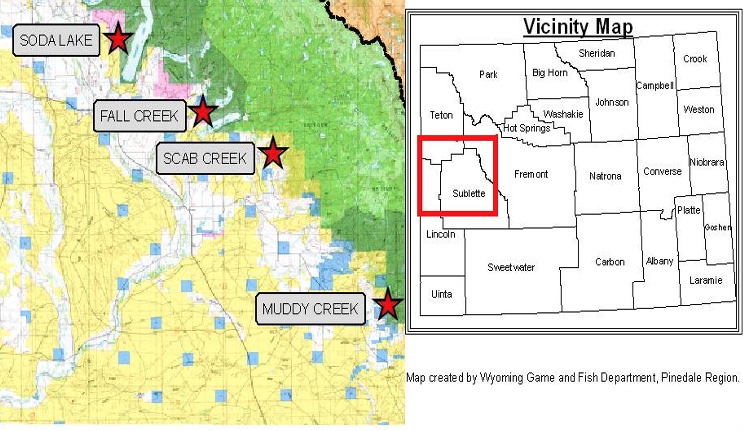
The Scab Creek Feedground is located on Bureau of Land Management property. The feedground’s population goal is 500 elk, though closer to 800 animals gathered at the site during two recent winters, according to Game and Fish’s recently completed elk feedground management plan.
Although it’s been known to occur in southeast Wyoming elk since 1986, chronic wasting disease is in the early stages of making inroads into Northwest Wyoming’s feedground region. The deadly malady was first found in the Jackson Herd in 2020, but since then it’s spread to the Pinedale, Piney, and, just recently, the Fall Creek herds.
Although the incurable disease currently occurs at trace levels in feedground elk, that’s not expected to last. Scientific projections for CWD’s effects on elk populations are grim, especially if elk feeding — a historical practice that artificially concentrates animals — continues. Just last week, U.S. Geological Survey researchers completed an analysis that predicts the Jackson Elk Herd will decline by more than half if feeding continues on the National Elk Refuge.

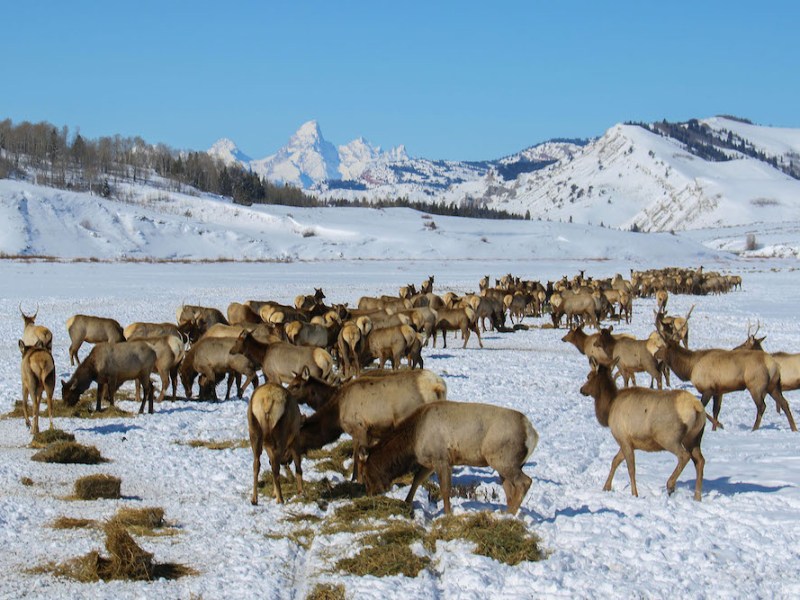
Projections for the future of elk herds attending state-run feedgrounds are also dismal, especially if feeding continues. Continued feeding of the Afton, Fall Creek, Piney, Pinedale and Upper Green River herds would lop those populations nearly in half, while contributing to CWD prevalence rates above 40%, according to 2023 USGS research.
Wyoming Game and Fish’s management plan does not demand reforms to elk feedgrounds as a result of chronic wasting disease. The door, however, is open to changes or closures that will be prescribed through tertiary “feedground management action plans” that will be developed for two herds per year over the next three years.
In 2025, the Jackson and Pinedale elk herds will be reviewed — the latter of which includes the Scab Creek Feedground.
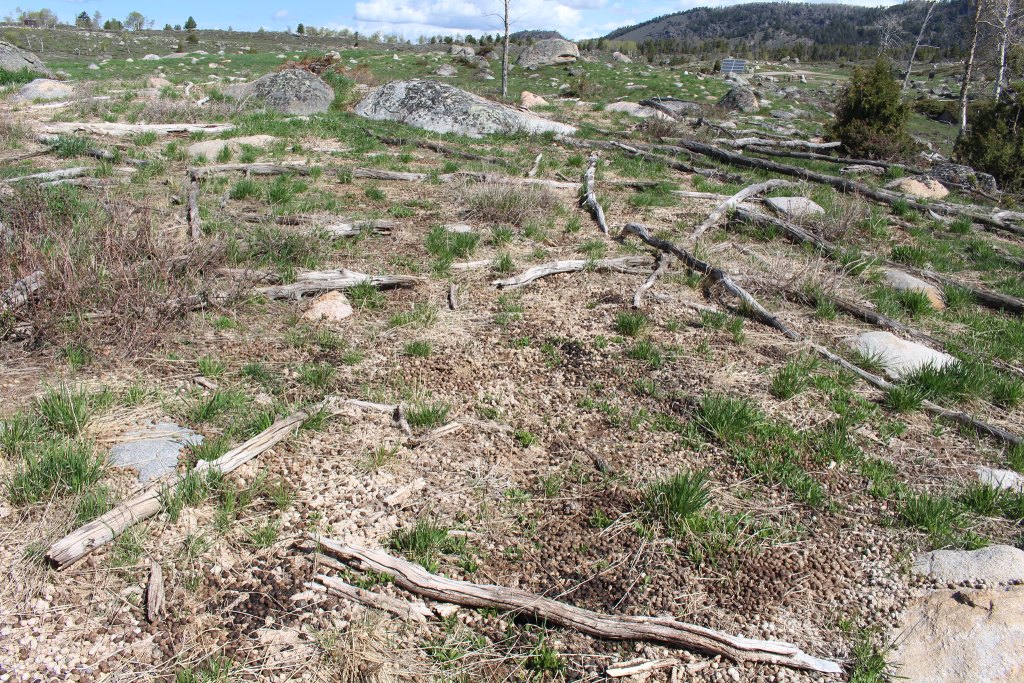
Part of the insidious nature of chronic wasting disease is that its vector — highly infectious misfolded proteins called prions — can live outside of animal hosts in soil and even absorb into grass.
“Prions are known to bind to many soil types, and when bound to bentonite clay, infectivity is increased,” Wyoming’s feedground management plan states. “To limit the bioavailability of prions in the environment to cervids, substrate conversions of feeding areas should be considered.”

Wyoming has tens of thousands of elk in 20 counties that aren’t confined on small disease-ridden feedlots each winter; only elk in 3 counties- Lincoln, Sublette, & Teton- are. Even those 3 very large counties are 80% public lands; there is ample native range to support thousands of wild, free-ranging, healthier elk, along with deer, moose, and pronghorn. Colorado has hundreds of thousands of free-ranging elk, Montana has tens of thousands of free-ranging elk. Both those states have larger human populations than Wyoming, and they also have livestock and hunting industries. Rocky Mountain elk obviously do not need feedlots to survive Rocky Mountain winters. It’s high time to carefully and expeditiously phase them out.
another example of humans interfering with nature and the natural order…. stop manipulation wildlife populations and stop the carnage of wolves, coyotes, and other predators who naturally keep the natural order in balance….
Wait, I thought for the last decade the reason we must close all feedgrounds was to stop spreading disease? But this disease has been spreading g all throughout the state without feedgrounds….. odd that proves feedgrounds aren’t the problem. Keep feeding our damn elk!!!!
Pretty stupid to be feeding elk. Why is this being done? Is it to bring them together in one spot for hunters? If there isn’t enough natural forage for the elk then maybe you need to allow wolves to call the weakest, rather than running wolves over with snowmobiles.
Pick up a history book. After the migration west by the American people our wildlife herds were decimated to near extinction. We set up a feeding system to help them through the winter. That part of our conservation efforts was a success. Bleeding heart mindless libs who think man isn’t part of the ecosystem and should never stray from the concrete jungle have absolutely no clue what conservation actually is.
The only reason to feed elk to have their numbers increase beyond the carrying capacity of their range. Never a good idea.
Instead of growing elk herds for the benefit of out of state hunters, we need to allow their natural predators control the spread of these diseases. Wolves and cougars are not susceptible to CWD. Muleys, white-tailed, bison, and moose are and will also benefit from the reintroduction.
Quit killing the one animal that can keep that disease in check- cougars!
“Projections”, “Models”, and random guesses. Meanwhile every winter elk gather in massive herds in close proximity to each other, regardless of whether they are fed or not.
As a side note, lets all have a round of applause for the hard working “researchers” at Plum Island or some other Govt. agency that decided to play god and mess around with animal and human infectious diseases under a microscope. NOT!