


Always-deadly chronic wasting disease has been found at a third Wyoming elk feedground, in an animal that had lived in a different area where an epidemic that could crater the population appears to be ramping up.
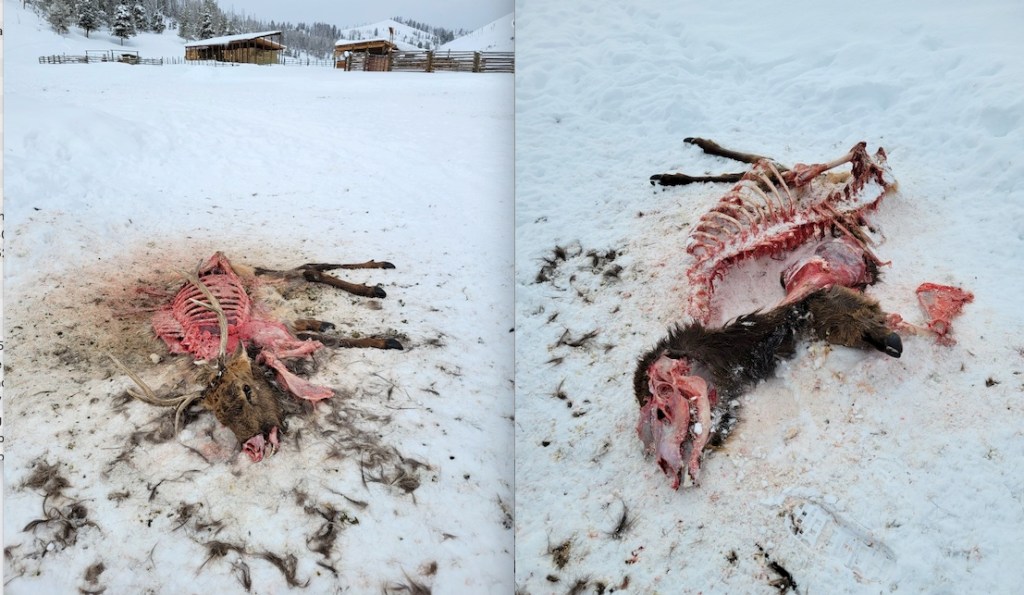
The Wyoming Game and Fish Department sent word on Tuesday that the Pinedale-area Black Butte feedground had been added to the growing list of feedgrounds where the malignant prion disease has been detected. The dead adult cow that tested positive died in late February after likely being gored by a bull. Upon inspection, Wyoming wildlife managers realized it was an elk they had handled before.
“We put metal ear tags in our animals when we do routine [brucellosis] testing,” Game and Fish Regional Wildlife Coordinator Brandon Scurlock told WyoFile. “She was actually tagged at the Dell Creek Feedground in 2024.”
That’s concerning to wildlife managers, but not wholly unexpected.
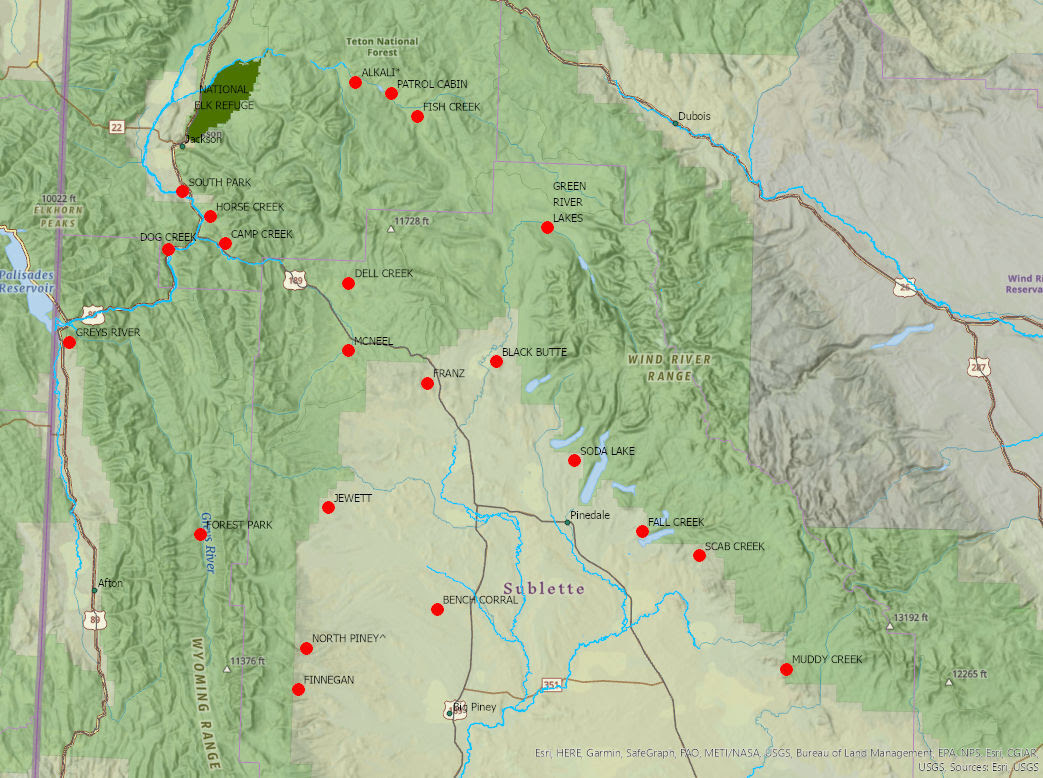
There’s a “lot of interchange,” Scurlock said, between the Dell Creek, Black Butte and Soda Lake feedgrounds. The Jackson Hole News&Guide reported Wednesday that elk marked at the now-infected Dell Creek state feeding site have also wound up on the National Elk Refuge.
Located at the foot of the Gros Ventre Range, the Dell Creek Feedground’s 32 acres have been the site of at least three CWD-positive elk deaths this winter. In January, it became just the second known infected feedground — and its 400 or so wapiti have continued dying. Shortly before that, the Scab Creek Feedground, also located near Pinedale, was identified as the first known feeding site to harbor infectious CWD prions, which can survive in soil and grass and persist in the environment for decades.
“Multiple [CWD-positive] elk are showing up on multiple feedgrounds,” said Hank Edwards, a Game and Fish retiree who formerly led the Wyoming Wildlife Health Laboratory. “This is not just an epidemic at Dell Creek. I would say this is about to be a feedground epidemic.”
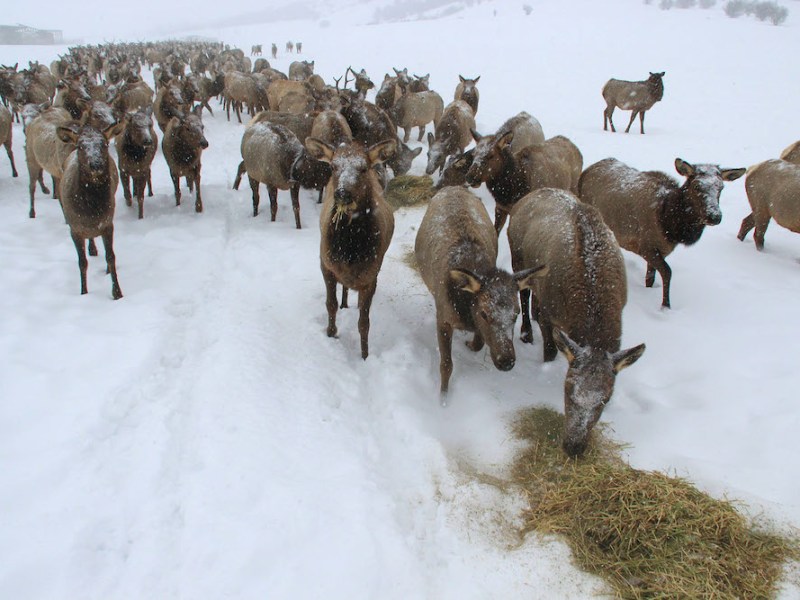
So far, CWD still exists at trace levels in northwest Wyoming. The malady has been known to exist in eastern Wyoming elk for nearly four decades, and in some herds, its impact is minimal. But wildlife managers have long feared that the degenerative neurological disease will behave entirely differently, with potentially devastating effects, when it’s introduced to thousands of animals that are closely clustered over cut hay and alfalfa pellets for months at a time.
An elk feedground management plan the Wyoming Game and Fish Commission OK’d in 2024 does not allow the agency to make major unilateral decisions in response to a CWD outbreak. Instead, taking major actions requires building consensus with historically pro-feeding parties, like hunting outfitters and cattle ranchers. Closing a feedground even requires support from the Wyoming governor.
Edwards worries that northwest Wyoming’s elk can’t afford to wait for more planning and consensus-seeking.
“In this state, we don’t do anything until it’s too late,” he said. “I really do think that by the time that we’re starting to see population impacts, it will be too late.”
Meantime, Wyoming wardens and biologists can take some smaller steps in response to the CWD outbreak. Already, hay is spread out as much as possible to reduce animal densities. Carcasses are also hauled away to limit the spread of infectious prions.

Wardens armed with rifles are also riding along with elk feeders periodically to keep an eye out for sick, dying or dead elk, Scurlock said.
“We’ve only removed one, to my knowledge, to date,” he said. “That was at Scab Creek, and I believe she tested negative.”
The newly infected Black Butte feedground hosted 888 elk during Game and Fish’s mid-winter survey, Scurlock said. Its “quota,” according to Wyoming’s feedground management plan, is 500 animals — though in recent winters, tallies have roughly doubled that goal.
I’ve lived in Teton County surrounded by elk feedgrounds for fifty years. I bought my first elk hunting license a year after I established residency and have hunted elk every fall since, on foot and horseback, not always successfully. I wrote my first piece on this issue in the fall of 1996, “Feedgrounds Aren’t Forever”. During my career as an environmental activist I delved into this issue extensively, gathering information from scientists, historians, attending agency meetings with stakeholders, reading virtually everything I could find on the issue and about brucellosis, CWD, and other existing or threatening feedground diseases. I wrote a white paper in 2015, “What Happens When Elk Feeding Ends”, and wrote and submitted extensive science-based comments on numerous federal agency feedground EISs, the state’s CWD Plan, and the state’s Feedground Management Plan. I presented feedground phaseout plans to the Greater Yellowstone Interagency Brucellosis Committee and to the Wyo Governor’s Brucellosis Coordination Team, and presented a poster titled, “Changing the Paradigm of Elk Management in Western Wyoming”, at the Park City, Utah, CWD Symposium. I found that with few exceptions every wildlife disease expert and all professional organizations counseled not to artificially concentrate and feed cervids. It’s clear that western Wyoming’s elk feedgrounds can and should be phased out expeditiously, and that the hunting and livestock industries can be protected as that moves forward. My gmail is lloydjdorsey@ and I would be happy to share my extensively referenced comments with anyone.
Has anyone attempted to do a study on how much the introduction of wolves contributed to the spread of this disease? Do the wolves get the disease, do they spread it in their feces?
Was that a part of the study of the impact of introducing the wolves?
The feed grounds still need to be a available and if elk die during that time just remove the carcuss the same a rancher does. Pretty simple
Wolves do not get the disease. It is fairly species (or closely related species specific). If anything, they would help to remove ungulates in the late stages of the disease. Sheep, cows, and even humans (two versions) have a version of this TSE disease.
This is a problem, but what will happen to the elk if the feed grounds are closed? Development and loss of instinct through the generations may make it impossible for the elk to uptake the migrations to survivable wintering grounds that historically sustained them.
What many of us have predicted for two decades is now happening. I take no joy in having been right.
CWD was found in elk nearly 40 years ago, 1986, in the Laramie Peak herd. There is no feeding in the Laramie peak area, however, Elk wintering behavior puts the animals in close proximity to each other regardless of whether they are being supplementally fed or not.
Today in 2025 the Laramie Peak elk herd, which encompasses Elk Hunt Areas 7 & 19, has a population estimate of around 12,500 elk, significantly exceeding its population objective of 5,000.
The fear mongering about necessary feed grounds is irresponsible or worse.