

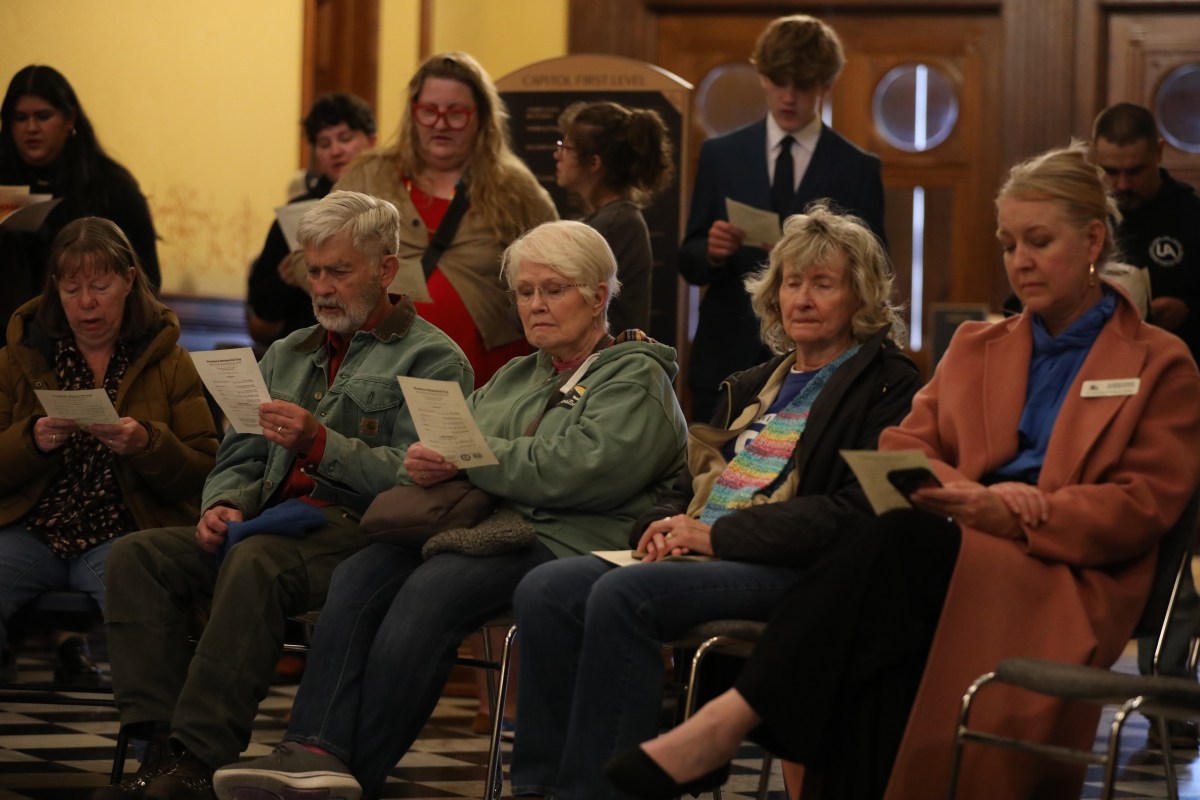
CHEYENNE—A silver triangle rang out 45 times in the Capitol’s rotunda. Each ring commemorated a worker who went to work in Wyoming in 2023 and didn’t return home to their families because they were killed on the job.
About three dozen people — mostly from local unions — gathered for the Workers Memorial Day ceremony on a cool and wet Monday evening.
“Every person who goes to work deserves to come home,” said Marcie Kindred, executive director of the Wyoming AFL-CIO. “Every family deserves the peace of knowing their loved ones are protected. Every life lost is one too many.”
The Rev. Delaney Piper, pastor of Highlands Presbyterian Church, led the group in prayer.
“Oh God, we do not understand why deaths like this, that we remember, that we mourn today, occur,” Piper said. “More so, we do not understand why everyone — workers, business leaders and political leaders — don’t just join in taking decisive action to prevent future deaths and to protect workers.”

The annual event recognizes Workers Memorial Day, the anniversary of the 1970 Occupational Safety and Health Act. The measure, in response to the carnage of workplace fatalities, injuries and illnesses, is supposed to ensure safe work conditions. Though accidents do happen, Kindred said, far too many are entirely preventable and, collectively, they point to a systemic disregard for workers.
“Behind every workplace fatality lies a story [of a life] cut short too soon and a ripple of grief that continues long after the headlines fade,” Kindred said.
Kindred and other speakers noted that Wyoming’s 45 occupational fatalities in 2023 made it the deadliest state in the nation for workers that year — a distinction Wyoming has held far too many times. Marcia Shanor, executive director of the Wyoming Trial Lawyers Association and a longtime worker advocate, said the annual commitment to demand safer working conditions appears to ring hollow among state leaders.

“We have committed, every single year for the last 20 years, to do better,” Shanor said. “And here we are, 20 years later, decades later, with one of the highest workplace fatality rates since 2007. It feels hollow to have to say those words that I have said every single year as we have remembered the great people who keep our state working.”
United Steelworkers Local 13214 President Marshal Cummings, who works at the WE Soda trona mine near Green River, believes Wyoming’s perpetual worker fatality epidemic is the result of a disregard for workers enshrined in its “right-to-work” laws. Such laws ostensibly protect employees from being forced to join a union. But, in Cummings’ estimation, the laws are specifically intended to limit the power of unions, along with their persuasion to hold employers accountable for worker safety.
“Let’s be very clear about this: right-to-work is a lie,” Cummings said. “It’s not about jobs. It’s not about freedom. It’s about weakening the very organizations — our unions — that keep us safe.”
In states with right-to-work laws, workers see lower wages, fewer health benefits and weaker retirement security, according to Cummings.
“Most importantly, workplaces [in right-to-work states] are more dangerous,” he said. “What is the right to liberty if you can’t speak up on dangerous conditions because you might be fired if you do? What’s the right to personal happiness if you’re trapped in a system where your work, your blood, your sweat, your tears, if your sacrifice is treated as disposable?”
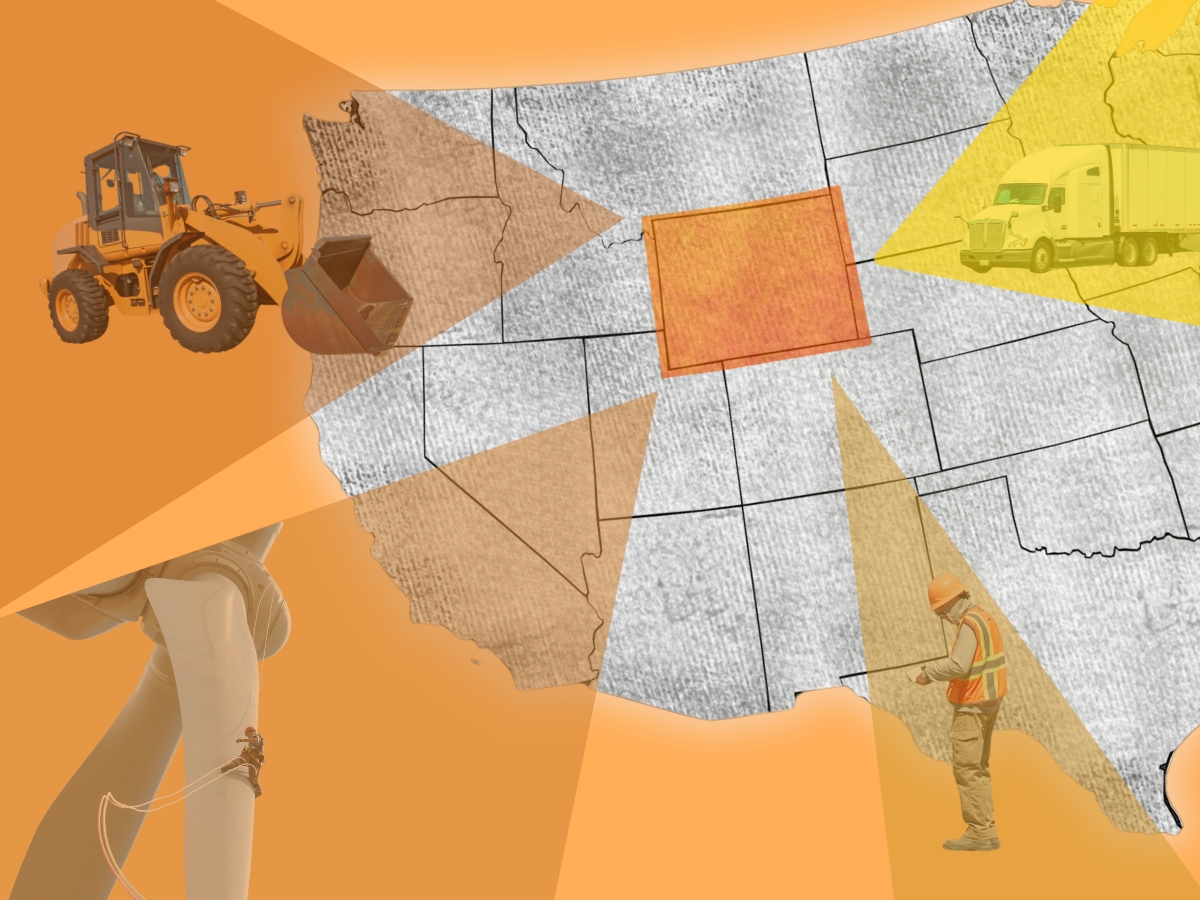
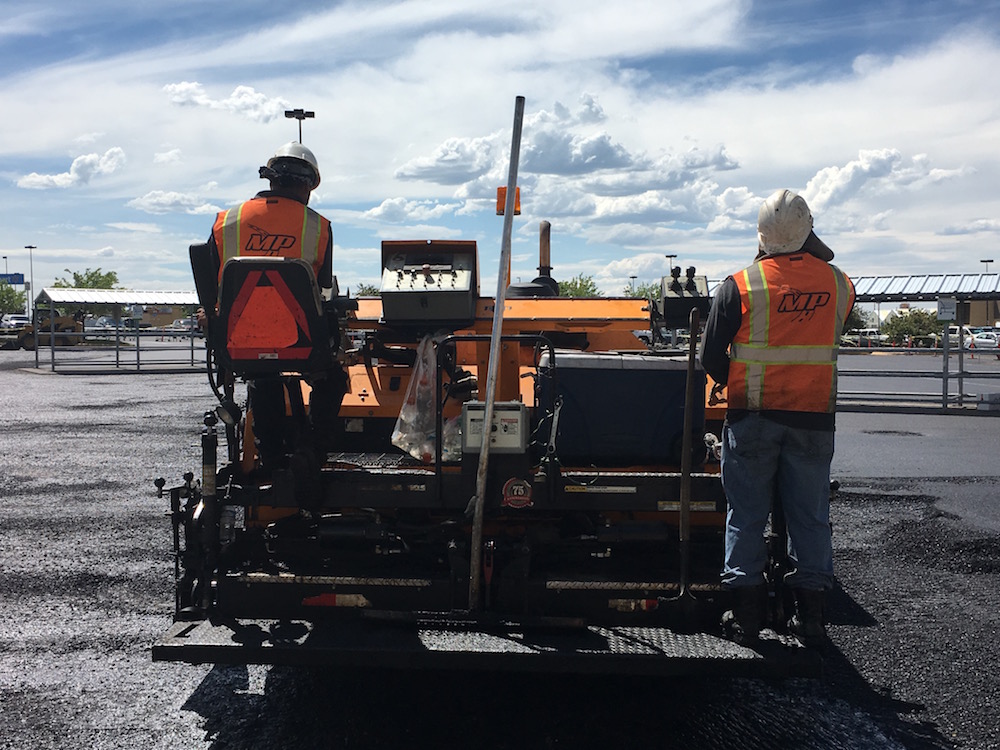
For now, the Wyoming AFL-CIO is focusing its legislative efforts not on the state’s right-to-work laws, but on the larger and more immediate goal of improving workplace safety, according to Kindred. The union group, the Wyoming Trial Lawyers Association and other worker advocates see an opportunity to reignite past statewide efforts that had nudged Wyoming toward safer workplaces — efforts that seemed to fizzle out after the COVID-19 pandemic.
“It shouldn’t be one time a year that we all get together and talk about why this is an important issue,” Shanor said. “We should be having those conversations at the workplace, upstairs [in the House and Senate chambers], the governor’s office, and we should have leadership by our elected officials in helping us actually make steps forward that stay in place.”

Apologies for writing so much, but I hope the story is relevant. I’m 72 years old. My Dad died at 56 in an oilfield accident in 1979. He was killed by a trap somebody else built. It was a wrongful death, so my Mom sued. Nearly 5 years later she got a $100,000 settlement of which her lawyer took $50,000. Although that was a lot of money at the time, it slowly dwindled, but she made it last until about 5 years before her death, by living in sickness at a poverty level income, too low to even use Medicare–so she depended on Medicaid at the end, like many elderly Wyomingites still do. When I called Dad”s employer to inform him of the death, his only question was: “Do you know anybody I could call to replace him?” I hung up. Fast forward to 2009-10 when I hurt my back at a non-union job and was incapacitated for over 10 days without a doctor’s release. They made me use up all my “paid leave” while waiting on Worker’s Comp to rule it a compensable injury, which they eventually did. After taking a Medrol steroid pack to get back on my feet, the doctor recommended I take PT twice a week, which was 90 miles away round trip and I had to drive there at no pay because I was out of paid leave. Worker’s Comp did pay for the PT and paid me for my mileage. I was also going for doctor ordered LSI treatments (lumbar steroid injections) which they also paid. In the middle of all this, I got a phone call from my boss who said: “You need to get back to work as soon as possible or this isn’t going to work out well for you.” So I went to my doctor and told him that. He told me, I needed to continue the PT, but gave me a doctor’s release with a 35 lb. lifting restriction. My job description lifting requirement when I was hired, was 75 lbs., but “coincidentally” after my back problems, it was increased to 100 lbs.. After finishing PT, I had been back at work for some months, but not lifting anything more than 35 lbs.–when my District Manager arrived at my workplace with his Superintendent and presented me with a “Memo” he had written containing a list of tasks I was not allowed to do–including changing a tire on my company truck, or I would be in violation of the doctor’s release and would be immediately terminated under Wyoming’s “At Will Employment” law. I took this as a purposely orchestrated CYOA push come to shove out the door. In 6 months time, I had left the company and taken a higher paying job, with another non-union employer who did not care about my back problems. I have since retired, but get notices from Worker’s Comp that my claim has “expired” because I am not going for medical treatments or taking any medications on a regular basis. I have also had a revolving door of case workers, because they keep changing them around, many of whom end up being the same people I had before. I tried for a disability in 2012 but the “independent” doctor, my former employer sent me to, ruled that I had a 2% TBI (total body impairment). I asked my boss at the time: “If my job description requires me to be able to lift 100 lbs., does that ruling mean I can lift 98 lbs.?” He just laughed and walked out of the room–disability was denied and I got a Worker’s Comp check for $1,600. Sure, I could have attempted a lawsuit, but after the way my Mom’s turned out, why bother? One lawyer I talked to told me the check and memo I signed pretty much lets them off the hook—because most employers will “low ball you” or win outright with something like that. Worker’s Comp did not do anything in my favor about the injury except agree that it was job related and paid for short term doctor ordered therapies. Everything else was in favor of the employer and their doctor’s disability ruling was written in stone. I still have episodes that incapacitate me and still have to occasionally take a Medrol steroid pack to get back on my feet. Last time I did, it didn’t work as well as it used to, probably due to my advancing age. My back is simply worn out and after working in Wyoming’s Oil & Gas Industry for 43 years, I didn’t wear it out sitting on my butt. For the record, I also do not take any pain pills and never will. Even though I may eventually end up in a wheelchair, I gave up a long time ago, rather than jump through all the hoops with the revolving door Worker’s Comp people, because in my experience, it is all just for show for them to keep their jobs by doing as little as possible about ours.
While it is tragic when any person is injured or killed on the job, classifying somebody that commits suicide on the job is distorting the true facts. The tragic loss of the young man from Douglas has nothing do to with workplace safety yet is included as a workplace death – which only “pads” the numbers. We do not need to pad the numbers to discuss the seriousness of the issue, but “fake” news makes it harder to plead your case and get public buy in.
If Wyoming really cares about protecting workers two things need to happen. First, repeal the prohibition on workers suing employers when injured on the job and give workers the choice of taking worker’s compensation or suing. In fairness the Worker’s Compensation Act should just be repealed in its entirety. It does more to protect employers than workers, but I realize that might be a bridge too far. Eliminate State OSHA and MSHA, all they really do is protect businesses from the heavy fines the corresponding federal agencies would levy. There are many good, caring employees in those agencies but the statutes, rules and regs have been so twisted to protect employers that they are of little real benefit to workplace safety at this point. I have no real expectation of any of this happening because the Legislature has always placed profit above people. Don’t believe it, just go look at the number of times worker’s compensation was amended after a worker won a lawsuit against an employer so that avenue was closed to future workers.
I have some thoughts…
“First, repeal the prohibition on workers suing employers when injured on the job and give workers the choice of taking worker’s compensation or suing.”
It’s not true that employee’s have to take Workers’ Compensation. Anyone can sue, but accepting the benefits remove’s your right to sue. In Wyoming there is no statue that defines a level of injury that an employee can claim, nor the employer has to report.
“Worker’s Compensation Act should just be repealed in its entirety. It does more to protect employers than workers…”
In her book No Right to Be Idle, Rose outlines the three foundational legal doctrines that highlighted the need for Workers’ Compensation. When injured workers attempted to sue their employers, they faced what became known as the “Unholy Trinity” of defenses: contributory negligence, the fellow servant rule, and assumption of risk.
Contributory Negligence: This doctrine held that if an employee was even slightly responsible for their own injury, they were barred from receiving compensation—even if the employer was also negligent.
Fellow Servant Rule: Employers could avoid liability if the injury was caused by the actions of another employee, even one working for the same company.
Assumption of Risk: Employees were assumed to understand and accept the inherent dangers of their jobs simply by agreeing to work.
In the early 1900s, as American industry rapidly expanded, working conditions became increasingly hazardous. Although employees could try to sue for injuries, the legal process was long, uncertain, and often ended without compensation. The creation of Workers’ Compensation addressed this problem by providing a structured, no-fault system that benefited both workers and employers.
Under this system, employers pay premiums and, in return, receive limited liability—except in Wyoming, where employers assume unlimited liability for workplace injuries unless the harm was intentional. This gives employers a financial incentive to maintain safe working conditions. In Wyoming, companies with a low Experience Modification Rate (EMR)—a measure of risk and injury history—receive premium discounts, while those with higher EMRs face surcharges and may be ineligible to bid on certain contracts.
The Workers’ Compensation Act is built on compromise. It isn’t a tool for enforcing workplace safety violations—that role falls to other government agencies. Instead, Workers’ Compensation focuses on determining disability status, covering medical expenses, paying benefits, and collecting premiums. It is an insurance system designed to make injured workers whole: covering medical care, providing retraining if necessary, offering survivor benefits, and more.
Prior to the Act, families of injured or deceased workers were often left destitute, relying on charity to survive. The Act helps prevent that by providing financial stability after a workplace injury or death. For example, before reforms at the Ford Motor Company, the factory averaged twelve lost fingers per month; after implementation of compensation protections, such injuries declined significantly.
While not perfect, the system has reduced injuries over time. Suing an employer outside this framework often does little more than duplicate what the Act already provides—financial compensation for injuries. Lawsuits can clog courts, raise costs, and rarely deliver substantially more than what Workers’ Compensation already guarantees. Moreover, accepting compensation does not protect employers from investigations or penalties by other enforcement agencies.
Preventable workplace injuries are still a serious issue.
As a society, we cannot tolerate unsafe conditions or treat worker safety as expendable. Claiming that Workers’ Compensation only protects employers is simply untrue. No one is forced to accept benefits, and doing so does not prevent accountability through other legal or regulatory channels.
“Eliminate State OSHA and MSHA, all they really do is protect businesses from the heavy fines the corresponding federal agencies would levy.”
I’m not sure how this conclusion was reached. I think something to keep in mind is that these agencies are not attempting to shut down employers, but working to get them into compliance. OSHA and MSHA rules are written in blood, and I’m not certain how their removal will do
Just for clarification Felix, if an employer is participating in the Worker’s Compensation system, the employee’s sole remedy is Worker’s compensation as W.S. 27-14-104 (a), so while workers don’t have to take workers compensation, if they don’t, they get nothing. It is true that in the case of a deliberate act employees can sue, but the conditions that have allowed are restricted by new law every time a worker wins a case.
I can tell you, not from textbooks or theories, but from 14 years in the Wyoming Legislature and 25 plus years working in underground mines, that the original compromise of the worker’s compensation system in Wyoming has been so heavily tilted in favor of the employer, that it serves them far more than it does employees.
As to OSHA and MSHA, please note that I was referring to the state programs not the federal programs. I am well aware that those regulations were written in blood as a portion of it came from friends and coworkers. When employers are given advance notice of inspections by state agencies giving them the opportunity to “clean up” the job site, when fines are never levied and employers are only asked if they would correct a serious violation, I question the legitimacy of that effort.
Finally, in regard to reducing injuries and fatalities on the job, even a casual glance through history will show that strong unions did more to make the workplace safe then courtesy inspections from the state ever did.
This is always a sad memorial. Forty-five people killed at work in 2023? We can do better.
As Steve Earle said while playing some years back at the Beartrap Music Festival, “If you’ve got a boss, you need a union.”
“A silver triangle rang out 45 times in the Capitol’s rotunda. Each ring commemorated a worker who went to work in Wyoming in 2023 and didn’t return home to their families because they were killed on the job.”
This was a gathering of rememberance, a mourning. 45 gathered together to honor and grieve 45 of our fellow human beings who died at their work for us., their families, our Wyoming. We must not forget them. We must do better.