

JACKSON—The 32-year-old ultra runner cited with a federal misdemeanor for cutting a switchback during his fastest-ever climb of the Grand Teton did not take the witness stand during his trial last week in Jackson federal court.
Even without Michelino Sunseri’s testimony, however, the proceeding offered new insight into the circumstances leading to the fateful shortcut and the law enforcement decisions that followed. Through subpoenaed witness testimony, clips of recorded phone calls and social media messages obtained by law enforcement, the trial pulled back the curtain on private conversations Sunseri had with peers, the switchback-cutting route’s years-long history of use and the rangers’ decision to issue a citation.
“It’s not a good look” to be taking the switchback cut for a public record, Jackson native and professional athlete Kelly Halpin said from the stand while clarifying why she urged Sunseri to avoid the shortcut ahead of his attempt.
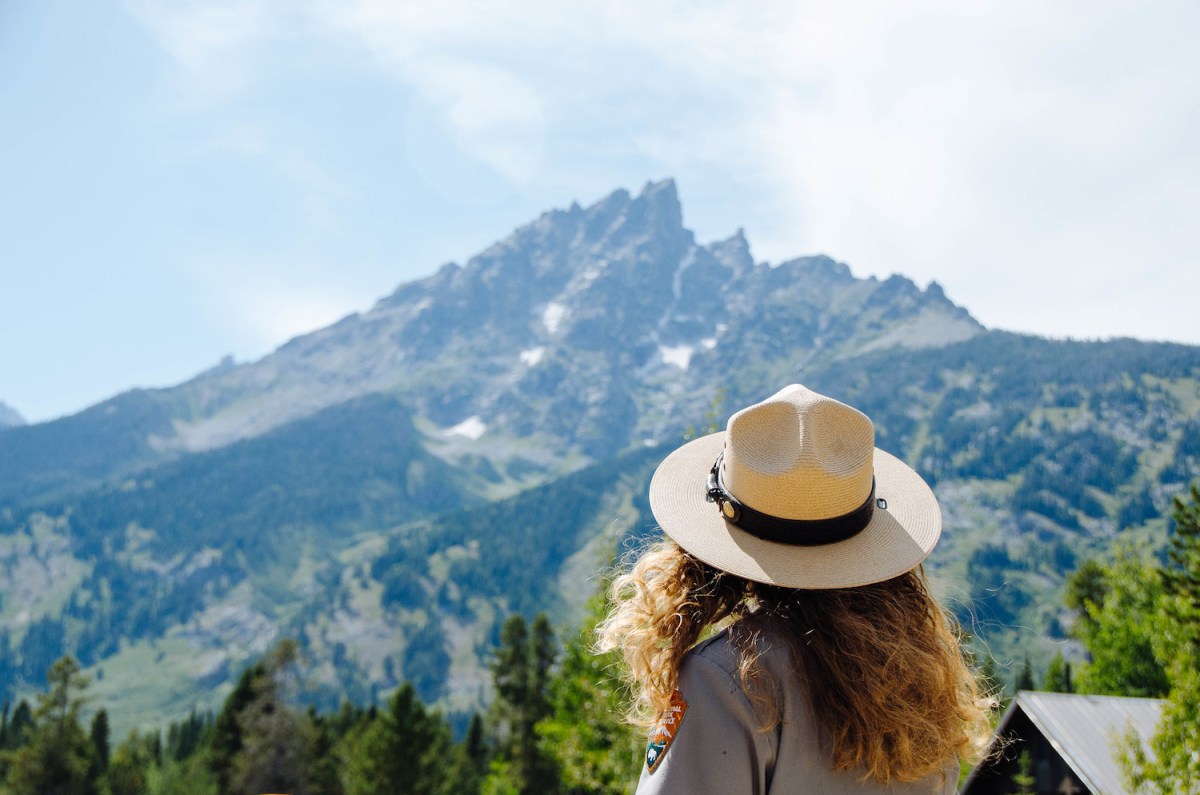
Grand Teton National Park Climbing Ranger Michelle Altizer, meanwhile, was asked if the federal misdemeanor citation was prompted by Sunseri’s status as a professional athlete and the online buzz that followed his feat.
“The amount of people this reached” did factor into the conversation among park staff, she said. “The hope … was to deter this activity from happening again.”
After a day and a half of testimony, the trial concluded without a verdict. Magistrate Judge Stephanie Hambrick opted instead to review the exhibits and arguments before issuing her finding.
Not up for debate is whether or not Sunseri left the park-maintained trail on his scaldingly fast descent of the mountain in favor of a historically used shortcut that saved him roughly a half-mile. He admitted as much shortly after the climb in a log on the speed-tracking website Strava.

At trial, Sunseri’s team set out to establish that the park service didn’t fulfill its obligations required to enforce trail closures and singled him out for a penalty that hadn’t been handed to past speed-record holders who had taken the shortcut.
Extensive debate about a trail in the lofty Teton Range may appear frivolous. But the case has drawn intense attention in the outdoor-athletics world, and both sides believe much is at stake — from the preservation of a natural park landscape to the ability of public lands visitors to move about with reasonable freedom. At the same time, the case is being used in a national conversation as an example of injustices caused by the proliferation of federal regulations. President Donald Trump criticized such “overcriminalization” in a May 9 executive order.
Hambrick’s verdict could have implications for future law enforcement and trail norms in the increasingly popular world of elite mountain sports.
The infraction
On Sept. 2, Sunseri ran and scrambled the 13.2 miles from the Lupine Meadows parking lot to the summit of the 13,775-foot Grand Teton and back with a time of 2:50:50 — a stunning feat that broke a 12-year-old record.
But he did so by cutting the switchback. He acknowledged his decision in unapologetic terms in a Strava post, which also published a GPS track of his route showing where he cut the trail. Fastest Known Time — the organization that arbitrates and tracks official speed attempts — rejected his submission due to the offense. Not long after, park rangers issued him a citation.
Rangers gave Sunseri a ticket for violating 36CFR2.1(b), which prohibits “leaving a trail or walkway to shortcut between portions of the same trail or adjacent trail in the national park.” The citation comes with a maximum penalty of $5,000 and six months in jail.
When offered a plea bargain of a misdemeanor conviction, a five-year ban from the national park and a fine, Sunseri opted to challenge the charges. Supporters say the government’s offer was overkill and a park ban is unreasonable for Sunseri, whose livelihood as an athlete depends on his ability to travel there.
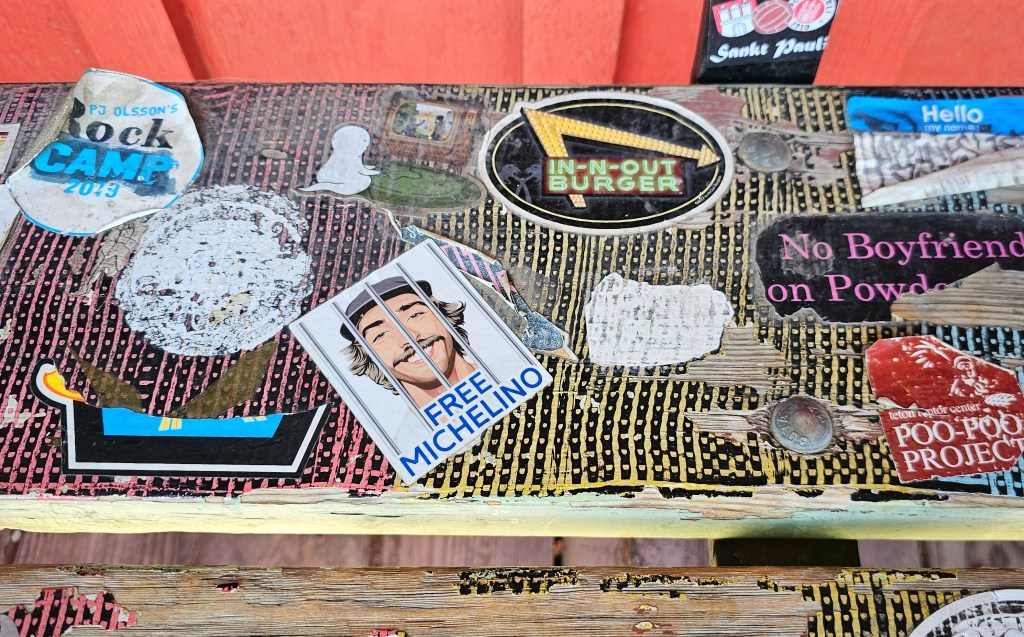
The bench trial opened May 20 in the Clifford P. Hansen Federal Courthouse in Jackson. A small crowd of Sunseri supporters showed up, including his father Edward Sunseri, who traveled from Florida for the event. Many wore hats emblazoned with the words “free Michelino.” They were not allowed to wear those hats in the courtroom, where recording devices and cameras were also barred.
The old climbers trail
Over the two days of testimony, the shortcut was carefully examined.
It’s not merely an untrodden landscape he ventured onto to connect two switchbacks. Instead, the route is a historic trail so well-used that it’s become a skinny singletrack. The National Park Service has installed small signs near the bottom and top of the trail. One says “short cutting causes erosion” and the other says “closed for regrowth.”
The signs make it clear the trail is closed, prosecuting attorney Ariel Calmes argued, and Sunseri’s communications show he traveled it with that knowledge. The defense, meanwhile, set out to show the established nature of the trail is evidence that it’s been commonly used throughout the years and the park service did not do enough to close it. The trail is known as the “old climbers’ trail,” according to the defense, though others said they had never heard that name.
Prosecutor Calmes’ first witness was Halpin, a professional mountain runner and acquaintance of Sunseri. The attorney focused on Instagram messages between the athletes in the run-up to the speed attempt in which Halpin urged Sunseri not to take the switchback cut.
Halpin didn’t explicitly say the trail is illegal in those messages, but told Calmes that she saw it as a stewardship no-no that the park service doesn’t want users on — a “bad look” especially for professional athletes who set the standard for those to follow.
Sunseri’s team, meanwhile, called several witnesses to recount how they have used the trail dating back decades. Bryce Thatcher, who set a Grand Teton speed record in 1983, said it was recognized back in the day that “the climbers’ trail was what you transitioned to when you got really strong” since it’s steep and grueling. Galen Woelk, another climber who has accomplished hundreds of climbs in the park, said he has seen even park rangers take the old climbers’ trail.
He remembers the signs at the top and bottom, but said, “we never believed the signs informed us it was closed.” Rather, he said, “we always presumed it was there to direct tourists” to take the maintained trail.
Calmes, however, argued that these old memories are irrelevant to something that occurred more than 20 years later. “I think it’s far too remote in time to be relevant in this case,” she said of Thatcher’s testimony.

Defense attorney Ed Bushnell called to the stand Utah Statewide Trails Program Manager Patrick Parsel, who has worked in trail management his whole career. Parsel had hiked up to view the shortcut the previous day, he told the courtroom.
If he was advising the park service on effectively closing and revegetating the old climbers’ trail, Parsel said, he would recommend conspicuous signage that contains specific language that it’s closed and illegal — “regulatory rather than educational.”
Bushnell also repeatedly brought up another park trail, Delta Lake, that is popular with hikers but not on the park’s official map, in an attempt to show inconsistent park enforcement.
Singled out?
After training all last summer, including climbing the peak dozens of times, Sunseri intended to try for the record between Aug. 25 and Sept. 3. It snowed in the high peaks on Aug. 26, narrowing the window.
Warm temperatures followed, and Sunseri set out the morning of Sept. 2, Labor Day. The holiday is among the busiest days of the year in the park. GTNP Social Scientist Jennifer Newton testified that the day Sunseri climbed was “one of the top five days in trail usage for that trail” in the park’s history.
Sunseri’s achievement created an immediate buzz in the mountain sports world. One of Sunseri’s sponsors, The North Face, posted an announcement to its more than 5 million Instagram followers that he had broken the record.
Ranger Altizer found out from coworkers on Sept. 3 that a new speed record attempt had occurred. Rangers took notice immediately that Sunseri cut the switchback, she testified.
Sunseri was open about it in his Strava log, which was read aloud during the trial.
“I flew down towards the catwalk, making questionable choices and being absolutely reckless,” Sunseri wrote about his descent. “I was jumping down sections that if I made one mistake or caught one toe, death was surely imminent. I didn’t really care at this point. I wanted this thing so bad, this was literally the only option.”

When he saw a member of his team, Sunseri wrote, “I yelled out ‘1:52:20, we’re cutting the switchbacks!’”
“I made the decision to cut the last switchback and avoid the Congo line [sic] of hikers that would be heading up Lupine Meadows Trailhead,” he wrote. “If I had to make this choice again, I would 100% make the exact same choice.”
If anyone disagreed with him, he continued glibly, they were welcome to try the speed record themselves, talk to former record holders “or fight me, whatever.”
The speed record was “particularly public,” Altizer said. Bushnell asked why she decided to cite Sunseri when others hadn’t received the same punishment. He prodded her about the publicity, and she said the public nature “contributed” to the citation. She and her colleagues felt they would fail at their jobs of stewarding and protecting the landscape if they did not cite him, she said.
Jenny Lake District Ranger Chris Bellino also took the stand. Bellino contacted Fastest Known Time within a week of Sunseri’s climb to advise them of the violation and encourage them not to acknowledge the record, he testified.
“We felt that would set a precedent” for future speed attempts, he said of the decision. “Shortcutting is prohibited” in the park regardless of the trail in question, he added.
“It was pretty egregious and it was pretty public,” Bellino said on a September phone call to Sunseri, parts of which were played for the court.
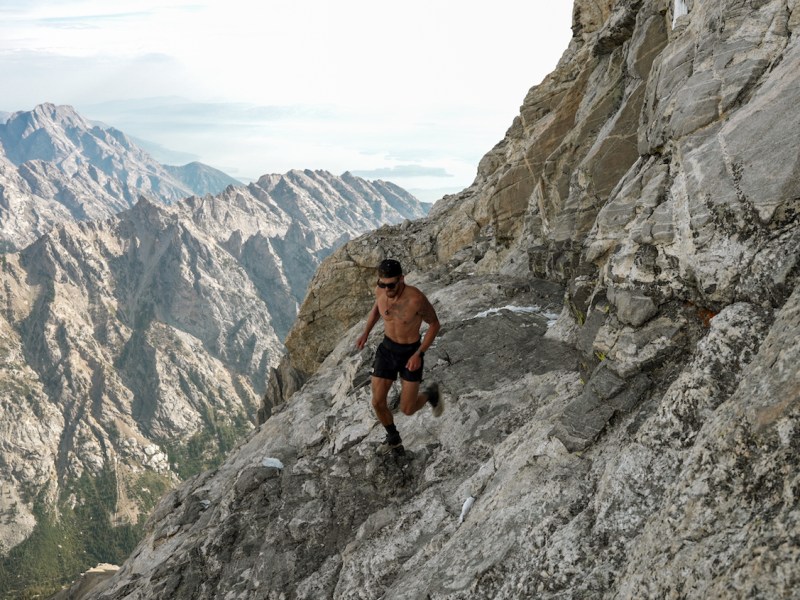
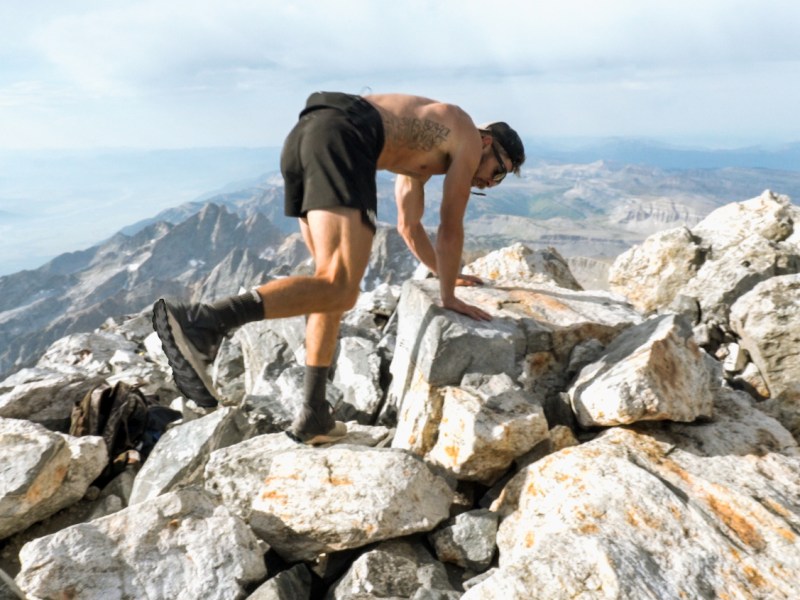
Sunseri also cut switchbacks higher up on the mountain, Bellino said on the stand. That was reported by a trail crew who reported seeing the athlete knocking rocks down in their general area. The park service considered issuing a further violation for creating a hazardous situation there, he said.
Good faith or criminal intent?
Sunseri formally offered to resolve the case with a deferred prosecution and community service to close the old climbers’ trail, court documents show, but the prosecutor declined to capitulate on the ban.
Now, fate rests in Judge Hambrick’s hands. It will take some time to weigh the evidence of the important matter, she told the court.
In her closing argument, Calmes said it’s a question of the facts. The Park Service does not have to place a sign on every corner of every switchback, she said, and park visitors don’t get to substitute their judgment for park management. Further, just because something was done in the past and not cited does not mean it can’t be cited now.
“This is somebody who made a deliberate decision to make that cut,” Calmes said, calling Sunseri a “power user” of the mountain who had memorized his route.
Bushnell, however, said the court must consider “that unless it’s posted and prohibited, park users are able to travel where they like.”
As for Sunseri? Despite his earlier words that he would “100% make the same decision again,” Sunseri wrote in an Instagram post after the trial concluded, “to be clear and to offer up advice to others- don’t use this trail anymore.
“Never in my wildest dreams did I foresee such a wild outcome,” he continued, estimating costs of $50,000 of taxpayer money, $10,000 of his own and $30,000 of his lawyer Alex Rienzie’s pro bono time. He also noted that he offered “five separate times” to close the trail at no cost to the NPS.

The National Parks do not exist to support the livelihood of vain, arrogant financially-motivated extremists (…a Park Ban is unreasonable for Sunseri whose livelihood as an athlete depends upon his ability to travel there). In point of fact there is good reason for the rules of usage which bear directly upon the well-being of the Park. The difficulty here arises from (probably) decades of non-enforcement which results in the perception – when the ban is finally enforced – that the individual cited has been singled out unfairly. Nope. Just unfortunate for him but long overdue as the perception of the parks as some sort of Disneyland to be utilized for purposes which have nothing to do with the reason for their existence increases. If they need a steep climb let them run the stairs at the The Empire State Building. The message for Sunseri and all of his friends: obey the rules.
As a friend said, “Play silly games, win stupid prizes.” And as Gaston Rebuffat said, “To fully appreciate the mountain, one must embrace the bivouac.”
Sunseri does not present the most sympathetic defendant, but the prosecution of this case is a waste of everyone’s time and money. The cut-off was a known historic route, and the closure was poorly signed. The defense sought a plea deal that would include community service to rehab the old trail, but the prosecution declined opting for a 5 year ban. The Park Service doesn’t have the resources to enforce switchback cutting across the park. If it is going to be selective in its enforcement then it needs to be really clear that violations will be prosecuted to the extent of the law. The resolution opted by the Prosecution makes everyone look bad and feeds the perception of regulatory overreach. Meanwhile, the ultra-runner looks like an entitled brat. There are a variety of better solutions, but like so many things these days the parties are entrenched in their corners. It doesn’t need to be this difficult.
Well formulated and thoughtful comment. I fully agree with your assessment of the situation.
“Since other people broke the rules I should be allowed to break them also”. This is the argument a 5 year old would make. Idiots like this ruin it for the rest of us. And for what?? To break the world’s most worthless record. This guy is the definition of an entitled loser. Someone’s mommy and daddy never told them no…
So give him a fine.
Instead the Government decides to make an example out of him with ridiculous charges. Park LEO rangers in GTNP are more cop than ranger.
Both sides in this case are undesirable.
Agree 100%
If anyone needed any more confirmation on how entitled and smug, this guy is, he went crying to Hageman and is embracing her very loose interpretation of laws and how they only apply to some people (read: white). Sounds like a spoiled, desperate man with zero morals or accountability.
It is PUBLIC LAND. OWNED BY TAXPAYERS. We should be able to tread (lightly) where we wish. One heavy rainstorm, snow storm with slide, or fire alters landscapes. One man stepping on ground leaves little trace. It is OUR land.
You are correct…”It’s our land”! Not yours! Show some respect for it! Many of us want those trails protected from people like you who’d go wherever you want (lightly…LOL). You talk about “one heavy rainstorm” causing damage? It’s far worse where people hav cut the switchback. That trail becomes a till, then a gully, and will take years, and thousands of man hours of labor, to get back to a natural state, if it ever does.
Humans are part of nature. To claim otherwise is egotistical hubris.
Dude your so far removed from nature
Substitute nature with reality and I’d agree with you.
You’re right. It’s our land. And I don’t want people shortcutting my switchbacks. Good for the park LEOs.