


A longtime client of Exum climbing guide Jed Porter had the Grand Teton’s East Ridge route on his tick list for years. But the 2022 partial collapse of a pinnacle along the arete stymied his plans.
In spectacular fashion three years ago, a major portion of the Second Tower collapsed, pounding the Grand’s East Ridge and terrain below with tons of boulders, rocks and gravel. But by 2025, things appeared to have stabilized, and Porter and his client geared up for a go.
As they packed and planned, neither guide nor client realized that the Second Tower continued to fall apart. Days before they started at the base of the East Ridge on Tuesday, yet another part of the recognizable skyline pinnacle had disintegrated and rained tons more debris onto the climbing route, glaciers and snowfields below.
“It was obviously fresh debris … ugly shifting sand and angular rocks.”
Jed Porter
“I hadn’t heard of anyone climbing the East Ridge since 2022,” Porter said Thursday. On a climb of the Grand via the Exum Ridge on Sunday, he looked down on the Second Tower almost a thousand feet below to check it out.
“I was looking at it closely,” Porter said. “I didn’t see anything out of the ordinary.”
He checked with other guides who said they believed that the Second Tower had not changed since 2022.
Armed with that information and some extra gear in case a retreat might be in order, Porter, his longtime client and another client set off. They hiked to the base of the East Ridge, bivouacked Monday night and began climbing the East Ridge early the next day.
They would be, as far as they knew, the first people to see close-up what had occurred three years before. What they didn’t know was that they would be climbing across dust and detritus perhaps only three days old.
Ugly, shifting sand
Roped climbing on the East Ridge begins at about 10,600 feet, some 3,000 feet below the 13,775-foot summit. Porter’s team scrambled and climbed over and past various obstacles, including the Molar Tooth, the first tower on the long ridge.
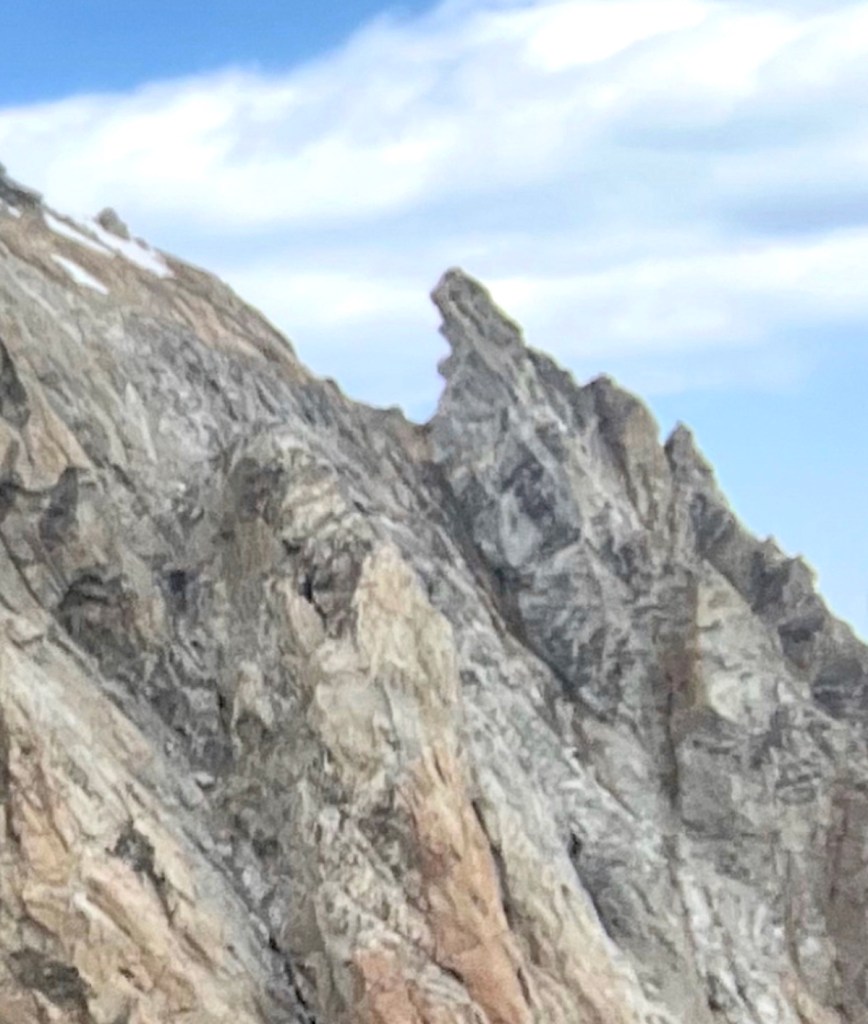
As they approached the Second Tower, they couldn’t yet see the uphill side where a major part of the tower had fallen away.
Only when they arrived at the notch between the Second Tower and the rest of the mountain would they see the geologic carnage and the Second Tower’s fresh, fractured face.
That last pitch up a chimney takes climbers beneath a stack of 15-foot high granite razor-blade chockstones, all held in place by seemingly imaginary forces. Despite the collapse just above it, the Damoclesian nightmare of chockstones remained intact. Porter climbed the chimney and brought his clients up where they saw the first traces of mayhem.
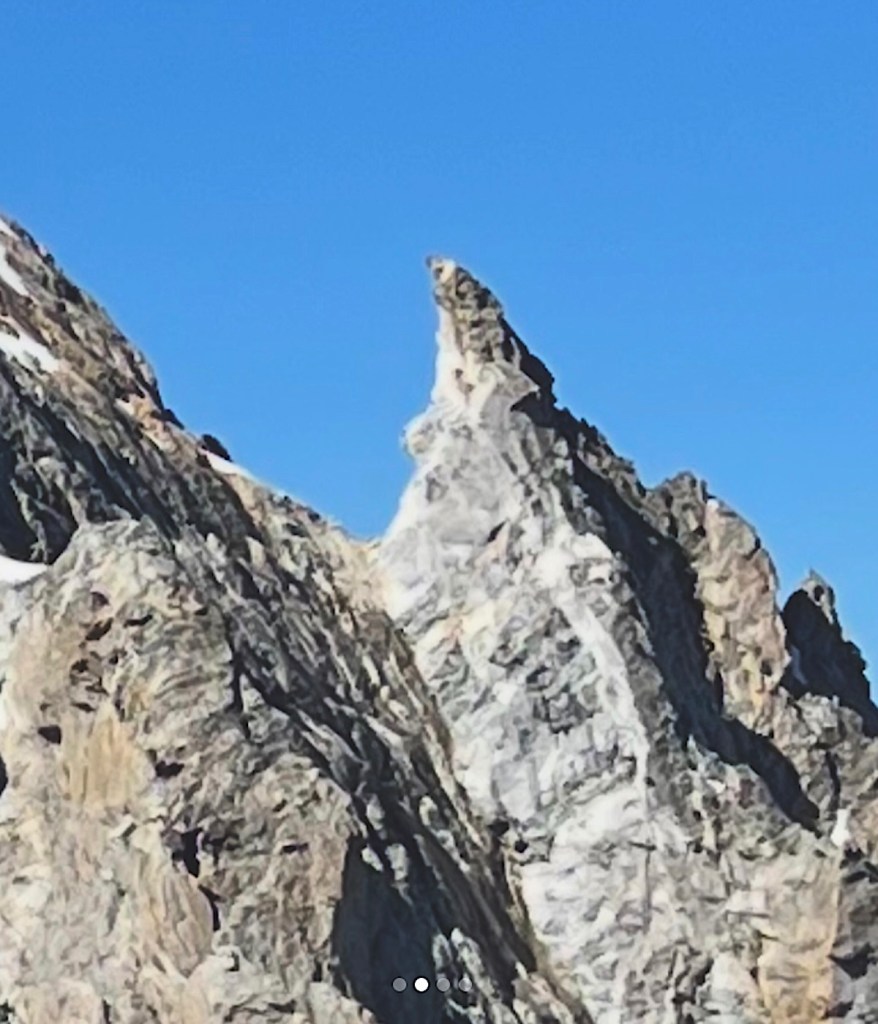
The slope was littered with “ugly shifting sand and angular rocks,” he said. “It was obviously fresh debris.”
“I didn’t realize how fresh it was,” Porter said. “I concluded it was from 2022.”
From the belay atop the chimney, the team passed across about 60 meters of fractured choss before reaching clean ground. All told, the group spent about 12 minutes in the danger zone, Porter said, still oblivious to the recent collapse.
Rangers’ Instagram
The team crossed the summit and bivouacked on the Lower Saddle on the way back to the valley. Once home, Porter’s client saw Monday’s Instagram post by Jenny Lake Rangers, Grand Teton National Park’s climbing and rescue squad.
Rangers published the post the day Porter’s group made its approach to the base of the East Ridge.
“Heads up!” the post reads. “Multiple major spontaneous rockfall events have occurred over the weekend.
“Most notably, another large part of the Second Tower on the Grand Teton has collapsed,” the post stated. “At this time, it is not known if the East Ridge climbing route has been impacted.”
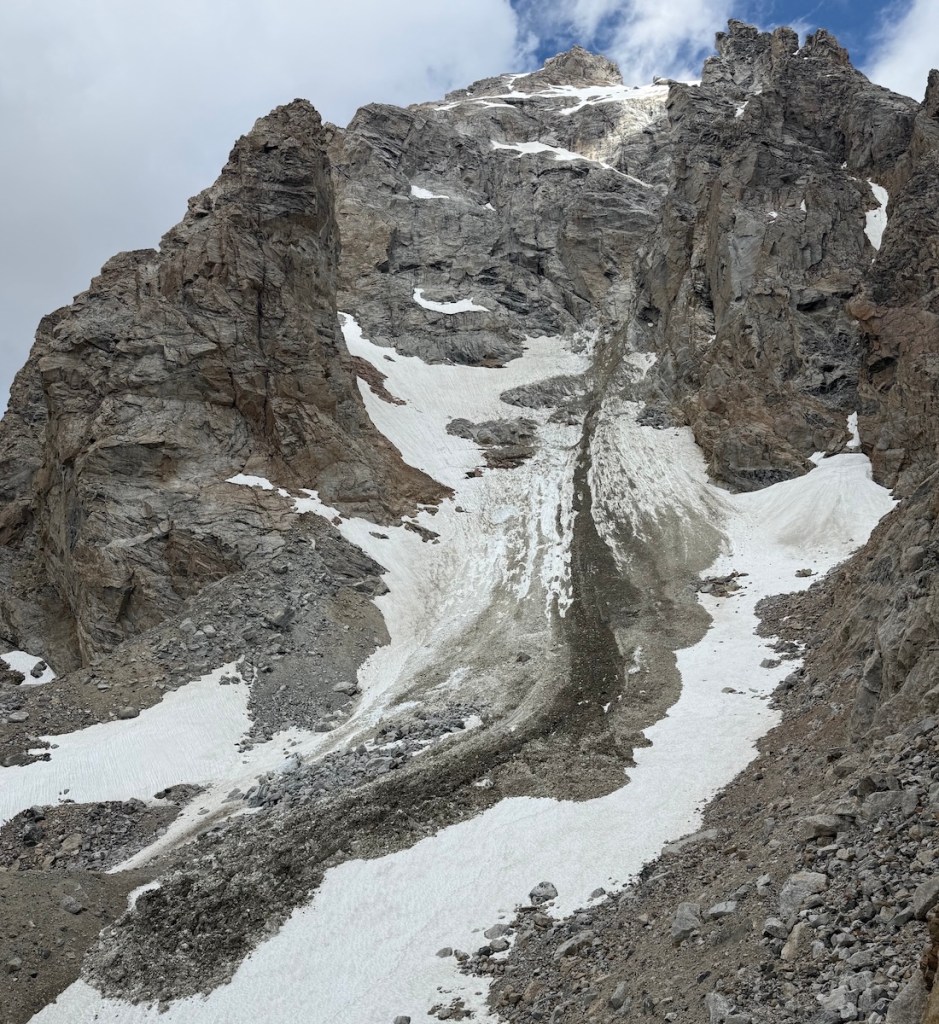
Porter guesses the major collapse happened July 4 or July 5 during a storm, most likely the 4th because the weather was worse that day.
Porter reckoned he and his client had given the mountain enough time to stabilize after the 2022 collapse.
“It made a lot of sense to stay away 2023,” he said. “But by now, it seemed long enough had passed.”
He offered an overview. Big events like the collapses of the Second Tower don’t happen in isolation, he said.
“There’s some level of warning, some level of follow-up over weeks and months and years,” he said.
For example, small rockfall presaged a major rockslide from the Stettner Couloir on the Grand’s south side years ago, he said, and more, smaller events followed.
A prolonged kaboom!
Across the Tetons and in other ranges, alpinists are watching mountains crumbling at a faster rate than usual. Exum co-owner Nat Patridge described an event that happened Sunday when he was climbing the Exum Ridge.
“It was a loud prolonged kaboom!” he said. A rock cuboid about 9 feet long and 6 feet on its other sides had peeled off the mountain just above a chokepoint leading to the 11,600-foot Lower Saddle.
Had anyone been at the chokepoint, a rock step where fixed ropes aid climbers over a wee bulge, “it would have had you shaking in your boots,” Patridge said.
He’s seen other events, including a rock and mud slurry that flowed past the same spot in 2022, carrying boulders 3 feet in diameter.
“I had to jump out of the way,” Patridge said of the event, which came in waves and lasted about 20 minutes.
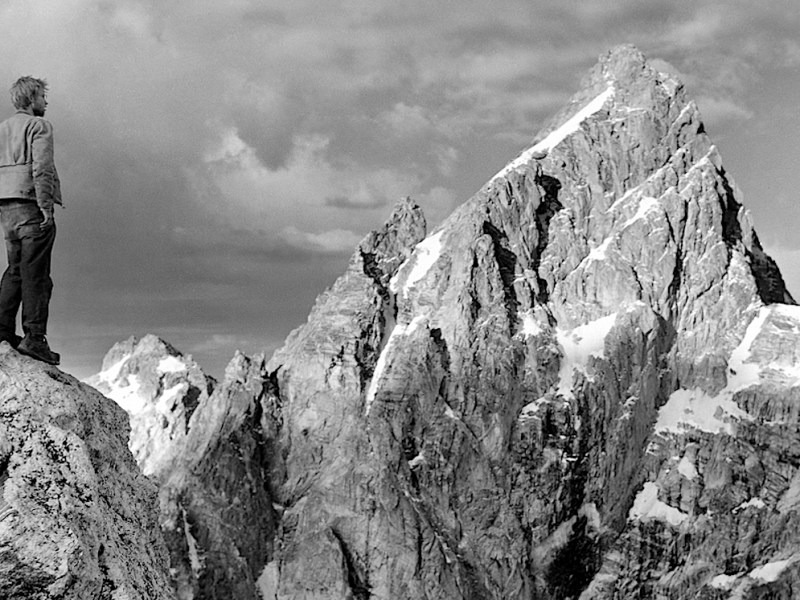
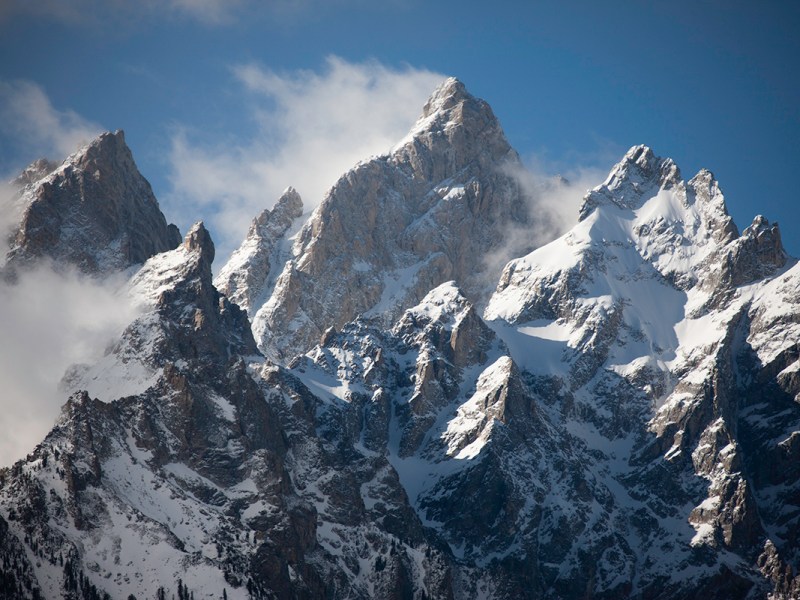
“It’s definitely related to heat, melting,” he said. “Snow used to hold things in place. Without the snow, we’re seeing much more rockfall.”
A guide with Jackson Hole Mountain Guides on Saturday photographed what appeared to be the debris from the second collapse of the Second Tower. Porter Crockard said he and fellow guides heard rockfall from their nearby camp the night before.
“We are seeing rockfall with climate change,” he said. “The mountains are a dynamic place.
“It’s up to all of us to be thoughtful how we move around,” he said, “and communicate areas of hazard among the community. Safety is always our top priority.”
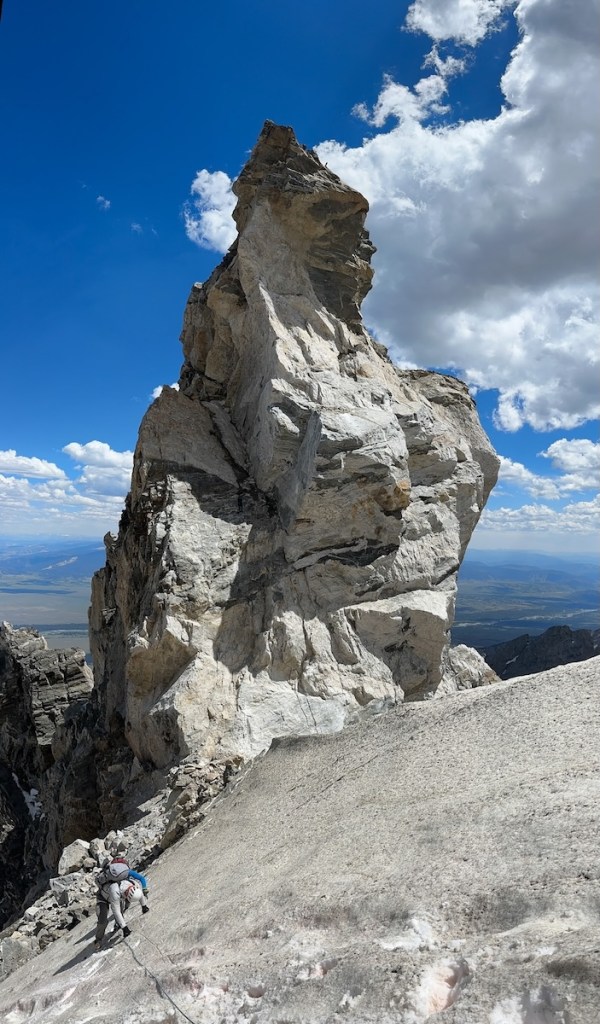

Is there an aerial overlook of exactly where this is located?
Good story Angus. Glad you and I climbed that route when we did many years ago. I do remember we were both a bit puckered when we climbed out from beneath the Second Tower with the North face below us and loose blocks littering our path. I’ve always felt a bit unsettled on the bigger alpine rock routes in the Tetons. They always feel so transient, like they might not still be there when you look back from the valley. Now that feeling is justified.
If thats a real picture, is that not a giant skeletal fossil that no one is looking into?
It looks like the face of America’s greatest president Donald Trump.
I enjoyed the article I don’t know if you all have heard of old man of the in Franconia NH after many years mother nature brought him down now he resides on second tower Tetons in WY
The Tetons are so very sacred to me. Ever since my first glimpse of them to this day I’m in awe of their glory!
Great article, thank you for sharing.