

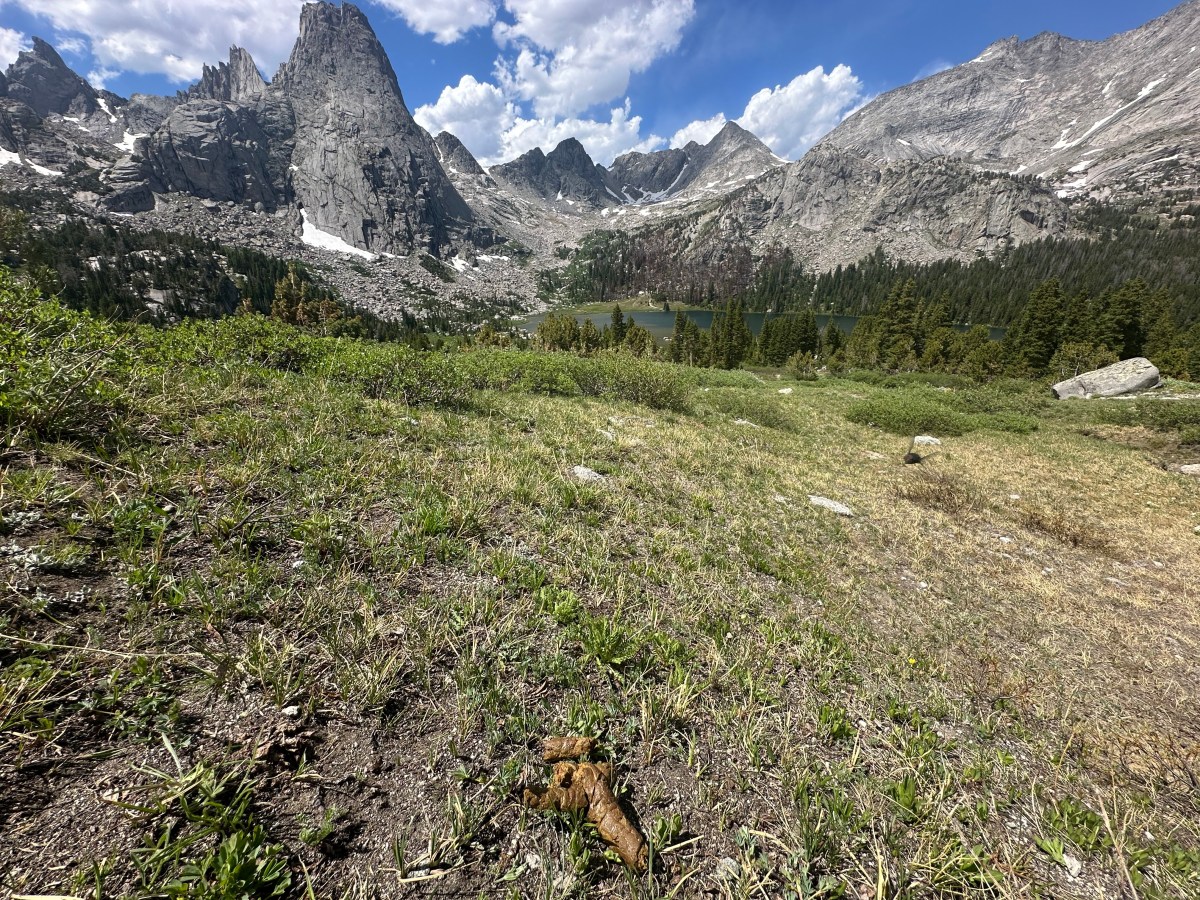
LONESOME LAKE—Whit Coleman belly flopped with style into some of Wyoming’s most famous alpine waters on Wednesday.
Out on a father-son backpacking trip with friends, the Salt Lake City man took the plunge with an incredible backdrop: the Wind River Range’s Cirque of the Towers, a semi-circle of big-walled granite peaks that all top 12,000 feet. The dip was pleasant, he recalled later in the day.
“It’s probably better that we didn’t know,” Coleman said. “We enjoyed ourselves. I’m not too worried about getting sick.”
Coleman learned of a potential health concern after the fact while hiking out from Lonesome Lake, which sits at the bottom of the cirque and forms the headwaters of the North Popo Agie River.
Lonesome Lake has long been reputed to be unfit for drinking and even swimming. That’s due to contamination presumed to be from the hordes of humans who poop while traveling through the popular backcountry basin. Now there’s a datapoint to back it up.
On Aug. 9, 2022, during the height of the recreation season, environmental regulators gathered a water sample from a foot below the surface near the outlet of Lonesome Lake.

The concentration of Enterococci — bacteria indicative of fecal matter — jumped off the page.
The U.S. Environmental Protection Agency didn’t make the results public for two years. When they were published, heads turned.
Lonesome Lake’s sample contained 490,895 calibrator cell equivalents of Enterococci for every 100 milliliters. The EPA’s safety threshold for swimming is 1,280 CCE/100 mL.
The concentration of fecal bacteria, in other words, was 384 times greater than the EPA’s criteria. Not only that, but the fecal bacteria were more concentrated in Lonesome Lake than in any of the other 981 lakes that were surveyed around the country for the federal agency’s National Lakes Assessment, which gathers data for randomly selected ponds, lakes and reservoirs every five years.
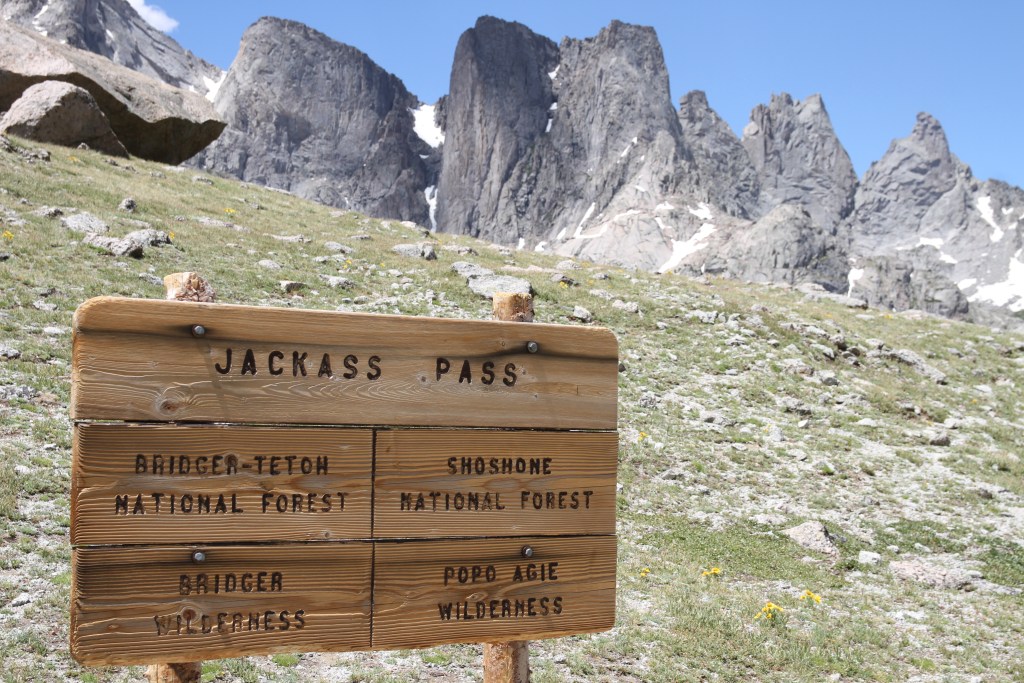
Arguably, Lonesome Lake was the most spectacular, remote waterbody in the broad study examining lake health all around the United States. Its snowmelt-fed 35 acres of crystal clear water, located within the Popo Agie Wilderness, are just a half mile off the Continental Divide along the spine of a mountain range that hosts more than two dozen glaciers and the highest peak in Wyoming.
And yet the data also suggested that Lonesome Lake’s water was the most polluted by poop. That’s especially remarkable given that the assessment also looked at lakes and ponds in urban areas and agricultural regions more typically associated with feces-related pollution.
Early in the process
The sky-high Enterococci concentration found during the EPA’s 2022 survey — sampling conducted by the Wyoming Department of Environmental Quality — set off a chain of events.
Because of its location in a designated wilderness area, Lonesome Lake is classified by Wyoming as a “Class 1” water. That’s a designation that protects uses like “primary contact recreation,” and demands that “nonpoint sources of pollution” be controlled through “best management practices.”
The DEQ and the Shoshone National Forest decided they needed more data to understand the scope of what’s going on.
“A single datapoint doesn’t necessarily tell us much of anything,” said Ron Steg, DEQ’s Lander Office Manager. “We need to get some real data to understand if there is a problem. If there is, we’ll react to the results of the data.”
In October 2024, weeks after the EPA results came out, staffers with the federal and state agencies trekked into the cirque to conduct follow-up testing. Gathering water samples outside of the busy backpacking and climbing season — trail-counter data shows that use virtually shuts off entirely come mid-September — they weren’t able to detect any levels of another fecal indicator bacteria, Escherichia coli (E. coli).
That sample was collected “well past peak recreation season, from a source standpoint,” said Jeremy ZumBerge, who supervises DEQ’s Surface Water Monitoring Program. “You’re also past peak exposure time — when people are most likely to be exposed.”
This summer, a much more extensive effort is underway to suss out what exactly is going on in Lonesome Lake.
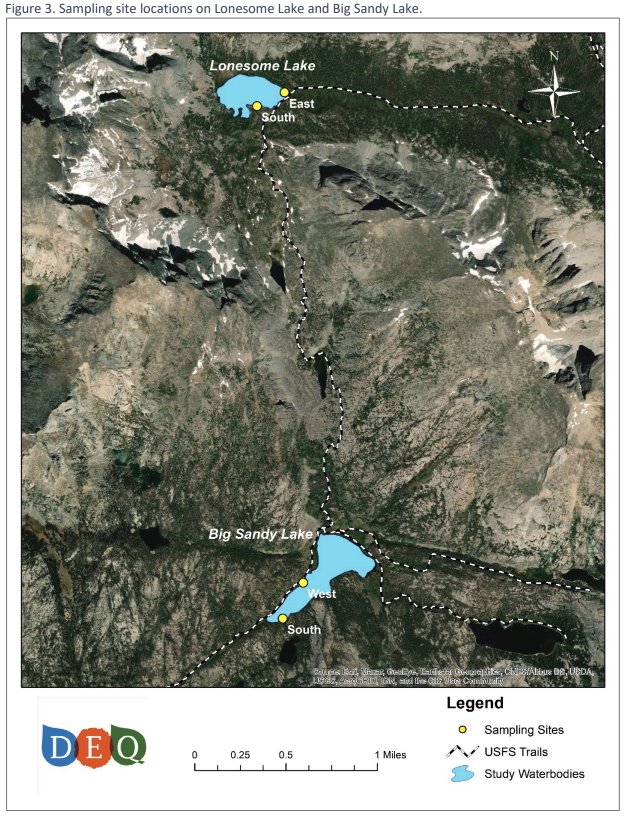
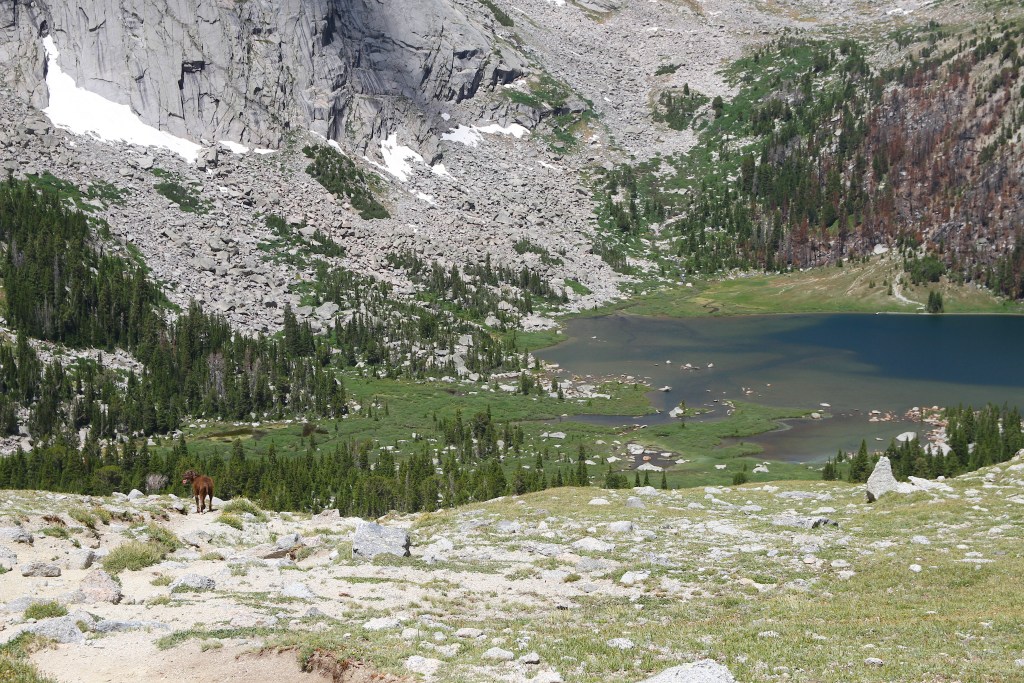
Between July 14 and Sept. 11, DEQ and U.S. Forest Service officials will take five samples near the south and west shore, where trails come down off of Jackass Pass and the North Fork and concentrate use. While they’re at it, the team of hydrologists and watershed protection specialists will also take water samples from Big Sandy Lake, located on the Bridger-Teton National Forest.
“That was of interest to the Forest Service, knowing that Big Sandy is also a very popular destination — and it is very convenient, as it’s off the main trail used to access Lonesome Lake,” ZumBerge said.

The specifics of the joint state-federal investigation are laid out in a “sampling and analysis plan” for Lonesome and Big Sandy lakes that Wyoming DEQ published in March. The results will be published in a subsequent DEQ assessment report.
The scientific inquiry has the potential to elucidate an environmental hazard that frequent Wind River Range travelers have long been aware of. It’s no secret: Lonesome Lake’s diminutive watershed — just 2 square miles — is thought to be overrun with poop that makes its water unsafe. The guidance is all over the place online, and is also frequently passed along word of mouth.
Poop lake
“I tell people definitely do not swim in there, I tell people definitely do not drink the water,” said Brian Cromack, an employee of Pinedale’s Great Outdoor Shop who often advises Wind River Range travelers. “It’s been heavily contaminated for a long time, just via the negligence of outdoor recreation enthusiasts over the years.”
Fecal bacteria readings 384 times the safety threshold “sounds about right,” Cromack said.
“Hopefully, people are more mindful,” Cromack said. “I think the big problem why Lonesome Lake is so bad is because of the serious climbing prevalence there. Generally, backpackers are a little bit more conscientious about how to dispose of their waste. Not to rag on any one group — I love to climb.”
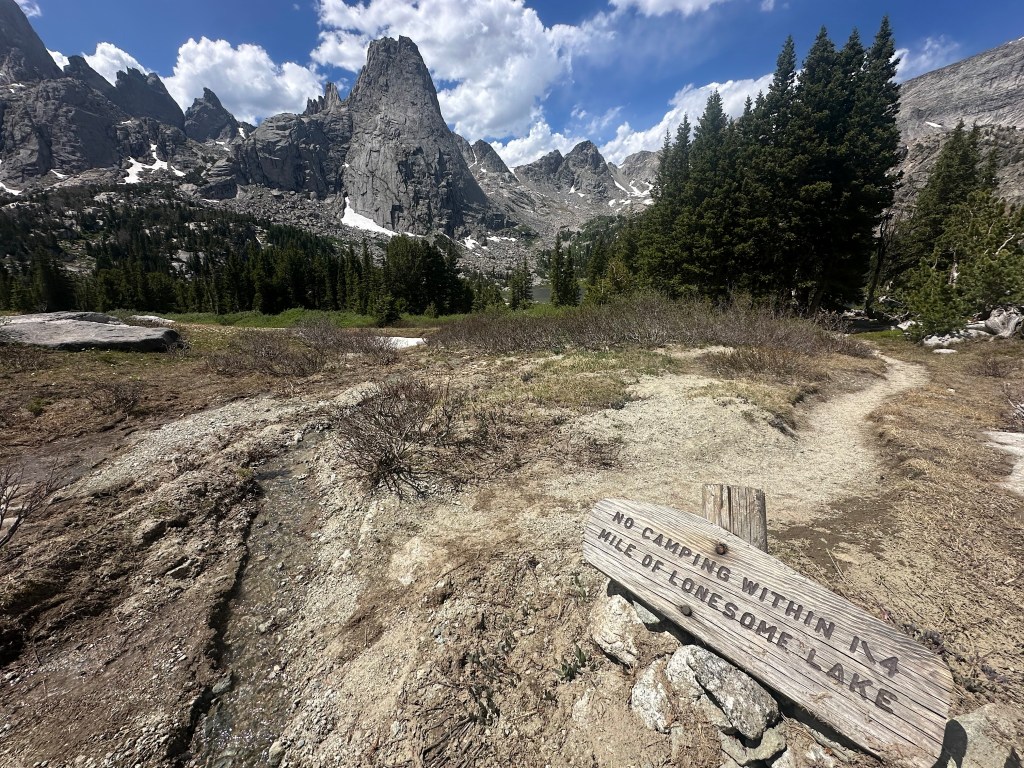
Regardless of who’s doing the pooping, there’s a lot of it and it’s easy to find.
WyoFile visited Lonesome Lake on Wednesday and within minutes found seven makeshift latrines in likely areas — in the trees, not far off the trail. Most were loosely buried to varying degrees. In other places, toilet paper and excrement had become exposed.
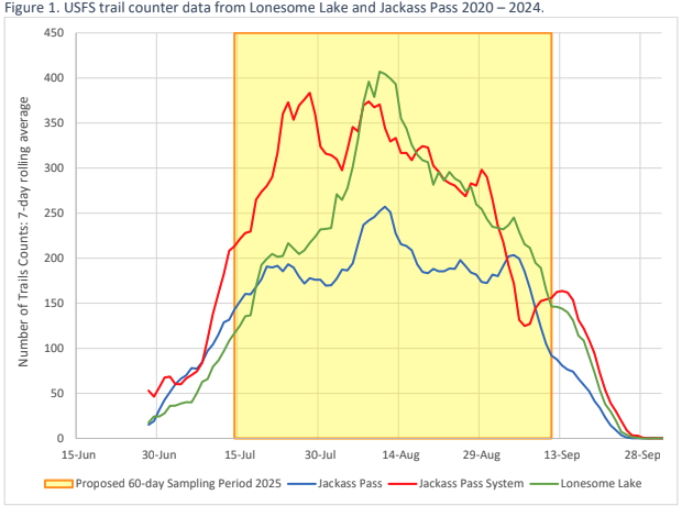
And it’s not yet peak busy season. Early July, according to the trail-counter data, attracts 100 people or fewer to Lonesome Lake weekly. By early August, the weekly counts crest 250 wilderness travelers, and by the middle of August, a whopping 400 people are trekking into the Cirque of the Towers every seven days.
Collectively, it’s a lot of biomass. A decent chunk of it gets left behind. Back-of-the-napkin poop math suggests that, at roughly a quarter pound per stool, perhaps 100 pounds of human feces are getting squished under rocks or buried in the shallow soil that rings Lonesome Lake on a weekly basis during the height of summer.

“I don’t know specifically how that [fecal bacteria] transport to the lake could occur,” said ZumBerge, the Surface Water Monitoring Program supervisor. “I imagine there’s a few different ways that transport can make it to the lake — if it’s happening.”
At between 10,000 feet and nearly 13,000 feet in elevation, the Cirque of the Towers and the basin it surrounds are buried by feet of snow each winter. It melts off in the spring and summer, bound for the low point of Lonesome Lake.
Possible fixes?
Hiking along Lonesome Lake’s southern shoreline early Wednesday afternoon, Glenwood Springs, Colorado, resident Carl Meinecke, an arborist, wasn’t so shocked by the fecal phenomenon.
“It’s not completely surprising,” Meinecke said. “Things aren’t like they used to be. We’re getting such high use in some of these areas, it becomes tricky.”

The regulations on many western rivers, he pointed out, require that campers carry out their waste in specialized containers known as wag bags or a groover.
“That would be pretty tough here, carrying it out,” Meinecke said.
It wouldn’t be unheard of.
As nearby as Grand Teton National Park, poop-removal regulations are in place. Portable toilet systems are required for backcountry camping on Jackson Lake and all overnight users of Garnet Canyon must pack out their human waste in EPA-approved containers, according to the park regulations.
Steg, at the DEQ, emphasized that it’s tough to know what the future holds. But if the data bears out, he said, the fecal bacteria concentrations will “certainly need to be addressed.”
“It’s a very unique situation to have a water quality issue this many miles into a wilderness area,” Steg said. “It’s not something that any of us have regularly dealt with. We’ll see where the data points us.”
ZumBerge, his DEQ colleague, was unaware of any other Wyoming waters where human use has been implicated in a fecal bacteria problem. During the 2022 EPA assessment, there were 27 total lakes randomly sampled in the state, including six in the Wind River Range.
“Lonesome was the only one that rose to our attention as being potentially elevated,” ZumBerge said.
Environmental regulators do have tools at their disposal designed to address water quality problems. “Total maximum daily load” [TMDL] plans, for example, are years-long strategies commonly used to bring waterways into compliance with the Clean Water Act. In Wyoming, they’ve been used to attempt to address livestock feces-related E. coli bacteria pollution in places like Star Valley’s Salt River.


Steg, who supervises that program, said it’s way too early to say if a TMDL will be necessary for Lonesome Lake.
“That’s a pretty big tool for a pretty simple problem — if, in fact, there is a problem,” he said.
This story is produced by WyoFile, in partnership with The Water Desk at the University of Colorado Boulder’s Center for Environmental Journalism.

A reservation or lottery system is needed to control entry at Big Sandy Trailhead, backed up with rigorous enforcement. Prohibit dogs year-round. Allow horses only during hunting season (I’m not a hunter). Otherwise we will soon have nothing left. For the near term close the trailhead June 1 through September 15, together with closing the Lonesome Lake drainage, the Big Sandy Lake corridor, and the valleys east of Big Sandy Lake in order to buy time to work out a plan.
The 22 years I lived in Jackson we worried about Giardia hiking around the area….. not people pooping. This will shock you…the cleanest natural lake in the country for the umpteenth time is the lake I grew up on, Lake George in the Adirondack Park(2.4 times bigger than Jellystone) of New York State. It’s 32 miles long. One of the main reasons…very strict law enforcement. If a boat has a head, they are checked…if it is not plugged … $1000 fine.
Due to bad behavior, shut down the trail ..how does this affect the wildlife ??? Can’t be good.
7/5 Day hike out to the Cirque and back.
Not peak season yet.
Almost as many dogs as people (all off leash).
I’m all for the ability to freely explore the the wilderness, but something needs to be done before it cannot be undone.
And 2 years before releasing the study?!?!
Don’t want to say it or believe it but it sure seems like a permit system can’t come soon enough.
Spot on Arlo
Never seen dogs at Lonesome but definitely a lot of horses. Sorry to hear it is over crowded now. Might br time for some sort of holding tank toilets and use a fire fighting like chopper for pump out once a year.
I hope scientist and engineers and Rangers can come up with a solution.
Thanks for sharing. In all my days I never would have suspected a problem at Lonesome.
I wonder how the alpine waters of Austria, Germany and Switzerland compared with Montana waters?
Permits for camping at Lonesome Lake, Seneca Lake and Island Lake are soooo far overdue! The United State Forest Service is failing miserably in it’s management of these spectacular places that are being destroyed.
The permitting system used in similar National Parks or WIlderness areas serves multiple purposes. First, it limits the number of campers in an area, secondly it stops so many campsites from being developed. A limited number of camping spots (similar to Cascade and Paintbrush Canyon’s in Grand Teton National Park) causes much less damage to the area. Finally, the people who go through the effort of getting the permit tend to be more environmentally conscience and will follow proper waste disposal etiquette by properly going off trail, finding a proper place for their waste, digging a deep hole and covering up their defecation. Finally, the permit system at many parks often involves an educational piece before the permit is granted. As much as i have been disappointed in the management in the Wind Rivers, I have been equally impressed with the permit system in Yosemite, Kings and Sequoia National Parks which did all of these things.
CAN THE US FOREST SERVICE PLEASE PUT THE PERMITS IN PLACE ! ! !
If the hikers cared at all they would carry out their waste.
The article gives substance to the Poopoo Agie Wilderness Area.
Being an avid hunter and camper, this is a topic that makes my blood boil. We hunters catch a lot of grief about our sport. Having walked many miles in our wonderful outdoors and been disgusted and at times outraged by the ‘care and respect ‘ shown by other groups of so called nature lovers. Year after year it just gets worse and worse. It should not surprise me, after all, they trash the cities they come from so trashing our back country is just par for the course by these nature lovers that are escaping their concrete jungles. They need to learn good woodsmanship. It may sound cliche but Boy Scouts they are not.
Thanks for this detailed, nuanced article that describes in essence the philosophy of regulation of water pollution. When it comes to drinking it there are standards but when it comes to polluting it, the guiding principle is “dilution is the solution to pollution”.
The Cirque watershed is one big toilet bowl that generates exorbitant amounts of fecal material that by the time it drains into the river gets diluted as it goes downstream. When it comes to swimming in it there are no Federally enforceable health standards for the amount of fecal one can “safely” swim. In fact it is pretty rare for any entity to set a public health standard for “swim beaches”, then sample for that standard and then have enough gutsy leaders to close the beach if exceedances are detected. Think Jaws but on an invisible level. Everytime I encounter a designated “Swim Beach”, I ask the management whether there are set standards for the fecal levels where the beach is closed. The answer is usually that there is no sampling and if they do there are no procedures for closing the beach. In some places sampling occurs but nothing happens even when astronomical levels of fecal are detected.
Public land managers can install vault toilets but getting the material out requires some considerable effort. In Yosemite some backcountry toilets are packed out by mules in 55 gallon drums or by helicopter. One could install a septic system, which would help if properly cited and people took the effort or did not vandalize it; however, in the meantime do not swim and if you do keep your mouth closed and no open wounds on your skin.
This should be investigated. This is news. Not only the fact thatv300 people a week go through there but just the fact that poop can travel from the dry ground to the lake. Usually the contamination is from home septic tanks near the water ways. This is absolutely a scientific miracle. Can I please congratulate you on finding this data. Can I see how you gathered the data and is this fecal matter human?
With all the money spent on endless surveys you could build bathrooms near the trails and solve most of your problems. I leave my dog at home when I hike. She got tired of pulling me up mountains.
My first trip into the Winds was in 1970 to Island Lake and Lonesome Lake in 1973. In the early 70’s you could dip your Sierra cup in any stream – we drank from them often and never had a problem.
However, I remember that around 1974 the forest service posted a warning not to drink the water in Lonesome Lake. It wasn’t much later that giardia became a problem. We’ve filtered our water ever since, and not had a problem.
I’ve seen many examples of feces and toilet paper lying on the surface (eg. Hobbs Lake). I think all the lakes on the trail to Island Lake and including Island Lake potentially have an ecoli problem too.
Sad, but this is the reality of increased usage and visitors who don’t practice good backcountry hygiene.
When I got to Wyoming in 1992, it was already well known–not “reputed”–that Lonesome Lake was badly contaminated by human waste from the hordes of hikers and climbers that flushed themselves through the Cirque every year. It was also known that it was getting worse every year, year by year, as human use increased. So now we have some hard data to prove it. Acquiring that data took long enough.
So what to do? Aside from the very technical aspect of cleaning up the Lake and the surrounding area, which I understand would be a long, involved process, I think it will be necessary to restrict or deny entry to the Cirque. We could, for example, establish a lottery to enter the Cirque, much like limited quota hunting licenses, and enforce that restriction. We should also require everyone entering the Cirque under permit to have proof of Leave No Trace training, such as from NOLS or another outdoor school. That means we’ll have to have a forest warden or two or three on site to enforce the rules. If climbers complain, well, too bad. The other option is to shut down the Cirque completely.
This is what happens when public lands users care more about their “personal experience” than they do the land. Acquire some discipline, folks.
Every time I see a Subaru with a kayak I cringe.
Unfortunately a lot of backpackers (perhaps climbers too? are undisciplined. There has always been an “outlaw” attitude, much as is really evident with a small minority of mountain bikers, that the rules “don’t apply to me,” and getting away with breaking them is part of who I am! I have a friend who is squeamish about carrying out his toilet paper and doesn’t, even when it’s required.
There was a giant outhouse at the 11,500′ level on the trail up Mt. Whitney that helicopters would empty. They tore down the outhouse and hikers are required to carry out their poop.
20 years ago permits were required to enter the Enchantments in the Alpine Wilderness in Washington. A couple years ago permits were instituted to hike in the Three Sisters area outside of Bend Oregon. The Pacific Crest Trail can only be hiked end to end with a permit, which is “limited” to 50 people a day. Having hiked most of that trail over the years, I can attest to the prevalence of toilet paper and poop at popular campsites.
These wilderness areas were being loved to death – e.g., Lonesome Lake at is worst. The same phenomenon, but less obvious and measurable, is happening in the little drainages defined by Deep Lake, Temple Lake, and Black Joe Lake. All start at the Big Sandy Trailhead. On a busy weekend those drainages have campers every 100 yards or so. Sometimes finding a parking space at the Big Sandy Trailhead is impossible and you have to park on the access road.
A permit system needs implemented to control entry into the wilderness from Big Sandy, and probably Elkhart Park to the north.