

In Sheridan County School District 3, which serves schools in the tiny community of Clearmont, the base pay for a first-year teacher is $48,000. But the median home price in the community, Superintendent Chase Christensen said, is over $400,000.
“I believe that a couple that are both involved in education should be able to make a living to a point where they can raise a family, buy a house in the community they live in,” said Christensen, who noted that he also serves as special ed director, tech director, principal and part-time bus driver for Wyoming’s second-smallest district.
He urged lawmakers to increase teacher pay Friday during the Select Committee on School Finance Recalibration meeting in Casper. For too long, educators have been underpaid, and it will hurt the state, he said.
“I urge you not to be guided by what has been done before, or by practices that have taken advantage of a group of professionals for far too long,” Christensen said. “Instead, I invite you to step out and set a base rate of pay that you believe is respectful of the profession, that is right, that will help recruit and retain the best, and that will drive our state’s economy for generations.”
A base salary of $70,000 better reflects the preparation, skill and responsibility required by the job, he concluded. “I recognize that this represents a significant increase, but our students are worth the investment.”
As lawmakers waded through the preliminary findings of consultants tasked with assessing Wyoming’s educational funding model last week, the need to pay teachers better was a recurring theme.
Pay is one of the myriad components being assessed by the ongoing recalibration process. The Legislature’s exhaustive and tedious assessment of public education funding is mandated every five years.
This time, however, lawmakers are doing so in the shadow of a district court ruling that the Wyoming Legislature violated the state’s constitution by underfunding public education and must amend that. They are also doing so in an age when many legislators are seeking government spending cuts.
Preliminary findings
The recalibration process is required every five years to ensure the Legislature fulfills its constitutional duty to “provide for the establishment and maintenance of a complete and uniform system of public instruction.”
To do that, the state’s consultants, Picus, Odden and Associates, are holding meetings with Wyoming educators, analyzing data and making recommendations over the course of several months.
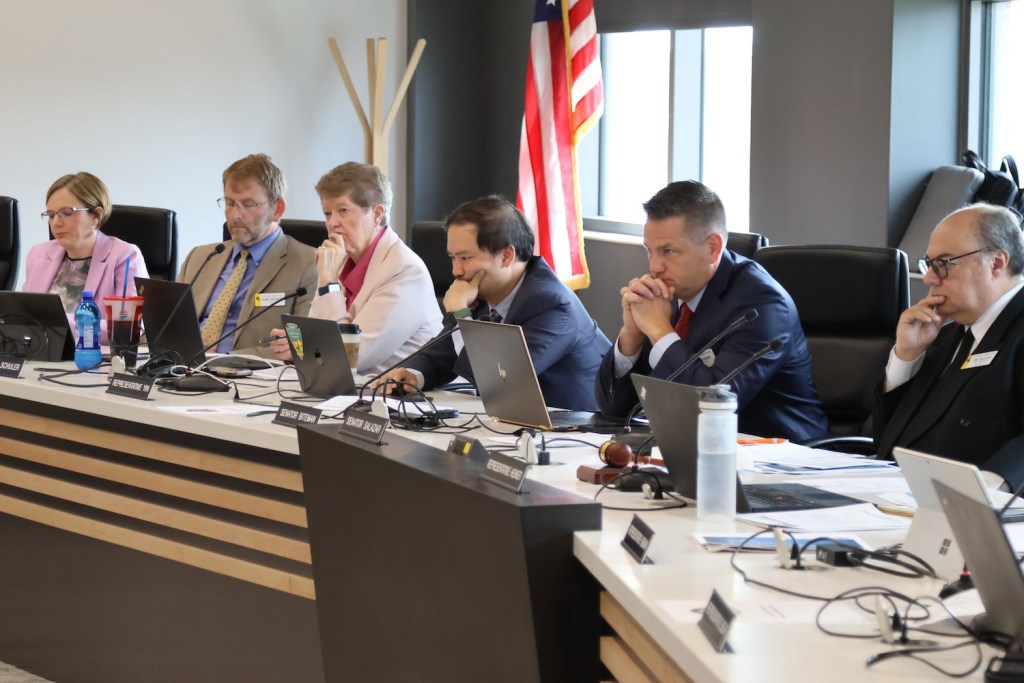
The consultants, who have been working through the assessment since early summer, presented their preliminary findings to the committee Thursday and Friday. Amid the minutiae and acronym-heavy language of education, several issues emerged as topics of high interest for educators and lawmakers. They include teacher retention, school resource officers, school nutrition programs, transportation needs and technology.
Many of those issues overlap with areas identified in the February court decision on school funding. The ruling, which the state is appealing, is the latest in a string of court cases that have further delineated the state’s education obligations.
In his 186-page order, Laramie County District Court Judge Peter Froelicher found the Legislature failed to properly fund the “basket of quality educational goods and services,” that the Wyoming Supreme Court in 1995 ordered lawmakers to set, update and fund every two years. The judge also found the state failed to properly adjust funding for inflation; failed to provide funding for adequate salaries for teachers and staff; and failed to provide sufficient funding for mental health counselors, school safety resource officers, nutritional programs and computers for students. Lawmakers have failed as well to properly assess school buildings for “educational suitability,” and have allowed inadequate facilities to exist for too long without repair or replacement, he ruled.
Consultants don’t yet have salary recommendations; they plan to dig into that topic during the next meeting in October, consultant Dr. Larry Picus said.
However, in terms of the court-required elementary school mental health counselors, Picus said, it appears Wyoming’s 2025 “evidence-based model” for funding already meets that. That model, he said, funds one core counselor per prototypical elementary school (288 students), plus counselors for struggling students. The additional cost is $13 million.
Discussions of other court-identified areas led lawmakers to seek more details, answers or information. That included the costs, models and benefits of school resource officers; caps on school reserve accounts; and how much general fund money districts are spending on nutrition programs.
“This is a terribly important issue,” Sen. Tim Salazar, R-Riverton, said about school nutrition. “It’s something that we need to get right, and do it right, and so I think there’s still a great deal of work that needs to be done on this particular issue.”

Technology in schools — such as providing computers to every student — also generated questions. Aside from salary levels, Picus said, this topic was the top thing identified as not adequately funded by the state’s model.
The annual cost of a computer per pupil, Picus estimated, is $215. But when you add in hardware, technical assistance and other related costs, it bumps up to nearly $500 a student.
Sen. Bo Biteman, R-Ranchester, pushed back on the assumption that giving every student a computer is essential.
“My question regarding computers is, ‘Where is the evidence?’” Biteman asked. “Where’s the evidence that shows that having each kid have a Chromebook, in this case, rather than a textbook, produces better outcomes for the students? I’m just not seeing the evidence.”
The data he’s found, he said, actually links heavy computer use with worse outcomes.
“So I really want to see the evidence before we go down this rabbit hole that the judge sent us on,” Biteman said, adding that to do so would be inefficient and expensive. “Just because it feels good to a judge doesn’t necessarily mean that that’s what’s best for our kids.”
Teacher pay
Though consultants were not prepared to present on teacher pay, Picus did suggest Wyoming pay its substitute teachers more — up to about $300 a day.
And teacher pay still came up. Many of the district superintendents and administrators at the meeting at least touched on how the high cost of living and low salaries have made attracting and keeping teachers more difficult.
“When we talk about, what does it cost for someone in Teton County to actually live in Teton County, we can’t pay enough right now,” said Kristen Mayo, Teton County School District 1’s executive director of resources. She recognized her county is an anomaly and said that while the district and local communities have launched separate initiatives to address the issue, it’s still a serious problem. Owning a home is virtually impossible, she said, and renting is becoming increasingly out of reach.
“Really, at the end of the day, I would say we need more money in our salaries, just so our teachers can live in Teton County, in the community that they work in,” she said.
Sheridan County School District 1 Superintendent Jeff Jones said salary increases will have a direct impact on the quality of educators in a state struggling to fill positions.
“If things improve with salaries here, we’re going to see a different salary pool,” he said. “Not just in numbers of people, but the quality of people is going to change as well.”
Consultants plan to hold more in-person listening sessions with educators around Wyoming before the next committee meeting, scheduled for Oct. 28-29 in Casper.

It would be helpful to jave starting and average salaries including several comparable professions, including nurses and teachers. Use the same basis for all such as hourly.
Maybe school superintendent should give teachers a housing stipend instead of paying the elite to keep there children home. Naw she won’t do that.
Money spent on education and the health of our children is the most important use of state funds. Bo Biteman’s opinions about computers for each child shows how out of touch he is with the systems of today. Textbooks cost $$$ too, and are out of date within years. Most textbooks are online anyway- doesn’t he know that?
A society that does not educate their children will only fall backwards rather than forwards.
Teachers need to be paid much more- as Sheridan is trying to do. Why would anyone want to teach when they can only make as much or less than those who did not get an advanced education? Teachers also need to be revered. They are molding the future of our society and their jobs have become increasingly difficult with not only more indisciplined students, but rules, laws, and meddlers questioning everything they teach from history to science to even music!!
And freedom caucus doesn’t like what is in the books.