

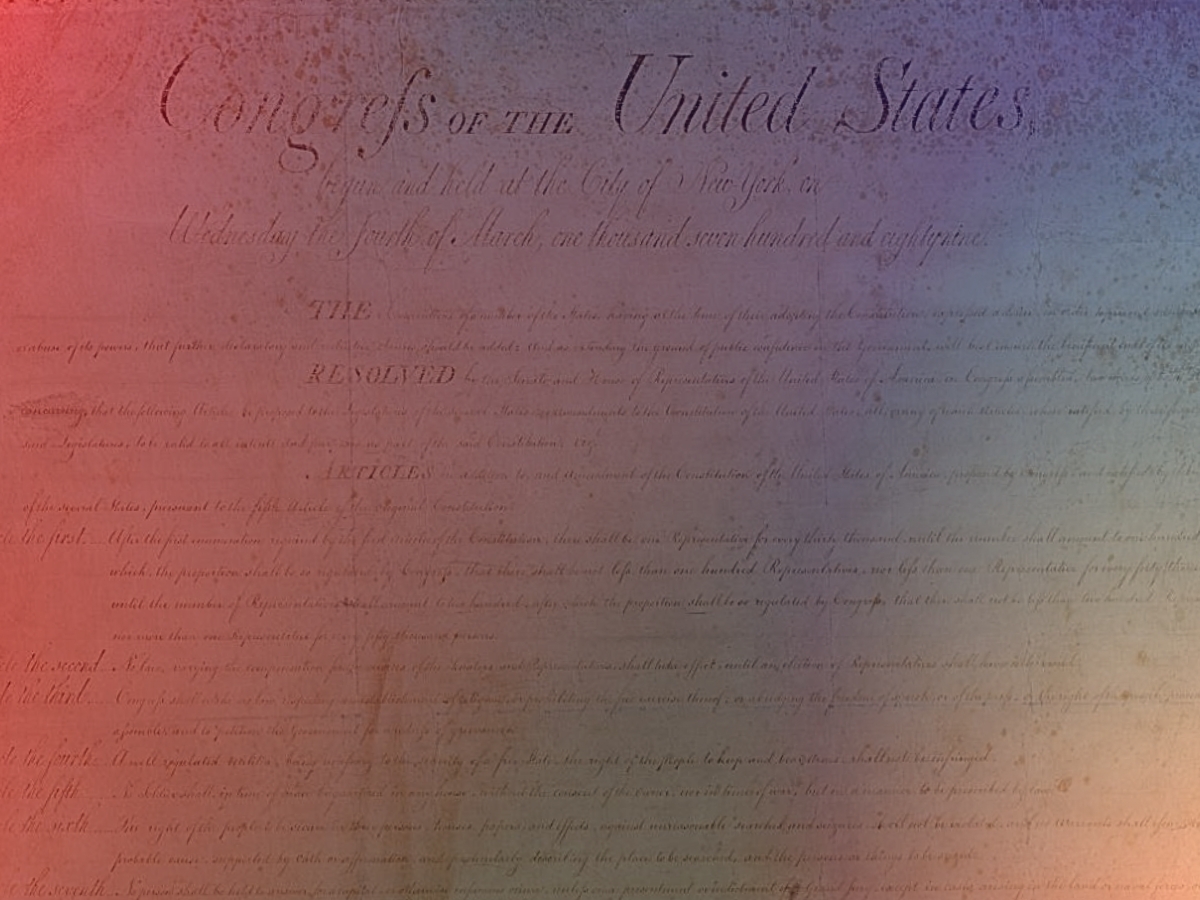
Our Bill of Rights, the first 10 amendments to our Constitution, is our most popular and familiar part of that cherished document. Asked to quote a passage from the Constitution, most folks would reply “right to bear arms” or “freedom of speech” or “due process.” Those rights and more are enshrined in the Bill of Rights.
Opinion
But, if presented to the nation in 2025, would the Bill of Rights have enough support to be ratified?
That’s the question I asked my circle of friends and frenemies in an informal telephone poll the other day. I sat on my sunny porch with Good Dog Henry, drinking PBR and taking the pulse of a passel of folks in both the public and private sectors vis-à-vis that question. I think my universe of friends pretty much covers the waterfront and most hues in the political spectrum, and none of them would try to blow smoke up my fundament. The answers I got didn’t surprise me.
The Bill of Rights was ratified in 1791 and represented James Madison’s compromise with the Anti-Federalists (mostly in the southern states) who demanded a statement of individual rights as a condition of ratifying the new Constitution. Madison’s compromise saved the whole shebang, and we live under its wisdom today.
The Bill of Rights was patterned after the Magna Carta, which King John of England was forced to sign, which limited the “Divine Right of Kings” to have unchecked power over the people. Even though our Constitution instituted a republican form of government, Thomas Jefferson and the Anti-Federalists didn’t fully trust our new government to protect individual rights against federal power.

So they demanded and got our Bill of Rights. God bless ‘em!
Good Dog Henry and I sat in the sunshine, scratching our noggins and wondering if that same level of statesmanship and citizenship could prevail today. That prompted my impromptu telephone poll to ask folks I respect to weigh in on the matter. What if the Bill of Rights didn’t exist? Would it pass into law today, given the current atmosphere in the United States?
Consider this: in 1791, the population of the United States was 3.9 million, while today our population is nearly a hundred times that. In 2025, there are around 350 million U.S. citizens living in an advanced techno-society and all connected by the internet. Things have changed since Madison’s time.
A constitutional amendment still requires a 2/3 vote in both houses of Congress, and if that succeeds, ratification by 3/4 of the states. In 1791, there were 13 states. Today, there are 50. The sheer numbers argue that the Bill of Rights would have a tougher time getting ratified today than it did back when our elected officials all wore wigs.
Add to that the demonstrable polarization in America today, and the equally demonstrable unwillingness to grant rights to folks we don’t like or agree with, and you have the atmosphere in which my poll was conducted.
Respondents to my porch poll pointed out that red states wouldn’t ratify the First Amendment (free speech and all that hippie stuff) and blue states wouldn’t ratify the Second Amendment (guns). The other eight amendments would be tussled over and pulled apart by the partisan and ideological divides that make it nearly impossible to get anything done in this country, let alone ratifying a Bill of Rights.
I’ll submit that, given recent pronouncements made by the Wyoming congressional delegation, the Bill of Rights as Madison wrote it, probably wouldn’t pass out of Congress to be presented to the people. One respondent to my poll pointed out that “Congress couldn’t even pass gas today.”
As I said, the answers I got didn’t surprise me. Only one person answered “yes.” There was one “maybe” and one “only by an act of God.” There were 30 or so firm “no way Joses.”
Before you make a snarky comment on this column, or discount my results, try it yourself. Call up a bunch of folks in your own circle, and ask them the same question. If your results differ from mine, then we have something to discuss. If not, then we are left with a bleak view of individual rights in today’s America.
But perhaps the more important question is, “Would you, as a citizen, support passage of the Bill of Rights today, knowing that it would grant the same rights to folks you may consider political enemies as you yourself enjoy?”
If not, why not?
I’m only beginning to understand this and why it matters. It tends to make an “opinion” every bit as important as a fact, one perhaps coming from a person who studied the subject all his life. I’m not sure if I believe in it right now. It takes the right leadership.
Freedom of speech, to keep and bear arms, to practice your own religion, to be safe and secure in your home, etc.—all these rights bespeak another, which is a right to find, expose and distribute the bare truth. When those in power repeatedly lie to the people, as history demonstrates, this perversion of truth also reshapes the arc of freedom. In today’s age of social media’s domination of information, beware those who would use the words freedom and truth in the same legislative context, attempting to convince the people of an under-the-table need for more power in governance, for they will undoubtedly destroy our Republic.
No way would I vote for the 10 Amendments as they were presented. On the southwest wall of the Jefferson Memorial is my favorite quote:
“Some men look at constitutions with sanctimonious reverence, and deem them like the Ark of the Covenant, too sacred to be touched. They ascribe to the men of the preceding age a wisdom more than human, and suppose what they did to be beyond amendment.
I am certainly not an advocate for frequent and untried changes in laws and constitutions. But I know also that laws and institutions must go hand in hand with the progress of the human mind.
As that becomes more developed, more enlightened, as new discoveries are made, new truths disclosed, and manners and opinions change, with the change of circumstances, institutions must advance also to keep pace with the times.
We might as well require a man to wear still the coat which fitted him when a boy as civilized society to remain ever under the regimen of their barbarous ancestors.”
So, maybe we should have required a provision in the constitution that says we must edit/change/add these 10 amendments every 10 years or so—I’m sure somebody more skilled than I has a solution! Given our current circumstances, I think we are still wearing the coat that fit us as children.
I’d be O.K. with the second amendment if they’d read the whole damn thing.
There was several years ago (twenty? thirty?) a more formal poll done of U.S. citizens (wish I could remember the source in which the results were published) in which the same question was asked, if in more detail. Each of the 10 rights was rewritten in contemporary Mercan English and presented, item by item, to folks. The gist was that overwhelmingly those polled didn’t support a majority of the Bill of Rights. No new news, sorry to say.
No. Why a person like Al Simpson with common sense couldn’t be elected in this state much less pass the Bill of Rights. The freedom caucus has already shown that you have the freedoms they believe in and don’t forget it.
I’d rewrite it to define the rights better and to better dictate when and how the government could limit them. The allowable “time, place, and manner” restrictions on free speech were not in the document; they were created entirely by SCOTUS, and applied only to the First Amendment and not any of the others. We didn’t have electronic communications in those days; nor assuredly deadly weapons that could fit in the palm of your hand and kill at a great distance; nor spy satellites and drones; nor cryptocurrencies; nor vast lobbying organizations; nor Federal agencies (independent or not), which now represent an entire “branch” of government not contemplated in the Constitution at all. Political parties didn’t run our government back then (though Washington, showing great prescience, was concerned that they might take control as they have). And just as it’s really obvious that we have to rethink things, we have absurd divisions, conspiracy theories, and insane ideologies created by partisan propaganda outlets, demagogues, and social media. The Constitution, for all its wisdom, is close to failure, and it is falling apart in a way that will make it tough if not impossible to fix.
Thanks for bringing up the Bill of Rights because we Americans should have more discussions about “the why” it was written as well as the order in which it was conveyed. To my mind the Bill of Rights articulates the philosophy of the Founders and their understanding they had with the people they were representing. The Founders were trying to protect the people against the overreach of a powerful ruler as well as one using religion to wield that power.
The 1st Amendment is a direct result of the wars of religion that preceded the US Constitution as the Founders knew if any religious sect was allowed to put their beliefs into law so that the State had to enforce those religious beliefs, then there would be religious wars again. To me it is clear that the religious have infiltrated our Federal government and especially the SCOTUS, which is why we are starting to see people use the 2nd Amendment to attempt to restore that balance. Unfortunately our religious SCOTUS has corrupted the #2A beyond all recognition as exemplified by Clarence Thomas’s ridiculous Breun decision.
If the Founders were alive today, the 3rd Amendment would have read “The government has no right to manage a citizen’s womb or put Federal Troops in or on my private property”. The 4th through the 8th Amendments would stand as these have been somewhat interpreted correctly with the advancement of society and its potential for a surveillance state.
I might put in another Amendment that would protect our laboratories of democracy by restricting the government’s ability to withhold funds if a State does not pass a law the Feds want to pass like the 0.08 level for drunk driving or the stupidity of banning naturally occurring plants at the Federal Level due to the interstate commerce clause. Geez I hate that I had to learn all this stuff just to argue for Freedoms that our Founders, for the most part, clearly wanted and desired.
I find it very interesting that Dick Cheney’s mentor at UW was very concerned that people did not really understand our Constitution, but alas his concerns were ignored. That gentleman should get a little more press in Wyoming.
Interesting, and I would agree %100.
Thank you for encouraging me to go read the Bill of Rights. That’s good for the soul. Much like the movie version of the Hamilton production caused me to review more than a few elements of US history from the eighteenth century. As for the question of whether I’d vote for those ten amendments, yes.
Roll the clock back five years Rod, and tell me anything was different then. The “other side” was championing the silencing of anything but the official government narrative. The Govt. was actively pressuring ALL media (social and conventional) to squash opposing views. Families were encouraged to disown their kin over the difference in opinion.
The Republicans arent just the enemy, Rod.
Our current Govt./political system is, and it is WHOLLY bi-partisan. The Bill of Rights is there to protect the People from the Government, and our government is doing everything it can to remove it. They simply take turns as you would see in any good ole fashion professional wrestling tag team match.
Complete nonsense.
No Gordon and Dewey, it’s exactly what happened and there is no denying it.
You two are as stuck in your fantasy as the MAGA crew is in theirs with trump.
America fully buys into a professional wrestling act.
Quick!! Make more accounts so you can agree with yourself some more.
It’s just me, Chuck. But focus on anything you can make up when you and Gordon cant win a debate.
BJ, thats the problem is America is divided into 2 camps. And both camps seem to think Authoritarianism is okey dokey.
Yes, professional wrestling. Trump falls under a pile of people and comes up with a bloody ear. Been done a thousand times for the crowd going back generations.
It’s not about winning a debate chad/jack/doug as you seem to think.
It’s about pointing out the lack of honesty and integrity with someone who goes to extreme lengths to appear like he’s won something. You leave your random thoughts all over the comments here criticizing those who don’t agree with you. A proven liar will not sway anyone except himself. Your thoughts and arguments aren’t unique. As you’ve been told before, you should look at the part you’ve played (lies and all) in destroying civil discourse instead of crying about others not agreeing with your asinine thoughts.
Speaking of professional wrestling, Secretary of Education Linda McMahon spend 29 years as the president/CEO of WWE Inc. she’s got vast experience in professional wrestling, but not so much in running the Dept of Education. You said “The Govt. was actively pressuring ALL media (social and conventional) to squash opposing views.” Sorta like what’s happening today?
We need to stop pointing fingers, and dredging up the past, it’s history, move on. We can’t change what is past, but we can improve on it moving forward.
” Roll the clock back five years and …”.
On what planet ? Absurdia ?
A thought-provoking article. Knowing that there are fellow Americans out there that care not for the rights and values that I once thought bound our nation together as a people is depressing. What is worse is that I do not know if this sad state of affairs can be fixed.
I’ll take your poll. No way, the conservative mindset is to take away anything and everything that doesn’t benefit them specially. And they’re enough of them to block just about everything.
Depends on the direction Project 2025 wishes to go.
The short is “no”. But to have any chance of being ratified, the First Amendment would have to be worded along these (satirical) lines: “Congress shall make no law respecting an establishment of religion, except to ensure that the preferred religion of the majority shall be prominently displayed in public schools, courthouses, and legislative prayers. Congress shall make no law prohibiting the free exercise thereof, provided such exercise does not contradict prevailing political sentiment. Freedom of speech shall not be abridged, except when inconvenient, offensive, or factually incorrect . . .” and so on.