

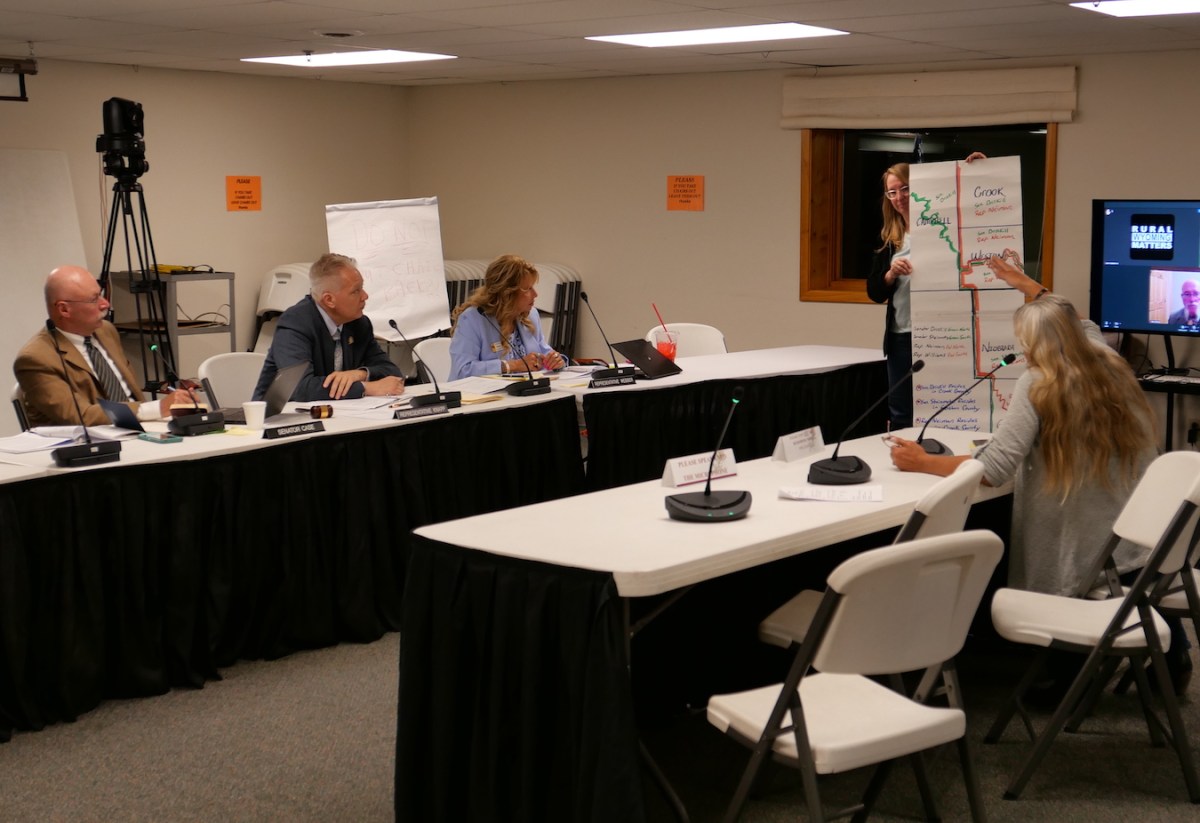
NEWCASTLE—Last year, Weston County attempted to send additional lawmakers to the Wyoming Legislature under the theory that one of the state’s least populated counties was underrepresented in the statehouse.
That effort didn’t succeed directly, but it did spur more discussions on the issue of rural representation, culminating Thursday in a group of Weston County voters making their pitch to lawmakers for redrawing the state’s legislative maps to adhere to county lines.
County residents offered a variety of solutions, from weighted votes to dramatically expanding the number of lawmakers. But their message was similar: the state’s most rural communities need a bigger voice.
“It makes all the difference in the world to have someone from your county that knows your school boards, knows your sanitation issues, knows your local hospital district issues,” local resident William Curley told the Wyoming Legislature’s Joint Reapportionment Committee.
Since Wyoming’s legislative districts were redrawn in 2022 following the last census, Curley, an attorney, has led the charge for Weston County, with a population of fewer than 7,000 residents, to have its own senator and representative. Right now, Weston County’s four legislators also represent varying portions of Campbell, Crook, Goshen and Niobrara counties.
“It’s got to be a hard job for a senator to represent more than one community of interest in Wyoming at the same time, equally on all things,” Curley told the committee.
Curley and other supporters point to the Wyoming Constitution, which states, “each county shall constitute a senatorial and representative district” and each “county shall have at least one senator and one representative.”
A legal challenge, however, upended that requirement in 1991 when a federal court ruled that Wyoming’s legislative maps violated the Equal Protection Clause of the U.S. Constitution — also known as “one person, one vote.”
Since then, the Legislature has shifted away from strict adherence to county boundaries and toward population. While the approach has held up — including against a 2012 legal challenge — supporters of county-aligned legislative districts contend it’s costing rural voters their say.
They presented several proposals to the committee Thursday to shift back to county maps, including weighted voting in the Legislature as well as both reducing and expanding the number of lawmakers.
While some proposals attempted to take the Equal Protection Clause into account, several residents actively pushed back on the legal rule that one person’s voting power ought to be roughly equivalent to another person’s within the same state.
“Why should somebody that lives in an apartment in Cheyenne be able to run just as much of this state as a rancher out here that’s got 5,000 acres that’s paying probably 10 times the property tax that that person in there is?” Danny Bau asked the committee. “Where’s his representation?”
How we got here
Weston County commissioners passed a resolution in April 2024 declaring two legislative vacancies in an attempt to redress their concerns regarding the absence of lawmakers representing their county alone.
At the time, supporters of that movement said they expected other rural counties to follow their lead, including those that also lack exclusive representation in the statehouse. That includes Big Horn, Carbon, Crook, Hot Springs, Johnson, Niobrara, Sublette and Washakie counties. None ultimately did so.
Following the resolution, the Weston County commissioners voted in October to select Curley and Karl Lacey to fill the seats they’d declared vacant, according to Newcastle’s News Letter Journal.
The Wyoming Republican Party backed the process, but without a corresponding legal challenge, it failed to go any further. Meantime, the Wyoming Legislature passed Senate File 174, “Constitutional apportionment of legislators.”
The new law created the subcommittee and requires lawmakers to study the topic of county-aligned legislative districts. It calls on the committee “to conduct meetings around Wyoming to take input on apportionment options from members of the public and other interested stakeholders.”
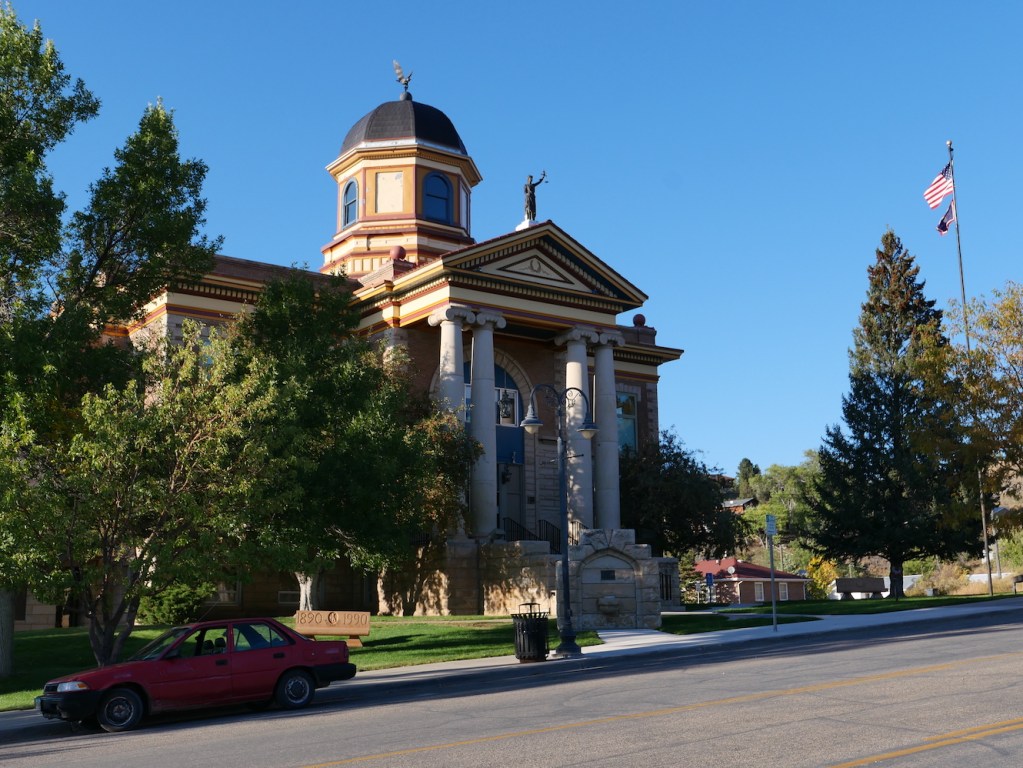
Newcastle meeting
Thursday marked the committee’s first meeting.
“I would like to thank you for providing this nice, calm venue to discuss this and not being right after a census and taking the time to do research and talk to us,” Tricia Baumann, another local resident, told the committee. “It’s really appreciated.”
Baumann presented lawmakers with what she called a “population-adjusted legislative apportionment” that would rely on lawmakers using a weighted voting system in Cheyenne.
Under the proposal, the state’s least populated county, Niobrara County, would have one representative in the House with a quarter vote on the floor.
“Our point is the Niobrara citizens now have a person from their county sitting in Cheyenne speaking for the commissioners, speaking for the courthouse of Niobrara, speaking for the citizens of Niobrara, but understandably can’t put a lot of weight into the floor vote because their population is so small,” Baumann said.
In all other aspects of the Legislature — including in committee meetings where bills must get approval to move forward — all lawmakers would have equal footing despite the size of the population they represent.
More populated counties would elect more than one lawmaker in at-large races, meaning voters in places like Laramie and Natrona County would elect several lawmakers to represent the same area.
That raised a concern for Torrington Republican Sen. Cheri Steinmetz. More specifically, Steinmetz worried what it would mean for voters living in the rural areas just outside the more populated areas. Such voters tend to vote more conservatively than voters in the nearby cities.
“If they’re all at-large in Natrona County, what is to prevent Casper, the urban center, from electing all of the senators or representatives? Is there something in the proposal to address that?”
The proposal does not address that possibility, said Curley, who drafted the plan with Baumann.
Curley pointed to another potential shortcoming of the proposal.
“If you follow county lines, maybe it’ll be an issue with tribes under federal law,” Curley said.
Subcommittee Chairman Sen. Cale Case, R-Lander, represents the Wind River Indian Reservation. The district in Fremont County includes Lander, Ethete, Fort Washakie and parts of Riverton.
“It captures all the places on the reservation and elsewhere where Native American people live,” Case said. “And so that was done very, very deliberately. Now, if all of a sudden that representation were based on the county line … there’s a potential for that Native American strength in their voting to be diluted.”
Case also pushed back more generally on the weighted-vote proposal.
“Let’s go back to that example of Niobrara County,” Case said. If the county ends up with a representative with a fraction of a vote, “Are they really better off that way?”
Local resident Sue Mareles presented a second proposal to lawmakers called “The Founders’ Plan” that used a “formula” to determine the number of representatives and senators per county.
“It is a nice hybrid plan that you don’t have a huge legislature and you also don’t have weighted voting,” Mareles said. “You have an individual — a whole person with a whole vote.”
Using Mareles’ formula, Niobrara County would have one representative, while the state’s most populous county, Laramie County, would have 11 representatives.
The formula’s findings differed quite greatly from the legal memo and math completed by the Legislative Service Office ahead of the meeting.
“If the smallest county—Niobrara with 2,467 residents at the 2020 census—was apportioned one senator, and each Senate district represented no more than 10 percent over 2,467 residents, the Wyoming Senate would need at least 213 members to meet the proportional requirements. The Wyoming House would then need at least 426 members,” the memo states. Currently, the Wyoming Senate has 31 lawmakers. The House has 62.
Mareles’ formula didn’t square for Case.
“How is that fair in any sense of the way and how would that conform with the United States Constitution about having equal representation?” he said.
Mareles pointed to a sentence on the last page of the proposal — “larger deviations require justification by legitimate state interests (e.g., preserving political subdivisions, avoiding gerrymandering).”
What now?
While the committee heard out voters, no lawmaker committed to any one proposal.
“I just want to thank all of you guys for how much hard work you’ve put into this and giving us so much to think about,” Steinmetz said. “And we may not come up with an exact solution tonight, but getting this discussion in depth is really good. And maybe it’s making you rethink some ideas, too.”
Steinmetz floated the idea of amending the Wyoming Constitution while Douglas Republican Sen. Brian Boner pointed to New Hampshire as a possible model for Wyoming to consider. Its chamber consists of 400 members.
Speaker of the House Chip Neiman, R-Hulett, who attended the meeting, asked lawmakers to take the issue seriously.
“Those are the real concerns that the people that I talk to every day are worried about, is the fact that our voice is diminishing quickly,” Neiman said.
“So we’ve got to be wise about how we do this and how we respect those lines,” Neiman said. “Does the state of Wyoming have the guts to say we’re going to challenge the federal government on this because it’s hurting us the way we’re doing this? The way you want us to do this, ladies and gentlemen, is harming our state’s ability to be able to even function.”
The committee will hold another meeting sometime before its Dec. 1 deadline to provide a report to the Legislature. It had not been scheduled by publishing time.

I hope the folks in Weston County don’t really expect a locally elected state representative will actually pay attention to the local education, sanitation and healthcare needs of the county citizens. If they vote in a Freedom Caucus member, he or she will do as they are told by the caucus leadership, regardless of what their constituents want or need. As usual, most of the discussion revolved around protecting turf, rather than actually making sure problems are solved in Cheyenne.
Personally, I feel that each county should have one senator to represent them. The representatives can be elected based on population. The Federal government does this. Each state is allocated two senators. The representative is elected based on population. Wyoming being the least populated state still has two senators just like New York, Texas, and California.
Wyoming should be able to do the same. I’m not sure how a county can be properly legislated from someone that is not from their county. It’s kind of like having a Cheyenne city council person living in Laramie. I do feel that the politicians that are representing more than one county have a very hard job in representing their large districts. I know that they are trying their best.
The Supreme Court says otherwise.
At one time in this country we apportioned representation based on the number of slaves owned. Now folks seem to think representation should be based on the number of cows owned. The more things change, the more they stay the same.
Chairman Case did an exemplary job of conducting a respectful hearing, and those commenting did so without recourse to inflammatory rhetoric. It’s reassuring to find an example of how the system is supposed to work.
As to the substance, the glaringly missing piece was a clear articulation of the problem the folks in Weston County seek to solve. Although they share the services of these legislators with all or portions of surrounding counties, Weston County is currently represented in the Wyoming Legislature by Chip Neiman, Cheri Steinmetz, Ogden Driskill, and JD Williams. In what way have these four failed to adequately advance the interests of Weston County? How would the interests of Weston County be better served by having their very own Senator and Representative, but with each carrying a mere fraction of a vote? or each being but one of several hundred in an expanded legislature? “Be careful what you wish for” may be appropriate here.
The hearing was well-run by Senator Case and remarkable for its civility. But as a plaintiff in the lawsuit that brought about legislative districting – meaning that each Wyoming lawmaker represents about the same number of people – I found the lack of support for this basic concept of fairness disappointing. The proposed county-based representation inevitably enhances the political power of less populated counties at the expense of more populated ones. Wyoming now has 30 years of experience with legislative districting and no one provided any examples of how rural areas of the state have been disadvantaged under that system. Wyoming’s Constitution provides that Wyomingites enjoy “equal political rights.” If two lawmakers cast equal votes in the legislature and one represents 2600 people and the other represents five times that many, that is not equal political rights.
While I completely understand the frustration of feeling like your voice isn’t being heard, conservatives seem to think that land votes and it doesn’t. Rural states like Wyoming are over represented in the electoral college, the House of Representatives and the Senate compared to states like California. For example, Wyoming only has one Representative and California has 52. Based on population, if California was represented at the same level as Wyoming, the would have 67. While I’m sure that’s fine with people from Wyoming, for those in California, their voice is greatly watered down.
We often see maps of the United States with all the “Red States” and how it’s “not fair” when Democrats win the Presidency, House or Congress. But again, land doesn’t vote, people do and those red states are less populated than most blue states. Just because you live in an apartment vs on a ranch, your voice doesn’t count less. There’s a good chance your concerns are different and you may feel why should someone on a ranch have more of a voice than they do when they have no idea what’s important to them?
While other lines could be drawn, the one person one vote must be maintained.
What they really want is over sized representation. The freedumb caucus at work.
So….because you own a bunch of worthless scrub brush land….your vote is worth more than mine? Right. Got it. For people who won’t stop whining about how little everyone else knows about basic civics, these people know startling little about a LOT. 🙄
Wyoming is supposed to be a staunchly Republican state which implies less government yet, Wyoming already has one of the lowest per capita legislative per citizen numbers in the country: https://ballotpedia.org/Population_represented_by_state_legislators
Seems like more representatives just means more government.
I know there are some who will shake their head at my comment, but what makes one rural voter more important or deserving of representation than the apartment liver in a large community? I suppose the rural voter is more likely to be of a conservative mindset. I was raised on a farm with a life shaped by parents and grandparents of the depression era plus friends and neighbors from a rural Presbyterian Church. Isn’t everyone in our towns and rural areas deserving of equal representation? Since coming to Wyoming in 1969, it has seemed that rural counties have continually fought to be made “more equal” than those from more urban areas. Can’t we be more compassionate to all our residents and care equally about them?