


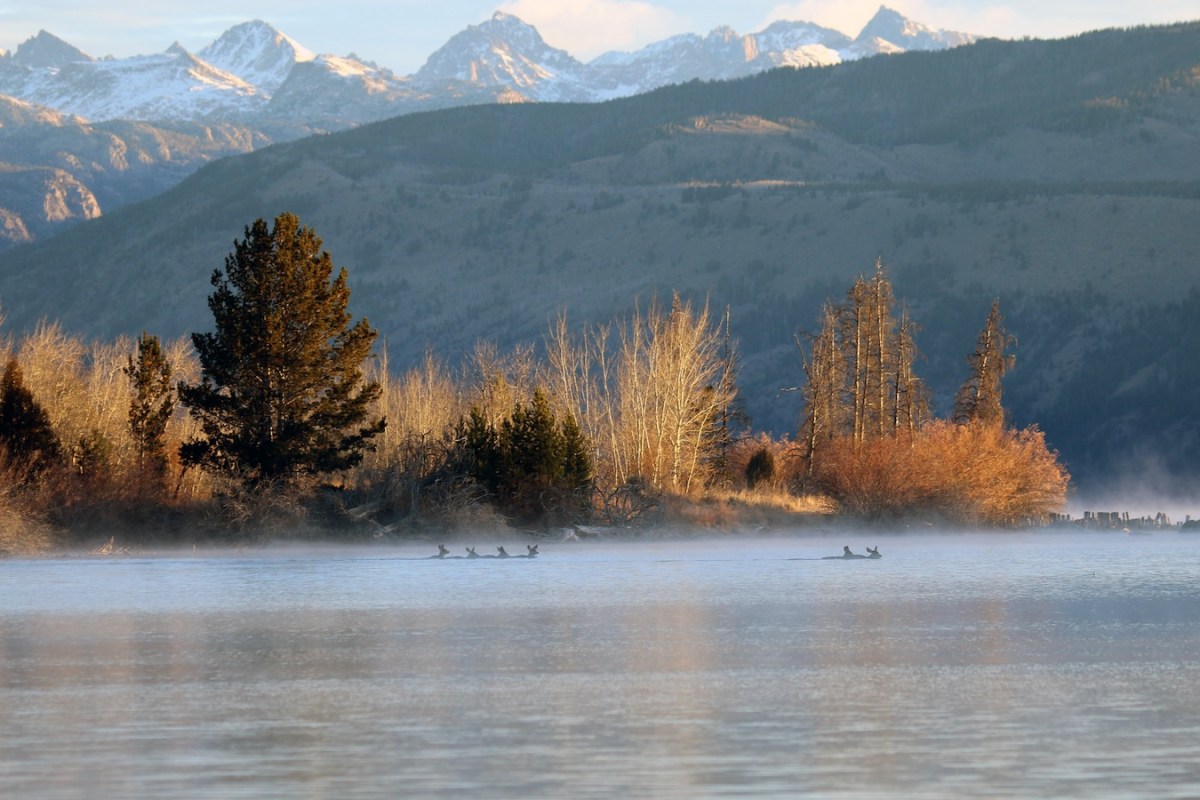
Old Gus and I were coming out of the Big Sandy country in November of that year. It had been the last elk hunt of the season, and we had closed up the home place for the winter. Just in time, too. The snowstorm the night before had made the road around the north side of Little Prospect Mountain impassable, and we had to take an alternate road to hit the pavement at Farson. My hope was that we might reach the store before it closed and get an ice cream cone. I was 11, and as always, my dad’s outdoor adventure accomplice.
Opinion
We were chained up and grinding steadily forward, off the mountain and out into the land of gray and white. The wind was blowing, and there were patches of bare ground, but every big sagebrush had a mini-drift on the leeward side. There were mare’s tails of airborne snow drifting off the rockpiles of the Prospects and Little Prospect. My images of that day are in black and white, sagebrush and granite and sky. And mule deer.
They were everywhere that day, on the flanks of those cold desert mountain ranges. Little bunches, big bunches — hundreds of them. The bucks were strutting, with their big, swollen necks extended and walking that stiff-legged gait they adopt as the rut draws closer. Gus normally paid little attention to mule deer. He was an elk hunter, and a very effective one. In his world, deer were just rats with antlers. But even he had to stop the truck on the divide between Lander Creek and Little Sandy and gawk at the spectacle that unfolded before us that cold gray afternoon.
We didn’t know it at the time — indeed, we wouldn’t know until 50 years later, when wildlife researcher Hall Sawyer opened our collective eyes — but we were witnessing the longest big game migration in the Lower 48. There were many more deer in the upper Green River country back in the mid-1960s, and the scope of this mass movement of mule deer was much greater. Thousands of deer were moving from summer ranges that extended all the way to eastern Idaho to a winter range in the desert east of Rock Springs. It was a wintertime Serengeti.
They’ve probably been doing it for as long as their ancestors have been in the country. They leave the mountains beginning in October, moving along the west face of the Wind River Range, just about where the aspens meet the sagebrush. The does have fawns in tow, and it’s by this journey and their incredible memories that these young deer learn where to stop and rest, where to move quickly and how to surmount the obstacles in their way. Centuries ago, those obstacles were minimal. There were rivers to swim and predators to avoid or escape, but there were no fences or highways or 5-acre ranchettes.
That’s not the case now. These deer have a gauntlet of obstacles to face as they move south in the late fall, then back north in the spring. There are dozens of fences, including elk fences 8 feet tall. There are dozens of roads, some lightly travelled county roads and some high-volume paved highways. There are lakes and rivers, subdivisions and a host of other barriers. But the deer still find a way, with a little help from their friends. We’ve modified fences and created conservation easements. We’re building highway crossings and working with state, federal and private partners to keep this migration route intact. That’s the good news.
The bad news is President Donald Trump’s “national energy emergency” and the associated rush by the Department of Interior to lease parcels smack dab in the middle of this migration route for oil and gas development. For those of us who have been in the trenches of wildlife conservation in Wyoming, this is not our first rodeo. It’s not even our second or third. It’s just the latest one — the latest in a series of bad land management decisions driven by corporate interests and their friends in positions of political influence, the beneficiaries of their generous campaign contributions. When it comes to sacrificing mule deer to create corporate profit, we’re old hands here in Wyoming.
We sacrificed the deer on the New Fork Mesa — the Pinedale Anticline, to use its fossil fuel era moniker. They told us they could mitigate the damages. We sacrificed the country west of Baggs and south of Wamsutter. They told us the same thing, and it wasn’t true there either. We sacrificed the deer in the Powder River Basin to coal-bed methane and the mule deer of Star Valley to rural subdivisions.
And the story was always the same: “We can mitigate it. They can move around it. We can impose stipulations to protect them and improve habitat off-site. Development doesn’t need to be bad for deer.” I have to say I was impressed recently with Steve Degenfelder from Kirkwood Oil and Gas. At least he was straight up honest when he said, “There’s no place that I’m going to say is a place that shouldn’t be leased.” I can grudgingly admire his chutzpah, if not his grasp of historical precedent.
Let me be very clear: I am definitely willing to say that there are places that shouldn’t be leased. There are places too special to convert from a deer migration route to a gas field. There are people like my family, four generations of Gassons, who believe that it’s more important to maintain this migration route than it is to add one more area to Wyoming’s long list of broken promises. No, Steve, there are indeed places that shouldn’t be leased, and this is damn sure one of them.
Somewhere, on the other side of the Great Divide, Old Gus is looking at this and silently shaking his head in wonder.

Great to see so many comments from old friends and colleagues. Nicely said Walt! It is clear that in Wyoming it takes a ground swell from those of us who love and use Wyoming landscapes to see that they are protected. Like the guy who started to tear down his house to keep it warm, short-term decisions to develop have long lasting effects.
I understand your passion for the environment and the plight of wildlife in the current age. Vilifying people who see life in a different way is not helpful. Assassinating their character by insinuating that their only motivation is profit and resource exploitation doesn’t open the door for open conversation. Solutions require compromise.
I would really like to see a study with maps and supporting data on this topic. That way, science takes over supported by facts that can be used to arrive at a solution. I am tired of hate.
It started with 1800s westward expansionism and fueled by the railroads’ desires to be free from animal or human disruption caused the almost entire removal of American Bison from the continent. Wolves were next as they caused financial catastrophe to sheep and cattle ranchers. Yellowstone (the park) only exists due to the foresight of Teddy Roosevelt
Hopefully, if everyone sends in comments on the BLM RMP supporting conservation in the Big Sandy Foothills/Red Desert, we will still be able share stories like Walt’s with our children and grandchildren. (“You don’t know what you got till it’s gone…” Joni Mitchell)
Walt, this is excellent perspective and perfect advice to Steve Pearce. The longest migration corridor and largest sage grouse lek should never be leased or developed. It is Wyoming’s wildlife legacy to the world. Thanks Walt and WyoFile!
Having seen first hand what Steve Pearce did in his district in New Mexico when he was a U.S. Representative I don’t think he will give a rat’s ass what anyone other than Trump thinks. The fact that he felt the 2020 election was stolen should tell you something.
Walt, wonderful story that all of us in Wyoming need to heed. Wyoming is losing its wildlife one cut at a time. And now former congressman Stevan Pearce has been nominated to head the BLM. Pearce has a long history of promoting the privatization and selling off of public lands. Pearce’s nomination puts our public lands at major risk. Please write our senators and ask them not to approve his nomination. He is a terrible choice to lead the BLM.
Thank you, Walt.
I’m not a hunter, but I’m a stalwart advocate of protecting our wild spaces.
Not everything should be for sale.
Thanks, Paul. Keep up the good work.
Nicely said, Walt, and best regards.
Many thanks, my friend. Right back at ya!
https://www.wyomingnews.com/opinion/guest_column/stroud-lets-not-destroy-our-wildlife-heritage-with-irresponsible-development/article_b60f2d0a-df14-4c2a-afaf-94c484369973.html
I’m with you Walt!
Nice essay, Walt.
Thank you, sir.
Well said, Walt. He’s not just telling a story, he’s speaking the truth about protecting THE amazing mule deer migration corridor. I’ve worked and recreated in these areas since the late 70s and agree that some of this country shouldn’t be leased. And what about the 300+ male sage grouse lek just a short distance from the migration corridor? I guess because bad winters and drought have caused mule deer and sage grouse numbers to dwindle, no need to protect what’s left? God help us.
Thanks, buddy. You’re the best friend that country ever had.
Excellent Walt! Your well recited recollections should not fall on deaf ears any longer, albeit too late for what has already been taken away. But, as you know, and I maintain, unless we can put a defensible high dollar value on the natural resource, we have limited negotiation power. The almighty dollar and greed predominate….and, of course, some political shenanigans.
Thanks, Bob. God bless.
Very well said Walt.
I come from the same 1970s generation of big game hunters, as do you. Back “in the day,” I heard stories from the “old timers” about the big bucks and bulls thriving on our public lands. It had been an era when those old “Average Joes” could knock on a rancher’s door and have a very good chance of getting permission to hunt their property. “Just leave the gates how you found them, and don’t tear up muddy roads.” When our time came, landowner permission was harder to come by, but there was plenty of game, and my generation of “Average Joes” enjoyed good hunts. Now, looking back, we too enjoyed the “Good Old Days,” we just didn’t know it at the time.
So, yes Walt, lots has changed. We’ll never fully return to those Days. But there are things that today’s Average Joes can do. Let your elected representatives know that big game hunting is still important to their constituents. The developers do not always keep their promises. The developers are not always our friends. Perhaps unchecked development is not in the best interests of us Average Joes.
Our representatives have the power to strike a fair and balance between development and our best shot at restoring, at least in part, the Good Old Days.
Thanks, Ray.
Great article Walt. Doug Crowe would agree and be proud.
Many thanks, my friend.
Wonderfully stated and spot on, Walt! Thanks for sharing your story and expertise.
Thanks, Andrea. You’re the best, buddy.