


Say someone is breaking into your home. You have a gun. Can you kill them to protect yourself?
Before 2008, in Wyoming, you had to try retreating before using lethal force. Things changed that year when then-Gov. Dave Freudenthal signed the state’s “castle doctrine” into law, granting an exception to a person’s legal “duty to retreat” before using lethal force in self-defense if that person is in their home or on their property.
In 2018, lawmakers extended self-defense rights even further, passing a “stand your ground” bill that expanded this “duty to retreat” exception to any place where a person is lawfully present. This measure also included a provision that requires courts to “award reasonable attorney fees, court costs, compensation for any loss of income and all other expenses” incurred by someone defending a civil lawsuit resulting from their use of “reasonable defensive force.” (A civil lawsuit involves a dispute between private individuals or organizations.) That bill became law without then-Gov. Matt Mead’s signature.
This year, lawmakers sponsored a bill that would go a step further and pave the way for compensation in criminal cases — legal action initiated by the government.
House Bill 14, “Protecting self-defense-reimbursement and amendments,” would require counties to reimburse “all reasonable costs, including loss of time, bail costs, attorney fees and other costs and expenses” incurred by a person who fends off a criminal charge because a jury or judge determines they lawfully used self-defense. The bill would also allow such individuals to file a petition to have the charge expunged from their records.
Wyoming’s self-defense ethos is entwined with its embrace of the Second Amendment. Gun rights advocacy groups like the National Rifle Association and Wyoming Gun Owners have in the past supported legislation to expand lawful self-defense. House Bill 14 is no different — Gun Owners of America helped draft the bill, Mark Jones, the organization’s national director, told WyoFile. “It’s kind of a natural progression in states with stand your ground laws to protect people.”
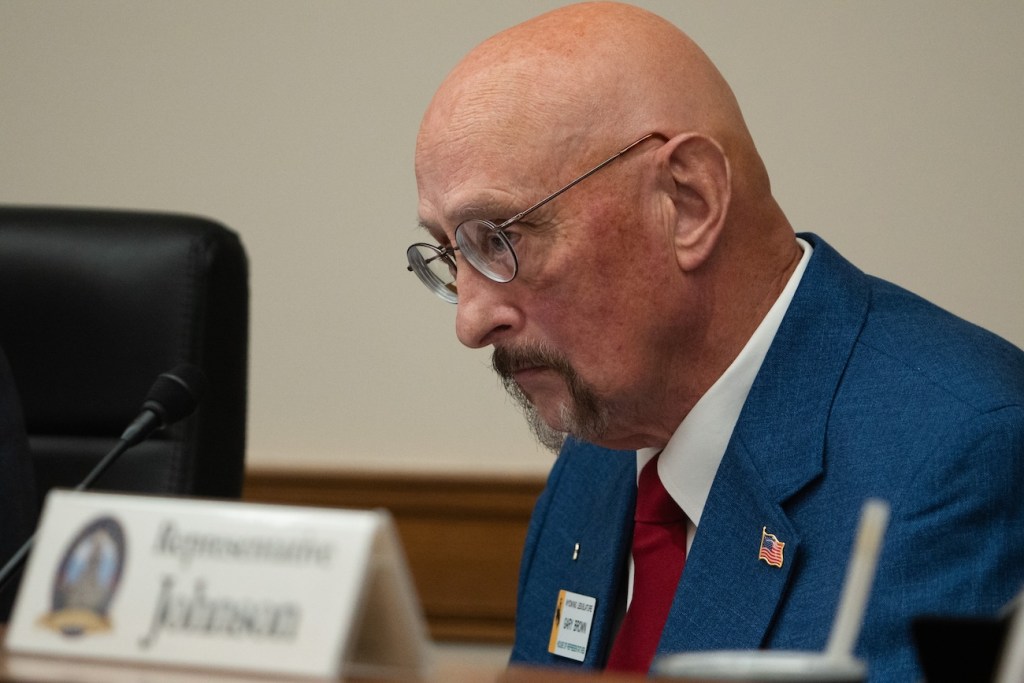
Jones said he has “talked extensively behind the scenes” with the bill’s main sponsor, Cheyenne Republican Rep. Gary Brown, a freshman lawmaker, to craft the measure. (Brown didn’t respond to calls and an email from WyoFile.) Brown brought a conceptually similar bill to last year’s legislative session. It wasn’t introduced, so lawmakers didn’t have a chance to debate the measure or gauge appetite for the legislation through an introductory vote. But the bill garnered 30 cosponsors the first year — nearly a third of the entire Legislature. It has 26 this year.
Jones said he has talked to lawmakers since last session to explain what the bill does. He thinks the measure has “a pretty good shot” at being introduced this year, despite a higher two-thirds vote requirement for introducing most legislation during budget sessions.
WyoFile contacted several cosponsors of the bill, some of whom responded but declined to comment because they didn’t know enough about the measure. One cosponsor, Casper Republican Rep. Tony Locke, told WyoFile that the bill seemed like a “common-sense preemptive action” to prevent charges being brought by “people who think you don’t have the right to defend yourself.”
“The system should bear the weight of the cost if it thinks it has a case,” he said. He noted, however, that wrongful charges in self-defense cases aren’t, to his knowledge, a widespread issue in the state right now. “Have I seen this specifically in Wyoming? I have not,” Locke said.
People do sometimes get charged and then acquitted on self-defense grounds in Wyoming. “It happens,” Ryan Semerad, a Casper attorney, told WyoFile. “I wouldn’t say there’s a pandemic of wrongful charges.” One of the state’s well-known self-defense cases — State v. John — ended in the Wyoming Supreme Court affirming that Jason Tsosie John, a Casper man who had been charged with first-degree murder, had lawfully used self-defense under Wyoming’s recently enacted “stand your ground” law. In 2018, the state charged John with shooting and killing a man, Wesley Willow, from the front of his trailer.
A series of text messages between John and his ex-girlfriend, Melissa Hayden, who was dating Willow at the time, precipitated the confrontation, the Wyoming Supreme Court’s decision states. John texted Hayden, “expressing disgust about her relationship with Mr. Willow.” Hayden told John to stop texting her. John did not.
The vitriolic exchange of text messages escalated into a phone call between John and Willow, after which Willow, Hayden and another man drove to where John lived. The group approached John’s home and saw him in front of his trailer holding an AR-15-style rifle with a mounted flashlight. John warned the group to get back, but Willow “sprinted” into John’s home, and John shot him. (Willow was unarmed, according to the court documents. Hayden had an empty vodka bottle, and the other man had a closed knife.)
The state subsequently charged John with first-degree murder. But a Natrona County District Court judge dismissed John’s murder charge after deciding that his shooting of Willow was legal under Wyoming’s self-defense laws. The state then appealed the decision to the Wyoming Supreme Court, which agreed to review the case and address questions about the statute’s meaning and application. The high court subsequently reaffirmed the lower court’s decision.
Sometimes, self-defense is so apparent that it doesn’t have to go to court. But history shows prosecutors may bring charges for more ambiguous cases.
In a situation where someone is killed by another person, law enforcement officers first investigate the death — they take pictures, interview witnesses and may even detain people for questioning. While they’re doing the investigation, they pass along information to the local prosecuting attorney, who is responsible for deciding whether there’s enough evidence to bring a charge.
At this point, the prosecuting attorney may decide that a person was reasonably using self-defense under Wyoming’s laws, so they don’t press charges. But if there are doubts, prosecutors can decide to scrutinize the matter in court.
“This will mostly have an effect on cases that are gray,” Semerad, the Casper attorney, said.
It’s a tricky balance to navigate. Even if a person is acquitted of a crime for self-defense reasons, news coverage of their court case and social media attention can continue to haunt them. “To indict is to destroy,” Semerad said. “There’s no way to go back to the world before you were charged as a murderer.”
What’s more, legal fees and other costs related to court battles in self-defense cases can easily rise to hundreds of thousands of dollars. “A lot of the time, this bankrupts individuals,” Jones said.
Yet, HB 14 could also “impose high costs on local government even when a case is brought in good faith belief self-defense does not apply,” Michael Blonigen, the former district attorney for Natrona County, told WyoFile in an email. (Blonigen left his post a few months before the state charged John with murder.)
“It would mean victims would not be heard unless a case is a slam dunk. Police and prosecutors would be afraid to file viable cases because of costs to the local governing body,” Blonigen wrote.
(WyoFile emailed or called six other current and former county prosecuting attorneys regarding the bill. Most didn’t respond. Others declined to comment on the proposed legislation.)
For more legislative coverage, click here.

On the other end of the spectrum, if someone is found guilty to something and then DNA or other evidence clears them, are they eligible to be compensated for their time in jail or the years of life missed as they were in jail?
“WyoFile contacted several cosponsors of the bill, some of whom responded but declined to comment because they didn’t know enough about the measure.” Do any of these co-sponsors know how idiotic that statement is? Oh, sure we’ll co-sponsor it, oh, BTW, what was it about again! I guess if it pertains to guns, well, we’re on it.
Nope, this potential law needs to go sit down. There is no need to start compensating people for an alleged murder that was later adjudicated as not guilty by reason of “self defense”. Let the lawyers duke it out in a civil trial.
Let the NRA pay from the $$ they receive from the gun manufactures.
James, in case you didn’t know, the NRA is essentially dead. Pick a different boogeyman to use for dehumanizing firearms owners.
Gun Owners of America has become the replacement for the NRA, they actually defend the 2A vigorously, instead of running a grift operation that the NRA ran for years.
Seriously? This bill is an unnecessary waste of time. It attempts to take all the responsibility out of gun ownership. We have too many irresponsible gun owners causing unnecessary injuries and death locally as it is. Remember the drunks at Alcova last summer pulling guns on each other? If one of them had been shot dead, I suppose the other would have been “standing his ground.” Remember the National Guardsman who shot his friend in the head because they were playing quick draw with loaded guns? Several minors who brought guns to fist fights? The boy who shot his former girlfriend? This bill encourages shooting first and asking questions later. It belongs in the trash heap.
Who gets to interpret or misinterpret another person’s intentions? “Dead men tell no tales.”
And “justified” rhymes with homicide… rhymes with alibied.
First issue is why is the county be asked to pay the bill? The Legislature continues to reduce available county funds with property tax exemptions and then adds to the list of things the county is expected to pay for. Since the State passed the law, require that the state provide legal representation out of the State Public Defenders office without any income qualifiers. They created the need, let them pay the bill. Second, once again the Freedumb caucus is presenting a solution to a problem that isn’t there (they’re really good at that). Most of the sponsor couldn’t even answer questions about the bill and those that could admitted that there really haven’t been any cases where this was an issue. They need to quit jacking the car up before the tire goes flat.
How the hell are you a cosponsor to a bill but you don’t know enough about the measure? I would really like to know the names of those cosponsors that sign their name to something without knowing what it does.
Sounds reasonable to me.
Many other states are zealous in their prosecution of those that dare defend themselves against a threat.