

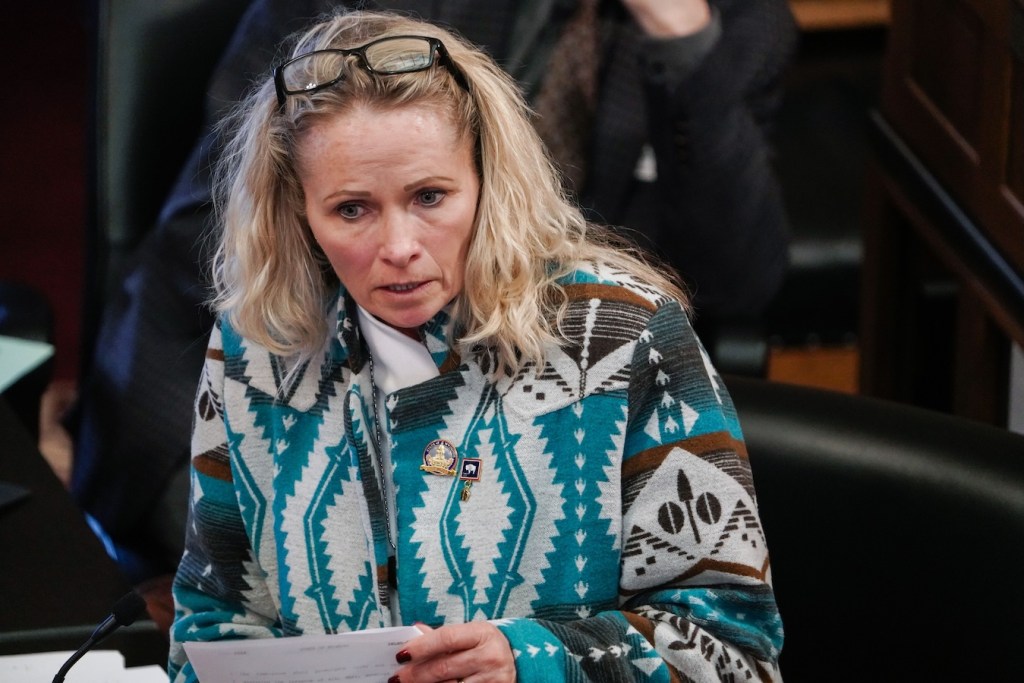
CHEYENNE—Sen. Laura Pearson suspects a barrage of correspondence from upset hunters effectively killed the two landowner hunting license proposals she’d been championing.
“I had a few constituents send me screenshots,” Pearson, a Kemmerer Republican, told WyoFile. “I think it was social media posts.”
The messages, she explained, came out a few days ago. They encouraged hunters to contact Pearson and other senators in opposition to one proposal in particular.
That now-dead bill, Senate File 51, would have opened the door for property owners to sell special elk, deer and pronghorn licenses on an open market. Pearson attempted a similar bill last year, then withdrew it, but came back this year with the support of the Wyoming Legislature’s Joint Agriculture, State and Public Lands and Water Resources Interim Committee. Still, on Monday afternoon, the first day of the 2026 budget session, state senators shot down the bill 6-25 — far short of the two-thirds support required for it to advance.
A related Agriculture Committee-sponsored landowner hunting license bill that Pearson championed, Senate File 15, is also now dead. Voted down 9-22, the proposal would have set a floor for the percentage of hunting licenses that landowners were entitled to in limited quota areas to not less than 40%.
Hunting and fishing advocacy groups have opposed Pearson-pushed reforms to Wyoming’s landowner license statutes out of concern that the measures would be a detriment to public hunters. When the Game and Fish Department administers a lottery for licenses where there are a finite number available, landowner licenses are allocated first — before the rest of the public gets a shot. The pool of licenses left is therefore diminished, and in some Wyoming hunt areas the share that goes to landowners is significant.
Pearson has argued that her efforts are aimed at helping agricultural and livestock producers make ends meet. Selling landowner licenses is allowed to various degrees in other western states, and when the tags are auctioned off they can net significant sums.
“I’m looking out for the landowner,” she said. “Ag land is feeding these animals year-round.”
State wildlife officials anticipate that making landowner licenses “transferable” would increase interest in the program, which dates to 1949 in Wyoming. Currently, only a portion of eligible landowners apply for them.
Acquiring a landowner license depends on a number of factors. Recipients must possess at least 160 acres, and they must provide habitat for the species the license is granted for. Up to two licenses per species per property can be procured for elk, deer, pronghorn and wild turkeys. The licenses are good throughout the hunt area.
Last summer, the Wyoming Game and Fish Department sought to tighten its landowner license requirements, but reeled back the proposal after it sparked vociferous opposition.
Game and Fish lacks the authority to put a cap on the percentage of licenses that go to landowners in hunt areas. A separate bill that’s still alive this legislative session would change that: Senate File 25 would allow the agency’s commission to make rules imposing a cap in limited-quota hunt areas. Shortly before the two Pearson-backed bills out of the Agriculture Committee died, Senate File 25 passed its introductory vote 30-1, with only Pearson opposed.

The measure was routed through the Legislature’s Travel, Recreation, Wildlife and Cultural Resources Committee, which typically deals with Game and Fish-related statutes. Sen. Bill Landen, a Casper Republican and committee co-chair, attributed part of its success to “protocol.”
“That was an interim topic that was provided to Travel and Wildlife,” Landen said.
The Legislature’s Management Council typically assigns topics to be studied between sessions to the body’s various committees. The Agriculture Committee began reviewing landowner licenses — even though it wasn’t assigned — under the chairmanship of Sen. Tim French, who had strong feelings about the issue. French relinquished that seat after he was assigned to the Appropriations Committee.
Jess Johnson, government affairs director for the Wyoming Wildlife Federation, was pleased by Monday’s results in the Senate. The two measures that died were “divisive,” needlessly creating a wedge between public hunters and landowners, she said. But Johnson was much more upbeat about the surviving bill, SF 25, which gives the Game and Fish Commission the flexibility to make changes, but doesn’t demand them.
“It offers the commission the authority to place a cap on landowner tags in areas that may have 100% landowner tags — where there is no opportunity for a sportsman to draw,” Johnson said.
Landen anticipates that SF 25 will be considered by the Travel, Recreation, Wildlife and Cultural Resources Committee on Thursday, though it’s not yet slated in the legislative committee.
Pearson, meanwhile, is weighing next steps and will consider bringing another transferable landowner license bill in the 2027 general session.
“I don’t think this is a topic that can be swept under the rug,” Pearson said. “Hunters are mad, the landowners are mad. This issue in Wyoming, we have to find a solution for it.”
Reforming the landowner license system is a political hill she’s willing to die on.
“I’m not somebody that’s going to vote a certain way because I think a population is going to say, ‘She needs [to be] replaced,’” Pearson said. “That is the last thing on my mind.”
For more legislative coverage, click here.

Our Legislators need to remember that it is the public’s wildlife and Wyoming is statutorily responsible for the management, protection, and regulation of all wildlife in the state. There is no, I repeat, no landowner that needs to sell their permit in order to survive. When I learned that some landowners were “selling” small percentages of stock ownership in their ranch LLC, or Corporation solely for the purpose of supplying (think selling here) a landowner tag, it made me sick. Public wildlife is not for sale, period.
Well, replace her then.
Good. I’m glad that some of our legislators are remembering that this is a budget session year.
Land owners can charge a trespass fee and there are federal programs that pay for wildlife conservation . Land owners need compensation for what they provide . The alternative is nothing more then a junkyard with a realtor sign. I can understand why they want to have permits to sell but that puts us down the road of only the rich can hunt like the commissioner and governor tags which is another BS story.
I also struggle with the fact that only a wealthy person can afford a governor or commissioner’s tag. But the sale of these tags generate a lot of money for wildlife conservation, which means we all benefit from the sale of those tags, even though most of us, including myself, could never afford to buy one. That’s very different from reselling landowner tags, where the money just goes into someone’s pocket.
In Wyoming, landowner tags are valid for the entire unit, including public land. Wyoming landowner tags are not limited to just the property for which they are issued. Should a private individual sell tags for hunting publicly-owned wildlife on public land? That’s a hard “NO”!
There is a big difference between selling governor / commissioner tags and selling landowner tags.
Governor/commissioner tags are intended to be auctioned off, and everybody benefits from these sales since the proceeds are used to directly benefit wildlife.
But if landowner tags are sold, that money is going into a private individual’s pocket. No benefit to the public or our wildlife resources.
It’s not the same. Tim French and Laura Pearson just can’t seem to understand that.
Good point, Gloria. There is another difference as well: governor and commission tags are few in number, and are extra tags that don’t diminish the pool of available tags to the public. Landowner tags, on the other hand, are numerous and take away from the public’s ability to draw a tag. Senator French’s argument that it’s a double standard simply doesn’t hold water.
she needs to be replaced!
Who are the 6 who voted for it? It was Pearson, French…and who else?
Peason, French, Boner, Hutchings, Ide and Laursen.
Good.