

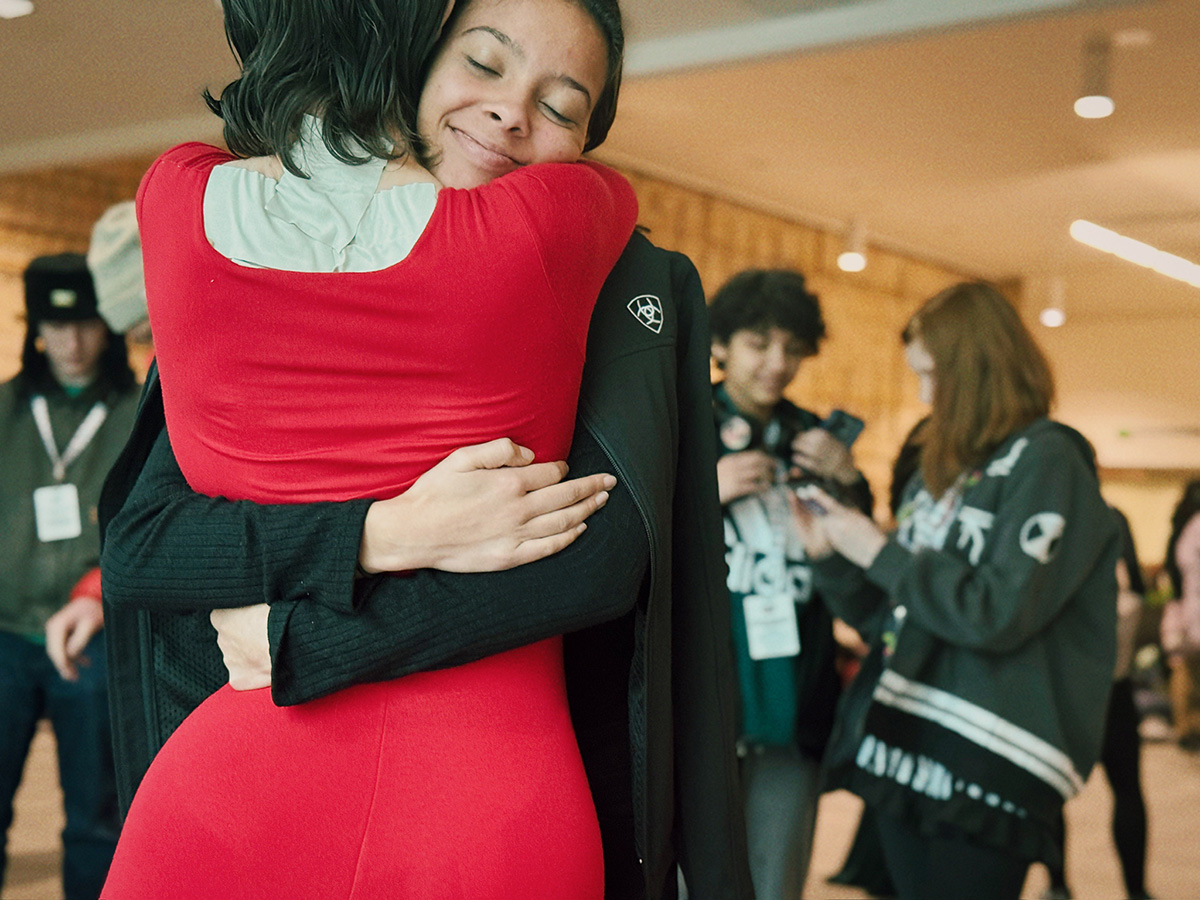
High school students laid bags of chips, folded notes of affirmations and cash beneath Oakley Boycott’s seat during a performance of the endurance piece, “SILENCE,” in the University of Wyoming’s Buchanan Center for the Performing Arts lobby.
Opinion
Inspired by the work of Serbian performance artist Marina Abramović, the Lander artist invites viewers to sit in an empty chair across from them in the piece. Sometimes they sit in a crowded theatre lobby, other times in an empty gallery. They sit in complete silence, still and presumably unmovable, unless you stay long enough to notice the intensity between the chairs.
I later asked the students why they left things under the seat for Boycott. They said, simply, “We wanted to take care of them.”
Their call to care is a stark contrast to today’s dizzying discourse. As lawmakers propose cuts targeting everything from Wyoming Public Media to the Wyoming Department of Health, these students saw opportunity in strengthened — not reduced — resources. While adults hurl insults across the political aisle, these young people chose connection over division at the feet of a stranger.
They dug into their backpacks to feed a stranger and watched closely as if Boycott belonged to them. Some may be quick to define this as youthful naivety. I believe this snapshot of compassion was an innate call to reciprocity — an instinct many Americans have long forgotten from their own juvenility.
In her book, “The Serviceberry,”, indigenous plant ecologist and author Robin Wall Kimmerer writes on the roots of a practice: “In a serviceberry economy, I accept the gift from the tree and then spread that gift around, with a dish of berries to my neighbor, who makes a pie to share with his friend, who feels so wealthy in food and friendship that he volunteers at the food pantry.”
The gift economy refers to a system in which goods are exchanged without contract or expectation of reward. The students thought Boycott would surely be hungry after hours in the chair, so they left a snack. No invoice was sent, nor was an arrangement made to ensure their favors were promptly returned.
Kimmerer’s book continues: “If I were to buy a basket of berries in a market economy, the relationship ends with the exchange of money. Once I hand over my credit card, I have no further exchange with the clerk or the store. We’re done.”
I’ve watched participants use Boycott’s performance to share personal stories exploding with emotion, while others sit in silent reflection. Without question, these young people make the most of this time in and around the chair. Perhaps another innate call, not yet forgotten with age, toward relationships over transactions.
The beauty of youth, and perhaps the root of agitation for some, is that young people’s cultural norms have not been permeated by the systems that adults live by. They exist, as we once did, in an economy much like the birds and the berries of Kimmerer’s book. They exchange time and attention, care, and creativity in place of our transactional systems of profits and losses. They remember instinctually that building worthwhile connections does not start with a balance sheet or invoice, but with mutual care.
I watched as the students in Laramie got silly in an attempt to make Boycott crack a smile; they laughed and cried freely. They whispered theories and hung letters detailing their hypotheses about their new, silent friend on the walls around them. They stayed for the performance’s end, and they hugged Boycott tight as if they’d built something together — a community. I believe they did just that.
This scene captures the immense value of trusting, safe connections that enable conversation and growth. Boycott’s performance exemplified vulnerability and placed two chairs in a space reserved exclusively for connection. This infrastructure enabled students to freely express their thoughts and feelings through dialogue with themselves and their peers. The most lively city park and dynamic public library require financial capital, of course. Yet the best spaces and most valuable connections are also products of robust social capital.
This currency of connection is at the heart of a Wyoming we can love. It gives you peace of mind when you forget to lock your bike at the farmers market, and it inspires neighbors to shovel your sidewalk just because. Social capital builds networks of meal trains, pet sitters and the annual zucchini harvest exchange. It is as essential to our ecosystem as rain for the horse’s hay.
Today, I see communities churning in cyclical outrage. The seeds and the birds and the soil’s microbiome are far from working in symphony. Rather, vitriol from our leaders fuels fear in our neighbors, and that fear trickles into each place we connect — a traffic light, a church service, a grocery store aisle. Is it any wonder why our environment feels so hostile and unkind?
In Wyoming, we can’t simply wish for our gardens to grow and our forests to thrive. We must steward them thoughtfully through the harshness of the wind and cold. Our social climate is no different. If we want a future where our students feel called to leave their snacks at the feet of a stranger, it’s time we tend to the soil.

Thanks to Oakley for figuring out how to reach people at this basic human level. The power of the artist. And thanks to the students who responded with compassion and love.