
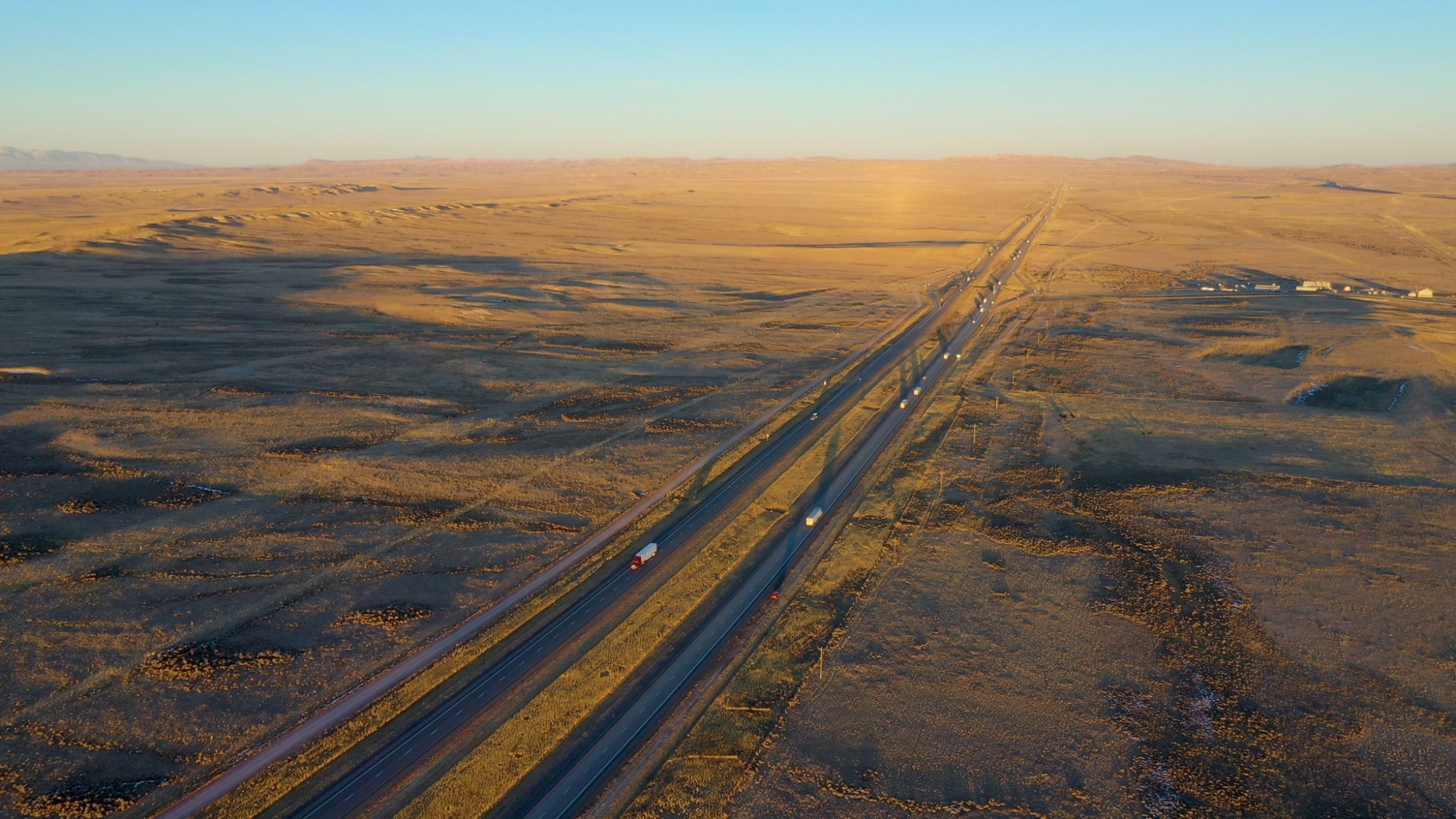

Mule deer 959 was born on the western flank of the Red Desert to a mother that never leaves home.
In his first year of life, the male fawn did the same, sticking tight to sagebrush-dominated natal range near the historic coal mining town of Superior.
By June, though, Deer 959 had matured into a young buck and started striking out on his own. Maps of the GPS-collared animal’s travel paths show that one factor shaped his inaugural migration: Interstate 80.
Fencelines, four lanes of pavement and nearly 14,000 vehicles a day effectively deterred the yearling deer from giving into instinct and trotting south. For 12 days, he instead paralleled westbound traffic, often in sight of the interstate.
Over 80 miles later, Deer 959 made a run for it near the Flying J Truck Stop just before Rawlins. He spent the summer and fall fattening up at over 8,000 feet on the Atlantic Rim south of the interstate.
A new research project out of the Wyoming Migration Initiative aims to better understand and make life easier for the thousands of elk, mule deer and pronghorn that share Deer 959’s instincts to migrate across Interstate 80. The barrier the 56-year-old highway poses to Wyoming wildlife is well known: It’s an issue that’s received attention in the Washington Post; there’s even a short documentary film about it.
Until now, however, much of the focus has been on major, costly fixes like adding wildlife overpasses in the most collision-prone areas, like where Elk Mountain slopes toward the interstate at Halleck Ridge. The new effort will look at improving the many “leakage” points where animals are still crossing to reach the landscapes they call home each winter and summer.
“There’s still some movement across the interstate,” said Wyoming Migration Initiative co-founder Matt Kauffman, who’s also the longtime leader of the Wyoming Cooperative Fish and Wildlife Research Unit. “We should be able to identify it, we should be able to enhance it, and we might be able to increase the permeability.”
Funders include the Knobloch Family Foundation, the Wyoming Wildlife and Natural Resource Trust, University of Wyoming’s School of Computing and others.
Starting point
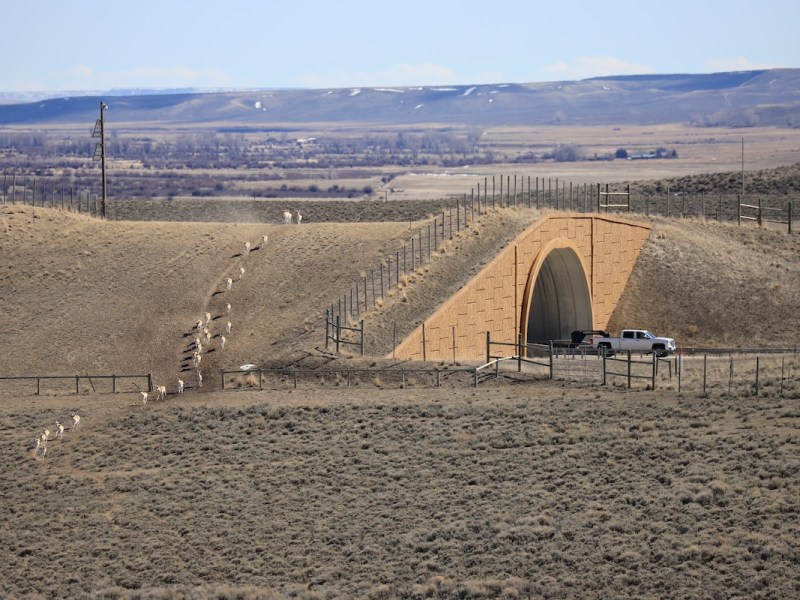
A first step is to catalog and create a handbook of the few dozen places where Wyoming ungulates are already known to pass under the interstate. Those crossings begin as far west as Evanston, where members of the Uinta Mule Deer Herd migrate from high-elevation summer range in Wyoming and Utah north toward less-snowy reaches of the Bear and Green river basins.
“This herd actually still has connectivity across the interstate,” Kauffman said. “It’s not because of purpose-built [infrastructure] — it’s because there just happened to be these machinery underpasses that they’re using.”
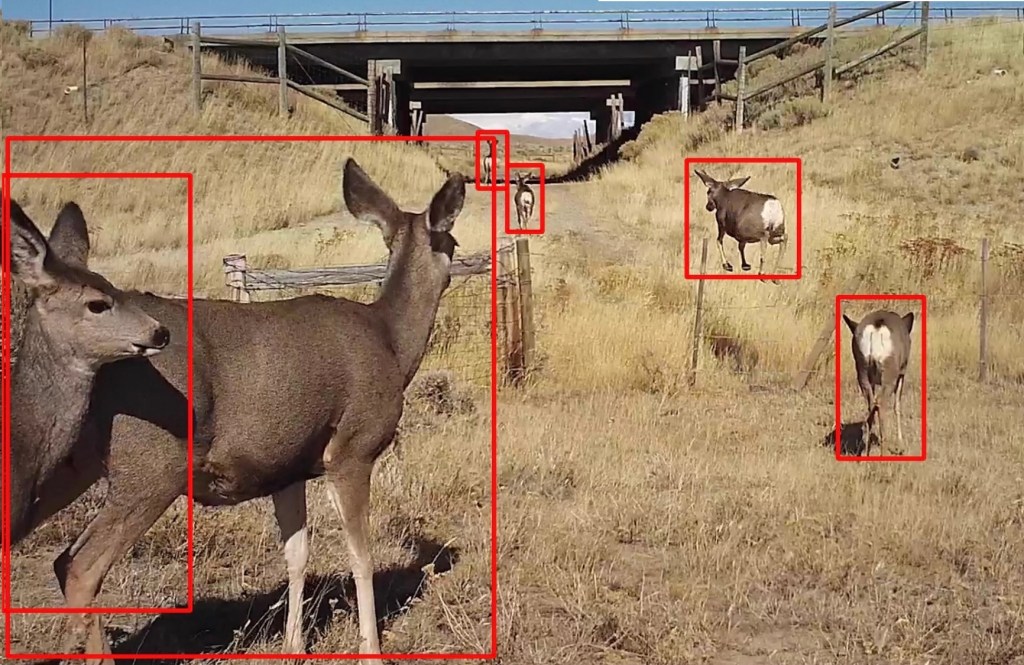
At one of those sites, near mile marker 15, remote cameras detected nearly 1,500 mule deer crossings between 2021 and 2023. That suggests between 300 and 400 individual deer are still migrating under the interstate in that one spot alone, Kauffman said, and it’s one of many such crossings in the area.
The makeshift underpasses continue east down the I-80 corridor and are known to exist past Elk Mountain.
Although longtime employees of Wyoming’s Transportation and Game and Fish departments know exactly where many of the animals cross, their institutional knowledge is bifurcated into administrative regions and can get lost when there’s turnover. Moreover, it has never been compiled in one place.
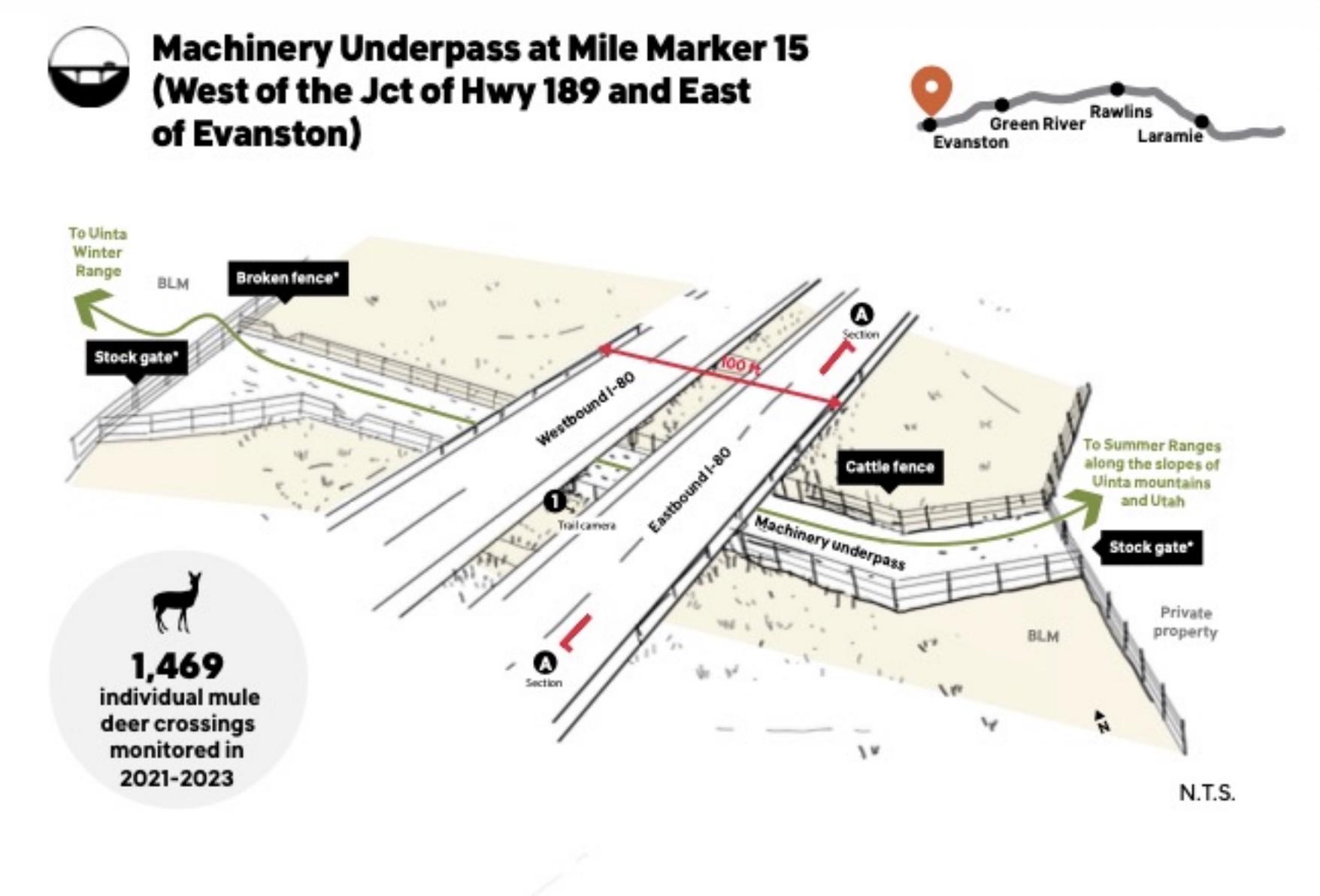
That’s the goal of a handbook that Kauffman is working on with landscape architect Sonya Gimon. It’ll consist of to-scale architectural drawings of the crossings and nearby features, like fences and rivers, all the way down the southern Wyoming corridor.
UW School of Computing Assistant Professor Ben Koger is spearheading a tech-heavy facet of the project. At the most-used crossing sites, a network of trail cameras will provide real-time monitoring of the flow of animals. Artificial intelligence will assist in tallying the mule deer and pronghorn that shoot through.
“This will be like a dashboard that WYDOT and Game and Fish will have access to,” Kauffman said. “In real time, if a storm comes through, they could pull up the dashboard and see if it pushed some animals through.”
The final big component is filling in some of the holes on the map showing where ungulates cross I-80, Kauffman said. Next winter, the plan is to capture and collar roughly 40 pronghorn and 40 mule deer in close proximity to the interstate, with the hope of catching animals along suspected migration routes.
Altogether, the project that should help WYDOT prioritize where to invest its dollars to help prevent mule deer and pronghorn from getting creamed by semis, roadtrippers and commuters. On-the-ground projects that could result are “low-hanging fruit,” said John Eddins, a district engineer for the state agency. It might be adding or modifying fencing to help direct animals toward the makeshift crossing structures.
“It’s not a $100 million project — it’s a handful of $500,000 projects,” Eddins said. “The devil’s in the details. A lot of them will work. Some of them won’t.”
The number of wildlife-vehicle collisions that occur on I-80 annually is hard to estimate, Eddins said.
“They get hit, and there’s nothing to pick up,” he said. “There’s so much traffic.”
Even so, addressing I-80 roadkill has been identified as a major Wyoming goal. In 2017, WYDOT and Game and Fish completed the Wyoming Wildlife and Roadways Initiative, which identified a 7-mile stretch of the interstate near Halleck Ridge as the second-highest priority crossing opportunity in the state.
Anything helps
Funding a wildlife overpass there has been a challenge.
“The status of Halleck Ridge is on hold, until somebody comes up with tens of millions of dollars,” said Lee Knox, a Wyoming Game and Fish Department wildlife biologist whose district includes the easternmost reaches of the I-80 corridor.
In the meantime, work is already underway in that portion of Carbon County that fits right into what Kauffman is trying to do. There are existing makeshift underpasses structures near Halleck Ridge, and Game and Fish and WYDOT have worked together on extending the high fence there to encourage use, according to Knox.
“Anything we can do to allow these migratory animals to connect their habitats north and south of the interstate is pretty critical,” the Game and Fish biologist said. “In a world where we’re already losing habitat at a pretty fast rate, losing full connectivity is a big deal.”

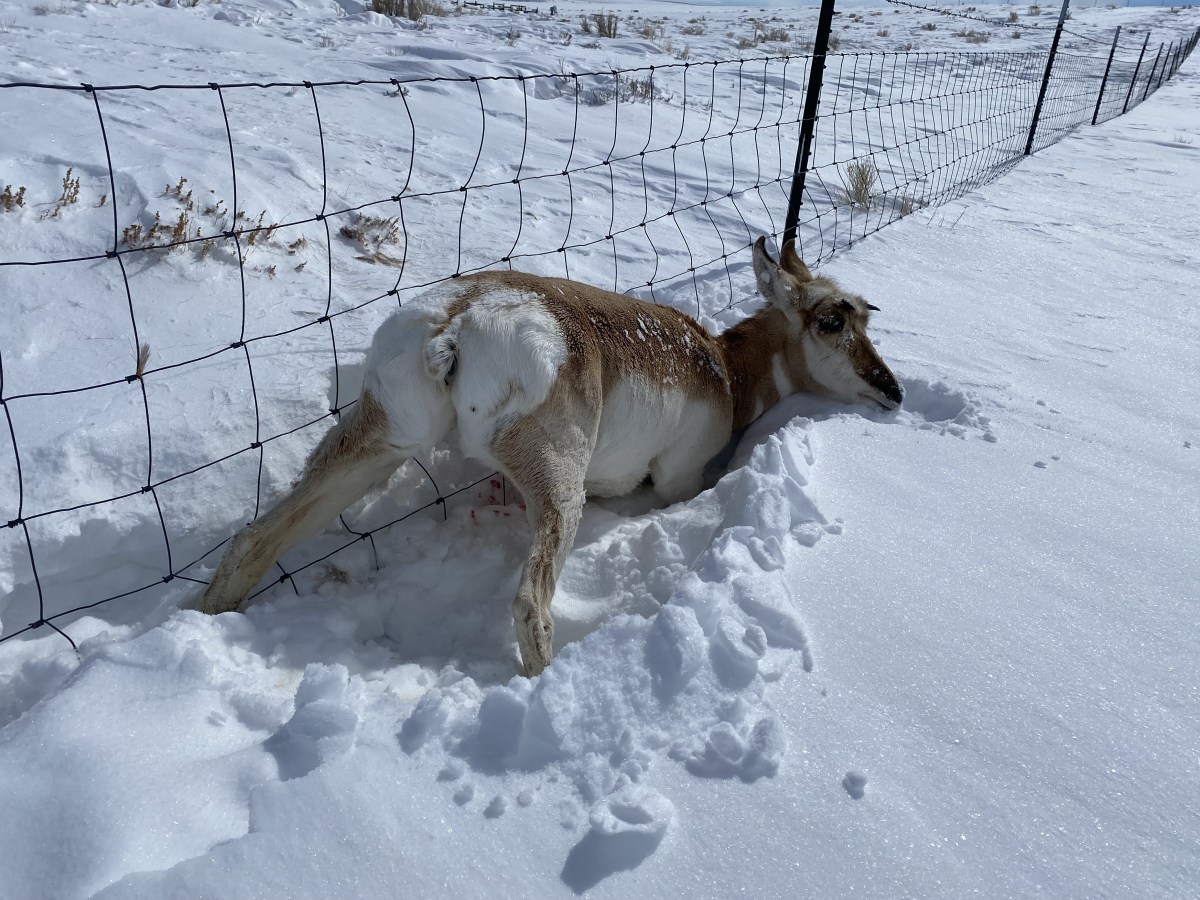
Interstate 80’s effects on Wyoming ungulate populations has been well documented. During the thoroughfare’s infancy in the early 1970s, a winter hit that was comparable in severity to the deadly 2022-23 season. The new four-lane highway and fences in the region cut off the once-premier Red Desert Pronghorn Herd’s ability to escape — a phenomenon that still happens today.
“That was the first time they documented large die-offs of pronghorn, piling up on the interstate and piling up in the corners of the fence and dying by the thousands,” Knox said of the 1972-73 winter. “Five to 10 years earlier, those pronghorn would not have been inhibited by those structures.”
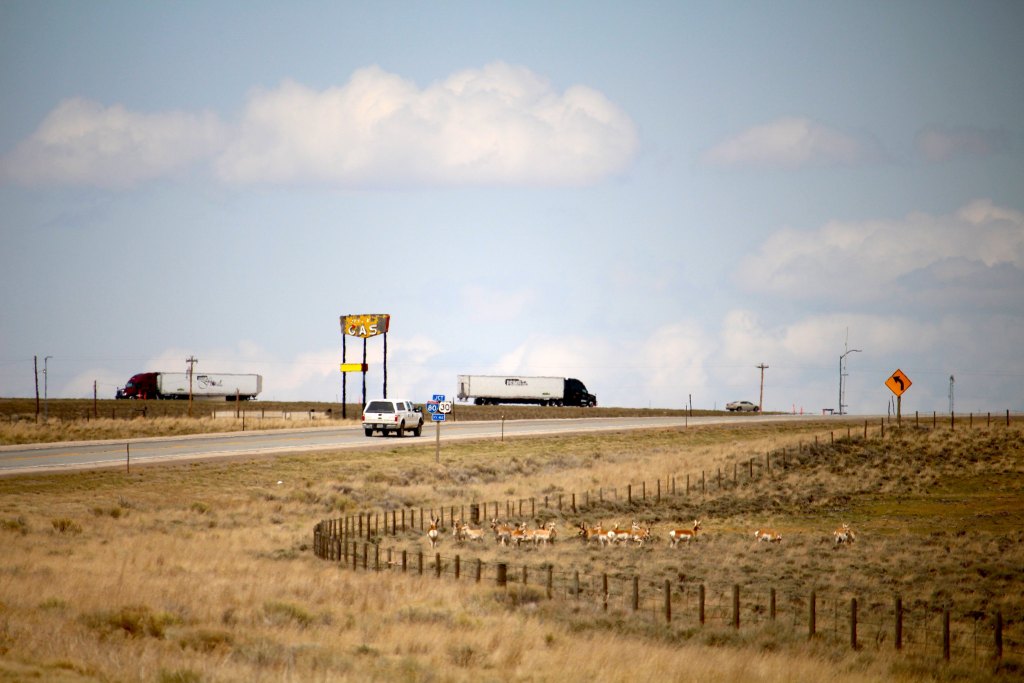
Fast forward to the present and many of Wyoming’s long-distance migration routes functionally end at I-80. That’s the case for the world’s longest mule deer migration, which connects most animals from Red Desert winter range to summer habitat in the Hoback River Basin and Jackson Hole (some go even further).
“Most of the studies that have been done adjacent to the interstate show that a barrier effect occurs,“ said Wyoming Migration Initiative co-founder Bill Rudd, who’s partnering on the I-80 project.
Improving I-80’s existing crossing structures can only help, he said.
“If we can find those holes and animals can figure it out, then we might see reestablished migrations,” he said. “That’s what you’d hope would happen.”
Those movements might start with an individual animal.
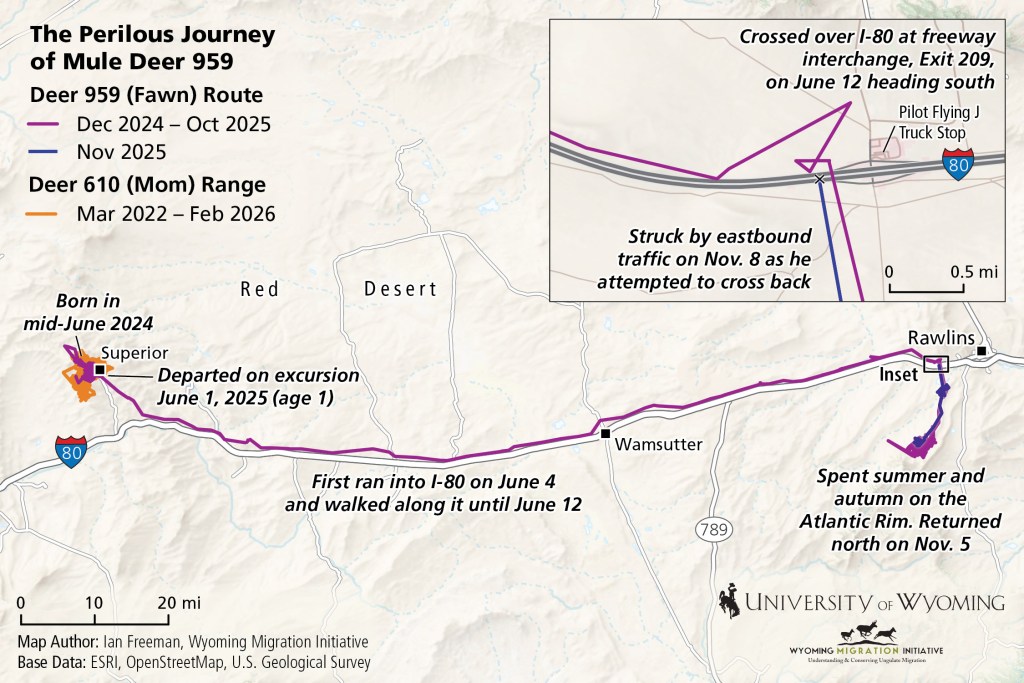
Deer 959, the summer-range bound buck, took his chances and cut south across four lanes of traffic after the long trek paralleling the interstate.
That fall, the yearling deer took almost the exact same route back north. His life came to a close on Nov. 8 while attempting to cross the eastbound lanes of Interstate 80.
Although Deer 959 didn’t use any of the makeshift crossing structures, he passed by a handful of them on the journey south, Kauffman pointed out. One unimproved machinery underpass was less than a mile from where he was struck and killed.

Sure seems like the insurance companies would want to contribute to this issue. One wonders why they don’t. Don’t they have much to gain by helping to prevent wildlife/vehicle collisions that often incur fatalities? One wonders…
Thanks for a great article, Mike. When Pronghorn or Mule Deer, like the 959 example, pace fencing for dozens of miles just to find a crossing, it significantly reduces evolutionary fitness and depletes energy storage. So even if they are lucky enough not to get hit on the road, they are still experiencing reduced energy levels that also increase their susceptibility to mortality away from the highway. I80 seems like it would be a significant contender for federal funding like the 5-year Wildlife Crossings Pilot Program, yet it appears it didn’t receive any, even for Halleck Ridge. What stipulations are affecting the funding for this? The research and data evidence is high, and it’s a highly traveled interstate. Thanks for what you’re doing to get the word out on this, we need as much support as possible to hopefully get the funding needed.
great product.
Wyoming and the US need to more to protect wildlife, this is a good start. I know much is being done but now is time to get serious or wildlife will suffer more.
The interstate highway system, while a boom for commerce and tourism, has irrevocably altered the migration patterns for countless wildlife species throughout the country.
Just another example of the devastating and far reaching impact car culture continues to have on the natural world.