

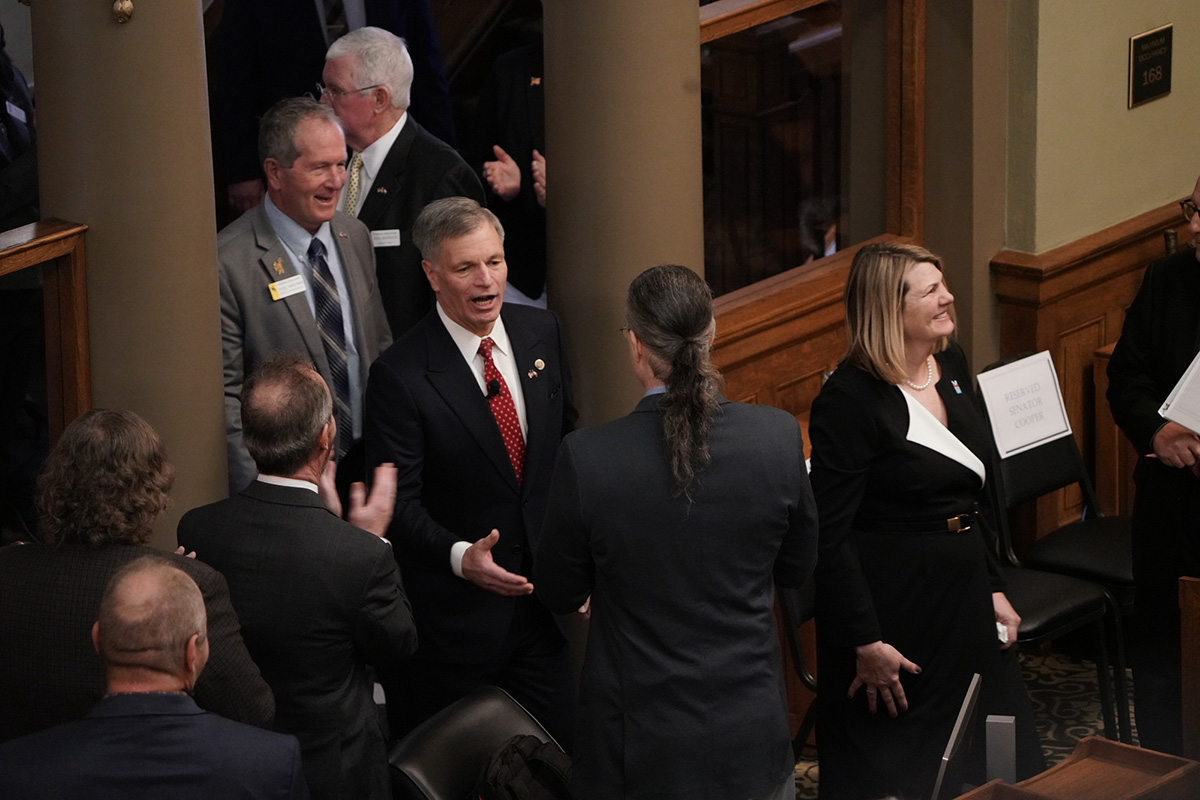
An effort to override Gov. Mark Gordon’s veto of a controversial bill to block public employers from administering voluntary payroll deductions for union membership fees failed to receive the necessary two-thirds vote Wednesday in the House.
Proponents of House Bill 178, “Public unions-transparency and dues withdrawal limitations,” sponsored by Lusk Republican Rep. JD Williams, had two primary arguments: It’s not the proper role of public employers to facilitate deductions when it comes to certain unions, and providing the service is an improper expense.
The measure had the backing of conservative political action group Americans for Prosperity, which has pressed for the policy in several states and in Washington, D.C.
“Gov. Gordon’s veto sends a resounding message that some taxpayer dollars are fine to use for subsidizing private interests, if they’re interests like teacher unions that he’s in favor of,” Americans for Prosperity Wyoming State Director Tyler Lindholm, former House District 1 Representative, said in a written statement Tuesday, the same day that the governor issued his veto. “Wyoming taxpayers can rest assured that AFP-WY will be back hard at work to right this wrong in next year’s legislative session.”

The practice does not divert taxpayer funds to unions, opponents argued. It simply allows employees to direct a portion of their earned salaries where they choose.
Critics of HB 178, to alleviate concerns regarding the cost of providing payroll deduction services, brought an amendment that would have assessed a fee for the service. The bill’s backers shot it down.
National anti-union groups regarded Wyoming — a right-to-work state with a small union presence — as an easy mark, Wyoming State AFL-CIO Executive Director Marcie Kindred said. “They were wrong.”
“What outsiders don’t understand about Wyoming is that underneath the surface, aside from all of the political theater and national rhetoric, the heart of this state is still just one big neighborhood with long streets,” Kindred said in a written statement Wednesday. “Trade workers and teachers, miners and state employees, pipefitters and retirees, active union members and workers who have never carried a card — they set aside their differences, stood shoulder to shoulder and told some of the wealthiest special interest groups in the country: ‘Not here. Not in Wyoming.'”
Gordon, in his veto letter, took aim at “the increasing trend of out-of-state interests foisting out-of-state solutions on Wyoming.”
“With alarming regularity, these think-tanks-for-hire use our legislative process to enact solutions to problems we do not have,” Gordon wrote. “It allows them to continue to raise funds for the fat cats who support these efforts.”
He described the practice of voluntary payroll deductions as a “convenience” offered by both public and private employers, “not an obligation.”
The heavily amended HB 178 would have prohibited public employers from implementing automatic payroll deductions for political action and candidate committees, as well as for some nongovernmental organizations. Those would have included the Wyoming Education Association, which has challenged the state in court over school voucher payments, and the Wyoming Public Employees Association. But it carved out deductions for charitable donations and health insurance premiums as well as voluntary dues for police, firefighters and other public safety labor organizations.

“This raises questions about the potential retaliatory nature behind this initiative,” Gordon wrote, “rather than an honest response to the concerns brought forth by our constituents.”
Both Gordon and union representatives also argued the bill would have jeopardized Wyoming Retirement System beneficiaries because many receive health benefits via a labor organization.
For more legislative coverage, click here.

Payroll deductions of all types should be banned.
When people have to directly pay something they ask more questions and demand accountability for the money they lose.
Payroll deductions essentially put people in the mindset that the money was never there.
I came across this quote the other day, it makes perfect sense to me. Maybe some others on this forum will appreciate it as well. It doesn’t necessarily pertain directly to the article at hand, but paints a broader picture of current political agendas.
“Pitting the right against the left is a calculated tactic to divide and distract us from the actual enemy: the ruling class exploiting our labor and hoarding wealth.
Immigrants aren’t the ones hurting your paycheck. Your CEO is.”
—siouxzeequeue
Very glad this turned out the way it did. We should not look for problems where they are none. It would be problematic if the 2027 Wyoming legislature formed an alligator or python task force because some states have alligators/pythons which have to be dealt with to help keep their citizens safe.
There is no bigger misnomer than “Americans for Prosperity.” These groups oppose labor unions because they believe that prosperity is for the wealthy, CEOs and their corporations. They believe that the average working American should be happy with whatever crumbs are left on the table after the rich are finished feasting. The same can be said for states that describe themselves as “Right to Work” states. These efforts picked up steam with the Reagan administration and have increased since then. The only union Reagan ever supported was in Poland.
100%