

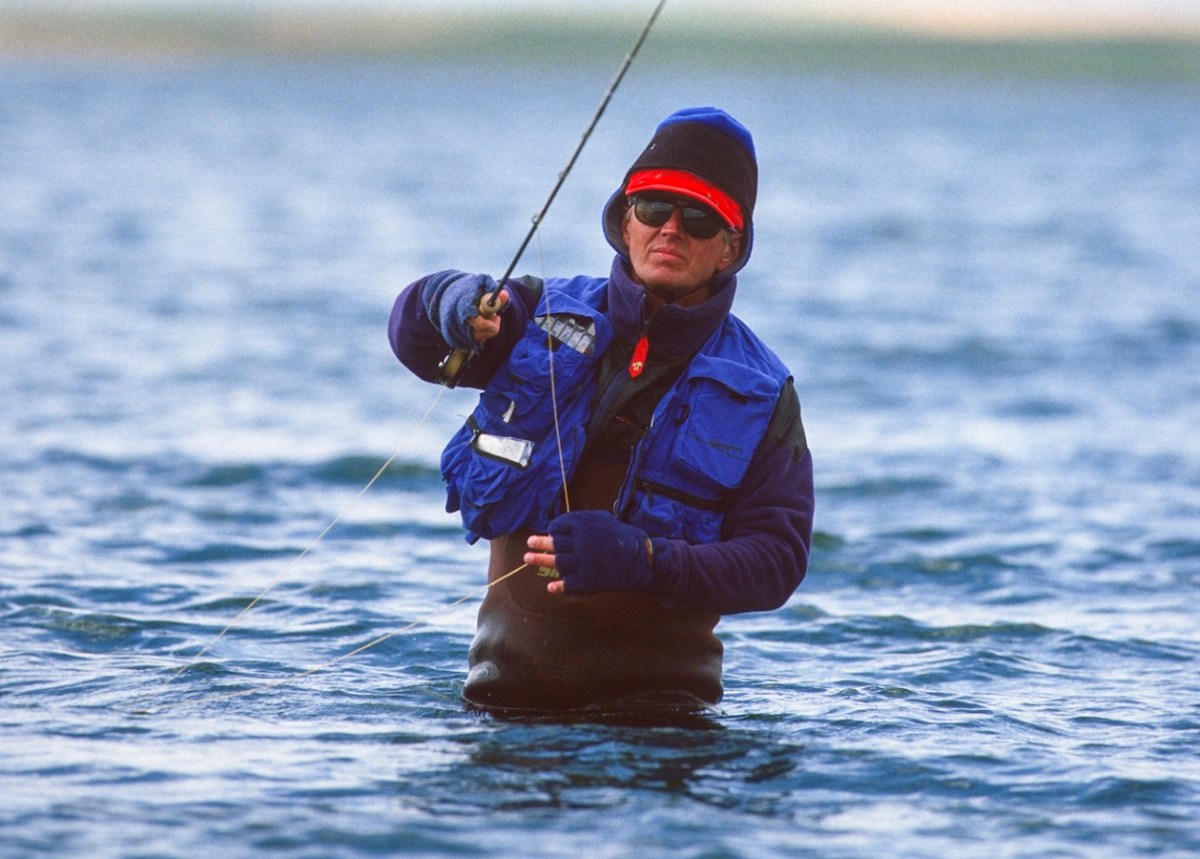
Now, only one person knows the answer to a vexing mountain mystery, and he’s not talking.
Not talking about a significant moment. A moment when two men sucked it up and skied — actually leapt — into what’s arguably the wildest in-bounds couloir in the country.
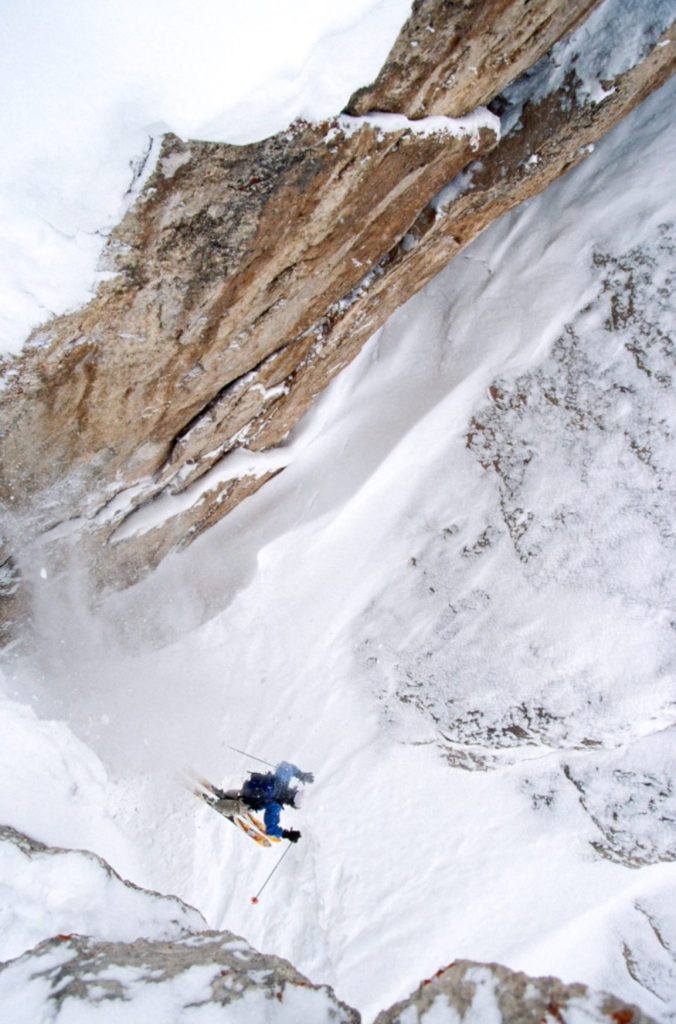
John Simms and Charlie Sands took the leap back in the late 1960s, the first people to ski S&S Couloir.
S&S stands next to world-famous Corbet’s Couloir, but it makes that harrowing ski run look like a pale cousin. From the wind-blown cornice at the top of S&S, there’s up to a 20-foot drop — accounts and measurements vary — into the rock-walled chute to the snow landing below.
A cheese-grater slab on the skier’s left would shred your Arc’teryx parka if you got near it. If you nail the landing, you might not break a femur.
In the rarified world of ski history, being the first carries significance. So the story of S&S remains incomplete.
But above the lip, Simms and Sands forged a compact. They would share the glory, notoriety, or whatever recognition the obscure feat might bring.
The compact has held for more than 50 years.
“Don’t ask who was first,” Clay Hoyt, a longtime Wilson resident and skier, warned.
Many have asked, none have been answered. Nurses at the Jackson hospital tried to coax the secret from Sands one day as he was being sedated for a procedure, slipping into sleep.
It didn’t work.
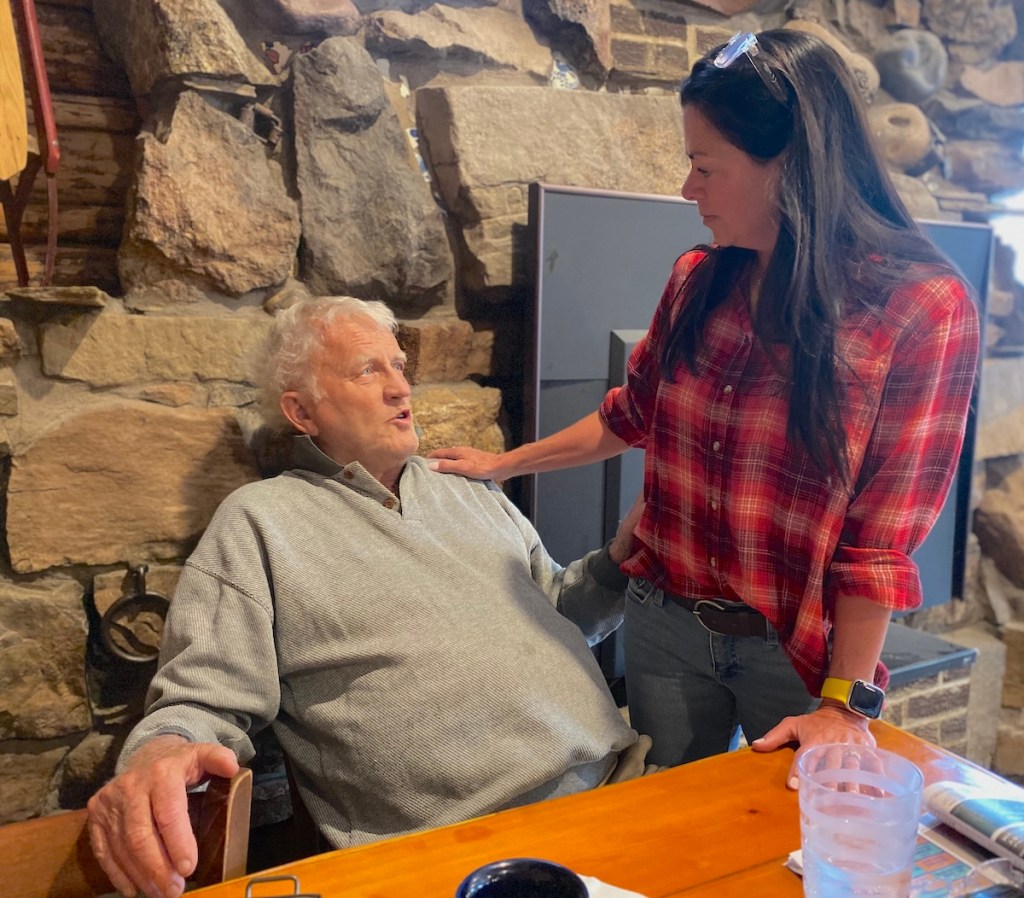
“We both went first,” Sands said Tuesday at Nora’s Fish Creek Inn in Wilson, his go-to breakfast spot. “That was the arrangement.”
John E. Simms died June 2 of brain cancer. He was 89. He took the secret to his grave.
Avalanche probe poles
Simms grew up in the Allegheny Mountains of western New York, where his family owned a mill and plywood business, according to a biography on the website of Simms, the fishing gear company he founded. His ties to the West started with an early-1960s road trip, landing at Arapahoe Basin, Colorado, where he landed a job as a ski patrolman.
By mid-decade, he had moved up to Jackson Hole, where began his several careers, including as an avalanche expert, fishing guide and inventor.
Among his first innovations was a method to retrofit a pair of ski poles with screw-together fasteners that enabled a skier to quickly create a longer avalanche probe. Next came a portable shovel to help extricate a victim buried in a snowslide.
His company, Life-Link International, branched out into fly fishing gear, a natural evolution for an angler, guide and tinkerer. Simms fishing products are now world-renowned.
“He was the inventor of the neoprene waders, something that really changed the game of fly fishing,” said Casey Sheehan, who first met Simms in Jackson Hole when Sheehan was 16. The closed-cell foam neoprene provided more insulation than conventional waders and opened up the world of late-season steelhead fishing in frigid places like British Columbia.
(Casey Sheehan serves on WyoFile’s board of directors. Board members have no involvement in WyoFile articles.)
Outdoor scribe and Jackson Hole fishing guide Paul Bruun said Simms was “one of these guys who would take something and start fiddling with it — around his desk was a collection of little projects.”
Sheehan, who eventually ran the Simms company, said he used the tinkerer’s ethos and real-world practicality to inspire the company’s design-development team. “That kind of authenticity is something that the great icons of outdoors all share in common.”
“He was on a par with the Yvon Chouinards and Buckminster Fullers, doing things in the world of fishing and skiing that will last with us for a long time,” Sheehan said. “I don’t think he felt he got the same recognition as other outdoor pioneers.”
Secret slough
“As a novice guide it didn’t take me long to realize that John would always land the biggest and most fish, and somehow that never changed,” fishing guide Tom Montgomery wrote in an Instagram post upon Simms’ death. Watching Simms row his 14-foot jon boat “Troot” (Scottish for trout), down the river was “an education in elegance and rowing efficiency.”
Simms, as all now know, could keep a secret, especially about a honey-hole channel on the upper Snake River. Montgomery, working with Simms but rowing a separate boat of clients behind his mentor, would suddenly lose track of the older, wily guide.
To enter Simms’ treasured, trout-heavy channel, “you had to row back up a slough and go under a tree,” Montgomery told WyoFile. Simms would reveal nothing about where he had been for two hours, emerging out of the willows later in the day.
If the apprentice asked where Simms had been, “he would just look at me blankly,” Montgomery said. “It took me two years [to find it], and I was with the guy every day.”
On an angling excursion to Livingston, Montana, in the 1970s, Bruun learned Simms had a surprising trait.
“He was very shy,” Bruun said.
The revelatory moment happened at The Sport, one of those Western places with dead animals on the walls and live characters on the barstools. One display was a brick with three holes labeled “South Dakota bowling ball.”
Simms wouldn’t fuss over a celebrity other than to say that evening, “that’s Richard Brautigan,” author of the novella “Trout Fishing in America.”
“Well,” Bruun said as Brautigan slipped into a back room, “if that’s Brautigan, he’s got to be with [Tom] McGuane.”
Gregarious Bruun led the charge to find the two gabbing with Jim Harrison and “Gatz” Hjortsberg. Bruun made the introductions. Simms “just stood there with that John Simms grin on his face.”
Bruun learned he had to pull Simms into engagements — even at trade shows where Simms was promoting his own products. “It flabbergasted me,” Bruun said.
Sheehan agreed, calling Simms “a reluctant businessman. It wasn’t his nature to be a marketing and sales guy.”
But when the ice broke, Bruun said, Simms “became an instant favorite with people because of his friendliness and his in-depth thinking about things.”
Metalworks
After quitting the ski and fly fishing business, Simms devoted his time to creating large metal outdoor sculptures, including “Bison” and “Imploding Red Octahedron.”
“My works transcend these Euclidian forms by bending, warping, and fastening them into unexpected shapes and surprising relationships,” he wrote in a statement on the website of Diehl Gallery in Jackson.
Simms was inducted into the Intermountain Ski Hall of Fame in 2022. Two weeks before he died, he was on the river and landed fish with Montgomery.
He is survived by his wife, Barbara, and daughters Evan, Morrison and Jodi Hammer.
His sculptures will endure, as will the legend.
Sands and Simms were in the “top of the world” ski patrol shack on Rendezvous Peak back on that day when Simms said, “let’s go look at that chute.”
“Think it will slide?” Sands asked.
“No”
They went. They leapt. They returned to the Top of the World to report their feat to colleagues.
“Bulls**t,” was the reaction. But the ‘trollers went out to confirm, “and saw the tracks,” Sands said.
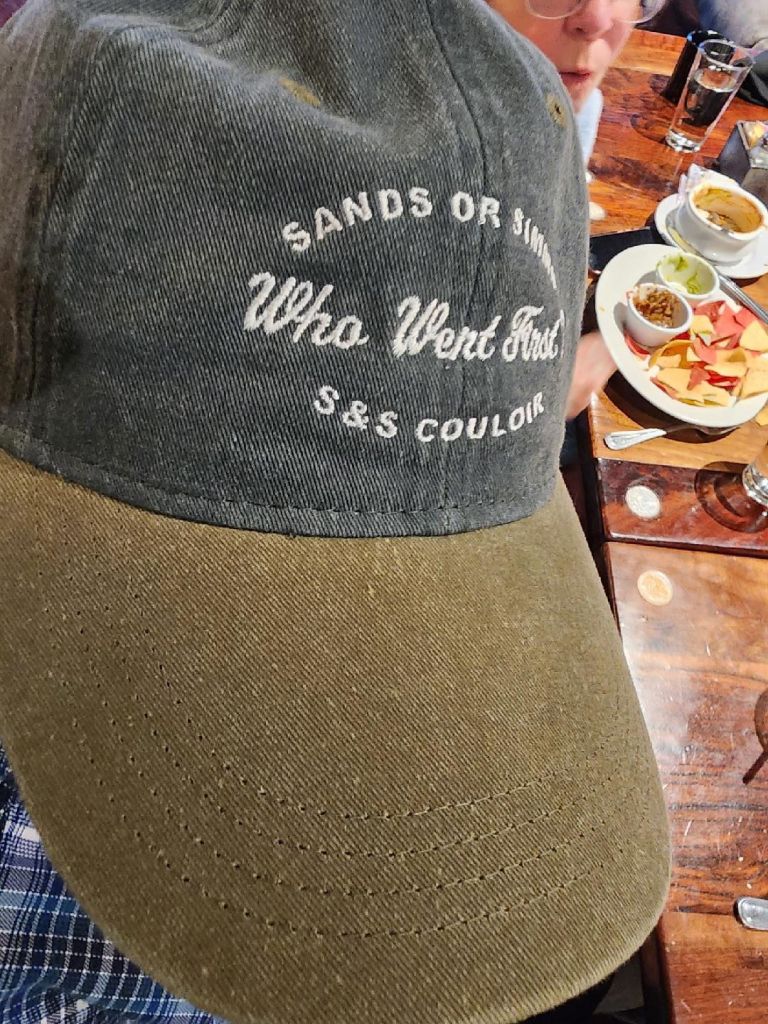
What does S&S Couloir stand for? Simms and Sands or Sands and Simms?
“Sands and Simms,” Sands said, but his declaration did not solve the mystery.
“A before I,” Sands said. “That’s the way the world works.”
Update: This story was changed to include the name of Simms’ daughter, Jodi Hammer. — Eds.

I’m glad I read this article and coincidences will show up at the most unexpected times. I was just telling my brother not more than two days ago the books I read while in college and one book and one name was one I couldn’t quite recall. The article refreshed my memory, Richard Brautigan and his book, Trout Fishing in America. I read it back in my college days in the 70’s and the copy was in my locker at work for years but disappeared somewhere along the way. I was in Livingston pursuing the shelves of a bookstore a few years ago and saw his name which I had long forgotten. He was connected to the Paradise Valley in some way. I’ll have to see if I can find that book again. Nice article by the way. Good story.
Thanks for this tribute Angus.
John and his young family were our neighbors at the end of Fish Creek Road when I was a teenager in the late 60’s. I had the pleasure of helping John clear trees and plant clover for his young daughters. He liked to tell the story over breakfast at Noras’s of how Fish Creek Road finally got plowed when his daughter, Morrison, turned five years old and needed to get to the Wilson school. John went to the Board of County Commissioners and reminded them of the State law requiring them to serve Fish Creek Road with a school bus since Morrison was ready to go to school. They had no choice but to start plowing the road north of the Vandewater ranch – thanks to John’s diplomacy. Fish Creek Road was finally given year round access thanks to the Sims family!
I really enjoyed this article. It captures the low vibe magic that existed in JH and the intermountain west before it became “discovered.” I was fortunate to be there before that happened, and I mourn its loss. Perhaps, just perhaps, some remnants still remain.
We can hope. I hope.
Absolutely wonderful tribute to Simms by Thuermer. He captured Simms perfectly.
Thanks Angus – great article. I wish I’d gotten to know him better and earlier. Ireally wish I’d gotten to fish with him. A few months ago I was Zoom interviewing him for a JH Magazine article and mimed a cast and he immediately told me I was breaking my wrist – he saw that even on a Zoom call. Great man.
Nice writing as usual, Angus. Thank you.
Great work, Angus. Fun to read.
Concise and artful portrait of an exceptional western outdoorsman and entrepreneur laced with lore and leading characters from Jackson Hole’s golden age of derring do and hijinks. Refreshing tribute.
Angus, Thanks. A very nice essay. Simms had an inquiring mind! Sands’ “alphabet” answer seems very nice- it’s an answer, it’s gentler than a finger in the eye, and it keeps the secret. Charlie’s looking good! Having a great photographer was foresighted of him!
— Persevere.