


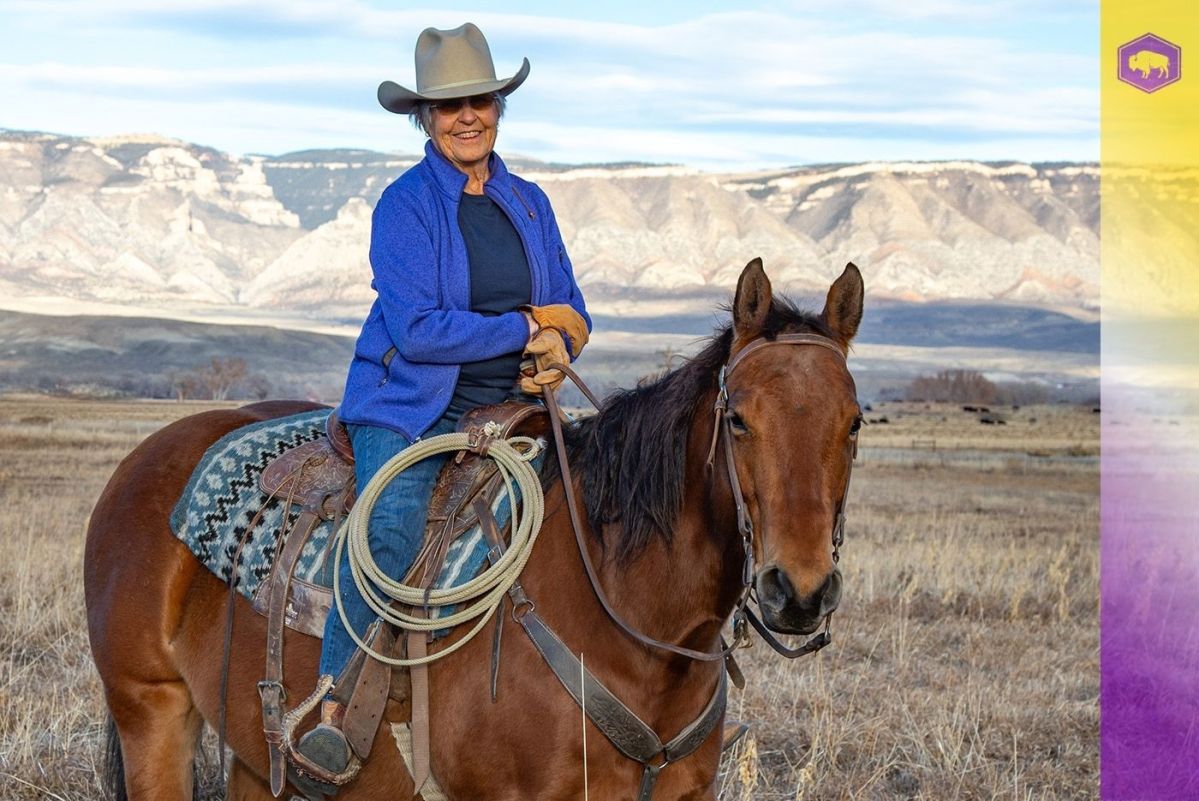
I’m a female octogenarian with a lifetime of experience in daily work and every aspect of the professions and lifestyles defined as “agriculture.” I‘m not a feminist — instead, a realist.
Opinion
That requires a sense of humor: As I think about women in agriculture and our place in The Equality State, I say, “Well, in winter coveralls and a wool cap, there’s not much difference.” Perhaps that’s equality. The ag life is full of cartoons and jokes about women working with men. Some are funny.
I’ve been asked if I think women in Wyoming agricultural professions have achieved equality as defined by the state’s proud self-identification from the year 1890. I don’t know how to measure “equal” for each and all of us. “The Equality State” has a nice ring to it, but that’s about all. Is there equality for women in ag, in the current day? Yes. No. Sometimes. Maybe. While women are equal in ability, they may not be equal in pay, and may not be treated as equals. Hence the answer, “Yes, no, sometimes, maybe.”
My fascination with Wyoming agriculture goes back to the late 1800s, when my great-grandfather established a ranch in southwest Wyoming. His wife and family joined him, and over time they created an actual town with a post office, store, school and a church. That family, like others, stayed in place in Wyoming into the present day. From their stories, I developed a huge respect for them and other “stickers,” as Wallace Stegner described the people who dedicated themselves to their place on the land — in fact, reaching the milestone of America’s Bicentennial, her 250th anniversary. Necessity created the strength brought by teamwork and partnerships, frequently man and woman.
“Agricultural,” by definition, supports many Wyoming livelihoods including livestock production, crops, conservation, water management, land use, wildlife, finance, recreation and tourism. Women’s contributions are absolutely equal in importance to that of men, but are those contributions equal in pay, power or rank? Yes, no, sometimes, maybe.
In early settlement days, a woman probably arrived in Wyoming with a man, or seeking one, according to lore — some wanted adventure, or came looking for a job; many women came “west” as schoolteachers who were quickly snatched up as wives by single men here in Wyoming. These women competently became helpmates and partners. They worked hard, many loved the out-of-doors work, and they held tight to the notion of “getting ahead.”
My mother was one of these, later, in 1935. Our family laughed each time she retold the story of my dad, who told his future mother-in-law that the bride “would not have to do a THING.” Later photographs showed her driving a team of horses which were pulling wagonloads of logs, and riding horseback and feeding hay-hands at the family ranch. Was she equal in skill? No. Equal in determination and commitment? Yes.
True, women don’t ride sidesaddle or drive a team of horses, or wear “housedresses” nowadays. They hold goals of their own within this male-dominated culture; they’ve gained confidence as decades passed. Women worked on the land; women and men must have had confidence that a lady would “do anything she could do.” My dad, for example, never doubted that his three “little bitty girls” could keep up, and would do their share of any job.
I was part of the scary 1980’s, when many farm and ranch women found paying jobs in town to supplement ag property income, determined to face the bankers when interest soared and market prices fell. Together, family members worked to hold on to the land. This was its own kind of equality — doing what we had to do. It was apparent that women could hold their own in any workplace.
Many women love the work, the life and setting, and are dedicated to high ideals of land stewardship, food production, animal welfare, health, air and water quality. Early-day Wyoming women were often profiled as colorful icons who ran for public office, or rode fast horses, or found notoriety beyond housekeeping. In the big picture, their presence in agricultural settings has been more important in creating the culture and economic strength of agricultural communities which exist today.
Wyoming women continue to earn respect and prominence in ways unforeseen in most professions, not just in agriculture. We’ll continue to do so. Do we need to be labeled “equal?” Yes, no, sometimes, maybe.
I doubt that “equality” got much emphasis in the vocabularies of early Wyomingites. Most ownership or opportunity came to women as wife or daughter or sister or cousin, and public prominence in politics or profession was hard to achieve. Yes, women have made gains. It is possible now for a woman to start her own business, run it, work on it, hire others, succeed on her own.
Men have historically dominated the agricultural livelihood because of the need for physical strength and stamina. In the present day, women can run big equipment, provide technological management and offer economic skills and knowledge, leadership and overall “savvy” as any business requires. Ambitious women with training and skills and hands-on experience fill priority positions in many venues, showing the determination and grit that identified Wyoming people long ago. I haven’t been able to find meaningful statistics regarding comparative pay and employment numbers for women in agriculture, and I cannot determine how far we’ve actually progressed in that way. Leadership opportunities and equal pay or prestige for women are still in question in many settings, and maybe agriculture is simply a lifestyle dominated by loud voices.
My personal life puts me in the company of smart, ambitious women who have achieved so much. They are successful, well respected, and well qualified in a chosen field of agriculture. I’m proud to be among them. In my view, women in ag are “doing anything they can do,” and a lot that they want to do. My lifetime in this profession makes it possible for me to see and recognize progress.
Am I impatient? Yes, no, maybe.
This column is part of an effort by local newsrooms supported by the American Journalism Project to reflect on the 250th anniversary of the Declaration of Independence. See coverage from other newsrooms here.

I never doubted your competence, Mary
Thanks Mary, you are more equal that us men!