

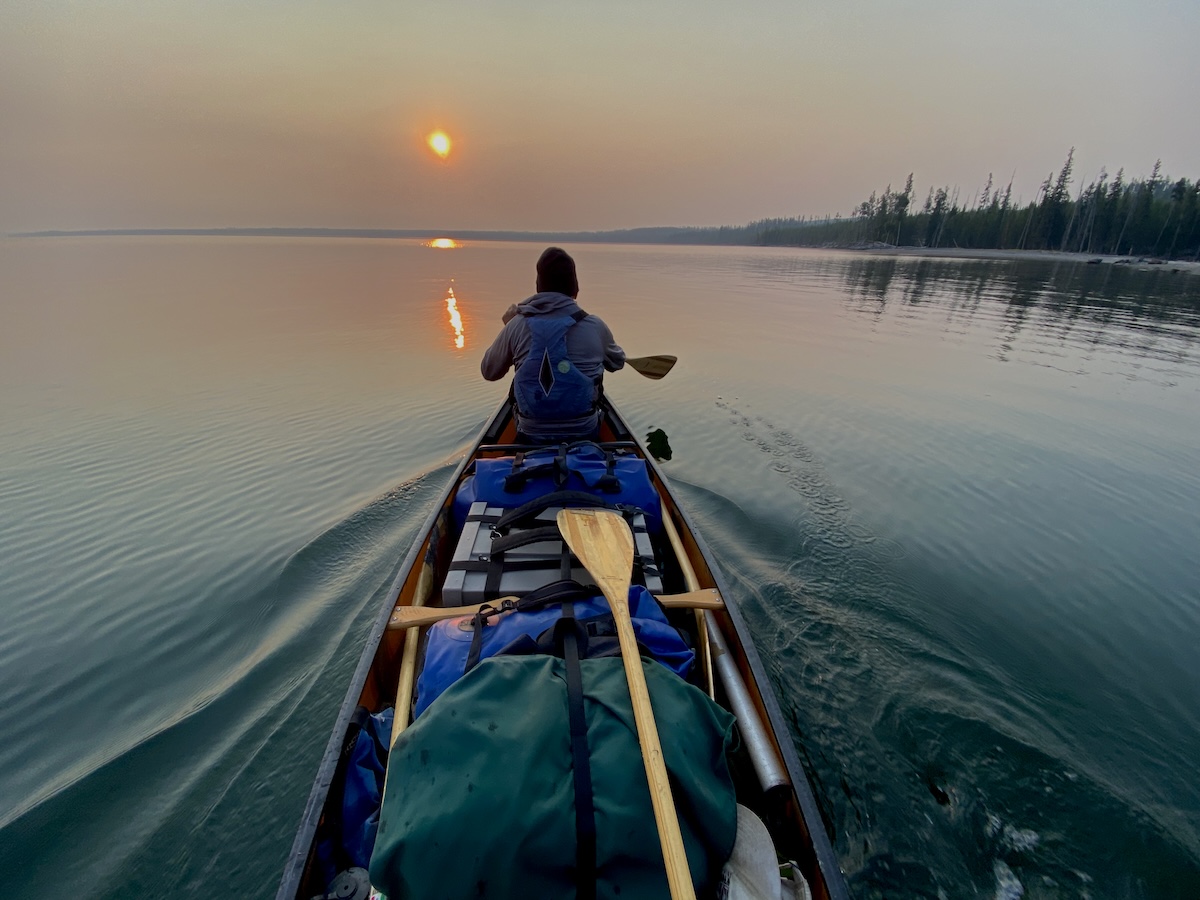

Over Yellowstone Lake, wildfire smoke turns the rays of the rising and setting sun orange, a phenomena caused by Rayleigh scattering of light.
Rayleigh scattering is the result of particles — such as those in wildfire smoke — that are smaller than light’s wavelengths. They diffuse rays and create specific colors. Without extra particles, the sky appears blue. With smoke, orange or red.
The phenomena takes its name after the third Baron Rayleigh, one John William Strutt. Strutt lived in Essex, England, from 1842-1919. A scientist as well as a nobleman, he won the Nobel Prize in physics for codiscovering argon. He described the light-bending properties of airborne particles, “the first theoretical treatment of the elastic scattering of light,” according to a Wikipedia summary.
You could say that with wildfire smoke, the sun Strutts its stuff.
The photograph above shows the morning phenomena at Yellowstone Lake’s West Thumb. West Thumb is a “caldera within a caldera,” a lake lobe created by a volcanic explosion 174,000 years ago. The Thumb is about 5.5 miles long and 4 miles wide.
Boating in Yellowstone Lake is rewarding but fraught with peril. Aside from car wrecks and illnesses, drowning is the largest single cause of death in Yellowstone. Yellowstone Lake is the site where the most have occurred — about 40, according to former Yellowstone National Park historian Lee Whittlesey.
“All things considered, no body of water in Yellowstone Park and probably in all of the United States is more potentially dangerous,” he writes in Death in Yellowstone. The most recent drowning — of a kayaker from Denver — occurred in June.
At 7,733 feet, Yellowstone Lake is the largest lake in North America above 7,000 feet. It is 20 miles long, 14 miles wide and covers 132 square miles. Cold water and winds make safety challenging.
Yet the lake’s remote southern arms provide a window into wilderness where paddlers can hear elk bugle and wolves howl.
