


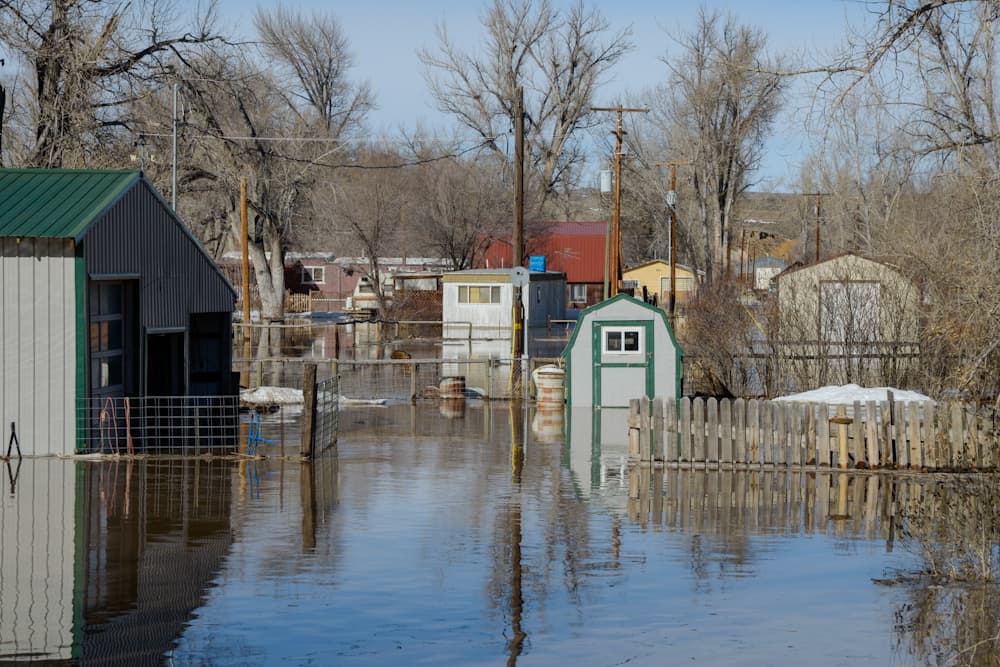
Sleep can wait. The flood won’t. So you’d better get moving.
You need to muster a coordinated force from a grab-bag of municipal offices, county authorities and state and federal agencies. You’ve got to make it happen in the middle of the night, with very little time, and no enforceable order-giving power.
Instead you have relationships, classroom training, hard-earned lessons from previous floods, and one pressing question: Where is all the water coming from?

Nick Hudson, Lander Fire Department administrator and emergency management coordinator, faced precisely this challenge on Thursday Feb. 9.
At 40, with almost two decades of fire department service under his belt, Hudson is described as a “young gun” and a “newbie” in Wyoming’s emergency management circles. His colleagues use the labels as terms of endearment, and optimism.
They recognize Hudson as a rarity. A troubling proportion of the state’s disaster response experts are nearing retirement. Many communities already lack a single, dedicated point person. Given the competitive national market for the skill-set, those in the know worry about where Wyoming’s next generation of responders will be found.
On Feb. 9, though, the responder was nearly found in the shower. A 10 o’clock call from Lander Police Department Patrolman Sean Weathers — “Squaw Creek is looking high where it crosses Baldwin Creek road…. You might want to come take a look.” — interrupted Hudson’s pre-bedtime routine.
Fifteen minutes later he was standing in the dark with a high-powered flashlight, puzzling over the torrent rushing past the elementary school, around the discount store and across Main Street.
No one had forecast a flood, but the clues were ominous: 54 degrees in February, high winds, frozen ground, brown foothills. It all pointed toward too much snowmelt and not enough places for it to go. Hudson realized that he was watching a rapid runoff event, that it was accelerating by the minute, and that it was time to get on the horn.
Some of the calls come right out of the playbook — public works to check culverts and make sand and sandbags available; the volunteer fire department to rouse vulnerable residents; the police and sheriff’s departments to manage traffic and eyeball the creeks; the county dispatcher to sound the public alert siren, establish interagency radio communications and notify downstream communities; the school district to initiate closures; WYDOT to monitor low-lying stretches of highway; NOAA to refigure forecasts and trigger the Emergency Broadcast System; the county commissioners and Wyoming Department of Homeland Security… it’s a big playbook.
Other calls require a bit more resourcefulness. How does one track-down a responsible party for the Shopko, the bowling alley and the BLM offices after hours?
Time speeds up. The flurry of activity morphs as each cog turns in the machine, and, before you know it, you’ve moved from assembly to execution, adaptation and problem-solving. How do we want this to look in the end, and what do we need to do, right now, to get there? Where can we find unfrozen sand? Who needs to know this latest bit of information? Do we need to scale up? Shift resources?
Never miss a Know How — subscribe to WyoFile’s free weekly newsletter
If all goes well, and Mother Nature is kind, you’ll be a step ahead of the rising water, and firing on all cylinders, when the neighborhoods, church groups and scout troops wake-up to a wet hometown and hurry to the sand-bagging station.
You might even find a few minutes near dawn to change shirts and grab a cup of coffee.
But don’t count on it. And if you have to choose, take the coffee. It’s going to be a long day.

Nicely written, Matthew. I’ve always been curious what steps were taken during an emergency. Informative piece.