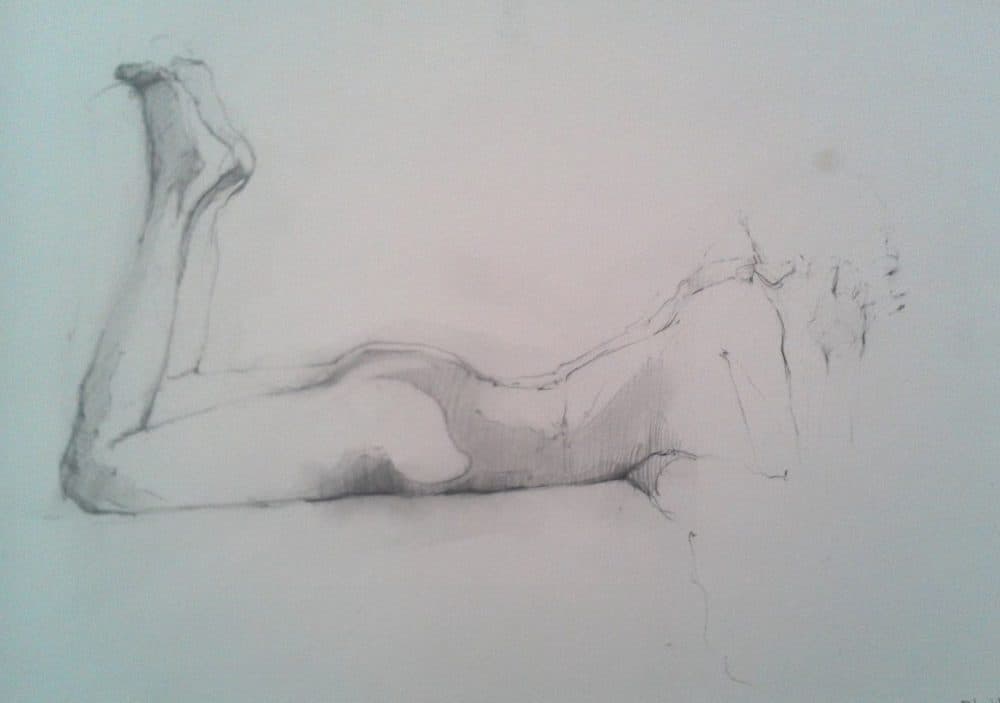
The exhibit Life Sketches, currently on display in Powell, illustrates the power of consistent practice. Simple line drawings of simple poses, these sketches are expertly rendered and demonstrate the power of classical figure drawing at its best.
Attendees at the opening reception commented on the exquisite lines and composition and marveled over the whimsical details each artist included. The twenty sketches are obviously of different styles, but they complement each other beautifully. With careful observation one can tell when the model is the same, or even in the same pose, but there is no tiresome repetition here. The drawings were purposefully selected and presented to give a rewarding experience to both the casual observer and the carefully observant.
Rebecca Weed is an artist and adjunct art teacher at Northwest College in Powell. Born and raised in Cody with an MFA from the University of Montana, she has participated in national and international shows. Her show statement comments: “Drawing, for me, has always been a conversation between me, the materials, and the subject. When drawing the figure, this conversation becomes more quiet and personal. One that can’t be said out loud, but with line.”
I find Ms. Weed’s lines to be dreamy yet precise. For this exhibit she’s chosen graphite on white paper. I’ve learned to look for a touch of whimsy — in the hints of facial features, the crossed fingers behind a model’s back, or even in the fling of her pencil stroke as she finishes off a toe. One favorite sketch shows the model casually standing in a three-quarters back view, elbows akimbo and hands on the back of her hips. The hands are barely suggested, and her head is a mere sketch of a cloud of hair, but the light is clearly indicated by hatching and shadows and negative space in just the right precise places. The line is masterful and completes the image. As she says, the line speaks.

Another drawing is of the length of a prone model, gracefully sketched from toes to shoulders but then giving only the slightest hint of elbows and hands supporting a face. During the reception, I heard someone ask, “Why don’t they draw the faces very often?” which reminded me of the discipline of presenting the classical figure — the anatomy and the light and space involved. Most humans are naturally drawn to the face, and it literally halts your progress in studying the entire presentation. It inhibits the artist from fully exploring the potential of the composition. You can draw the face OR draw the figure, in most cases, in my opinion. I was pleased with the balance of faces and figures in this show, and enjoyed the opportunity to really study the figures without the distraction of faces in most of the sketches.
Martin J. Garhart has worked as an artist and teacher for more than 40 years and has works in more than 40 institutions, including the British Museum, Library of Congress, the Smithsonian Institute and numerous private collections. He is a Professor of Art Emeritus at Kenyon College where he taught studio art for 31 years. Today he splits his time between Powell and the Black Hills, South Dakota, according to his website.

Garhart’s statement accompanying his drawings: “Drawing from the figure is the visual equivalent of the Zen Haiku. It is the giving over of oneself to the moment, the model, and the process. Then just draw.”
Alan Watts, writing on the blog The Unbounded Spirit, says about haiku: “a good haiku is a pebble thrown into the pool of the listeners mind … It invites the listener to participate instead of leaving him dumb with admiration while the poet shows off.”

Garhart’s drawings are immediately impressive, of course, but looking further into the pool you are truly invited to study and ponder, and to participate. First, one might notice the graceful frame drawn to limit the composition — the artist delineates his boundaries with a cardboard rectangle, kept on hand for just that purpose, before even approaching the first mark.
The marks are of fine burnt sienna pen and delicate white chalk, bathing the subjects in light and shadow on toned paper. His sketches are multidimensional; one sees the general anatomy and direction of the body and limbs in firm and graceful lines, each fascinating to trace out. But I’m also enchanted by the delicate touches of chalk highlighting the turn of an arm or neck, and the hatched shadows revealing the muscle and bone underlying the skin. I’m drawn in to ponder the tiniest marks, then step back to grasp the “big picture,” and I lose track of time.

My favorite of his drawings is a simple sketch of a male model whose spine and neck twist away from the viewer. The line is wonderfully minimal and spare, but the image blooms completely in the mind as you look. Other drawings are more enriched with hatching and shadows and expert touches, but this is the one I return to.
Both artists comprehend the importance of consistent drawing practice, which shines through even the hastiest sketch in the strength of the line or composition
Make it a point to see this exhibition, and you also will return to it. I promise.
Art lover? Subscribe to WyoFile’s free weekly newsletter for the latest on the gallery scene.
“Life Sketches” by Martin Garhart and Rebecca Weed is on display at Gestalt Studios in Powell through December 7, 2017.
Bobbie Brown, originally from Australia, lived in various western states, before anchoring herself to a cattle ranch in northwest Wyoming in 1989. In her former lives she has worked at a Napa Valley champagne winery, done some opera singing, and concierged at a dude ranch. She currently teaches English as a second language online to Japanese students, and studies art at Northwest College in Powell.