
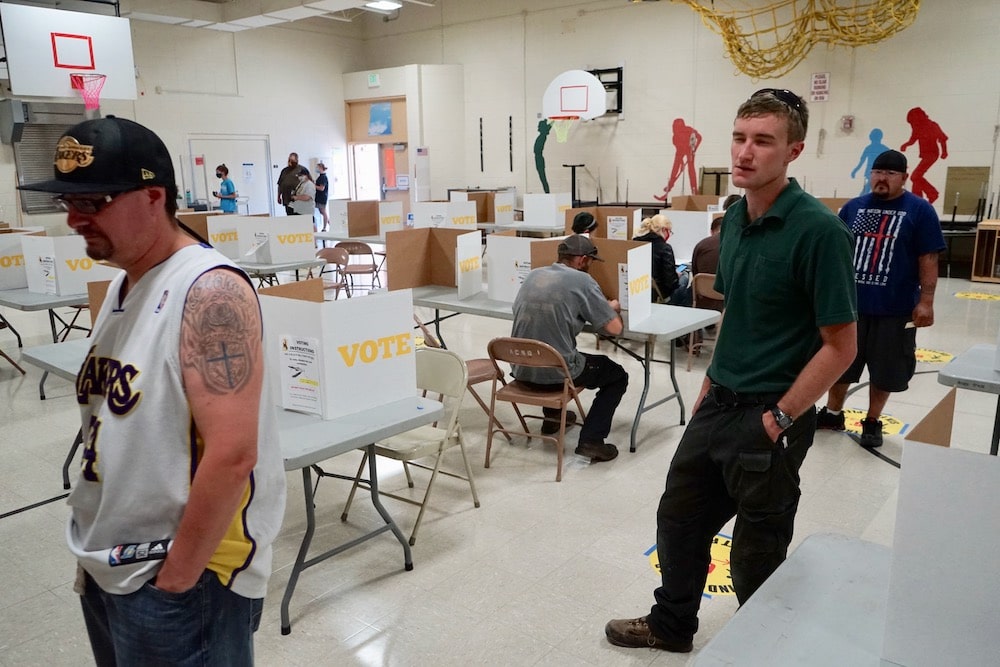
Stickers on the floor direct Albany County voters to keep 6 feet of distance as they wait in line to vote. (Andrew Graham/WyoFile)

U.S. District Court Judge Nancy Freudenthal ruled last week that Wyoming’s ban on electioneering within 100 yards of a polling place on election day violates the First Amendment. 

Why it matters: The decision likely nets advocacy groups and political campaigns greater leeway in how they interact with the voting public.

The case, Frank v. Buchanan, was brought by activists who wished to campaign and gather signatures in high-visibility areas for voters — in this case, polling places. 

Previously, those engaging in electioneering activities had to stand at least 300 feet from those polling places, well out of view of voters. Now, the Wyoming Legislature will likely need to change the law.

History: While Wyoming’s buffer zone on absentee and early voting days is just 100 feet — and judged to be constitutional by Freudenthal — the state’s 100-yard zone for election day is similar to those struck down by courts elsewhere.

In Kentucky, for instance, a Sixth Circuit court judge ruled a300-foot buffer unconstitutional in 2015 after the plaintiff successfully argued the size of the zone was arbitrary, and that there was no compelling interest to back it up.

Wyoming, which had a buffer zone of 60 feet before extensive election reforms in 1973, has faced similar challenges before. A 1988 lawsuit, NBC v. Karpan, forced the Legislature to allow exit polls within the buffer zone after an outright ban was found to be unconstitutional, for example.

Don Wills, an independent candidate for governor in recent decades, challenged the state’s 100-yard law following the 2014 election after finding it difficult to break through to voters. That action prompted renewed interest in those zones. 

Legislative reform efforts in the last decade — led by attorneys aligned with the Wyoming Liberty Group — were unsuccessful. That led to Stephen Klein, a former Liberty Group attorney, filing a suit against the state last fall.

“We really did try to fix this legislatively,” Klein said.

While the ruling invalidated the state’s 100-yard zone rule, the court did uphold Wyoming’s 100-foot buffer around polling places on absentee balloting days.

“This is not a complete victory,” Klein said

What’s next: Should Freudenthal’s ruling stand up through the appeal process, the Legislature would more than likely need to change the law.

The Wyoming Secretary of State’s Office would administer any changes.  

“We welcome the opportunity to have laws tested in court if someone believes them to be unconstitutional, as that is precisely the type of checks and balance system that is built into the Constitution,” Monique Meese, a spokesperson for the Wyoming Secretary of State’s Office, wrote in an email.
Support independent reporting — donate to WyoFile today

Leave a comment

WyoFile's goal is to provide readers with information and ideas that foster constructive conversations about the issues and opportunities our communities face. One small piece of how we do that is by offering a space below each story for readers to share perspectives, experiences and insights. For this to work, we need your help.

What we're looking for: 

  • Your real name — first and last. 
  • Direct responses to the article. Tell us how your experience relates to the story.
  • The truth. Share factual information that adds context to the reporting.
  • Thoughtful answers to questions raised by the reporting or other commenters.
  • Tips that could advance our reporting on the topic.
  • No more than three comments per story, including replies. 

What we block from our comments section, when we see it:

  • Pseudonyms. WyoFile stands behind everything we publish, and we expect commenters to do the same by using their real name.
  • Comments that are not directly relevant to the article. 
  • Demonstrably false claims, what-about-isms, references to debunked lines of rhetoric, professional political talking points or links to sites trafficking in misinformation.
  • Personal attacks, profanity, discriminatory language or threats.
  • Arguments with other commenters.

Other important things to know: 

  • Appearing in WyoFile’s comments section is a privilege, not a right or entitlement. 
  • We’re a small team and our first priority is reporting. Depending on what’s going on, comments may be moderated 24 to 48 hours from when they’re submitted — or even later. If you comment in the evening or on the weekend, please be patient. We’ll get to it when we’re back in the office.
  • We’re not interested in managing squeaky wheels, and even if we wanted to, we don't have time to address every single commenter’s grievance. 
  • Try as we might, we will make mistakes. We’ll fail to catch aliases, mistakenly allow folks to exceed the comment limit and occasionally miss false statements. If that’s going to upset you, it’s probably best to just stick with our journalism and avoid the comments section.
  • We don’t mediate disputes between commenters. If you have concerns about another commenter, please don’t bring them to us.

The bottom line:

If you repeatedly push the boundaries, make unreasonable demands, get caught lying or generally cause trouble, we will stop approving your comments — maybe forever. Such moderation decisions are not negotiable or subject to explanation. If civil and constructive conversation is not your goal, then our comments section is not for you. 

Your email address will not be published. Required fields are marked *