
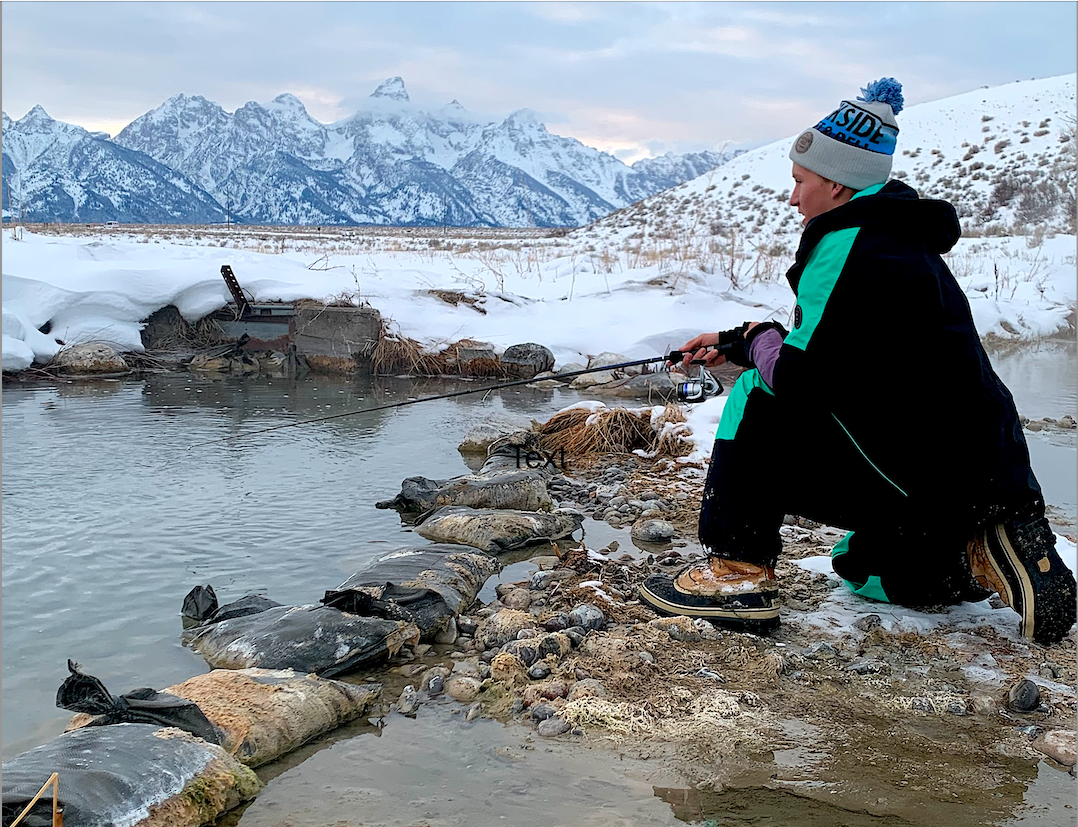
Pine island, Florida resident AJ Duda tries his luck at catching goldfish in Grand Teton National Park in January 2023. (Mike Koshmrl/WyoFile)

GRAND TETON NATIONAL PARK—It wasn’t AJ Duda’s first brush with angling for goldfish and other former aquarium dwellers within view of the Teton Range. 

The Pine Island, Florida teen, visiting Jackson Hole with family, had scouted this unlikely microfishing honey hole during a prior vacation. This time he came prepared. Armed with a spinning rod rig, line tipped with flies and small jigs, Duda worked the geothermally heated water coursing out of Kelly Warm Springs as it left the small pond.
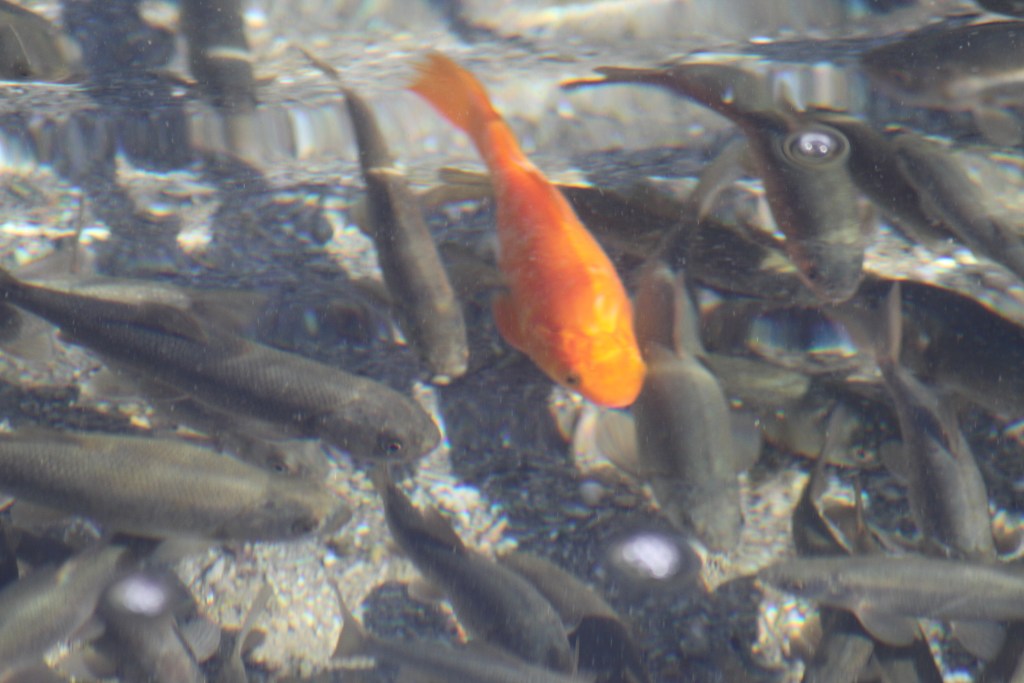
A goldfish schools up with dozens of other less colorful creek mates in an outflow from Kelly Warm Springs in Grand Teton National Park. (Mike Koshmrl/WyoFile)

His quest to hook unwanted exotic aquatic species was successful. Minnow-sized fish relentlessly attacked whatever bait he threw their way. 

Duda had his hopes set on hooking one of the brightest orange goldfish that stuck out in the fish swarm. Those fish were descendants of domestics let loose to live out their days in Grand Teton National Park. The goldfish, along with other invasive species — cichlids, bullfrogs, swordtails, guppies  — survived, and thrived, in this heated microenvironment. 
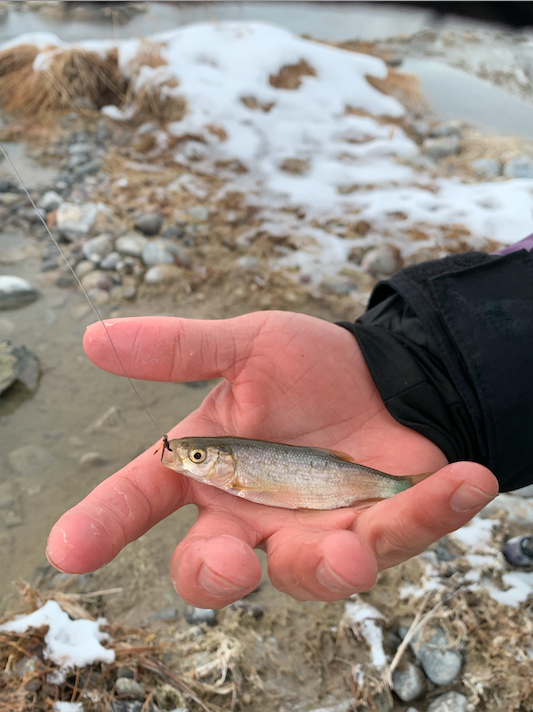
Florida teen AJ Duda caught this minnow, which he described as fallfish, while angling for goldfish in Grand Teton National Park’s Kelly Warm Springs. The minnow had likeness to a Utah chub, a native species. (Mike Koshmrl/WyoFile)

Using a piscicide, Teton Park fisheries biologists who prioritize native species have poisoned the 80-degree pond before. The tactic evidently didn’t do the trick. Goldfish and a host of other aquatic invasive species are readily visible to anyone who takes a stroll alongside the roadside attraction in the park’s southeast corner. 

Their persistence was no bother to Duda, who’d caught one duller-hued goldfish already and was eager to hook a bright one. They weren’t exactly elusive, but he couldn’t get his flies or jigs to the orange beacons in the water before other species like chubs would intercept them. While his family watched from the warmth of an SUV parked nearby, Duda fished on. 

Mike Koshmrl reports on Wyoming's wildlife and natural resources. Prior to joining WyoFile, he spent nearly a decade covering the Greater Yellowstone Ecosystem’s wild places and creatures for the Jackson...

Join the Conversation

4 Comments

WyoFile's goal is to provide readers with information and ideas that foster constructive conversations about the issues and opportunities our communities face. One small piece of how we do that is by offering a space below each story for readers to share perspectives, experiences and insights. For this to work, we need your help.

What we're looking for: 

  • Your real name — first and last. 
  • Direct responses to the article. Tell us how your experience relates to the story.
  • The truth. Share factual information that adds context to the reporting.
  • Thoughtful answers to questions raised by the reporting or other commenters.
  • Tips that could advance our reporting on the topic.
  • No more than three comments per story, including replies. 

What we block from our comments section, when we see it:

  • Pseudonyms. WyoFile stands behind everything we publish, and we expect commenters to do the same by using their real name.
  • Comments that are not directly relevant to the article. 
  • Demonstrably false claims, what-about-isms, references to debunked lines of rhetoric, professional political talking points or links to sites trafficking in misinformation.
  • Personal attacks, profanity, discriminatory language or threats.
  • Arguments with other commenters.

Other important things to know: 

  • Appearing in WyoFile’s comments section is a privilege, not a right or entitlement. 
  • We’re a small team and our first priority is reporting. Depending on what’s going on, comments may be moderated 24 to 48 hours from when they’re submitted — or even later. If you comment in the evening or on the weekend, please be patient. We’ll get to it when we’re back in the office.
  • We’re not interested in managing squeaky wheels, and even if we wanted to, we don't have time to address every single commenter’s grievance. 
  • Try as we might, we will make mistakes. We’ll fail to catch aliases, mistakenly allow folks to exceed the comment limit and occasionally miss false statements. If that’s going to upset you, it’s probably best to just stick with our journalism and avoid the comments section.
  • We don’t mediate disputes between commenters. If you have concerns about another commenter, please don’t bring them to us.

The bottom line:

If you repeatedly push the boundaries, make unreasonable demands, get caught lying or generally cause trouble, we will stop approving your comments — maybe forever. Such moderation decisions are not negotiable or subject to explanation. If civil and constructive conversation is not your goal, then our comments section is not for you. 

Your email address will not be published. Required fields are marked *

  1. This Duda dude may be accomplishing what the Park Service could not do with thousands of taxpayer dollars. Maybe we could hire him to take on those Lake Trout in Yellowstone Lake. Thanks for the story Mike.

  2. Correct me if I am wrong but I believe Grand Teton National Park spent thousands of dollars and thousands of employee hours attempting to eradicate those evil goldfish in Kelly Warm Springs and presented a park service employee with a national recognition award for same. Government at it’s best.

    1. It’s not the government unless you include, by the people for the people , tim people are still supplying the warm springs with goldfish and other aquatics every month , they move out of there apartments or homes and those county fair fish thrive in the mineral rich warm waters. It’s actually a great place to fill your own tank with free fish …..