

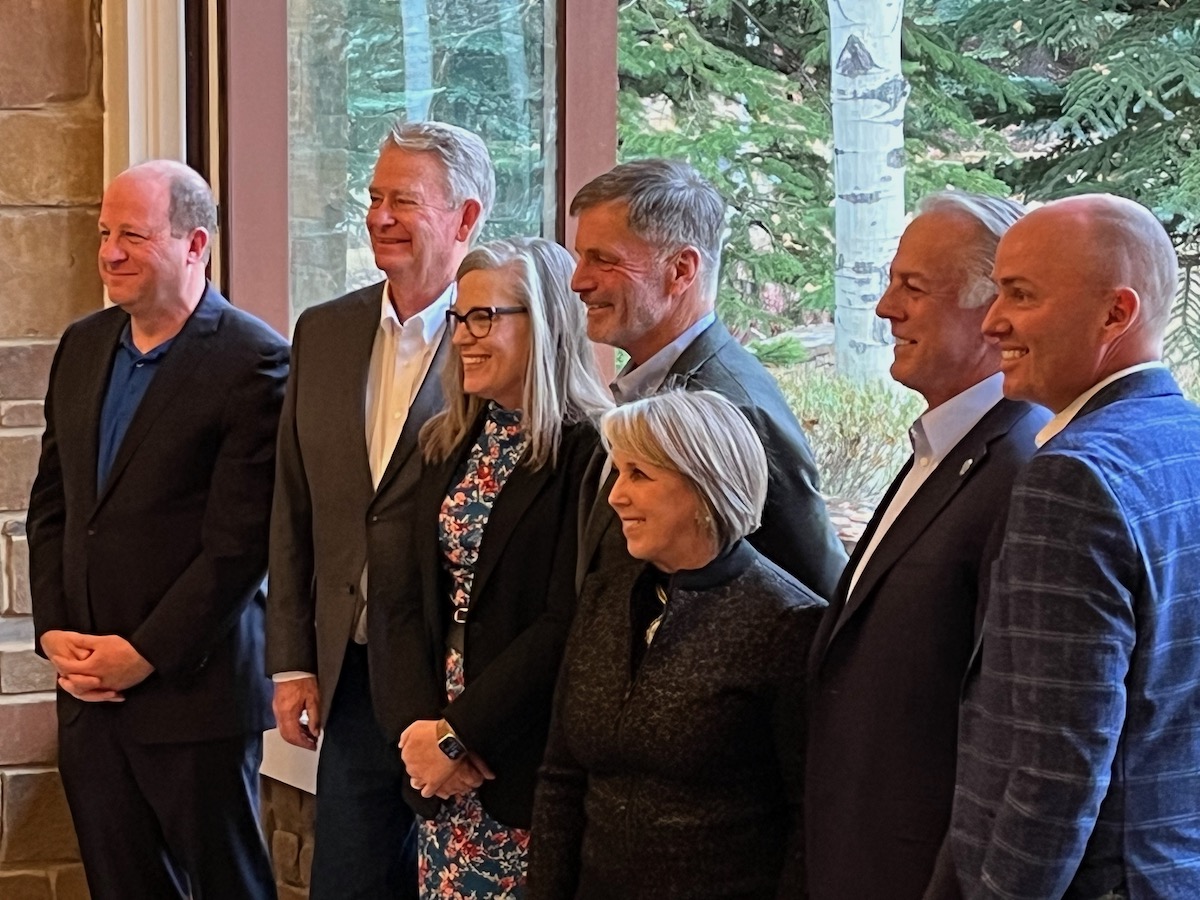
TETON VILLAGE—Wyoming spent more than a decade mapping its geology, forging federal partnerships and establishing its own regulatory framework to launch a variety of commercial-scale carbon capture and storage efforts. That work is beginning to pay off, Gov. Mark Gordon said Monday.
The state has attracted private investors in some of the largest direct air capture and carbon dioxide storage projects in the world, Gordon told six of his fellow western governors and a crowd of about 200 people.
“The technologies provide a pathway to significantly decarbonize both the energy and industrial sectors by capturing carbon emissions at the source and mitigating the [climate] impacts,” he said.
Gordon’s remarks kicked off the Western Governors’ Association’s winter meeting here, which will continue through Wednesday. Gordon was elected chairman of the group this summer, which comes with the privilege of choosing a special initiative for the association. Gordon’s initiative: “Decarbonizing the West.”
Gordon didn’t shy away from talking about climate change as a primary reason for pushing carbon capture technologies — just days after the Wyoming Republican Party and Freedom Caucus condemned him for saying the state must reduce its carbon emissions at a Harvard University event.
Federal support
Western states share the same urgency to address climate change for myriad reasons, Gordon told his colleagues and attendees. Wildfire is increasingly a danger, he said, and water is a growing concern.
“I have climbed these mountains and I have witnessed the Teton Glacier recede,” Gordon said.
Wyoming still tussles with the federal government and some states over the use of coal and other fossil fuels that have supported Wyoming’s economy for decades. But the state is advancing carbon capture and storage projects that make such fuels’ continued use possible, Gordon said.
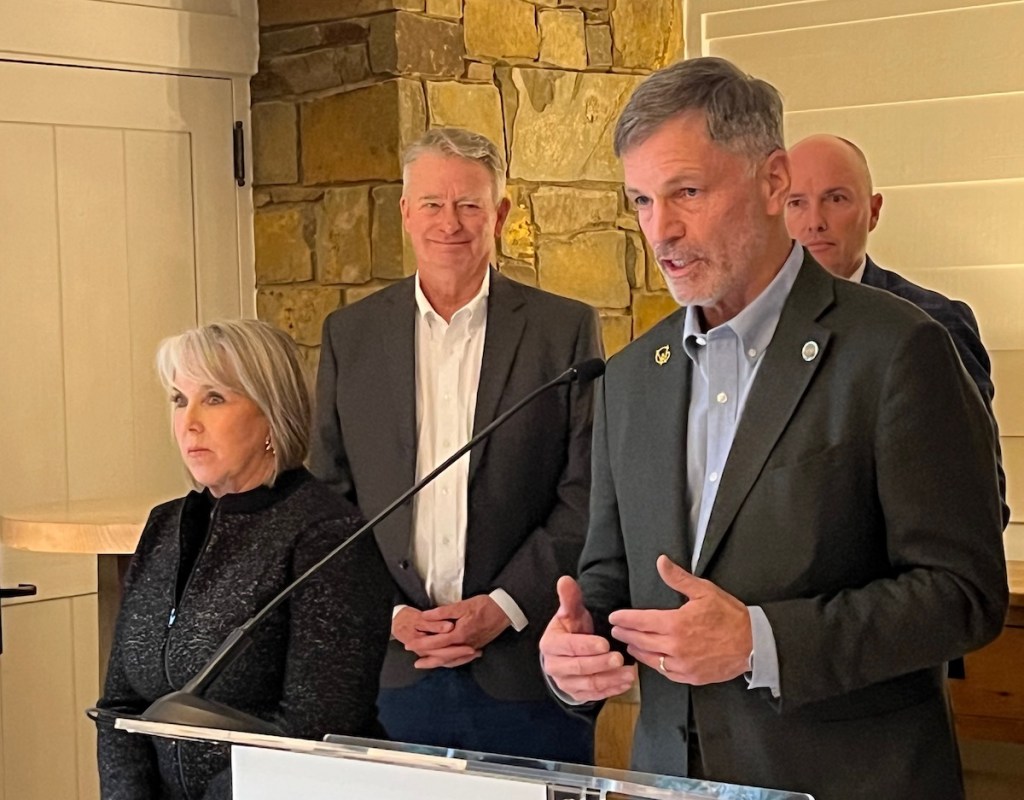
Perhaps most significantly for Wyoming and other western states, Gordon said, is that several federal agencies have come around to support carbon capture and storage efforts rather than stand in the way.
Gordon noted that he and Environmental Protection Agency Administrator Michael Regan found several areas of agreement during Regan’s visit to the state in August. Communities that rely on coal and other fossil fuels can use their existing industrial infrastructure and know-how to launch globally in-demand technologies that can reduce the impacts of carbon dioxide emissions.
“His point, which I thought was really valuable,” Gordon said, “is the faster we can develop this technology here and export it elsewhere, the better we’re going to be able to address climate issues worldwide.”
Gordon’s western colleagues are not unfamiliar with the concept of leveraging their extractive industrial sectors for more innovative opportunities. North Dakota, New Mexico and Utah all have similar ventures to capture carbon for enhanced oil recovery, for example. Others said their constituents have questions about the technological and financial viability of permanently storing carbon dioxide underground.
Answering those questions, along with helping fellow western states identify their own opportunities in the budding industry, is the goal of his “Decarbonizing the West” initiative, Gordon said.

Any one dumb enough to believe anything Gordon or his ilk say needs its head examined…as bad as believing what the “freedom caucus” spouts.
What is the bottom line on carbon emissions after the enhanced oil recovery is utilized and that oil is burned?
Carbon capture and storage is much more expensive than building wind and solar power, for the same amount of emissions reduction. If Wyoming’s top priority is to try to shore up the fossil fuel industry, it will miss the opportunity to become a major supplier of clean energy (and the tax base that will go with it).
Who is paying the bill to capture CO2? Is this cost added to the electricity bill?
As always and ever worse, the LIES. CO2 feeds plant life that in turn produces oxygen. Trees other plants , coral and such capture carbon on a scale boggles the lil brain of po dunk con man, Gordo.
From Natrona County – History of Natrona County. ” The Salt Creek Field is one of the largest CO2 oil recovery and geological sequestration projects of its kind in the world. The project currently sequesters enough CO2 each day to offset the equivalent emissions of more than 500,000 cars.”
There seems to be no question about the ability of the earth to receive and store CO2 gas especially in depleted oil and gas fields. The Governor’s initiative must be directed towards the technology required to capture CO2 from the exhaust stacks at coal burning power plants and other industrial CO2 discharge points of emission, After capturing, a network of pipelines are needed to transport the gas to the point of injection such as the CO2 flood at Salt Creek.
Not all CO2 is generated by combustion of fossil fuels – some is a byproduct of oil and gas production which encounters the gas along with oil, natural gas and water. Without injection at another point, the CO2 encountered during production must be discharged into the open air instead of being put to beneficial use like the Salt Creek CO2 flood project. Production CO2 can be a form of ” capturing ” the gas also.
Capturing and injecting is the way to go.
Sadly, this is just performative grabage, to (a) allow cover for retrograde fossil fuel support, and (b) to get minimal buy-in by conservatives for a new energy hierarchy. Carbon capture is pie-in-the-sky stuff, along with stuff like hydrogen cars. Our US Senators have actually gone so far as to introduce the “CARS” act, to make things worse by vitiating mileage standards and knee-capping electric automobiles.
Mark Gordon is a very thoughtful governor. I am wondering where the Montana governor is?