


Shortly after the ice came off in 2023, Pete Cavalli went to scout the conditions at Little Soda Lake in anticipation of an annual rite of spring: stocking the little water body outside of Pinedale with rainbow trout.
Even though the water was still cold, it was noticeably greener than usual. There was also a lot of manure around the shoreline, he said.
“The smell was overwhelming,” said Cavalli, a longtime fisheries biologist for the Wyoming Game and Fish Department’s Pinedale Region. “That definitely was a huge factor in recommending not stocking that year.”
In the year that followed, conditions at the little lake perched above mighty Fremont Lake and visible from Skyline Drive took an abrupt turn for the worse. No trout were stocked into the outletless, roughly 50-acre lake that spring, nor this year, and it ceased being a fishery. By this fall, the Wyoming Department of Environmental Quality sent word of a harmful cyanobacteria bloom, a notification that it was potentially not safe to swim or let animals drink the water.
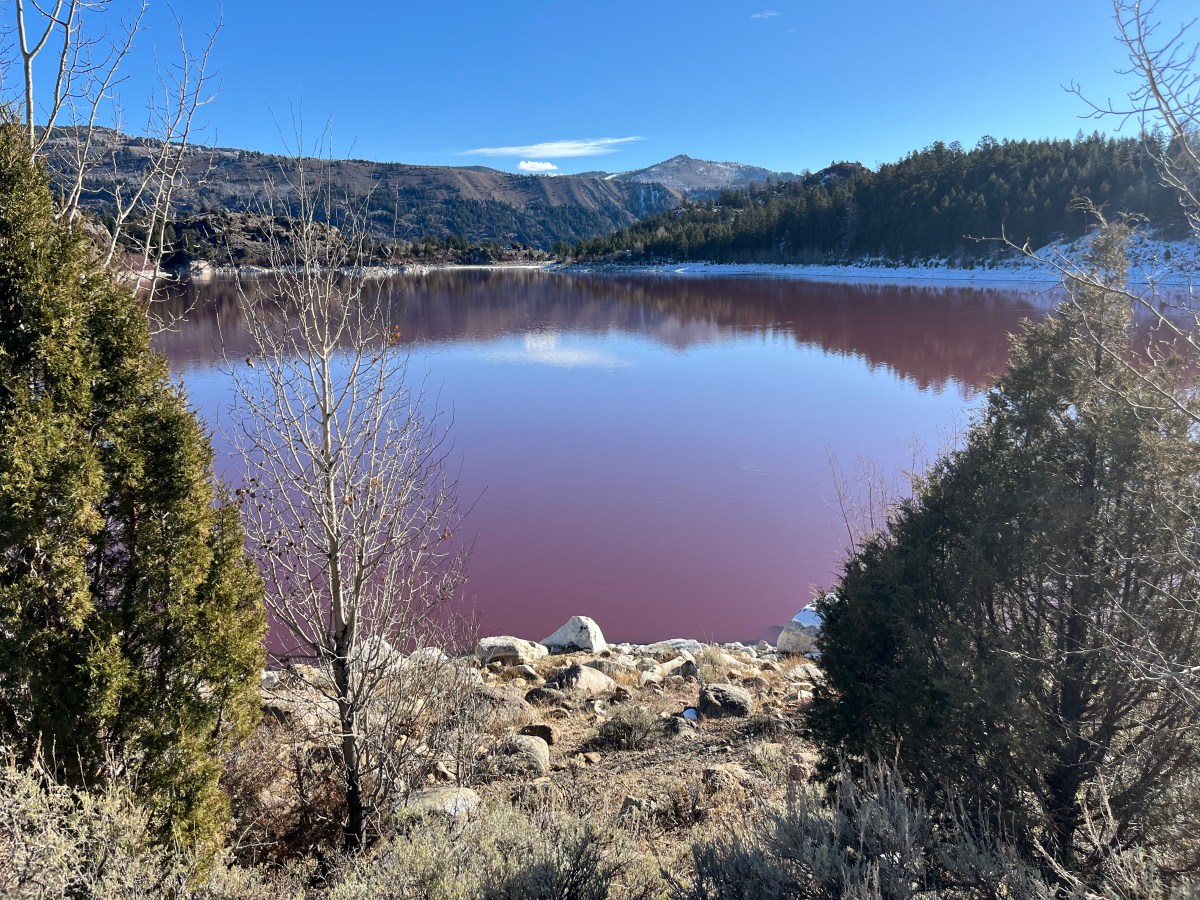
Notably, the bloom did not live up to the colloquial name: blue-green algae. Instead, Little Soda Lake turned a striking shade of red.

A hunter reported the mysterious water color, reminiscent of a mine tailings pond, in early November. Soon, Game and Fish and the Bridger-Teton National Forest were coordinating with each other and trying to determine what was going on.
“We don’t have enough information yet,” said Bridger-Teton National Forest staffer Jill McMurray, who handles water quality sampling. “Eucapsis, the main cyanobacteria species that the state identified in the sample, can turn red.”
More typically, however, Eucapsis is green or bluish-green, said Eric Hargett, Wyoming DEQ’s water quality standards program supervisor.
“In Wyoming, we typically do not see cyanobacteria blooms display in reddish colors,” he said. “It’s possible that the reddish color may be related to some other bacteria.”
Another possible explanation, according to McMurray, is that the organic matter that bloomed died when the lake “turned over” and the colder, deeper water mixed with the surface water. The phenomenon, combined with Little Soda’s unique chemistry, could have caused the color change.
“Kind of like how leaves turn red in the fall,” McMurray said.

Some members of the Pinedale community have posited that cattle crowding the small water hole over the summer played a role in the changes. The domestic stock’s presence is spelled out in the muddy banks, which were covered with cattle tracks and manure throughout the summer months of 2024.
McMurray believes it’s too early to make that judgment. Other backcountry lakes in the Winds have struggled with harmful cyanobacteria blooms without cattle grazing, she said, including three near Big Sandy Opening in 2024: V Lake, Twin Lakes and Meeks Lake. There’s more attention on harmful blue-green algae, even in the backcountry, than ever before, though oftentimes the environmental phenomenon feeding the cyanobacterial blooms is not straightforward.
One thing is clear about Little Soda Lake: It’s not likely to be a trout water anytime soon.
“It’s a non-fishery,” said Cavalli, the fisheries biologist. “It was a pretty popular fishery [previously], especially among Soda Lake anglers.”

With a water column reaching down more than 50 feet, the small lake once overwintered some stocked trout. Cavalli used to measure the oxygen content of the water, but he stopped years ago after finding that the lake was anoxic even at the surface — an oxygenless, lethal condition for fish.
The viability of the fisheries in Little Soda Lake and its larger neighbor, Soda Lake, have clearly been affected by climatic changes in the Green River Basin.
“All the evidence points to the fact that we’ve been in the long-term drought,” Cavalli said. “We’re not getting the moisture that we used to get, and [Soda Lake] is going down every year.”
Soda Lake, once renowned for its trout fishing, has dropped by about 15 feet from the high point decades ago, Cavalli said. Little Soda’s water level hasn’t fallen as dramatically, but it’s still declined by 6 to 8 feet, he said.

Even Soda Lake, about six times larger than Little Soda, is at risk of ceasing to be a functional fishery. At its peak in 1997, an estimated 47,000 trout called Soda Lake home. Estimates most years are now under 1,000, Cavalli said, and there are no easy solutions to make it better.
At the fishery already lost — Little Soda — Cavalli and his state and federal counterparts will be watching to see what happens.
“I thought when the temperatures dropped, the cyanobacteria would die back and it would clear up,” the fisheries biologist said. “But obviously, it’s still happening — whatever it is.”
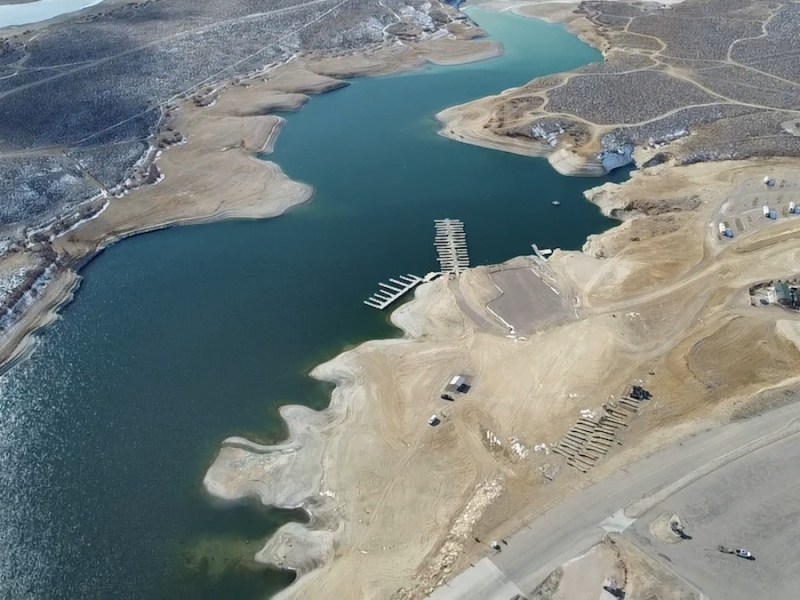
Photos Game and Fish biologists took from aerial flights in early December showed the reddish colored water is persisting even under the ice.

The DEQ plans to conduct additional monitoring at Little Soda Lake, Hargett said.
McMurray at the Bridger-Teton intends to help. Come next summer, she aims to test for nitrogen, phosphorus, nitrate, ammonium and phosphate — and also help get a read on cyanotoxins that might exist.
“We need to collect more information,” McMurray said, “and then figure out all the pieces.”
“It’s not just one thing that’s causing this problem,” she added. “The biggest thing is probably climate change and the change in the water table. And then there are other variables probably exacerbating this issue.”


Lee. Alkali is generally magnesium sulfate. Plus the photos show no algae bloom on water. A water test to pinpoint the issue is aprox $175. I run hundreds per year. Not complicated. 5-7 day normal turnaround. Lab right in Casper. The stink is from lack of Dissolved oxygen. She could or should run a BOD/COD TEST as well. $30. Simple
Cow manure is also cause for blue green Alge, here in Vermont. Also, fertilizer that gets in the water, the potassium it carries feeds the bacteria and causes blooms. Boaters can unknowingly transfer any aquatic invasive species from one water body to another.
Phil. With manure you would have E. coli.
As a frequent recreator of this area, I get to enjoy seeing herds of cattle living in muddy wallows of Little Soda lake all year long. There isnt a square inch of shoreline of this lake that isnt comprised completely of hoof prints.
However Im sure that the blame will fall on anything but cattle.
I remember the small alkaline reservoir, at the intersection of the Meeteetse Highway with Hwy 14-20 just outside of Cody, turning bright pink a few years back. I was told that it had to do with the lake water “turning over”. It also stank. Now the lake is back to normal, though water levels are low. It supports many birds both seasonally and as a migration stopover.
It certainly can’t be the cattle, and Biden is apparently too old, so it must be Obamacare.
Canada pumps air into their small fishing lakes, scattered across their prairies. It keeps the lakes alive and healthy. Also stimulates the tourist and fishing industries.
Lanthanum Modified Bentonite Clay (Phoslock) will permanently bind to the excess Phosphorus polluting this lake. Phosphorus is the main driver for the trophic state of all water bodies. It comes not only from the external sources such as manure and runoff, but also from the lake sediment itself called legacy phosphorus. Phoslock is also the top choice for trout fisheries as it does not change water chemistry like Alum Sulfate. Keeping trout safe and unharmed.
With over 150 peer reviewed papers worldwide, Phoslock USA resides in Casper, Wyoming and has a relationship with the WDEQ as well as servers on the board of the Western Aquatic Plant Management Society and sustaining member of the North American Lake Management Society.
Why are they so slow to figure it out?
In the late nineties, I fished Little Soda Lake probably a dozen times. Literally caught hundreds of Brook Trout that were between one and three pounds. The first day I fished it I caught between 50 & 60 fish all from the same spot. In all the times I fished it, I only saw two other groups of fisherman. Woming Game & Fish told me it wasn’t worth fishing. They didn’t know much about the lake as they told me it was only 20-25 feet deep. I took a canoe with a depth finder and found 60 foot deep water. The few years I fished it, it was completely full. I’ve never been back but often wondered what happened to it. I never caught any other fish besides Brooks
The cause is high iron content in water and microbes are digesting or oxidizing the iron. I see it all the time working with produced water in oilfeild disposals when I hired to clean them up. If they would start aeration of water in lake it would help turn the water clear as well. Several floating solar powered units on market. It not complicated process.
My colleagues at POWJH have found through research that nitrate concentrations are higher in the winter months than in the summer. Therefore, Ms. McMurray is going to get a better read by collecting samples now.
Can’t be the cattle. Got to be that damn Biden.
More: Just the name “Soda Lake” is a very strong indicator that there are significant total dissolved solids – alkali – feeding the lake. When there is abundant rain and snow, the fresh water dilutes the chemical constituents of the lake’s water which eventually overflows into the Green River. Without adequate diluting fresh water, the chemical composition increases. I grew up in the 10,000 lake country of eastern South Dakota – and right out there in the middle of hundreds of fresh water lakes in glacial till sand and gravels, was a foul lake called Stink Lake. Its source was obviously from the basement rocks and the fluids flowed up through a fault zone in the granite – it absolutely wasn’ t glacial water.
The point is, Little Soda Lake seems to be an outlying lake from the Yellowstone activity – however, witness the abundant variances in water color in Yellowstone – red water isn’t at all unusual there. In addition, many of the sedimentary formations in Wyoming contain high alkali salts which could affect Little Soda Lake. This very well could be a geologic phenomena and not from man made pollution.
Could it be:
1.) Has a dormant spring under the lake or near the lake all of a sudden started to flow again – happens in Yellowstone and at Thermopolis occasionally especially if there has been any earthquake activity – even a 2-3 quake can change spring flow – are there any other springs near Little Soda Lake????
2.) Are there any abandoned and plugged oil wells near Little Soda Lake where the plugging has failed or been bypassed thus allowing fluids to escape – remember the Pavillion polluted aquifer which was assumed to be from leakage from a nearby field – I also witnessed an apparent release from oil wells just NW of Moorcroft which caused the rancher to abandon his ranch buildings and move into town,
3.) are there any mapped fault zones near Little Soda Lake which have a zone of fractured rock along the fault line which allows fluids to easily move through the rubble in the fault zone,
4.) hydrothermal fluids in general can flow through the host rocks and then there is the possibility of geothermal heated fluids escaping – is Little Soda Lake near a hot spot in the earth’s crust – there are several well known hot spots in the Cody vicinity and at Thermopolis of course,
5.) the closer you get to Yellowstone the hotter the ground water – water along the fault line extending west of Thermopolis towards Meeteetse increases in temperature as you near Yellowstone – are there any indicators that Little Soda Lake is in an area remotely affected by Yellowstone magma???
Water sampling is absolutely necessary; however, the advice of an experienced geologist who knows the Pinedale area is also a must.