


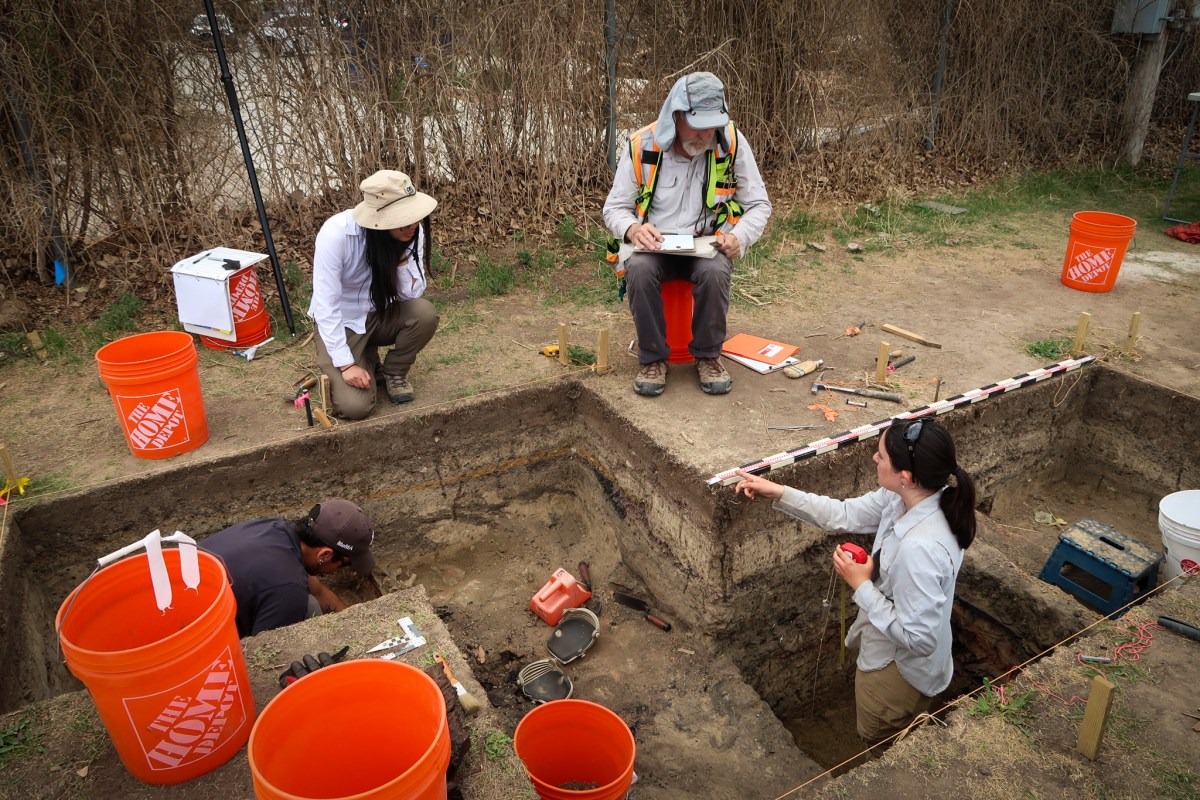
ROCK SPRINGS—A short drive from Main Street in Rock Springs, two rectangular holes, about 4 feet deep, form a checkerboard pattern in a grassy lawn. The green space, which connects a Slovenian Catholic church with a playground, has attracted a trickle of visitors from all over the country this summer to this small city in southwestern Wyoming.
Inside the holes, six Grinnell College researchers are digging, scraping and screening the soil. Most have never been to Wyoming before.
They’re looking for artifacts from 140 years ago, when a mob burned down what was once Chinatown in Rock Springs. In the violence, the mob killed 28 Chinese migrant workers and injured another 14, making it one of the most violent bouts of anti-Chinese violence in U.S. history.
In 1885, labor tensions had boiled over in the Union Pacific Railroad’s coal mines, stemming from an argument over who had the best work opportunities. The mob, many of them also migrants, blamed the Chinese. The mob burned several blocks that once made up homes and shops full of imported goods, later razed to the ground and redeveloped.
“[Because of this], there’s going to be a layer that is very distinctive in the archaeological record,” said Laura Ng, the Iowa-based archaeology professor leading the dig.
That layer is what’s known as the “burn layer” and it’s where Ng’s team is concentrating its efforts. Here they have found artifacts, ranging from pottery sherds, animal bones, an ornamental door handle and a wooden beam from an old building foundation.
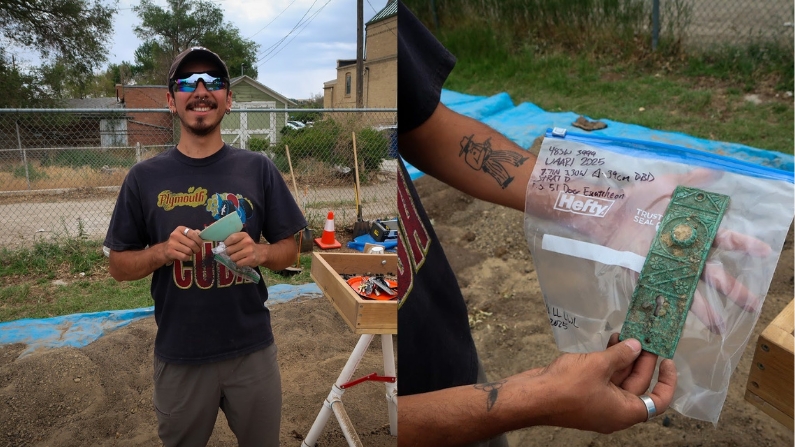
These artifacts tell the researchers what life was like in the 19th-century Chinatown for migrant workers, each of whom had a foot in two vastly different worlds. For many of the Chinese, work was in Wyoming and family in China. Not necessarily a personal choice, this was more of a reflection of federal immigration laws at the time restricting Chinese immigration.
“Railroads and Chinese-American communities go sort of hand-in-hand, but also discrimination, segregation,” Ng said.
Existing anti-Chinese sentiment built on the federal Chinese Exclusion Act in 1882, she added, and likely stirred the mob.
Descendants join the dig
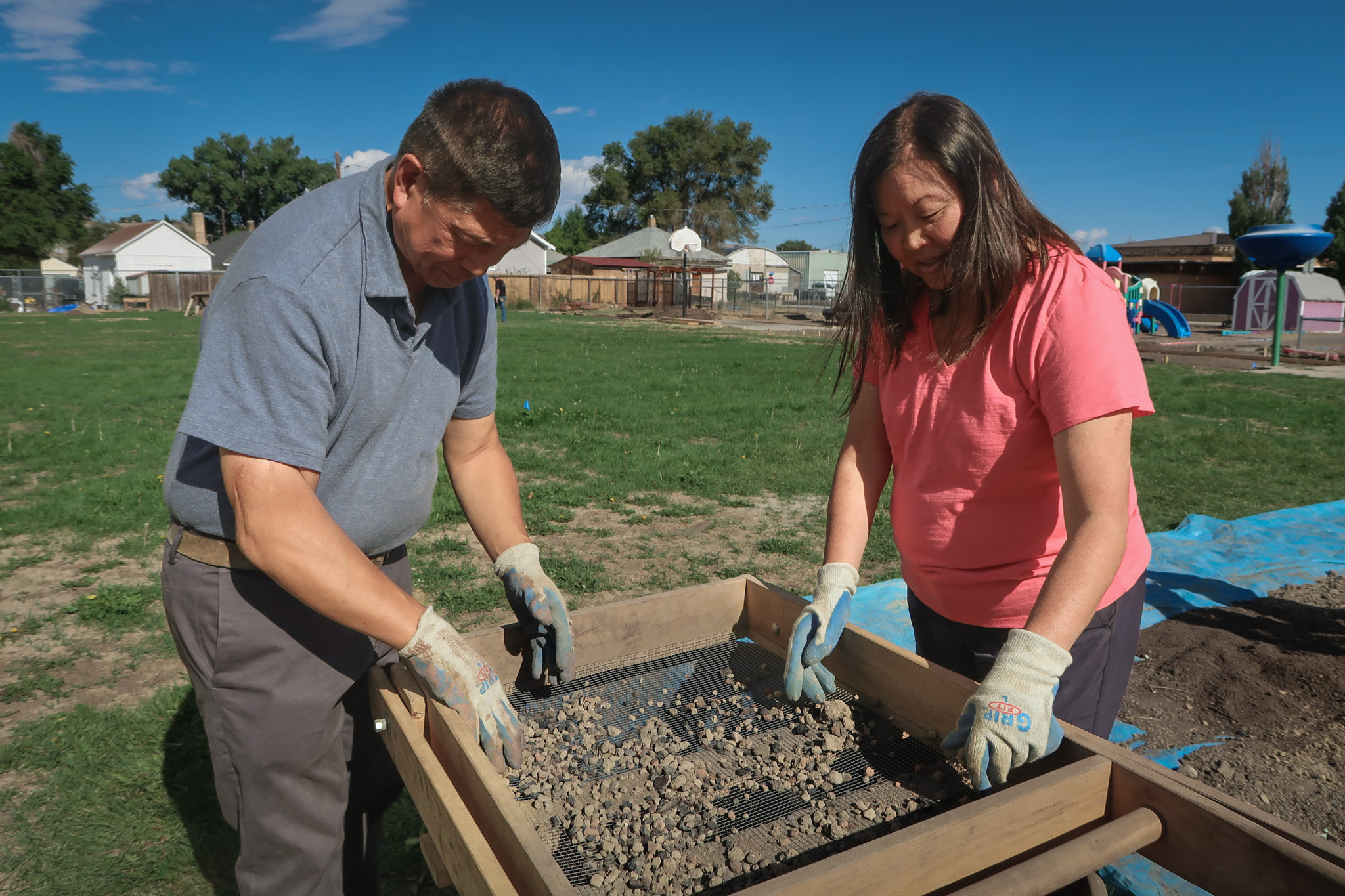
Despite spending most of their youth in Rock Springs, Grace and Ricky Leo only learned later in life about the massacre — and that they have ties to it.
“We didn’t know that we were related to the people that died in the massacre,” Grace said, during the Leos’ recent return to Rock Springs to join the dig.
Although the couple now calls Thousand Oaks, California, home, they’ve learned more about their family’s multigenerational ties to their hometown in recent years. The massacre was not something the Leos learned about in school.
At a 2019 event commemorating the 150th anniversary of the transcontinental railroad, the Leos met Rock Springs archaeologist and Western Wyoming Community College professor emeritus Dudley Gardner.
“I didn’t realize there were so many members of my family that were here.”
Ricky Leo
Gardner helped the Leos learn that Ricky’s father, a World War II veteran and owner of a Rock Springs Chinese-American restaurant, wasn’t the only Leo immigrant to make a life in Wyoming. Rather, it was a trend that spanned generations in the Leo family and dated back to the 1870s.
“That was very surprising,” Ricky said. “I didn’t realize there were so many members of my family that were here.”
That large number resulted from Ricky’s ancestors recruiting relatives to come work in Rock Springs.
Of the 28 killed in the massacre, 13 of them are from the Leo clan in China. His great-uncle was one of the survivors.
Two Rock Springs history museums mention the massacre in exhibits, though the Leos said some of it is incomplete. One suggests that there are no Chinese descendants from the massacre left in Rock Springs.
“We have to let them know that there are still descendants here,” Ricky said.
Whenever the Leos are in Rock Springs, they spend time keeping up Ricky’s late father’s home, which is still in the family. The Leos will return to Rock Springs this weekend to participate in a 140th commemoration to remember the massacre.
The commemoration begins Thursday in Salt Lake City with a visit to the Chinese railroad workers monument at the Utah State Capitol and then tours through Evanston and Rock Springs to visit historic sites and bless ancestors at the Chinese cemetery in Rock Springs. The event will culminate Tuesday morning with an 8:30 a.m. public dedication of a statue, designed by David Alan Clark, to honor the lives and memories of the miners killed in the 1885 massacre.
“The designer asked if I would be the model for the statue,” Ricky Leo said. “It’s an honor to represent the Leo family.”
Rock Springs’ immigration past and present
The Chinese weren’t the only migrant workers drawn to Rock Springs. The Union Pacific Railroad turned Rock Springs into a company town, pushing recruitment efforts all over the globe and earning the town the motto “Home of 56 nationalities.”
Every year since 1924, the town has held “International Day,” one of Wyoming’s only multicultural festivals, honoring the town’s long heritage of attracting migrants. These days, Rock Springs’ penchant for industry still attracts immigrants, though today the draw has changed and the migrants are less diverse. The railroad tracks still stand, but most travel by car on Interstate 80. Coal mining has also given way to trona.
The 2020 census shows that of the nearly 25,000 inhabitants of Rock Springs today, 60% identify as white and 18.7% Hispanic. Only a couple hundred Asian-Americans live there today.
Rock Springs isn’t isolated from the growing national crackdown on immigrants, and in some regards, is driving it. The sheriff’s department in Sweetwater County, home to Rock Springs, became one of the earliest in the country to adopt a contract to work on behalf of ICE in 2020. Under the second Trump administration, it upped its commitment to adopt all three possible types of contracts.
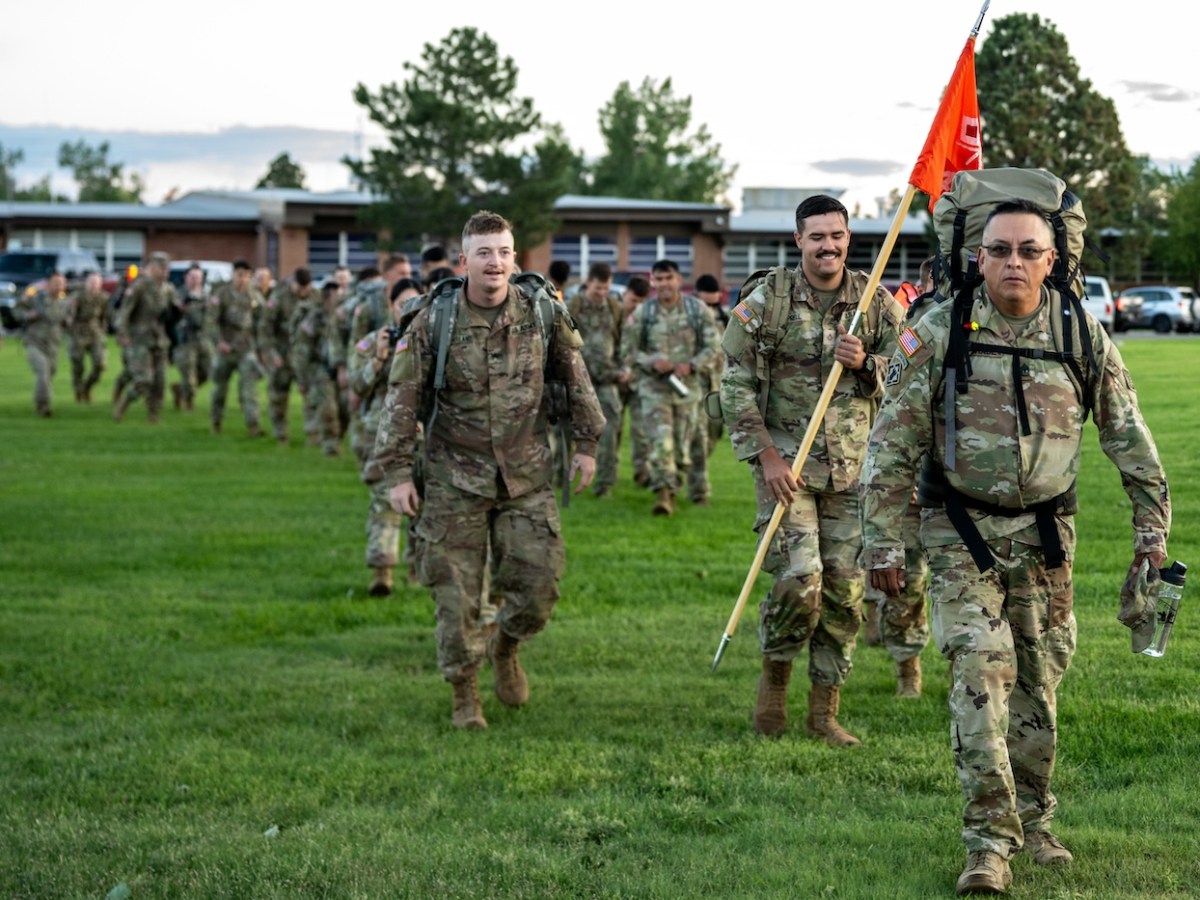
Four other Wyoming counties have followed suit, along with the Highway Patrol. Gov. Mark Gordon recently confirmed that the Wyoming National Guard will soon join immigration enforcement.
With the recent intensification in immigration policy, Ng described what she sees as a parallel from the past to the present: a system that lures migrants to drive the local economy without making it easy to stay. Instead, she sees migrants “villainized” and “criminalized.” A recent analysis of Wyoming data shows most immigrants arrested by ICE this year have no criminal backgrounds.

Even today, the Leos said some, including other descendants, would rather avoid talking about the massacre. Ng has heard similarly.
“Some people want to say ‘Get over it, it happened in the past,’” she said. “Why revisit something that makes America look bad?”
For Ng, the answer is simple.
“It seems like we don’t learn from history,” Ng said.
I just want to add a footnote to add to the conversation about how history has affected us now. The 7th Infantry was sent to Rock Springs to quell the riots and maintain the peace. It brought soldiers who stayed in Wyoming and their families stayed. We are one such family. It is often the case that we are where we are because of the sweep of history.
The Sweetwater County Library and Fine Arts Center has an amazing mural of the massacre, lest we forget.
I remember back in 1990 Mr Sutier was digging on the other side of the church just right of the entrance and found some artifacts. That’s all they did and was quick yo bury the site and finish. The parking lot. I always believed everytime they disturbed the site it would flood which has been true until this time. The fact that relatives are the ones involved must make all the difference. 1989 1990 the whole down town area was a lake soon after they dug there. ALSO just a few years ago the dug there and boom the place flooded. Glad to see that it makes a difference who and with what intent makes the site calm or a total wash. May the relatives find what closure and guidance they need and may a event like this never happen again.
Born in 1940 and growing up in Wyoming, I had never heard nor read about the Chinese contribution to our state’s history, nor about the 1885 Chinese massacre in Rock Springs. Moving to Rock Springs from Cody was a unique experience in encountering so many different nationalities. I found some information about those early days from articles in the scrapbooks of the early Rock Springs Woman’s Club describing their first International Days celebration. I interviewed a well-known Rock Springs resident, Dick Webster, who told about falling in behind a single file (he called it a queue) of a few Chinese men as they walked down Pilot Butte together. He told of the Chinese New Year’s Parade down that same street every year, with many good stories about one of their Chinese leaders: Leo Hung of the New Grand Cafe. I learned to polka from a Slovenian couple who told me the stories about The Grape Festival held annually at the Slovenski Dom. We later added a reenactment of the city’s celebration of inclusion of the many nationalities by marking the calendar each year for an International Day. The Rock Springs Chinese Massacre is such a deplorable and sad occurrence precipitated by human frailties and events, but not a good excuse for human actions. It is wonderful that we will follow it all up with this commemoration. Thank you to the Leos, the Ngs, Dudley Gardner and those who continue to make discoveries of our past and what it means to our future!
How is our so called president going to deal with this history? His asinine erasure of truth is an extension of his congenital lying syndrome, wherein he lies when it’s easier to tell the truth. History shows how ignorance and hate impeded our civilization. Can we learn?
We haven’t learned a damn thing.
Thanks for a good article on the grim subject of the history we need to learn from.
I think the year in the paragraph about the Sweetwater County Sherrif’s Dept joining ICE efforts needs to be corrected from 2020 to 2025.