
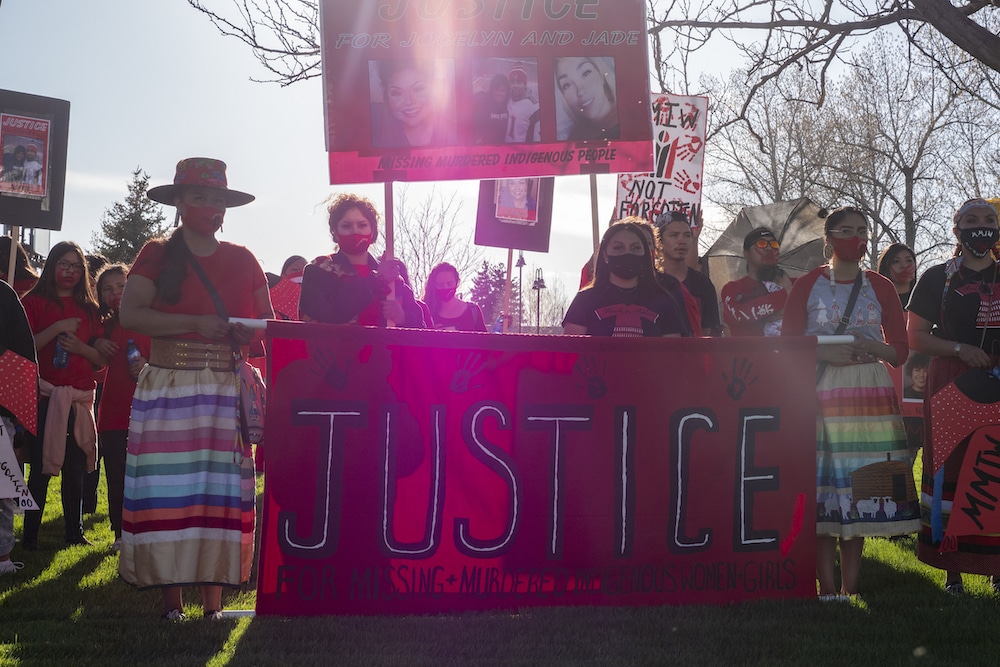
People gathered in Riverton’s City Park in May 2021 after marching down Federal Boulevard to commemorate missing and murdered Indigenous people. (BJ Klophaus)

A bill to create an alert system for abducted, kidnapped or compromised adults has thus far sailed through the Wyoming Legislature. 

House Bill 18 – Missing person alert systems passed through the House Labor, Health and Social Services Committee with a unanimous vote of support on Monday. On Tuesday it was placed on general file in the Wyoming House of Representatives, and upon introduction it passed the committee of the whole.

History:

If it passes, HB 18 would integrate federal, tribal and local law enforcement agencies in Wyoming under a common Amber-alert like system called the Ashanti alert — named for a 19-year-old Virginia resident, Ashanti Billie, who went missing after being abducted in 2017 and was found dead two weeks later 350 miles away.

The idea to bring Ashanti alerts to Wyoming — a system already in place elsewhere — emerged from the Legislature’s Select Committee on Tribal Relations in response to disproportionately higher rates of missing Indigenous Wyoming residents. In 2021, Indigenous people accounted for 17% of Wyoming’s missing persons cases, though they’re just 3% of the state’s population. 

Why it matters:

The new alert system would give law enforcement agencies another tool to locate missing Wyoming adults, Indigenous or not. The alerts are applicable to missing adults with special needs or circumstances and also missing adults who are “endangered” or have been involuntarily abducted or kidnapped.

Who said what: 

At the onset of the Legislature’s general session, Gov. Mark Gordon pushed HB 18 during his State of the State address.

“It is a needed solution to help all Wyoming people,” said Gordon, who created the Wyoming Missing and Murdered Indigenous Persons Taskforce from which the idea emanated. “It’s an opportunity to stop more missing persons cases at their inception, as well as take a meaningful step towards curbing human trafficking.” 

Sen. Affie Ellis (R-Cheyenne) during the Wyoming Legislature’s 2023 general session (Megan Lee Johnson/WyoFile)

Sen. Affie Ellis (R-Cheyenne), testifying to the House Labor committee, explained that research shows the first hours a person goes missing are the most critical to their recovery. 

“So the longer that we wait in issuing these alerts, the less likely it is that we recover these individuals,” Ellis said. “We did feel it was important to make sure that we were looking at not just children, but older adults.”

Ann Clement, a public policy manager for the Alzheimer’s Association, pointed out how the new alerts could help locate people prone to wandering. 

“There are about 10,000 Wyomingites that do have either dementia or Alzheimer’s,” Clement said. “About 60% of those with dementia will have a wandering episode. About 5% of those folks will make their way back home safely and unharmed [unassisted].”

Mike Koshmrl reports on Wyoming's wildlife and natural resources. Prior to joining WyoFile, he spent nearly a decade covering the Greater Yellowstone Ecosystem’s wild places and creatures for the Jackson...

Join the Conversation

2 Comments

WyoFile's goal is to provide readers with information and ideas that foster constructive conversations about the issues and opportunities our communities face. One small piece of how we do that is by offering a space below each story for readers to share perspectives, experiences and insights. For this to work, we need your help.

What we're looking for: 

  • Your real name — first and last. 
  • Direct responses to the article. Tell us how your experience relates to the story.
  • The truth. Share factual information that adds context to the reporting.
  • Thoughtful answers to questions raised by the reporting or other commenters.
  • Tips that could advance our reporting on the topic.
  • No more than three comments per story, including replies. 

What we block from our comments section, when we see it:

  • Pseudonyms. WyoFile stands behind everything we publish, and we expect commenters to do the same by using their real name.
  • Comments that are not directly relevant to the article. 
  • Demonstrably false claims, what-about-isms, references to debunked lines of rhetoric, professional political talking points or links to sites trafficking in misinformation.
  • Personal attacks, profanity, discriminatory language or threats.
  • Arguments with other commenters.

Other important things to know: 

  • Appearing in WyoFile’s comments section is a privilege, not a right or entitlement. 
  • We’re a small team and our first priority is reporting. Depending on what’s going on, comments may be moderated 24 to 48 hours from when they’re submitted — or even later. If you comment in the evening or on the weekend, please be patient. We’ll get to it when we’re back in the office.
  • We’re not interested in managing squeaky wheels, and even if we wanted to, we don't have time to address every single commenter’s grievance. 
  • Try as we might, we will make mistakes. We’ll fail to catch aliases, mistakenly allow folks to exceed the comment limit and occasionally miss false statements. If that’s going to upset you, it’s probably best to just stick with our journalism and avoid the comments section.
  • We don’t mediate disputes between commenters. If you have concerns about another commenter, please don’t bring them to us.

The bottom line:

If you repeatedly push the boundaries, make unreasonable demands, get caught lying or generally cause trouble, we will stop approving your comments — maybe forever. Such moderation decisions are not negotiable or subject to explanation. If civil and constructive conversation is not your goal, then our comments section is not for you. 

Your email address will not be published. Required fields are marked *

  1. This would be a positive step in the right direction for those who are experiencing vulnerability, entrapment, or violence. Thank you to legislators moving this forward.