

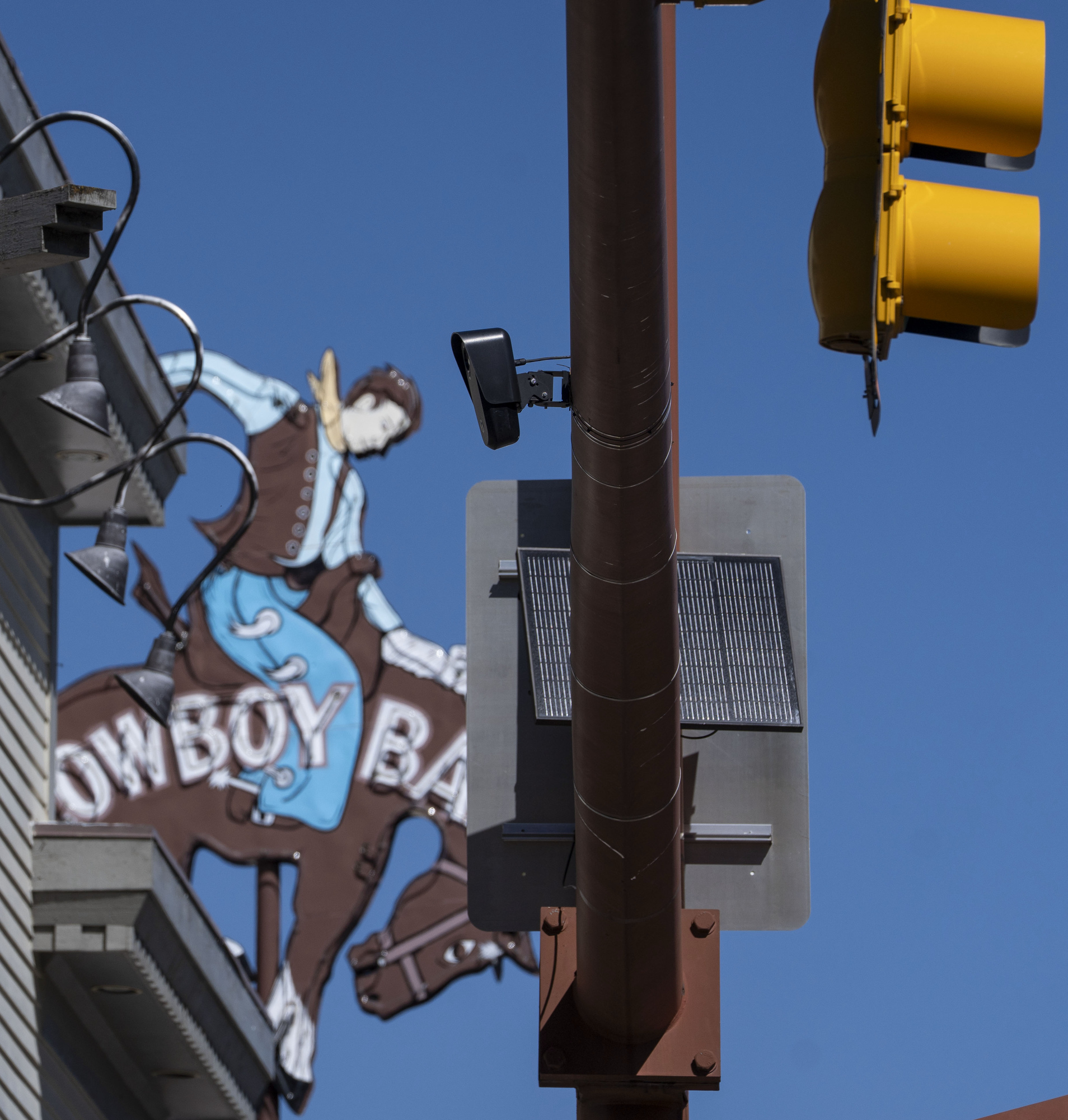
Editor's note:
WyoFile now provides audio versions of all articles. Feel free to send feedback to casey@wyofile.com
This story was jointly reported and authored by the Douglas Budget, Jackson Hole News&Guide, Green River Star, WyoToday Media and WyoFile. Reporting was coordinated and compiled by WyoFile, with editing from all participating publications.
The police chief turned his table to face a standing-room-only gallery in Glenrock’s aging town hall. With the Glenrock Town Council behind him, Police Chief Colter Felton sat for more than an hour explaining Flock cameras to an audience that alternated between concerned and agitated.
“To be clear, I am not in any way suggesting that any member of our town government or our law enforcement here is planning to misuse this program,” Rolling Hills resident Tim Cain told the council. “But evidence shows that the potential for harm across the country … outweighs the potential for good.”
The revelation that the Glenrock Police Department operates five Flock Falcon 2.2 model cameras — four in Glenrock, and one in neighboring Rolling Hills, which Glenrock police patrol — has ignited a furor among residents of this small, central Wyoming community.
Public anxiety over automated license plate reader technology and government surveillance has spilled over from city hall onto city streets in Wyoming and nationally. Cameras from Flock Safety, an Atlanta-based company, have particularly drawn attention.
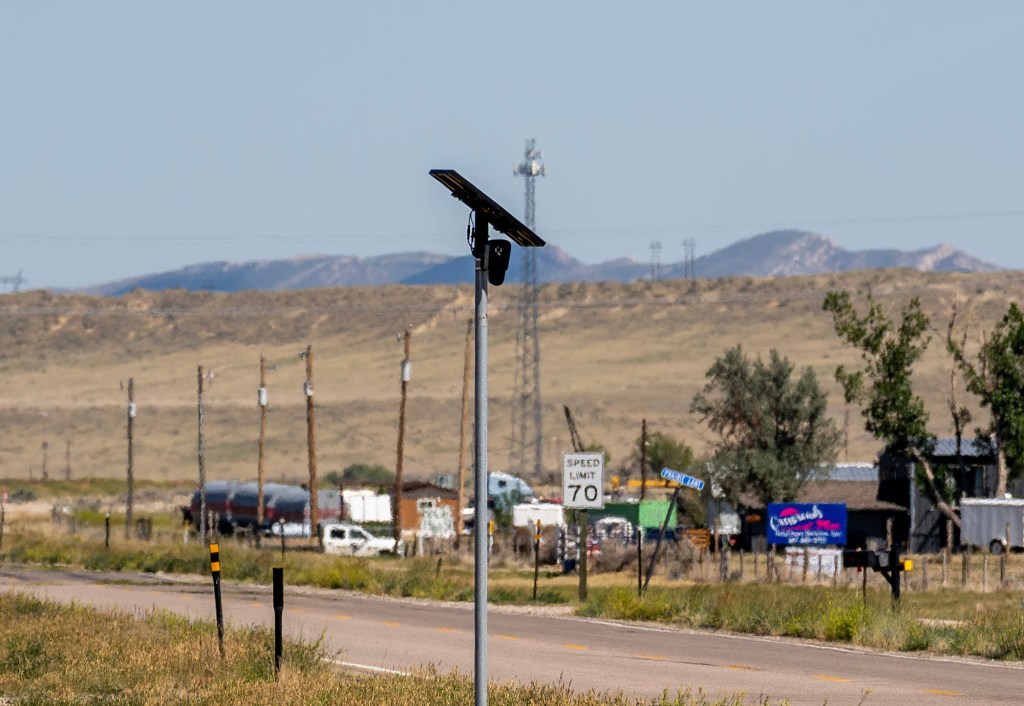
Flock’s system uses artificial intelligence to monitor and photograph passing vehicles. That information is uploaded to a central system that participating law enforcement agencies can search — though Glenrock and Jackson limit data sharing. There are now roughly 120,000 Flock cameras operating in every state but Alaska, and more than 7,000 law enforcement agencies use the technology, according to the New York Times. If you’ve been driving any notable amount over the past few years, chances are your car’s been recorded by the system.
In southwestern Wyoming, what began as a debate over federal grant funding and data privacy in Green River morphed into viral social media speculation and property damage in neighboring Rock Springs. On the other side of the state, Cheyenne police have embraced the cameras while the Laramie County sheriff has avoided them due to concerns about violating the U.S. Constitution’s Fourth Amendment, which protects against unlawful searches.
Some Wyoming law enforcement agencies view the technology as a vital tool to help catch fleeing suspects, locate runaways and track stolen vehicles. But vocal contingents of residents argue the systems represent an unconstitutional expansion of public surveillance.
The value of surveillance
In Glenrock, the cameras have been in place for two years after being added during a council budget session, which many residents now see as a sleight-of-hand maneuver to install them. Nearby Rolling Hills uses a single camera, which the council there considered during a regular session that drew a handful of opponents who spoke against installing the camera to monitor the community of about 400 people. The cameras cost $15,000 per year, or $3,000 per device, although the first year was a touch over $19,000 with installation costs.
Glenrock’s particular model of cameras takes pictures day and night, but doesn’t record vehicle speeds or video. The driver’s face isn’t visible through the windshield. According to Chief Felton, the cameras can search for details such as “red Ford Focus with bumper stickers,” but not, say, “Trump sticker” or “Biden sticker.”
While Glenrock has a more basic model, Flock also sells cameras that can record video or take more detailed pan, tilt and zoom shots, according to the company’s website.
During the Aug. 25 meeting, local residents detailed their concerns, occasionally interrupting the speaker as they expressed fears about a lack of oversight, uncertainty over Flock as a company and the security of photos stored for 30 days at a time. They questioned whether this type of surveillance violates their civil liberties.
At the individual level, one car passing a camera isn’t valuable. But when that same car passes multiple cameras at different locations and times, and they’re all communicating through Flock’s network, a savvy investigator can piece together a path of travel for a car without leaving their office, and, notably, without a warrant.
The potential benefits have spurred some tribes to allow license plate readers on reservations to enhance public safety in the face of officer staffing shortages and patchy enforcement due to complex, overlapping jurisdictions.
License plate reader cameras are in use on the Fort Peck Reservation in northeastern Montana, American Indian Movement Montana co-Director Lance Fourstar said. “I can remember a couple years ago, before the cameras were installed, we were having fentanyl overdoses like every day. And that stopped. The methamphetamine [use has] quieted down quite a bit. And we’ve used those cameras to save people that are being trafficked — all the way down in southern California.”
Fourstar said AIM and other activists vetted these license plate readers “so that they wouldn’t be abused by their law enforcement or governments towards our people and our exercising of freedom of speech.”
A Flock Safety license plate reader is seen
along a public road, Oct. 16, 2025, in Houston.
(AP Photo/David Goldman, File)
Local data, national reach
Flock’s product is data. When an agency participates in the national Flock network — Glenrock does not, according to Felton — it is logged into a searchable database that any officer with access can use to retrieve data, regardless of their location. To search, a unique case number and reason are required, such as “grand larceny” or another type of crime. In the last 30 days as of this writing, Glenrock’s cameras have identified 16,897 vehicles. Police have made seven searches during the same period.
Law enforcement have other means for obtaining pictures of cars and license plates on public roads — an investigator could go to a local bank, for example, and ask to see security cameras, and if the private business gives permission, the investigator has access without a warrant.
But the network and amalgamation of this information that Flock provides is unique and has been found to sometimes lack adequate guardrails to protect against abuse. An officer in South Florida, for instance, used the system to search a woman he met on the set of a television show, using the system to track her, pull her over and ask her out. He was later arrested. The Washington Post has identified at least 50 incidents of officers using the system for stalking purposes.
Glenrock police don’t share Flock data with the federal government or other law enforcement without an explicit request, Felton has stressed both in interviews and to the public.
Flock gives agencies the option to opt out of certain features, and in some cases, it’s as simple as flipping an off switch in the settings menu. There are options for immigration and abortion investigations, among others. Felton showed those two switches were turned off during his demonstration with the Douglas Budget.
Since Flock’s contract states that the company doesn’t own any of the data, the onus falls on law enforcement and local regulations to securely store and disseminate that information. In the case of Glenrock, that oversight falls to Felton.
Councilmember Judi Colling, who is running against incumbent Mayor Bruce Roumell in November, has concerns with the system.
“I think a publicly registered vehicle on a public road does not have the right to privacy that some people believe,” Colling said. “However, when you add in the possibility of misuse and abuse by public officials, that’s a real concern, and that is something we need to look into. Until I am convinced that the guardrails are in place to protect people from possible misuse and abuse, I have to say I am opposed to the usage.”
The council, as well as Felton, were open to more oversight of the system.
“I don’t have any problem with auditing,” Mayor Roumell said. “I think if somebody’s going to audit it, it should be another outside law enforcement agency, somebody outside the county. It’s not just going to be an independent somebody off the street that doesn’t know what they’re looking at.”
Glenrock’s contract is up for renewal this fall.
Surveillance tech stirs up Sweetwater County
In Green River, controversy over the cameras culminated when the southwestern Wyoming community’s city council considered a $112,000 state homeland security grant. The 100% federally funded grant would have allowed the Green River Police Department to acquire automated license plate readers manufactured by Motorola.
Green River Police Chief Shaun Sturlaugson tried to assure residents in the community of 11,000 people that police would use the cameras reactively rather than proactively. During a city council meeting, the chief clarified that officers would not use the cameras for routine traffic enforcement like identifying expired registrations, but rather to receive automated alerts when a vehicle tied to a national crime database or missing child rolled into town. He added that data retained in Motorola’s cloud system would be automatically scrubbed in under 30 days.
Despite the chief’s assurances, residents packed council chambers to express deep distrust over private vendor data storage, potential Fourth Amendment violations and setting a precedent of monitoring law-abiding citizens.

Among those who spoke was Dennis Laughlin, a local business owner and vice chair of the Wyoming Libertarian Party. Laughlin commended police but urged caution introducing surveillance infrastructure.
“Green River PD, you guys … I really have never felt safer,” Laughlin told the mayor and council. “That being said … I think maybe the fact that nobody has gotten up here and been like, ‘Yeah, let’s do this,’ maybe think against doing this.”
Laughlin praised the public for thoroughly researching the potential legal and privacy pitfalls associated with private software vendors like Motorola. He urged the council to examine how software architecture and third-party data distribution function before committing the town to automated surveillance systems.
Ultimately, the Green River City Council voted 6-1 to reject the grant agreement, forfeiting the federal dollars. Councilman Gary Killpack cast the sole “Yes” vote, arguing that neighboring jurisdictions already use the cameras and that rejecting the grant limits local law enforcement’s investigative capabilities without eliminating tracking elsewhere.
While Green River turned down the technology, rumors regarding surveillance swirled in its larger neighbor, Rock Springs.
As online rumors escalated, vandals tampered with and damaged city property. The city and the police department responded with a statement clarifying what technology has been installed and warning against destroying municipal infrastructure. Rock Springs police do not use Flock cameras, and the damaged equipment turned out to be solar panels installed by the city’s streets department to power streetlights. A private business installed the downtown cameras several years ago after art pieces were stolen or damaged.
While police acknowledged they could not prove vandalism resulted from the online posts, officials called the timing “concerning enough that we want to address it.” Officials cautioned residents against letting unverified social media speculation drive public action, pointing out the false assumptions can result in costly damage.
“Those solar panels and other components are there for a reason,” the city stated, noting repairs strain public funds and disrupt community services.
While acknowledging privacy and surveillance are legitimate topics for public debate, officials urged residents to base those conversations on facts.
Growing regional debate
Amid the growing statewide debate, municipal leaders in cities like Cheyenne and Jackson have embraced Flock cameras as essential “lead generators” for criminal investigations.
License plate-reading cameras have operated in Jackson for several years, helping police investigate crimes while generating persistent questions about surveillance, data sharing and federal access.
The Jackson Town Council voted 3-2 in 2023 to spend $184,800 to purchase and install 30 Flock cameras. Subsequent town reports have described 28 cameras operating around the northwest Wyoming city.
At the time, supporters said the cameras could deter crime, locate stolen vehicles and reduce the time officers spend searching for vehicles connected to investigations. The Jackson council has since renewed the agreement at a cost of nearly $90,000 annually.

In 2023, Jackson Councilman Arne Jorgensen voted against installing Flock, questioning the cost and whether the technology could eventually be used to track women traveling across state lines for abortions. He has since been elected mayor and voted in favor of renewing Flock’s contract after assurances Jackson has a contract and policies in place to limit how the data may be accessed and used.
“Can we trust Flock? I don’t know,” Councilor Jonathan Schechter said at the town’s June meeting, where residents continued to raise concerns about surveillance. “Can we trust them any more than any other company that is going to be vulnerable? I don’t know.”
Police say the cameras are used in cases involving stolen vehicles, hit-and-runs, missing people, welfare checks and other incidents involving cars. Jackson Police Lt. Russ Ruschill previously told the Jackson Hole News&Guide that Flock is “another tool, like a records system or a patrol car, that helps us move faster on cases and keep families safe.”
Under Jackson’s policy, camera data must be automatically deleted after no more than 90 days. Police permanently retain an audit trail documenting searches, including when a query was conducted and what information was accessed.
Jackson’s policies do not make the local data broadly searchable by other communities. Outside agencies must provide Police Chief Michelle Weber with a case number and supporting documentation before receiving access. Only the chief is authorized to release the information. Weber previously said Jackson had received about 15 outside requests, and none came from U.S. Immigration and Customs Enforcement or were abortion related.
Cheyenne police embrace Flock, sheriff doesn’t
The Cheyenne Police Department received city council approval in 2024 to enter a contract with Flock. The 23 cameras installed on major roads throughout the community cost the city of Cheyenne $146,300 over its two-year contract. The city is using American Rescue Plan Act funds to pay for the cameras.

The department also has additional automated license plate reading cameras that aren’t affiliated with Flock. These cameras are used for parking enforcement only, according to the department’s spokesperson. The agency has two parking vehicles with four total license plate cameras between them, as well as seven license plate cameras at the entrances and exits of city parking garages. These cameras are operated through the department’s parking vendor, Passport. Images from the cameras are automatically deleted after 90 days, according to the department’s spokesperson.
The Cheyenne Police Department actually experimented with the use of license plate-reading cameras as far back as 2014, Cheyenne Police Chief Mark Francisco said during a March public meeting on Flock cameras. “It was a successful trial, but it was expensive back then,” Francisco said. “The technology was expensive, and the storage was really expensive, so it just kind of went away.”
Francisco has described Cheyenne’s Flock system as a “lead generator” that helps solve crimes. Over the past 30 days, the cameras collected 223,424 unique plate reads, according to the Cheyenne Police Department’s Flock Transparency Portal. Cheyenne police searched the camera data 218 times and found 607 “hotlist hits” — license plate readings related to stolen vehicles, warrants or Amber Alerts.
“Really, it’s every day we are using this technology to help solve crimes in Cheyenne,” Capt. David Janes said during the March meeting. “It’s one of those very, very common things because most people who are committing crimes and victimizing others are using vehicles to get there.”
The data helped Cheyenne police track down a sex offender who had stolen a truck from the Cody area, Janes said. Law enforcement didn’t know the license plate number of the stolen truck, but they knew it was a white Ford Ranger with a rusted top. An officer was able to narrow down camera images using that information. Even then, he had to scroll for “hours and hours and hours until he saw the picture of the white Ford Ranger with the rust on the top,” Janes said. The officer got the license plate number from a Flock camera image and used that to check for other times the truck had passed Flock cameras. Officers found that the suspect was in Fort Collins. “So they were able to go down there, find him and arrest him.”
A three-page policy governs the Cheyenne Police Department’s use of its cameras. According to the policy, all database searches have to be associated with “an official law enforcement investigation,” and must be attached to a case number and explanation of the search’s purpose. Only trained personnel can use the equipment and databases. The data is wiped after 30 days, except for data that’s used for “evidentiary or legal purposes.”

Laramie County has been a hotspot for immigration enforcement in Wyoming since the Laramie County Sheriff’s Office signed agreements with U.S. Immigration and Customs Enforcement last year to enforce immigration laws. The partnership has raised concerns that the Cheyenne Police Department’s surveillance data could be used for immigration enforcement.
The data can be shared with “law enforcement or prosecutorial agencies for official purposes,” the Cheyenne Police Department’s policy states. Agencies with signed memorandums of understanding and Flock access “may request data through the Flock system.” But Francisco told community members at the March meeting that the department doesn’t share data with ICE. “There’s really only two that we share, and I believe one was a postal service, and one was some air force base. I don’t recall the name off the top of my head, but we do not share with ICE. We use these for criminal enforcement, not civil,” he said.
According to the department’s spokesperson, the Cheyenne Police Department hasn’t received a request from ICE to share data.
A community member asked why there wasn’t more transparency “right at the get-go,” when the police department and city council were considering purchasing the cameras. The city council approved the contract in a “consent agenda,” meaning it was grouped with other decisions voted on all at once.
At the time, the city was trying to decide how to spend leftover pandemic relief money, which had to be used by the end of 2024, Francisco said. “We were really under the gun, and as we worked with the mayor and city staff, I’m like, ‘I got an idea,’” the chief explained. “So literally, we had no time to do much other than get it through the system.”
But “hindsight being 20-20,” Francisco said the department should have alerted the public that the police department and city were considering the cameras. “I take responsibility for that,” Francisco said. “These things in my world have been ubiquitous. They’re everywhere. I would have expected the citizens of Cheyenne to maybe be surprised they weren’t already here, just because they’re everywhere.”
The city council will have to decide by February whether to renew the Flock contract.
The Laramie County Sheriff’s Office, meanwhile, didn’t adopt Flock cameras after the company approached the agency asking if it would deploy them throughout the county.
“Now, do I believe that there is a use for license plate readers in certain high crime areas, or if you have a big problem with auto theft? Yes, on a limited basis, yes, I do agree with that,” Sheriff Brian Kozak said in a video.
But, noting that Flock camera systems are connected by AI, and that they can search other vehicle characteristics like color, type and bumper stickers, Kozak said he was concerned that the cameras could bring up Fourth Amendment issues.
“For that reason, we did not deploy any cameras in unincorporated Laramie County, and I have no plan to deploy them in the future,” Kozak said.
— Sarah Elmquist Squires of WyoToday Media contributed to this report.




Thank you for this excellent, collaborative reporting.
A small observation: The following sentence somewhat carelessly repeats crazy talking points that insist on false equivalencies: “…the cameras can search for details such as “red Ford Focus with bumper stickers,” but not, say, “Trump sticker” or “Biden sticker.”
No one is talking about Biden any more, except Trump and his minions, and virtually no one in Wyoming has a Biden bumper sticker.
Just say no to nonsense!
I lean heavily towards a Libertarian view on most issues, this one maybe not so much as the authors of most of the other posts. Those who sacrifice liberty in the name of safety almost always wind up with neither. That being said, there can be no denying that a great many victims of trafficking, kidnapping, etc. have been rescued as a result of information collected by the surveillance state. While we all can loudly debate whether or not the risks outweigh the benefits, for the parents and loved ones of those rescued victims, there is no question of surveillance’s value.
Surveillance of our citizens is incompatible with a democracy. Flock cameras must go.
One of the cameras in Cheyenne is directly outside the main gate to F. E. Warren AFB. The russians are very good at hacking computers, and won’t be the first to have worked their way into the Flock system. This means they know when the Airmen and their commanders are coming and going. I feel so secure knowing that our nuclear weapons base is being watched over so well.
I have mixed feeling about Flock cameras because I’m sick of being on camera in public spaces due to our society’s moral compass malfunction. Yet, these cameras do catch bad guys.
However; how many readers carry a smartphone and drive a late model vehicle? These devices are spying on you every minute of the day, even when they are off due to the trickle of electricity needed to keep them functioning as designed.
I use a dumbphone and drive a 30-year old vehicle.
In order for the police to have my cell phone data, they need a warrant. Flock is just a work around of the 4th Amendment.
Currently, there are few places we can go without being on camera. Walk in a neighborhood, and every doorbell has a camera on you. Go to Walmart, the gas station, school, or the drugstore, and you’re on camera. High-traffic areas and street intersections all have cameras. For what purpose? SAFETY. Irrespective of the apparent help law enforcement may claim, it leaves open the question of what determines “probable cause” for a potential stop. It could lead to a warrantless search based on probable cause. We do not need to subject ourselves to the same surveillance that the whole of China subjects its citizens.
reason number 137 to hate cops. please, someone, tell me one positive attribute of modern law enforcement?!
One positive attribute of Law Enforcement, you ask: I sleep better at night knowing Law Enforcement is covering the watch. If my neighbors home has a chimney fire, one of those III watch officers might notice it before sparks land on my roof. There are more, but you asked for one. Thanks for the opportunity.
we do not want to live in a surveillance state. i will take my freedom over the constant surveillance of everything i do any time. Find better ways to make our communities safer without resorting to watching our every move. We have given up enough freedom. Enough is enough.
How many sheep herders have been replaced by Flock cameras?
We are giving away too much of our freedoms and once that is gone . its a hard road to get them back .
“Those who would give up essential Liberty, to purchase a little temporary Safety, deserve neither Liberty nor Safety.”
Benjamin Franklin.
Americans time and again show they are willing to give up their freedoms for promised safety, many times against perceived threats that are concocted by Govt\media.
I agree. The entire world has become much safer and less violent since 1990, so much so that law enforcement has to resort to being the nanny of the neighborhood to find any people to get into their pyramid scheme. Law enforcement’s first response was to criminalize drinking and driving, which only captured more people into the system but did not improve safety and now they are looking for more ways to criminalize non-existent crime.
“Glenrock police don’t share Flock data with the federal government or other law enforcement without an explicit request, Felton has stressed both in interviews and to the public. ”
Note explicit request. When an agency like ICE can use illegal warrants to make requests instead of using an actual judge instead of the whims of any ICE agent we are in a dystopian universe.