


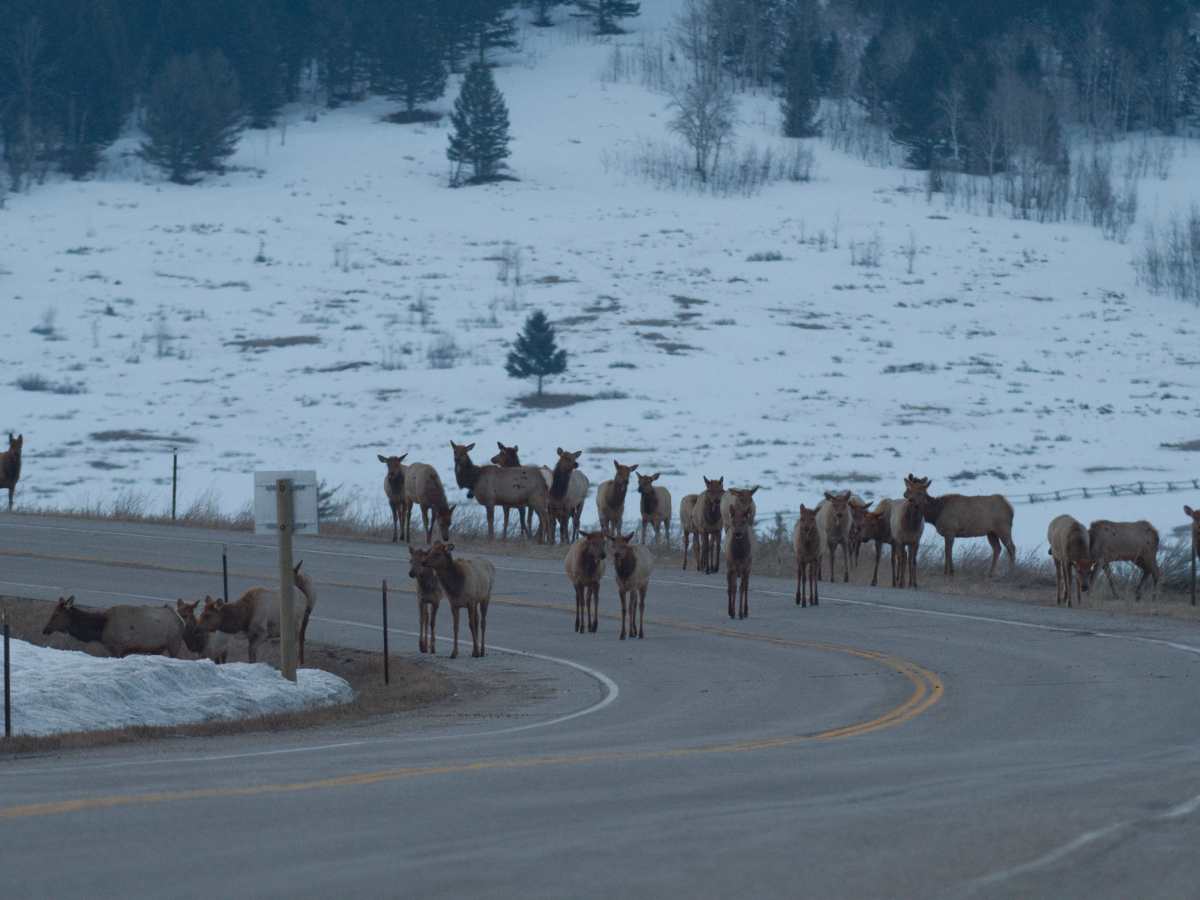
Someone recreating on public land south of Jackson called in the report of a dead cow elk.
Wyoming Game and Fish Department personnel went to investigate, and while they were at it they took a tissue sample to ascertain what might have killed the cow. Two days before Christmas, the state agency publicized the unwelcome, but not unexpected news: The forlorn animal tested positive for chronic wasting disease, an always-lethal sickness with the potential to devastate big game herds.

The CWD confirmation was a first for an elk from the Fall Creek Herd and Game and Fish’s hunt area 84, which sprawls south of Jackson in the Gros Ventre and Wyoming mountain ranges. With it the region has entered a new era in which CWD, with all its uncertainty, is part of the landscape. The confirmed presence of the neurological disease, which causes progressive body damage and behavior changes, will factor into wildlife managers’ decisions about the future of feedground operations. Elk congregating around human-supplied feed can inflame the spread of the disease.


Chronic wasting disease is spreading steadily through feedground elk, though perhaps not with the haste that many have feared. The prion disease first showed up in the Jackson Elk Herd in late 2020 when a hunter-killed cow in Grand Teton National Park tested positive. It’s been detected every year since, with verified CWD cases occurring south of Pinedale in 2021 and 2022. About this time last year it appeared for the first time in the Piney Herd. Now it’s in the Fall Creek Herd, too.
Since there’s been talk about redefining the feed grounds, then this miraculously happens, it seems a little planned to get people follow whatever the politics want. I don’t get the destruction of our govt.
So cwd id spreading , and hunters are complaining about dwindling heards . What’s the solution as environmental conditions and hunting lobbies chime in for less regulations I wonder aloud wtf . I really hate when someone’s stands over a bull elk claiming it’s this a beautiful and majestic animal , I hunt but I can’t say that , it’s demeaning , I hunt for the meat , not gloat over the animal who’s life I just ended and boast
CWD has been around for decades, some say 70 years, why is it a concern now? Shouldn’t this problem have been showing up on these feed grounds years ago? we have been feeding elk since 1910. Why now is CWD the concern? Why hasn’t CWD been observed on these feed grounds over the last century? Why are we looking for it so actively? We should have been finding dead elk on and around these feed grounds for years? Something stinks with this entire CWD issue! Why now????
Because the fish and game is now made up with environmentalists with a biology degree who want to put a stop to feeding operations and CWD is a good place to start. They would also like to shut down hunting altogether which is why they have gone away from general tags to draw only hunts. We no longer have true game management experts focused on building the herds.
We have the same problem over in western Idaho where winter mule deer ground were burnt last summer. They don’t want to feed because one unit group has CWD and they are afraid they will mingle with deer from other groups and they won’t do a emergency hunt to drop herd numbers because of public precipitation. So instead we expect that there will be a large die off because of starvation.
I agree…something stinks
This is so sad, I could cry buckets. Some reports suggest mountain lions help cull deer with CWD and help reduce the spread. Maybe time to talk with some Wildlife biologist to see what options might help.
These feedgrounds were the solution for ranchers dislike for elk on their lands. Now hunters, outfitters and local communities will fight to keep them despite the certainty of cwd expansion. Follow the money.
They have known for 20-25 years what causes it. How it spreads. Yet refuse to do anything that stops it.
So what’s the solution? Kill them all? Kill all the deer as well? Moose have occasional cases, too. Let’s kill all of them and we won’t have to worry about CWD anymore. First case of CWD was discovered at Colorado State University in a pen where they kept captive deer for research. So I suppose we could call that the epicenter of the disease. Apparently, it has somehow spread as far away as Wisconsin. Wisconsin tried killing all the whitetail deer and still the disease persists. Colorado is now doing the same. Not sure what their end game is, but if the prions stay in the soil for up to 20 years, why would killing them all possibly help? Are we going to build another ark to save a few and then try to repopulate after 20 years?
It’s my understanding that the deer herds in the epicenter of where CWD was first detected are doing fantastic 40-50 years later. So it seems those deer have developed an immunity to CWD.
Trying to stop CWD (which is allegedly ALWAYS fatal) by killing everything seems quite silly. Not to mention oxymoronic. Kill them to save them? Okaaaaay.
Why not let them develop the natural immunity that the Ft. Collins (CSU) deer have?
A good friend of mine who has private land near Casper told me that the presence of CWD on their property was pretty high 20 years ago, but they haven’t had a positive case for the past 8-10 years. He claims they haven’t even laid eyes on one they thought may have had CWD for the same period of time. Can one assume they have developed an immunity? Maybe not, but things are trending in the right direction, it would seem.
Our mule deer herds in Wyoming have been dwindling for the past 30 years. Do we really need to kill them off to hopefully keep them from spreading this disease? How about just letting them develop a natural immunity? They’re dead either way.
Clifford. They have long known CWD is spread via urine. The attractant made from female deer/elk etc out of captive farms is contaminated with the CWD. Yet every state has allowed these attractants to be made and sold and used. All in name of money made off hunting. It also been known that the elk feeding grounds spread disease. This is only done by state of Wyoming as huge winter tourist trap. Fallow the money.
In a perfect world, we wouldn’t need to be feeding elk. There would be adequate natural winter range for the numbers we currently enjoy, unobstructed migration corridors, no towns or subdivisions where elk should normally live. Get the picture? Maybe then Jackson elk could get to their old wintering areas on the Little Colorado Desert and not have to live among a multitude of gas wells.
scores of elk regularly die on the winter feedgrounds from hoof rot, aka necrotic stomatitis, caused by bacteria that thrive in the filthy feedlot conditions. The feedgrounds need to be expeditiously phased out and abundant predators conserved to promote healthier, free-ranging elk herds. The agencies can use the North Piney and Alkali Creek elk feedgrounds as prototypes to end feedgrounds.