

This story discusses suicide. If you or someone you know is having suicidal thoughts, you can call or text the Suicide and Crisis Lifeline at 988.
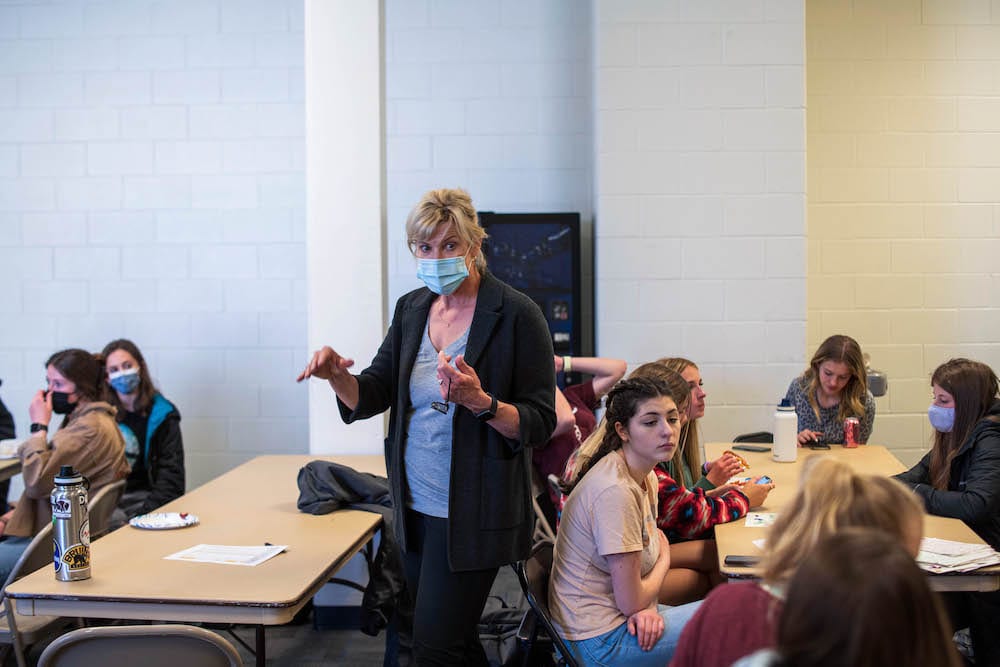
After a student’s suicide, teacher Deb White would pause the typical instruction in her Cody High School classroom. Instead, she consoled tearful kids or simply talked with them about what had happened.
“Every kid’s initial thought is ‘What could I have done?’” White, a retired science teacher who taught for 28 years, told WyoFile. “It impacts every single kid, every single classroom, every single teacher for weeks.”
Wyoming has at times suffered from the worst suicide rate in the nation. While it no longer holds that unfortunate title, the state’s suicide rate still ranks among the nation’s worst, according to the Centers for Disease Control and Prevention.
White is the program sponsor of Cody High School’s Youth for Justice Club, which has made it one of its missions to use state law to help prevent youth suicides. In 2014, the student club supported a successful measure to require school districts to provide suicide prevention education for teachers and administrators. In 2021, club members turned their attention to getting a law on the books that would also require school districts to equip students with suicide prevention tools.
That effort has so far been unsuccessful. But aware of the need for suicide prevention in schools across Wyoming, the Wyoming State Board of Education revised its health and safety standards to include new requirements for suicide prevention education in middle and high school. The current standards became effective in July 2024. Schools have until the beginning of the next school year to fully implement them.

While it’s just a suggested health topic for 5th grade, the middle school health standards require that kids be able to describe the physical, mental, emotional and social health impacts of bullying, which the guidelines specify could include suicide. In high school, according to the health standards, students should be able to describe “the behaviors and warning signs of self-harm and suicidal ideation, explain how to communicate with someone in need, and explain how to seek help.” The Wyoming Department of Education is responsible for ensuring schools adhere to these requirements.
Some Wyoming schools were already providing suicide prevention education for students even before the standards were updated. White said Cody schools, for instance, have used materials from the QPR Institute (QPR stands for question, persuade, refer) to equip kids with suicide prevention skills.

This year, the Youth for Justice Club asked Casper Republican Rep. Steve Harshman to sponsor House Bill 40, “Suicide prevention.” The measure would require school districts to provide suicide prevention education to students “in any appropriate manner,” as long as the curriculum is age-appropriate and evidence-based. The measure would go into effect July 1.
HB 40 doesn’t include a direct accountability or enforcement measure, but the Wyoming Department of Education is empowered to ensure districts follow state requirements. The Wyoming State Board of Education conducts an accreditation check for Wyoming schools every year to make sure they’re following state statutes and other public education rules.
Though the state education board’s health and safety standards already include suicide education requirements for kids, White said she believes HB 40 will “ensure fidelity to the content and make sure that every kid actually gets the information to help their peers.”
“There is no guarantee on the qualifications of who will be teaching it as far as this topic,” she said regarding the existing suicide education requirement for students.
HB 40 would require schools to use “evidence-based programs” that are consistent with suicide prevention education materials and training now provided to teachers and school administrators. The materials and programs that schools use now for teachers and administrators are approved by a suicide prevention review team and recommended by the state superintendent of public instruction.
The education under HB 40 would give kids “the skills to basically be gatekeepers,” White believes, including helping them notice signs and know where to go for help. The idea behind expanding suicide education to students is that kids will often confide in their peers before they go to an adult for help.

Lawmakers brought nearly identical bills to the Legislature in 2021 and 2023. The Joint Education Committee approved a measure in 2021 after hearing testimony from Park County staff, teachers and students, but it died in a 34-25 vote on the House floor. Cody Republican Rep. Rachel Rodriguez-Williams also sponsored a bill that year that died in the House.
Former Cody lawmaker Sandy Newsome then sponsored the same bill in 2023. But the measure sputtered out in a committee because of a procedural deadline.
The Youth for Justice Club had asked both Rodriguez-Williams and Newsome to sponsor these past bills, White said.
Much of the opposition to these measures centered on disagreements over who should dictate what is taught in Wyoming’s schools. While lawmakers agreed suicide is a problem, they disagreed on what to do and who should do it. Because it’s the Wyoming State Board of Education’s duty to set standards, some lawmakers saw a measure dictating suicide prevention education for students as legislative overreach.
“It’s a fair question, and hopefully we can have that debate,” Harshman, the Casper Republican, said.
The Wyoming Constitution bars the Legislature and state superintendent of public instruction from telling schools to use specific textbooks. But the Legislature can and has made laws that require schools to teach certain topics. Harshman pointed out, for instance, that the Legislature passed a bill in 2017 directing the Wyoming Department of Education to incorporate Native American heritage and history curricula into social studies content and performance standards.
Other lawmakers have opposed the suicide prevention measure because they believe it’s not the role of government to help prevent suicide, but rather that of churches and parents. That argument has extended to other suicide prevention bills, such as a measure to establish and fund a statewide suicide prevention hotline. (The proposal ultimately became law, although lawmakers chose not to fully fund the service.)
School districts typically have three years to fully implement new education requirements. Though the bill’s requirements aren’t entirely new, it’s unclear if HB 40’s July 1 effective date would give schools enough lead time. Harshman didn’t respond to a follow-up call from WyoFile to respond to this question before publishing time.
Students with the Youth for Justice Club have, in previous years, made the long journey from Cody to Cheyenne to talk with lawmakers and try to win their support. White said that about 15 young people will travel to Cheyenne again this year to make their pitch for HB 40 and other measures.
The ‘churches’ job??? So why would anyone want to even be in the Wyoming legislature if they don’t even believe in the basics of government??? It’s not like it pays well. Sadly, most of our state government is made up of people who are failures at every step of life. Little chucky grey? They don’t seem to really care about anything at all. Nor accomplish anything. Pathetic.
I am encouraged to see the involvement of students in the legislative process and, in particular, the quest to save lives. My hope is they are leaders of our future!