



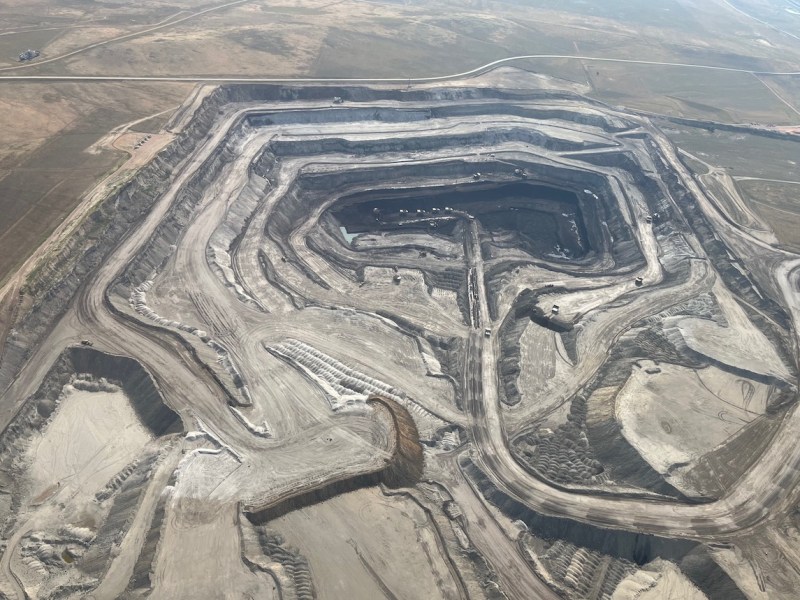
Wyoming’s congressional delegation this week celebrated a major step toward invalidating the U.S. Bureau of Land Management’s Biden-era ban on new federal coal leasing in northeast Wyoming — home to one of the largest coal deposits and the most productive coal mines in North America.
But whether the effort will result in any new, major coal leases in the region is in doubt, and the congressional method to overturn the ban has infuriated conservation groups across the West who say it’s part of a larger GOP effort to upend decades of careful compromise to achieve “multiple use” on public lands.
Joint Resolution 130, introduced in October by U.S. Rep. Harriet Hageman and Sens. Cynthia Lummis and John Barrasso, passed the U.S. House and Senate this week. The measure would overturn the ban by employing the rarely used Congressional Review Act to invalidate the BLM’s Buffalo Field Office Resource Management Plan, which was updated in December.
Under the Biden administration, the BLM suggested the ban would have little impact on the flagging industry, which primarily provides fuel to the nation’s aging fleet of coal-fired power plants, noting coal mines in the region already have legal access to enough reserves to continue mining at the same pace beyond 2040.

But both Wyoming’s all-Republican congressional delegation and the Trump administration have pointed to unprecedented electrical demands for artificial intelligence and other data computations.
“The Biden administration’s relentless war on American energy was waged at every level, including in Wyoming’s Powder River Basin, where it halted coal leasing,” Hageman wrote Tuesday on the social media platform X. “Passing H.J. Res. 130 will restore our national energy dominance, protect Wyoming jobs and prosperity and reassert Congress’s authority over an unchecked administrative state.”
Despite a bullish outlook and moderate upticks for the industry in recent months, a test run to resume leasing federal coal in the Powder River Basin failed — some say spectacularly — in October. The BLM received a single bid for a coal tract in the Montana portion of the Powder River Basin for an unprecedented fraction of a penny per ton of coal. Days later, the agency indefinitely postponed another coal lease auction on the Wyoming side of the basin.

“It’s a sham,” Lynne Huskinson said of the notion that the Powder River Basin coal industry is being held back by the Biden-era leasing ban.
Huskinson worked for decades as a Powder River Basin coal miner in Wyoming and serves as chair of the Sheridan-based landowner advocacy group Powder River Basin Resource Council. The $186,000 bid that Navajo Transitional Energy Company offered for the 167 million-ton federal coal tract in Montana was so low that it might not have even covered “a big repair on one of their motor graders,” she asserted.
Congress is using the CRA to override previously approved management plans elsewhere in the West. Because these plans are shaped by a formal public comment process, conservation groups say overriding them flies in the face of local input about how to best manage America’s public lands. It may even invalidate other uses permitted under BLM resource management plans, such as grazing and oil and gas leases, some conservation groups say.

“Senators heard one consistent message today: Multiple-use is hard,” Center for Western Priorities Policy Director Rachael Hamby said in a statement Thursday. “Finding the balance happens on the ground, with the residents, scientists and small-business owners who know the land the best. That’s why it’s so foolish for Congress to use a blunt instrument like the Congressional Review Act to impose land management decisions from Washington.”
Gov. Mark Gordon cheered the effort to overturn the “misguided” coal leasing ban, noting the potentially long-lasting implications of using the review act.
“When signed by the President, this action ensures that no future federal administration can authorize the large-scale termination of coal leasing in the area,” Gordon said in a prepared statement.

Progress. The future. Change. This state will go bankrupt before 2050 because people fear the future so much. Because people are so averse to any and all challenges that life brings, we as a state, shall ultimately fail. Nobody wants this coal. Period. They won’t tomorrow either. Burying ones head ever further up ones backside changes nothing. But it sure does make ya look stupid.
Didn’t the recently failed and withdrawn coal leases in the PRB show that this is not needed? When NTEC bid $186K for 167 million tons (1/10 of a penny per ton) for a lease that was available it demonstrated that the market is gone. Then the 2 more leases that were going to placed for bid were withdrawn due to the first low bid. With the existing leases that are already in place the PRB mining companies can continue to mine for at least another 15 years.
There is no war on coal, economics is driving the market for coal away. There are cheaper, more efficient, better ways to produce electrical power than burning coal. Most coal fired power plants are 50 plus years of age and at the end of their anticipated life. When the power plant owners review what they need to do to continue energy generation (and plan for future increased power needs) consistently these reviews have shown that using coal is now one of the most expensive ways to produce power. The power plant owners are playing the long game while our elected reps are playing the reactive short game, with knee jerk reactions.
This is not needed. The market for new leases is not there. There is no power grid emergency where the DOE needs to step in and force the power plant owners to keep old inefficient coal fired power plants online instead of letting the plants retire and allow the power plant owners to proceed with their anticipated plans for power plant replacement or refueling changes (i.e., change fuel from coal to natural gas).
Darn frustrating that our Washington reps and state leadership continue to look to the past in the rear view mirror instead of being proactive and planing for where it’s going. The world of energy production and the markets are changing; our elected leaders need to either get on board and plan for the future OR don’t be surprised when they’re run over left behind.
It’s all show and no go for our three goofballs.