


CHEYENNE—A measure to add more penalties and civil liabilities to an existing Wyoming gun law cleared the House on Thursday.
Senate File 101 passed the House in a 40-21 vote. The bill, which is sponsored by Senate President Bo Biteman, is now headed to Gov. Mark Gordon’s desk. The governor vetoed a similar bill last year.
The bill would add major changes to Wyoming’s Second Amendment Protection Act, a law that imposes restrictions on enforcing federal gun directives within Wyoming’s borders. Those alterations include adding a civil option for litigation, meaning anyone, and not just the state, could take legal action based on alleged SAPA violations.
The bill also imposes a $50,000 civil penalty per violation on agencies, including agencies that hire officers who enforced federal firearms directives under previous federal employment. Those civil fines would add to existing criminal penalties for individual officers.
The House rejected on Thursday an amendment that would have allowed courts to award damages to defendants in lawsuits deemed to be frivolous and narrowed who could bring civil lawsuits.
Rep. Art Washut, R-Casper, also unsuccessfully attempted to reinsert the word “unconstitutional” to describe the federal gun directives local law enforcement would be restricted from enforcing.
“It does a disservice to our law enforcement personnel if we say you’re going to be subjected to the conditions of this bill, even though you don’t know whether or not the actions you’re engaged in are going to be determined to be constitutional or unconstitutional at some point in the future,” Washut said. “They can only act on what they know today.”
The change is a small edit, but with big implications. “As we’ve seen in this country, the term ‘constitutional’ is very liquid,” Rep. Jeremy Haroldson, R-Wheatland, said, arguing against the amendment.
“I believe the constitutionality insertion actually creates more of a gray area than leaving it out and drawing a hard line of just don’t enforce federal gun control, period.”
When that effort failed, Washut brought forward an enactment clause amendment — a symbolic move that signals a last-ditch protest against a bill.

“Never in my history have I brought an enactment clause third reading amendment,” the lawmaker said. Washut described the bill as “ambiguous.” He had talked to various people about the bill, he said. “Guess what? They interpret it differently.”
“This bill is also based on a false premise,” Washut continued, “a false premise that the only way we can keep our Wyoming peace officers from violating your constitutional rights and your next-door neighbor’s constitutional rights is to hang the sword of Damocles over their head with a $50,000 civil judgment on it.”
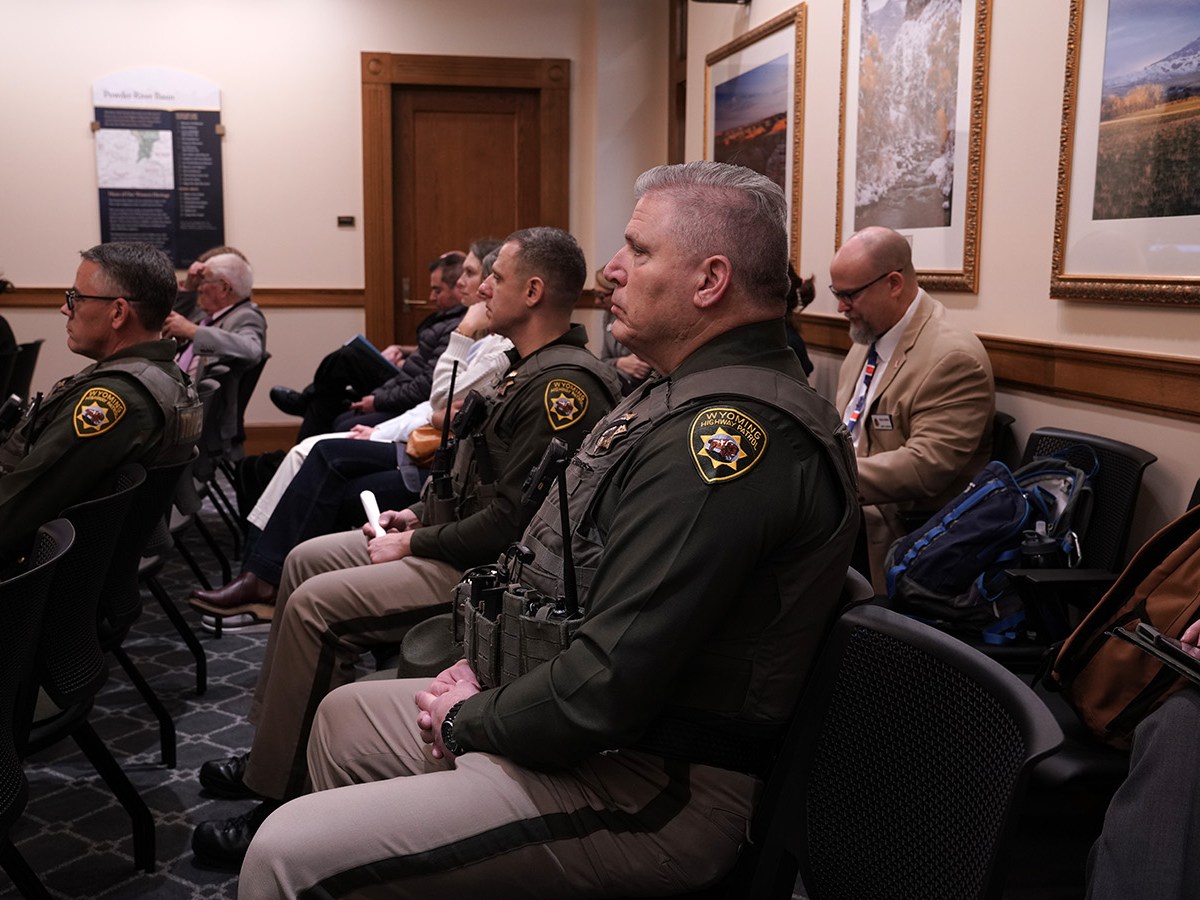
Wyoming law enforcement has strongly opposed SF 101 and House Bill 130, a twin measure that died in the Senate on Wednesday. Introducing the same measure in both chambers is a strategy to help get a bill across the finish line in the sponsors’ desired form. Law enforcement representatives have cautioned that the changes would create legal ambiguity that could put officers and agencies at risk for litigation, threaten federal partnerships and ultimately hamper efforts to address crime. All 23 Wyoming sheriffs put their names on a letter sent to lawmakers “strongly” voicing their opposition to the changes.
Those supporting the bills, including Second Amendment advocacy groups like Wyoming Gun Owners and Gun Owners of America, describe the changes as protection against a too-powerful federal government intent on confiscating citizens’ guns.
Rep. Bob Wharff, R-Evanston, who sponsored HB 130, told his House colleagues that SF 101 is narrow and only addresses federal actions that “solely” concern firearms, accessories or ammunition taken away from law abiding citizens. “That’s what this bill does. It does not extend beyond that,” Wharff said.
He disputed his colleagues’ arguments that the measure could hamper an officer’s ability to respond, for example, to domestic abuse situations that involve a gun. The measure wouldn’t get in the way of a law enforcement response, he said, since the initial call would be for a domestic disturbance, not for the purpose of seizing a firearm. “This is making a mountain out of a molehill,” Wharff commented.

The lawmaker maintained that “if there’s another crime that caused the law enforcement to respond, that’s not what this is dealing with.”
House Bill 130, the twin version of SF 101 that died in the Senate on Wednesday, had a circuitous journey.
A committee adopted last month a law enforcement-backed amendment to HB 130 that stripped it of civil liabilities and created further carveouts. The Senate deleted that amendment. Sen. Larry Hicks, R-Baggs, then added two amendments, one that allowed courts to award damages to defendants in lawsuits deemed to be frivolous, and another that narrowed who can bring civil lawsuits.
On the Senate’s last vote, several lawmakers stood to voice support for local law enforcement and urge their colleagues to oppose the bill. Lawmakers argued that the fines in the bill could impose a heavy burden on small communities, and that the bill was attempting to fix a problem Wyoming doesn’t have.

But Sen. Chris Rothfuss, D-Laramie, argued passionately in support of the bill, reminding the body that the Second Amendment’s original purpose was to ensure “protection of the citizens, by the citizens” against an overly powerful federal government.
“So when I think about what I want our local law enforcement to do, and what I want the people that are serving and protecting us in this state to do, when the feds say, ‘Hey, we want to take some guns,’ I don’t want them to say, ‘Okay, sure, we’d love to be part of your project,’” Rothfuss said.
Cheyenne Republican Sen. Tara Nethercott, who voted for the bill, noted that lawmakers had voted for other legislation that could expose people to civil liabilities and difficult decisions they would have to make on the job.
“So if we want to be equal to everybody, you know, I don’t know why our law enforcement would be any different than teachers, librarians, clerks, all types of different occupations in our state,” she said.
“We are on this trend of creating all this civil liability. Good for the lawyers. Not sure it’s good for the people.”
Gordon has three days to veto or allow SF 101 to become law.

Two other gun bills also passed the Legislature on Thursday. House Bill 96, “Carrying of concealed weapons-age requirement,” would lower the legal age for acquiring a concealed carry permit from 21 to 18.
Right now, someone who is between 18 and 21 years old can get a concealed carry permit if the sheriff of their county of residence writes a letter of recommendation for them to the Wyoming Division of Criminal Investigation. The division then decides whether to issue the permit. HB 96 would do away with these extra steps.
House Bill 98, “Prohibit Red Flag Gun Seizure Act-penalty amendments,” adds a misdemeanor to Wyoming’s Prohibit Red Flag Gun Seizure Act, Typically, red flag gun laws enable police and sometimes others to ask a judge to temporarily remove someone’s access to guns if they are believed to be a risk to themselves or others. Wyoming’s law bars enforcement of red flag gun seizures. The misdemeanor would be punishable by up to a $2,000 fine and/or a year in prison if it is violated.
For more legislative coverage, click here.

Mark Gordon is grandstanding on this one . Most of those 23 sheriffs would absolutely assist in an effort to confiscate firearms if told to do so. Highly doubtful this would ever play out, but it was probably thought of as doubtful even 15 years ago that a guy with a cartoon voice who dumped a deer carcass in Central Park would be a US cabinet secretary. Look how shady Wyoming DCI is, they release almost zero information to the people who pay their salaries and don’t even apologize, let alone take even token accountability for egregious violations of law like that hemp farm deal. Most of the Sheriffs would do anything they are told as well as every town police force in this state. Law enforcement is not on your side. They see themselves as above you.
Google NRA Beckett Brown International
If this type of law goes into effect law enforcement may well take a stand back and see what the shooters do. If they try and stop the shooter then the shooter will claim they are infringing upon somebodies right to shoot somebody else. Slippery slope.
So, full auto or select fire weapons would be ok? No fed permit required?
Yet they are big supporters of the agency that executed a man on the street for legally possessing a firearm.
Don’t get me wrong, I’m a huge supporter of the 2nd amendment. But I would like to show my fellow Wyo’s just how ignorant and incompetent our state legislatures are.
Let’s look at the proposed text of HB0130 section (a) which I quote verbatim as follows:
(a) Except as otherwise provided in this section, this state and all political subdivisions of this state are prohibited from using any personnel or funds appropriated by the legislature of the state of Wyoming, or any other source of funds that originated within the state of Wyoming, any federal funds and any other source of funds solely to enforce, attempt to enforce, provide material aid, support or participate in any manner in the enforcement or implementation of any act, law, treaty, executive order, rule or regulation of the United States government solely regarding firearms, accessories or ammunition against any law abiding citizen.
I think most of us can see the logic trap in the language as proposed. In essence Wyoming law enforcement will not enforce Federal gun laws against law abiding citizens. If you are in violation of the NFA you are not a law abiding citizen. Therefore this clause has no meaning and Wyo law enforcement may act accordingly.
It has been litigated time and again that Fed law supersedes State law. So this proposed bill is just another populist goat roping.
Whenever you hear someone say
“I’m a huge supporter of the 2nd amendment. But…”
They aren’t, period.
The NFA shouldnt even exist. Essentially any law restricting the peoples right to keep and bear arms is unconstitutional, and shouldn’t be enforced.
I don’t see anything “controversial” about holding law enforcement accountable for their actions against citizens rights or removing restrictions of rights on some adults that don’t exist for other adults.
Does anyone think the Federal Government is going to try and seize our guns?
Exactly! Thank you for this simple comment! Can we please just try discussing and making policy about reality, not fiction? And not just regarding firearms.
Who’s Federal Government? Vote in one the latest super liberal clowns and yes, yes I do.