

MEETEETSE RIM—Josh Shorb’s internal dialog upon learning that the destructive nonnative grass ventenata was found growing along the highway shoulder south of Cody spanned four letters and one syllable.
Because his gut reaction needn’t see print, the Park County Weed and Pest District supervisor pondered a more poignant way of describing his thoughts.
“How do I say this?” Shorb said. “I was dejected, but not surprised. Then it was just time to get to work.”
Late Tuesday morning, Shorb was getting to work. He was standing near where his colleague, Jake Jarrett, found the African grass growing along a Highway 120 ditch between Cody and Meeteetse earlier in the summer.
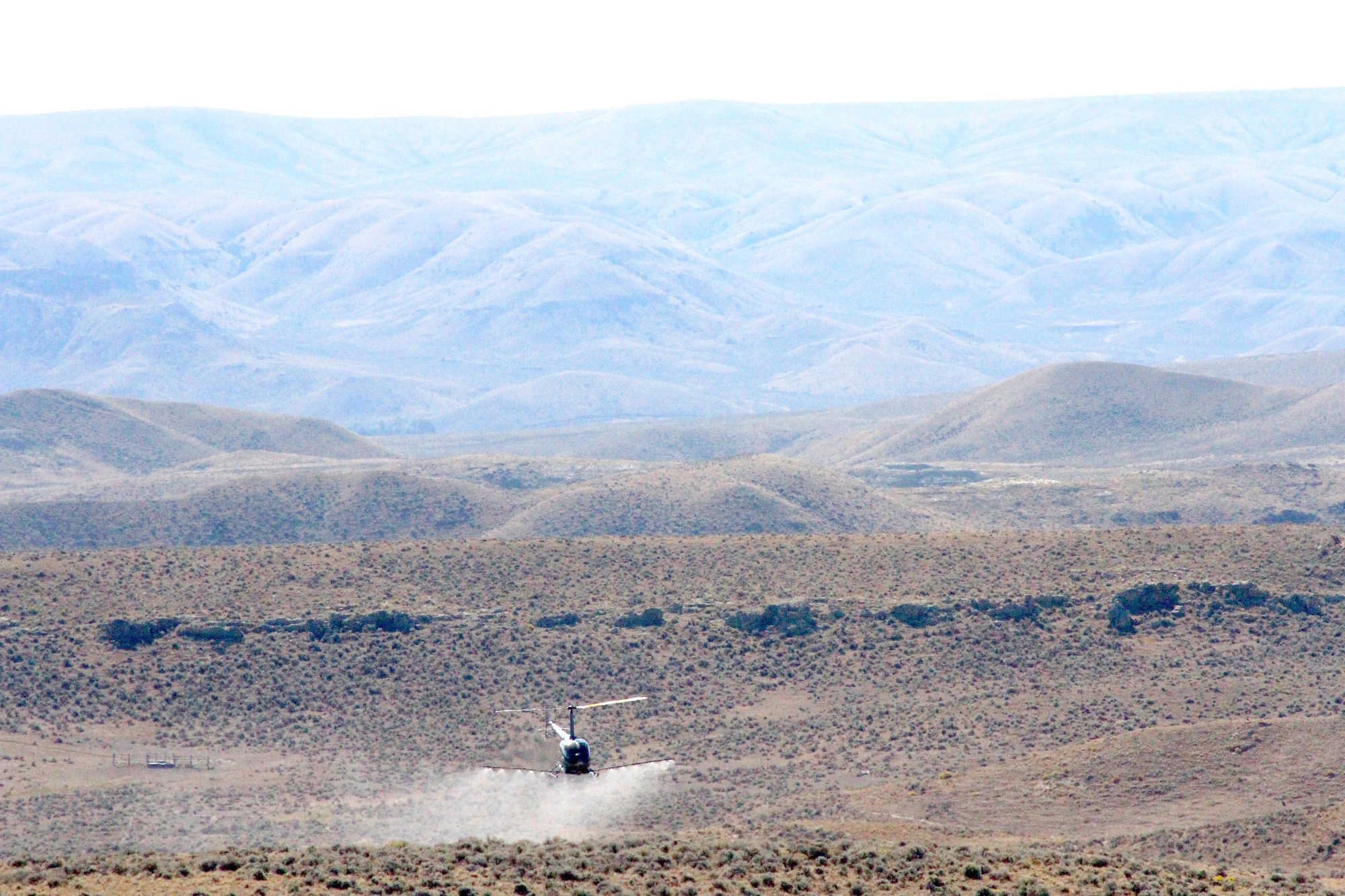
Shorb was overseeing an aerial mission to douse ventenata with a chemical that would kill it: Rejuvra. Make no mistake, he knew he wouldn’t get it all, even though his contracted pilot was putting down the herbicide on 420 acres and well beyond the patches where the noxious grass was found.
“This is day one,” Shorb said. “This is a plant where, if you turn your back for a few years, you’re going to be in trouble.”
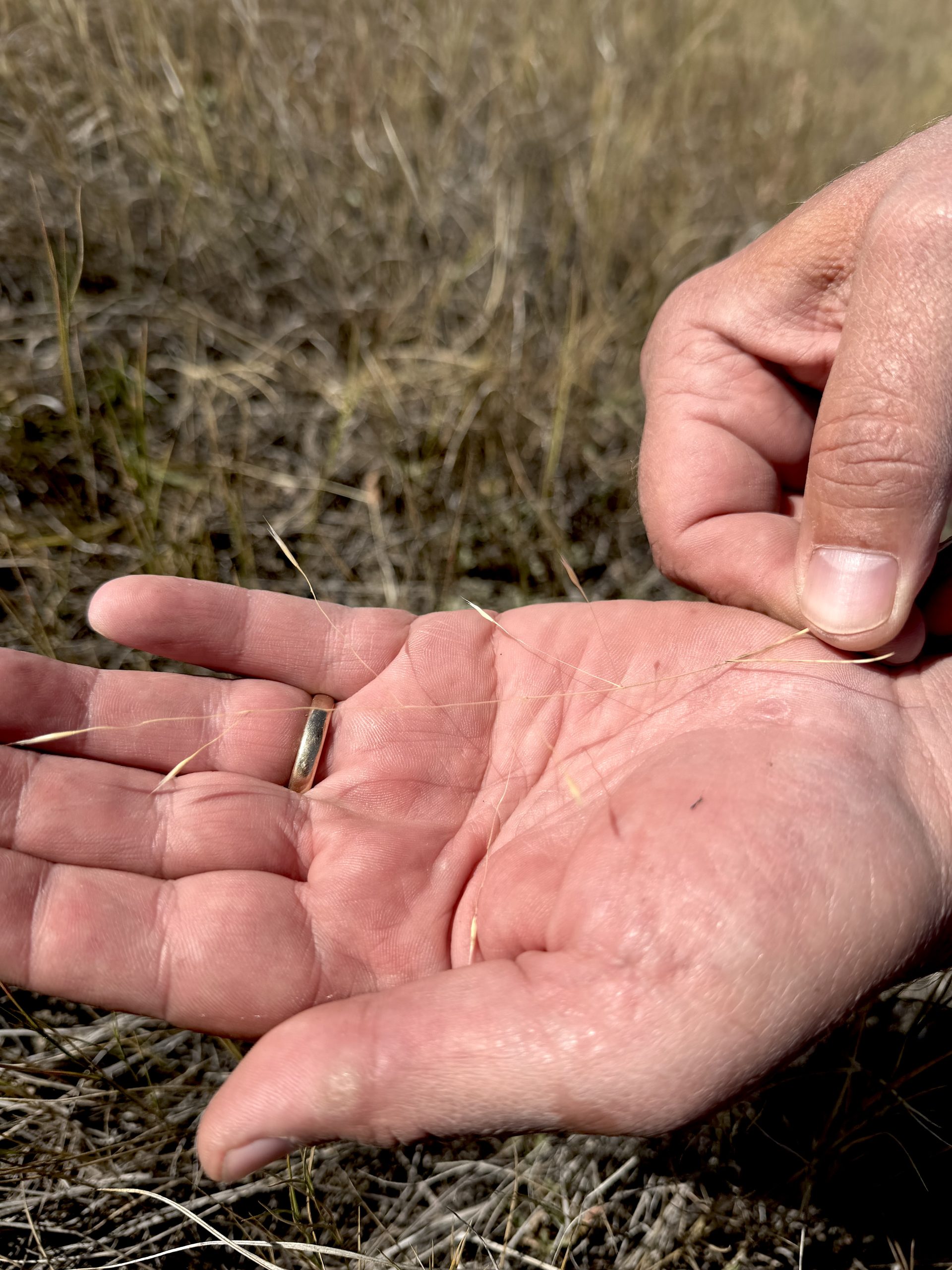
In the right conditions and the right place, ventenata can be even more destructive than cheatgrass, the most widespread annual invasive grass overtaking Wyoming. It has similar properties: Also called wiregrass, ventenata germinates in the fall, overwinters and cures out into tinder by summer. It’s even less palatable to livestock and wildlife, providing almost no nutrition to foraging critters.
But until now, ventenata was more confined to eastern Wyoming. It showed up in North America in the early 1950s and Sheridan County in 1997, but distribution maps show it has been most widespread in the Pacific Northwest and Idaho.

Shorb was standing and talking at the first detection site in Wyoming west of the Bighorns. His counterparts at weed and pest districts around the Bighorn Basin and broader western Wyoming are now on high alert.
Shorb guesses that ventenata seed was given an accidental ride into the area from Carbon County, Montana, which has a bunch of it.
“Something got kicked out of a tire, like a piece of mud,” Shorb said. “Now here we go.”

Heightening costs and declining resources will make responding more difficult. Envu-manufactured Rejuvra is already notoriously expensive — about $1,100 a gallon — but in 2026 the cost of spraying “has really gone up,” Shorb said. With fuel and herbicide costs on the rise, he’s now paying roughly $75 an acre. That means just on Tuesday, the Park County Weed and Pest District was looking at a $32,000 bill.
While one-time grant money allocated by the Wyoming Legislature helps, other funding streams have suffered. Property tax-reliant weed and pest districts around Wyoming have taken a hit, and now the Bureau of Land Management is scaling back its own spending to spray cheatgrass — and now ventenata. In 2026, the BLM’s Wind River/Bighorn Basin Field Office invested a whopping $1.2 million on cheatgrass spraying in Park County alone.
In 2027, however, Shorb’s bracing for vastly reduced assistance from the federal government.
“The BLM, they still have some money for noxious weed control, but specifically for cheatgrass control, we’re told that they’re out,” Shorb said. “This is just a perfect storm of what we don’t need right now.”

As bad as the invasive grass issue is here in Wyoming it pales in comparison to what I have worked on in Nevada and Oregon. While the misinformed anti-grazing lot like to blame grazing for the expansion of these grasses, the true villein is wildfire and the lack of ability to control these invasives post-fire. Some of these areas that experienced one fire then experience repeated fires that convert them into cheatgrass or medusa monocultures whether they are grazed or not. So doing nothing is not a solution just because they may get grazed. Targeted grazing and chemicals are about our only tools for control. And if we don’t get on this problem now there will be no habitat left. Because right behind cheatgrass is medusa, and ventenata, and bur buttercup, and barbed goatgrass. The true problem is not grazing, it is careless humans and a failure to to be able to locate and act on controlling these explosive populations before they spread. Saying why bother because they will just get grazed anyway is like saying why bother having watercraft inspections because quagga mussels will get here anyway. I encourage folks to learn about these species and if you find a small lonesome patch take a picture and note the location and share with your weed and pest. Much more productive that blaming grazing. Nice work Jake and company.
I drove by this operation a few days ago, was wondering what it was about. As far as killing the invasive grasses, I don’t know. That stretch of public land on on sides of the highway between Cody and Meeteetse gets ravaged yearly by cattle, allowed by the Cody B.L.M. office. Not much is growing out there and what does come up gets munched quickly. At least with cheat grass and other invasives, at least you’d have some cover. Seems like a waste of money however as the Cody B.L.M. people will continue to let the cattle graze at almost free rates to the ranchers. Nothing to feel good about spending thousands of dollars while not doing something about the real problem.
Early, targeted grazing is one of the techniques range managers can use to help with the control of cheatgrass. Where did you get your range management degree?
I drive that road twice daily, 5 days a week and it doesn’t take a range science degree to notice cattle on that range pretty much 365 days a year. Early targeted grazing is one thing, a continous pounding and pummeling via cows 365 days a year, every year is another.
Actually a factual statement from Mr. Parsons. If someone wants to personally witness severe 0ver-grazing, year to year with no rest or rotation and the aftermath being sickly sagebrush, piles of cow turds on bare dirt and tufts of cheat grass and other invasive weeds with cows everywhere, take a walk around the b.l.m. public lands around Cody. Heart Mtn, Oregon Basin, MacColloch peaks etc., all under the “watchful” eye of the Cody b.l.m. What you won’t see are a plethora of wildlife that used to inhabit these parcels. Spray all you want but to note take care of the other issues, it’s like a bad remake of GroundHog day
The permittee around Heart Mountain is The Nature Conservancy. Would a group like The Nature Conservancy really pound the land into oblivion with cattle?
Four letters one syllable, is the right word. Anything worse compared to cheat grass invading Wyoming is a double nightmare.