


CHEYENNE—Law enforcement officers, clad in black and tan uniforms, filled the front-row seats Wednesday of a windowless meeting room at the Wyoming Capitol. The room was quiet as lawmakers on the Senate Revenue Committee trickled in from their morning floor session, looking around at the group of men before taking their own seats up front.
The officers had come to speak against proposed changes to Wyoming’s Second Amendment Protection Act, often called SAPA. The law imposes restrictions on enforcing federal gun regulations within Wyoming’s borders. This year, twin bills in the House and Senate — House Bill 130 and Senate File 101 — aim to significantly change Wyoming’s SAPA by adding steep civil penalties and further restrictions to the law. (Introducing the same measure in both chambers is a strategy to help get a bill across the finish line in the sponsors’ desired form.)
Those supporting the bills, including Second Amendment advocacy groups like Wyoming Gun Owners and Gun Owners of America, have aggressively and persistently pushed for these SAPA enhancements, describing the changes as a kind of insurance against a potentially overzealous federal government intent on confiscating Wyomingites’ guns.
But Wyoming law enforcement has consistently pushed back, cautioning that the changes would create legal ambiguity that could put officers and agencies at risk for litigation, threaten federal partnerships and ultimately hamper efforts to address crime.
Officers who spoke at the Senate Revenue Committee meeting on Wednesday described the potential consequences of these amendments in dire and pleading terms.
“I don’t think that you guys are trying to pass a bill that decreases public safety, but in terms of passing the bill as written, as is, that would be exactly what you guys are doing,” Albany County Sheriff Aaron Appelhans told the committee. “We’re asking you, please don’t do that. Don’t handcuff us. Let us do our job.”
Wyoming is among more than a dozen states that have some kind of statute that attempts to curb federal gun laws within their borders. Lawmakers here passed a SAPA measure in 2022. The law bars Wyoming from using state money or personnel to enforce any “unconstitutional” federal government directive that infringes on people’s right to bear arms. Public officers who violate this would face a misdemeanor. According to Wyoming Gun Owners, an organization that supports HB 130 and SF 101, Wyoming has one of the strongest SAPA laws in the country.
But Wyoming’s SAPA is not as airtight as some would like. “That legislation had a few gaps in it,” Senate President Bo Biteman, the Ranchester Republican who sponsored SF 101, said of Wyoming’s SAPA at a committee meeting last month. “We knew that when we passed it.”
The twin bills in the Wyoming Legislature this year were drafted “in the wake of what happened in Missouri,” according to Wyoming Gun Owners lobbyist Aaron Dorr, who has been heavily involved in promoting many of Wyoming’s gun laws. Missouri passed a far-reaching SAPA law in 2021. The federal government challenged Missouri’s SAPA in court, arguing that it violated the U.S. Constitution’s Supremacy Clause, which holds that federal law supersedes state law. A federal judge ruled the law to be unconstitutional in 2023, and the 8th Circuit Court of Appeals affirmed that decision in 2024.
“It has major changes from the law that was enacted in Missouri, and those changes reflect what the courts said in the 8th Circuit, the issues they had with the law that was in the books in that state,” Dorr said. Rep. Bob Wharff, the Evanston Republican who’s sponsoring HB 140, told WyoFile that a Missouri lawyer worked with Wyoming Gun Owners to update the language in the proposed SAPA amendments in an attempt to accommodate the court’s decision.
Wharff introduced the bill Wednesday to the Senate Revenue Committee as “an old friend that seems to keep resurfacing.”
Indeed, lawmakers have tried every year since SAPA’s passage to give the measure more teeth. The two bills would impose a $50,000 civil penalty per violation against agencies, including agencies that hire officers who enforced federal firearms directives under previous federal employment. Those civil fines would add to existing criminal penalties for individual officers.
The proposed measures, as introduced, also specified that individuals, and not just the state, can pursue legal action for alleged SAPA violations, providing another means for people to dispute such violations if a county prosecutor doesn’t pursue charges. “I believe the vast majority of law enforcement officials are looking out for the constitutional rights of citizens, but there are cases where things go off the rails and a citizen deserves the right to go to civil court,” Mark Jones, the national director for Gun Owners of America, told lawmakers.
What’s more, the measures as introduced would bar the use of any funds, not just state funds, to enforce federal gun-related directives “against any law abiding citizen.” They also strike the word “unconstitutional” as a descriptor for the kinds of federal laws or orders that Wyoming officers would be barred from enforcing.

“When you put in ‘unconstitutional,’ that, to me, means it’s got to go through the legal process to be determined unconstitutional,” Wharff explained to the Senate Revenue Committee on Wednesday. “If the Supreme Court issues a ruling that it is legal for them to seize their firearms, you know, I have a problem with that.” The problem, he believes, is that “once your guns are seized, it’s like a black hole.”
Responding to law enforcement concerns, lawmakers have changed many of these provisions in HB 130. Senate File 101, meanwhile, remains largely intact.
A similar bill made it through the Legislature and to Gov. Mark Gordon’s desk last year. But the governor rejected it with blistering words. “I never expected Wyoming’s Legislature would ratify an idea undermining law enforcement,” Gordon wrote in a letter explaining his veto.
“To think our great state would take up a notion kindred to the ‘Defund the Police’ efforts we have seen elsewhere in this country comes as a shock,” his letter continued. “This Act has less to do with protecting our sacred Second Amendment Rights than it has to do with making law enforcement personnel in this state second guess nearly every action they take for fear of legal reprisal.”
Wyoming law enforcement has shared similar sentiments. Earlier this month, the Wyoming Association of Sheriffs and Chiefs of Police sent senators a letter signed by 44 law enforcement officials, including all 23 Wyoming sheriffs, “strongly” voicing their opposition to the twin bills. The letter, obtained by WyoFile, argues that the proposed SAPA changes “create uncertainty by requiring officers and agencies to interpret the constitutionality of federal enactments during active investigations.” Statutory ambiguity, it continues, could “expose officers and agencies to both litigation and inconsistent application of the law.”
Numerous law enforcement representatives have argued that the proposed SAPA changes could put them at legal risk, for example, when apprehending someone for a criminal violation who happens to have a firearm. They maintain that the bills would hamper their ability to work with federal partners — U.S. Immigration and Customs Enforcement, the Federal Bureau of Investigation and the Department of Homeland Security, for example — on enforcement activities that keep the public safe. Local law enforcement, for instance, often works with federal partners on human trafficking cases.
“This creates a high-stakes environment where a single error in judgment leads to substantial liability,” Wyoming Division of Criminal Investigation Director Ronnie Jones told lawmakers last month. Jones said that this risk may force him “to remove Wyoming agents from federal task forces entirely.”
House Bill 130 and SF 101 supporters say the bills wouldn’t prevent officers from enforcing federal firearms directives in cases where a person is apprehended for a criminal violation. The changes, they argue, apply only to federal directives that are “solely” aimed at firearms and that involve “law abiding citizens.” Opponents, however, say that the bills’ definition of “law abiding citizen” is ambiguous and could involve situations where, for example, an individual isn’t supposed to have guns because of their mental health status, not because they’ve broken the law.
Wyoming law enforcement’s worries didn’t fall entirely flat. Lawmakers have adopted amendments to both bills brought by the Wyoming Association of Sheriffs and Chiefs of Police. The bills now have a WASCOP amendment that makes another carveout so agencies can hire former military personnel.
On Wednesday, the Senate Revenue Committee adopted more changes to HB 130 suggested by WASCOP. Those amendments were significant. The committee deleted the section that would allow anyone, rather than just the state, to sue for alleged SAPA violations, although the $50,000 civil penalties remain. Lawmakers also nixed restrictions and penalties for hiring people who previously worked for the federal government and removed language that barred using sovereign immunity as a legal defense in relation to SAPA. Further, lawmakers added another carveout for emergency situations.
It also reinserts the word “unconstitutional” to describe the federal directives that officers would be restricted from enforcing.
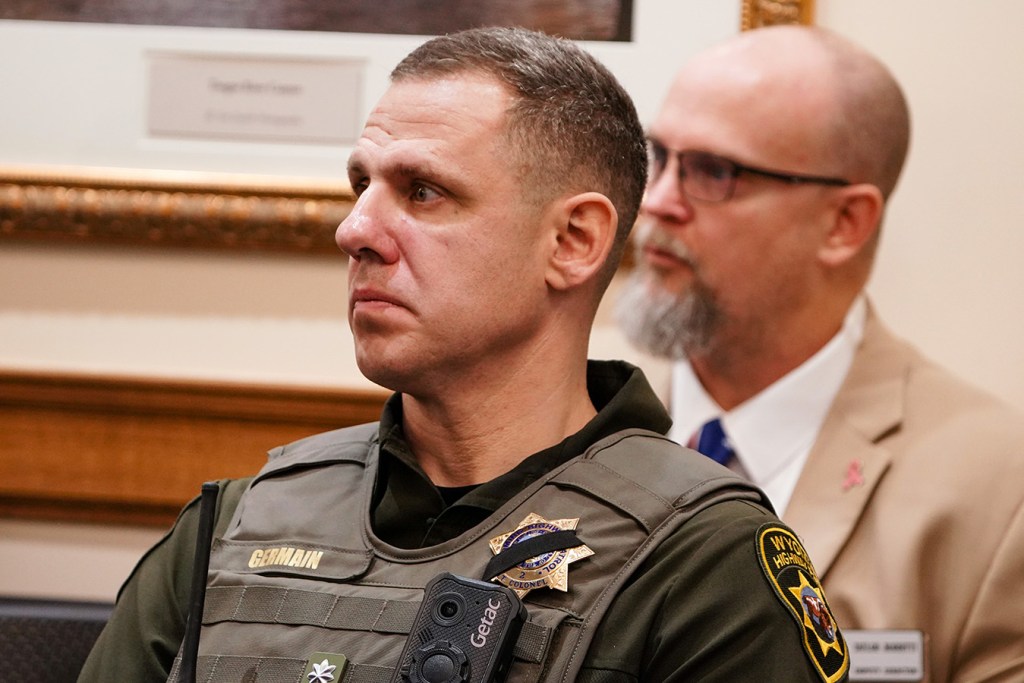
“It’s the first time we’ve seen them make changes to the extent that they did,” Wyoming Highway Patrol Lt. Col. Karl Germain, who had testified before the committee, told WyoFile after the meeting. The lieutenant followed up later after more closely reviewing the changes. “With those amendments that were passed today, I find that the bill is workable for law enforcement,” he said.
Allen Thompson, the executive director of WASCOP, also told WyoFile in an email that he had received feedback saying the bill “would be workable,” with the changes. “However, we have not seen the engrossed bill to ensure an understanding of the whole bill in context,” Thompson added. “And we have not been able to consult with counsel.”
The amended HB 130, however, doesn’t present a happy middle ground for everyone. Dorr, the Wyoming Gun Owners lobbyist, told supporters in an email newsletter that the bill had been “gutted.” Wharff, who was a law enforcement officer in Utah for two years, also described the Senate Revenue Committee’s amendment as “problematic” and told WyoFile that he would like to see it removed.
Meanwhile, SF 101 has remained largely intact. Advocates for a stronger SAPA law in Wyoming are pushing forward the bill’s Senate version in the final days of the legislative session.
Both bills must overcome three more votes to make it through the Legislature and to the governor’s desk.
For more legislative coverage, click here.
Don’t get me wrong, I’m a huge supporter of the 2nd amendment. But I would like to show my fellow Wyo’s just how ignorant and incompetent our state legislatures are.
Let’s look at the proposed amended text of HB0130 section (a) which I quote verbatim as follows:
(a) Except as otherwise provided in this section, this state and all political subdivisions of this state are prohibited from using any personnel or funds appropriated by the legislature of the state of Wyoming, or any other source of funds that originated within the state of Wyoming, any federal funds and any other source of funds solely to enforce, attempt to enforce, provide material aid, support or participate in any manner in the enforcement or implementation of any act, law, treaty, executive order, rule or regulation of the United States government solely regarding firearms, accessories or ammunition against any law abiding citizen.
I think most of us can see the logic trap in the language as proposed. In essence Wyoming law enforcement will not enforce Federal gun laws against law abiding citizens. If you are in violation of the NFA you are not a law abiding citizen. Therefore this clause has no meaning and Wyo law enforcement may act accordingly.
It has been litigated time and again that Fed law supersedes State law. So this proposed amendment is just another populist goat roping.
Any law that restricts the ability of citizens to own and carry any firearm is Unconstitutional by definition (an infringement).
States should do all they can to protect citizens from the Unconstitutional Federal laws and the enforcement of them.
We sell guns to the blind in this country.
Ray, the legally blind in many cases can still see. They can make out objects, recognize people in many cases, etc.
Do they not have the Right to self defense?
You would think that the more time I spend around people who seem to care more about guns than literally anything else on the planet, I would eventually begin to understand the allure. Decade after decade, after a lifetime in this epicenter of gun worship, the opposite is happening. I am increasingly offended when my neighbors seem to value their precious guns over the safety concerns of other people. Laws have changed, as have the demands of the gun lobby, to the point where gun owners must not be expected to bear any responsibility for the misuse of their firearms, no one must be disqualified from gun ownership, guns must be carried everywhere at all times, and there can be no restriction on the type of firearm or accessory allowed. We must live as if we are in a war zone, and still the gun lobby continues to push. The Second Amendment is one sentence. Read the whole sentence. I remember when the term “responsible gun owner” meant something. Gun owners have lost their moral compass.
What if they ‘defend’ themselves against their Mother, unbeknownst to the blind person.