

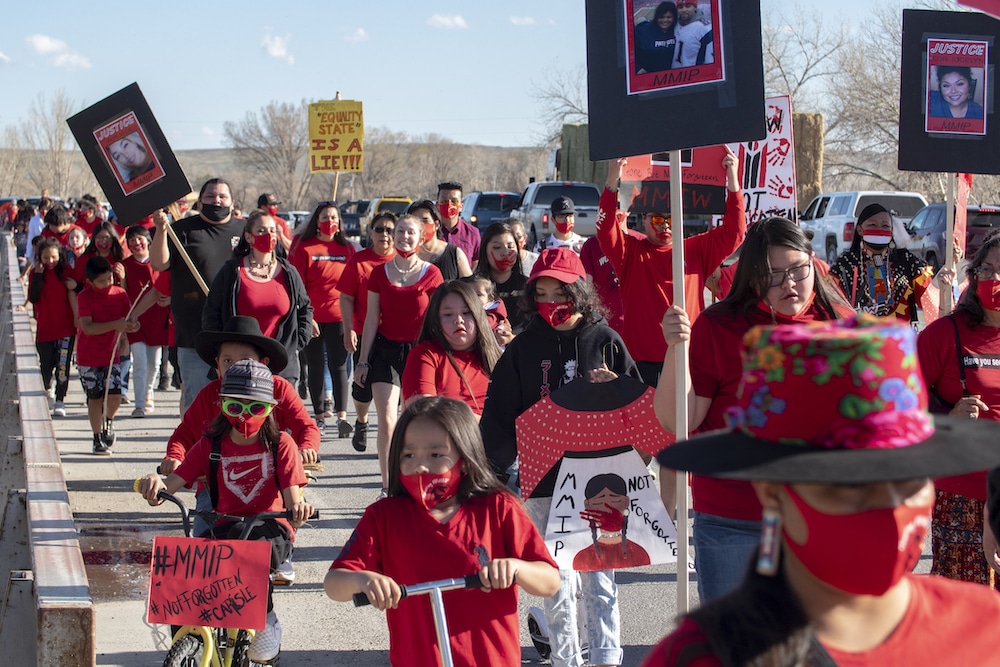
John Washakie knows what it means for friends and family around the Wind River Indian Reservation to go missing.
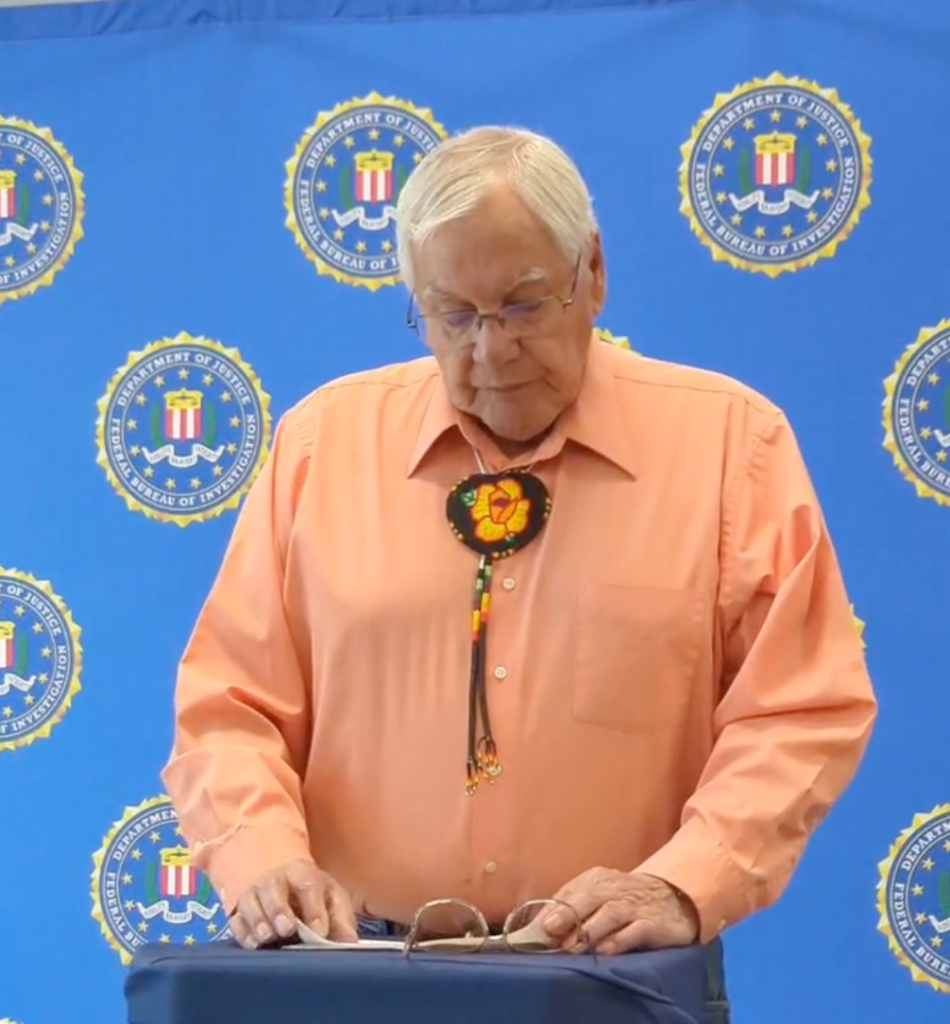
“Abigale Washakie was my niece,” he said during a press conference Thursday in Fort Washakie.
She had a family and home, he said, but drifted off and became involved with someone. She went missing. And then she was found.
“She was murdered and put in a trash can in Riverton,” he said.
He also knew a girl named Adrianna Goggles. When he worked at the local library, he remembered her checking out one Phyllis Reynolds Naylor book 14 times.
“They found her remains frozen in a snowbank,” he said.
Washakie is a member of the Eastern Shoshone Business Council. After he spoke, Lloyd Goggles, chairman of the Northern Arapaho Business Council, needed a moment before he could talk. When he did, he said the effects of these murders and missing people go beyond the confines of a family — or even the reservation.
“It affects all the surrounding communities,” he said.
In Wyoming, fewer than 3% of residents are Native American. Meanwhile, about 12% of homicides here were perpetrated against Native people in 2022, according to a 2023 Wyoming Survey & Analysis Center report.
While homicide rates against Indigenous people in Wyoming have started to decline, “[t]he 2022 five-year average homicide rate for Indigenous people was 18.3 per 100,000, nearly six times higher than the homicide rate for White people,” the report states.
The vast majority of those missing or murdered are kids.
After years of local and state initiatives — ranging from a task force and reports to a missing persons website and a new alert system — the FBI is now starting a 90-day initiative to gather more information on missing and murdered people in the state. That includes an effort to compile a complete list of cases involving Native Americans as well as solving cold cases.
The FBI is the main agency investigating these crimes on the reservation.
After the three months of data collection, the agency says it will research and investigate tips. The timeline of that work being presented to the tribes and public will depend on how much analysis the tips prompt, the FBI added.
“Findings will be presented to the Eastern Shoshone and Northern Arapaho tribes, then to the public,” it stated in a press release.
It’s asking the public to provide the FBI with tips via the hotline 307-433-3221 and the email address WYMMIP@FBI.gov.
The FBI has been cooperating with more local agencies and is responding to a consistent call for more and better data, according to Public Affairs Officer Vikki Migoya. Based on what the FBI learned from an MMIP initiative in New Mexico, the agency wanted to create something uniquely impactful for Wyoming, she said.
“MMIP isn’t a ‘one size fits all’ issue,” she said. “We have worked with the Eastern Shoshone and Northern Arapaho to craft a plan specific to here.”
Rifts
There has long been a strained relationship between tribal members and law enforcement, especially federal agencies.
That rang true in the 2023 WYSAC report, which identified the rift as an ongoing challenge to reporting missing and murdered people in Wyoming.
“I believe that some people that have had an unfriendly encounter with the police (and there are many) have little faith that anything will be done,” an unnamed community stakeholder is quoted saying in the report.
The FBI sees this 90-day initiative as a step towards healing some of that relationship, having sought out input and assistance from the Eastern Shoshone and Northern Arapaho business councils.
“This is an opportunity to shine another light on the MMIP crisis.”
Lloyd Goggles, Northern Arapaho Business Council
“In the past, tribal members have not always been comfortable working with law enforcement in general and the FBI specifically,” the agency stated in a press release. “The FBI recognizes these historical barriers and wants to do everything possible to improve the flow of information.”
Goggles appreciates these efforts from these federal partners, he said, and asked for both tribal and non-tribal community members to participate.
“It’s an important step because it also encourages healing,” he said of the initiative. “This is an opportunity to shine another light on the MMIP crisis. And I know that other people across the nation go through similar things … but this is our chance to achieve a measure of justice.”
Even if people don’t trust the agency, FBI Assistant Special Agent In Charge Leonard Carollo said, they can potentially bring information to others who they do trust.
“We understand that they might not want to come talk to us, they might not have trust in us or law enforcement,” he said. “If that’s the case, come to their tribal leaders or other tribally respected members of their community, and they will come to us. It takes time to build that trust, and we’re willing to be patient.”
Another challenge with working with the FBI has long been a perceived lack of transparency when it comes to cases like murdered and missing tribal members.
News sources, long scrutinized for their role in perpetuating harmful stereotypes and under-reporting these crimes, want more information from the FBI, too.
Responding to a question about that during the Thursday press conference, the FBI’s Migoya said, “We are very restrictive in what information we can give to the public about victims and about cases that are open.”
She acknowledged that the agency’s protocols are different from local law enforcement, adding, “We are going to do our best to communicate as clearly as we can to the tribes as well as to the public about that,” she said.

From the ground up
National efforts to address the inequities in murders and kidnappings among Indigenous populations have spanned nearly a decade. Many of those efforts have come in the form of trying to get law enforcement agencies — tribal, state and federal — to improve communication and better track this demographic.
However, a key point in the discussion is a lack of resources. That’s for both tribal members and law enforcement tasked with addressing crimes involving them.
Many see this as a continued failure on behalf of federal, state and local governments nationwide.
When asked about FBI resources going to this particular initiative Thursday, Carollo said he couldn’t reveal numbers.
However, he said there is a “large presence” of permanent FBI personnel in Lander and that there could be more resources and agents allocated to the area as the agency sees fit.
Are there any updates on this 90 day initiative? SNN Media is launching an investigation into these underreported missing cases and have begun recruiting Natives to assist Veterans On Patrol who is embedding a team in the Riverton homeless community. I am an Independent Investigative Journalist and will be documenting the homeless outreach taking place and efforts made to establish an independent reporting system designed to incorporate those who will not cooperate with Law Enforcement. My initial probe confirmed the mistrust in LEOs, including allegations of corrupted Tribal Officers. Thank you.
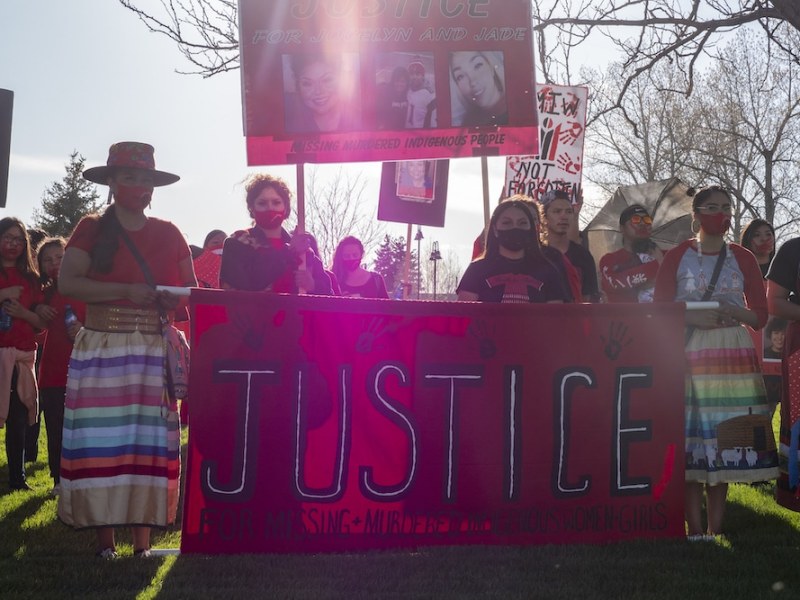
I have and have had a problem with the caption under this picture each time WyoFile uses it. I was there and estimated a few hundred people were at this 2021 MMIP March. At the very least there were 200. It diminishes accuracy when the press undercounts. By saying “more than 100” it implies there were a little more than 100 when in fact there were closer to, if not more than, 200 people. Honestly, it was a thing of beauty to see so many turn out; this undercounting by the press is a consistent problem by reporters and media outlets across the state.
I suggest continue getting unstuck from “what was” and keep moving towards what “can be” and “is becoming.” Learn the skills to make that happen — put aside past bigotry and mistrust and develop trust co work cooperatively, albeit respectfully, towards a worthy, common goal. It has already begun. It will never be perfect. It will provide more healing, awareness, and justice. It is the right thing to do.
The press could help by publicizing each MMIP case as quickly as possible.
It is about time the FBI begins investigating this disgrace. It has been going on far too long and must be stopped.
FBI couldn’t find the guilty if the guilty was given to them. I mean just look at all the evidence of corruption given to them on Hunter Biden’s computer.
Soon no more reservations only American Apache, American Navajo, American Arapahoe, no more rent pay for American soil, native lose gathering rights, sovereignty gone… Remember these words no more reservations… Coming soon…
Semper Fi!