

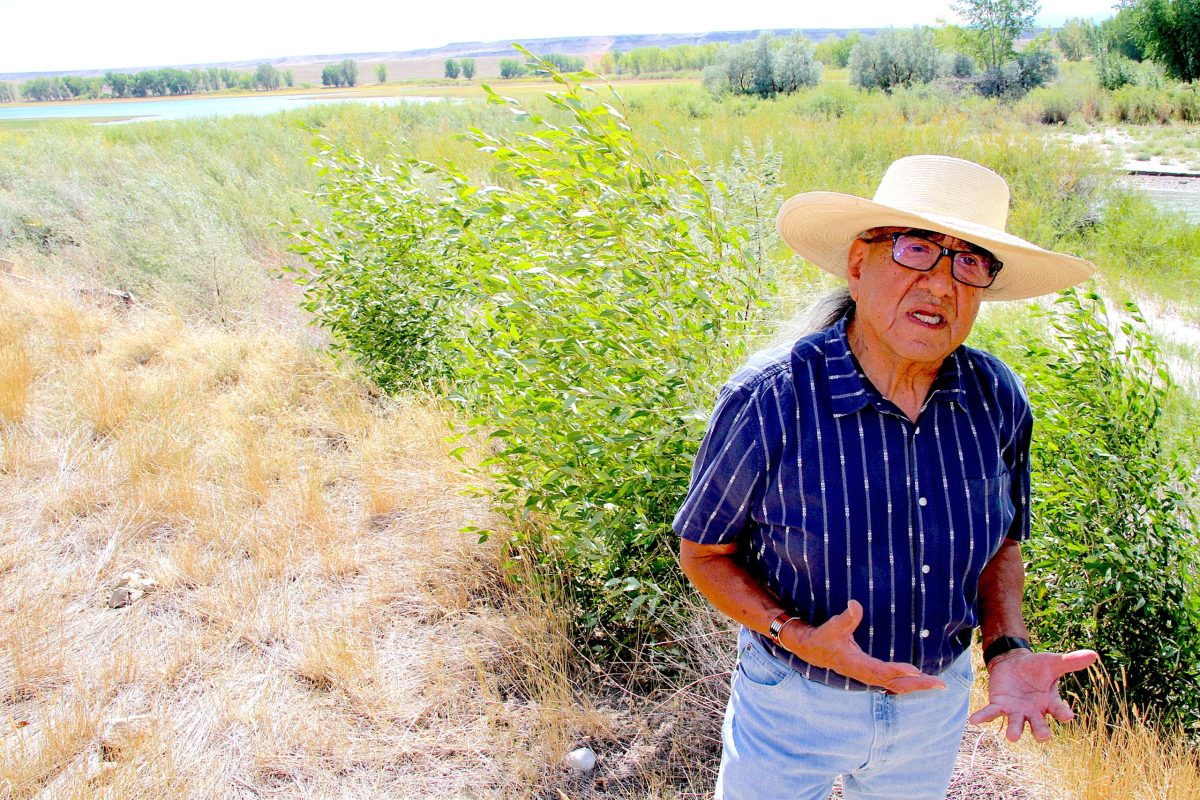

PAVILLION—Wes Martel’s frustrations bubbled up with ease while walking toward a penstock churning with water diverted from the Wind River.
“This is all reservation land,” he said. “That’s our position. This place never should have been created.”
Martel, a 77-year-old former Shoshone Business Council member, gestured across a portion of the northern Wind River Indian Reservation transformed by irrigation into a verdant agricultural landscape. The area had been opened up to white settlement more than a century ago, and the mechanism — an agreement ratified by Congress in 1905 — still does not sit well with many tribal members. Now, 119 years later, another congressional action has raised the ire of Martel and current elected leaders of the Eastern Shoshone Tribe.
Wyoming’s U.S. Rep. Harriet Hageman and U.S. Sen. John Barrasso have pushed companion bills that would require the U.S. Bureau of Reclamation to convey a derelict hydroelectric power plant located within the borders of the reservation to the Midvale Irrigation District. The legislation, which tribal leaders say was written and advanced without either lawmaker consulting the tribes, has already passed the U.S. House, and would also compel transfer of the land beneath the mothballed infrastructure.
Eastern Shoshone leaders, current and former, have traveled to Washington, D.C. to fight the proposed land transfer, which they say feels familiar.
“It’s a land grab,” Shoshone Business Council vice-chairman Michael Ute said.
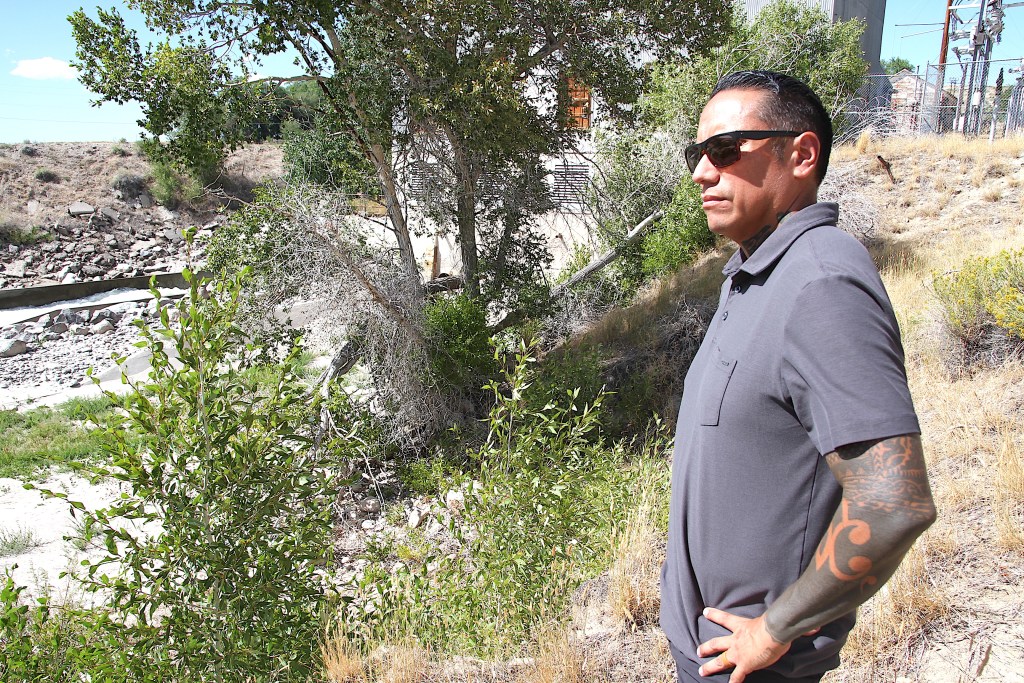
The elected tribal leader drew a parallel to the Chief Washakie era, when 1863 and 1868 treaties constrained the Eastern Shoshone to the reservation they now call home. After the treaties were ratified, white settlers pouring into Wyoming still desired the land and water of the Wind River Indian Reservation.
“If they could not negotiate with the tribes, they went behind their back and enacted legislation,” Ute said. “The same thing is happening today. They’re enacting federal legislation to take a piece of land right in the middle of the reservation.”
Familiar feeling
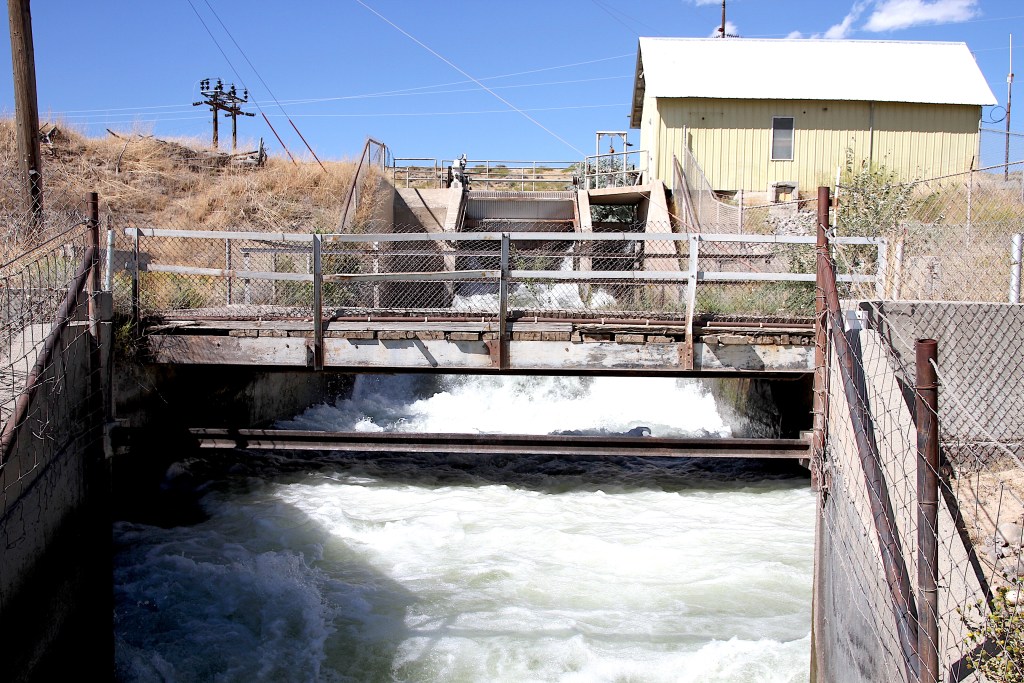
Ute joined Martel Wednesday at the site of the disputed property, which is owned by the federal government and managed by the Bureau of Reclamation. It’s essentially an old tin-sided building housing a hydroelectric facility that’s gone unused for 16 years. The infrastructure and land that would be turned over to the Midvale Irrigation District by the bill also includes a penstock filled with water diverted from the Wyoming Canal. The water, which used to spin a turbine to generate electricity, now bypasses the building, directly feeding Pilot Butte Reservoir.
The Eastern Shoshone have no firm plans for the power plant.
“It’s the principle,” Ute said.

Martel piggybacked on the thought: “We’ve just got to fight back,” he said. “We’re trying to familiarize ourselves with how this got this far, and what do we do to stop it?”
The Midvale Irrigation District approached Wyoming’s congressional delegation about transferring the title of the old Pilot Butte Power Plant so it could be rehabilitated. Dollars and cents drive the irrigation district’s interest in an era of increasing electricity costs for utility customers, farmers and ranchers.
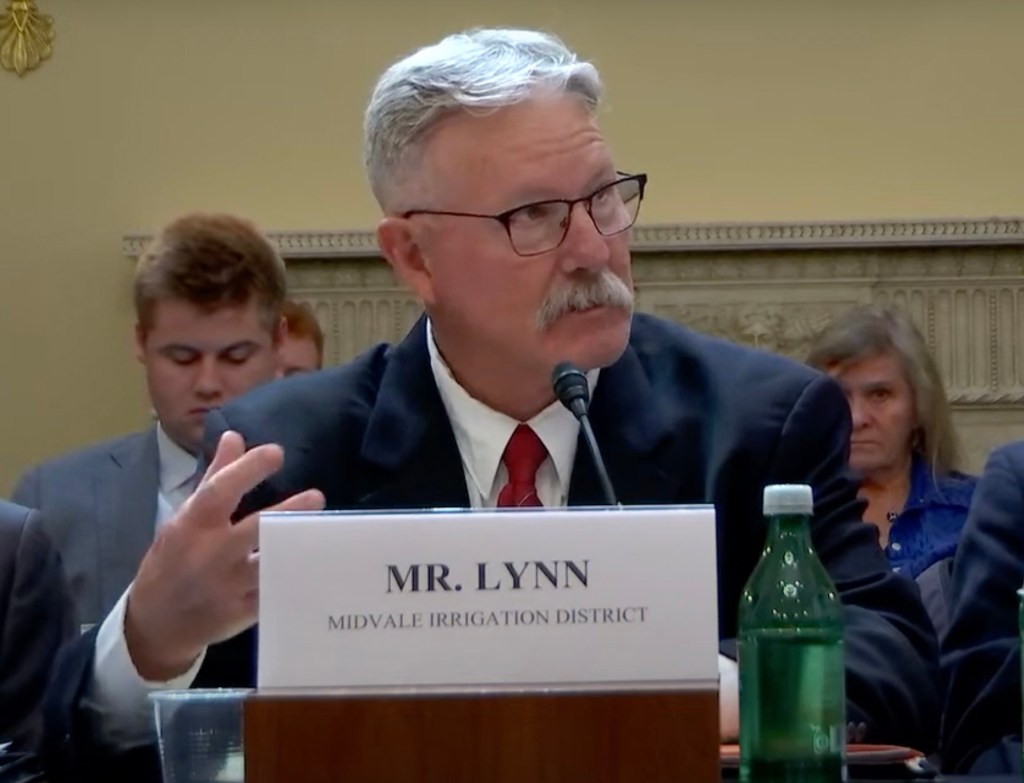
“Midvale is committed to doing whatever is necessary to keep costs down regarding its service to our customers,” Midvale Irrigation District Manager Steve Lynn testified to the House Water, Wildlife and Fisheries Subcommittee in September 2023. “The benefit of power production to our customers would be seen in minimizing the costs of services that we provide.”
A month later, the Pilot Butte Power Plant Conveyance Act was reported out of the House Committee on Natural Resources without discussion on a consent list. It passed the U.S. House of Representatives without debate or opposition in February.
Sen. John Barrasso’s identical bill cleared the Senate Committee on Energy and Natural Resources in December. An amendment, brought by Sen. Joe Manchin (D-West Virginia), was passed that directs Bureau of Reclamation Commissioner Camille Touton to “enter into negotiations with Midvale Irrigation District to determine the terms of the conveyance.”
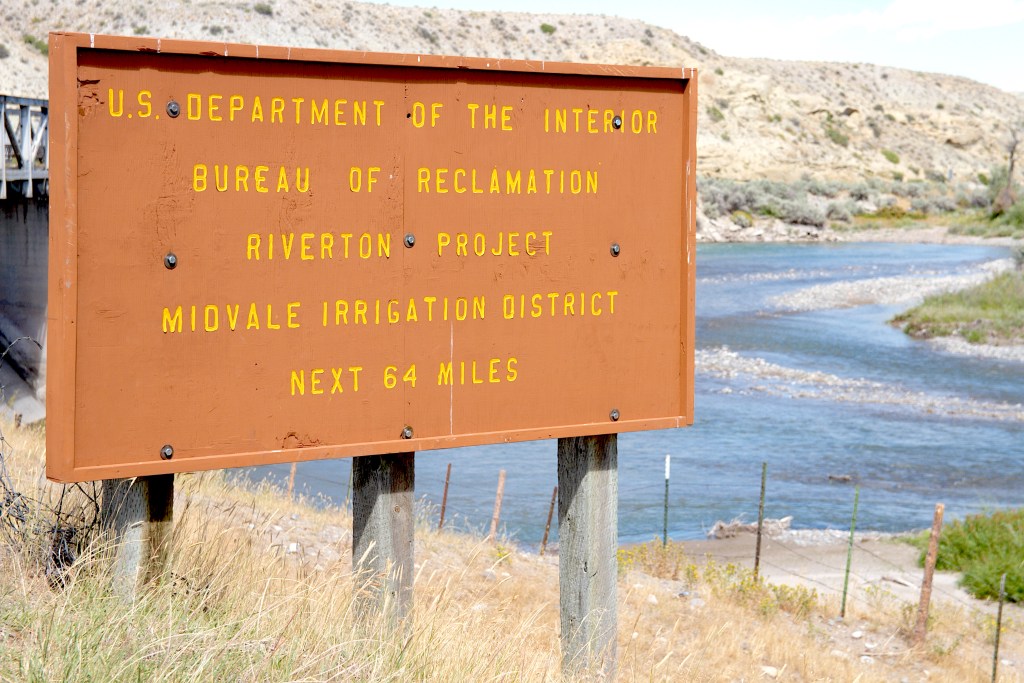
Hageman’s office did not respond to an interview request for this story. Barrasso’s media team pointed WyoFile toward remarks that the senator made while the bill was being marked up in committee.
“It’s a win-win situation,” Barrasso said during a December 2023 hearing. “The American people will no longer own a mothballed facility that would cost money to demolish. The people of Wyoming will be able to put the hydropower plant back into use.”
As the legislation has made its way through Congress, the power plant’s location within the borders of the Wind River Indian Reservation has not been a part of the discussion.
No consultation
“If you Google, ‘Pilot Butte Power Plant Conveyance Act’ and ‘tribes,’ nothing comes up,” Ute told WyoFile outside the mothballed facility. “It’s just a piece of legislation that seems non-controversial to everybody.”
The Eastern Shoshone Tribe learned about the legislation by reading the news, he said.
“That’s how the tribes found out about it,” Ute said. “It wasn’t the delegation coming to us saying, ‘Hey, we’re doing this, we’re doing that.’”
WyoFile was unable to reach the Northern Arapaho Business Council for input on this story.
Former Shoshone Business Council member Orville St. Clair, who’s a member of the Wind River Water Resource Control Board, was part of a tribal delegation that traveled to Washington, D.C. last winter to encourage Barrasso, Hageman and other members of Congress to kill the bill.
“I’m giving her the benefit of the doubt,” St. Clair said of Hageman. “She’s a freshman legislator.”
Displeasure with the lack of consultation was likely inflamed by the class of federal land that’s involved in the proposed land conveyance. The Bureau of Reclamation is not normally in the business of land management — it manages dams and other water-related resources — and for decades the federal agency has been looking into disposing of tens of thousands of acres of property within the Wind River Indian Reservation. The tribes, meanwhile, have been pushing to get that land back since the 1940s: Repatriating Bureau of Reclamation property is a campaign of the Greater Yellowstone Coalition, Martel’s employer.

In the early 1990s, the bureau requested disposing of somewhere “in the neighborhood of 56,000 acres” of excess land in the Muddy Ridge area. The process, however, “stalled out,” said Lyle Myler, who manages the bureau’s Wyoming-area office.
“Just recently, there’s been a renewed effort … to reinvigorate that process,” Myler told WyoFile.
The way the process works is revoked land — which is being reassessed and surveyed — would fall under the purview of the Bureau of Land Management, he said. That sister federal agency would then lead a process that could result in the BLM managing the lands. There’s also the potential of some of the property being returned to the Wind River Indian Reservation.
Not related to Muddy Ridge
The Pilot Butte Power Plant conveyance being pursued by Congress is unrelated to this process, Myler said.
“The power plant resides on land that was not identified and is not part of the Muddy Ridge revocation,” he said. “It’s separate.”
Selling the infrastructure requires an act of Congress, because it’s classified as “reserved works” that are otherwise not eligible for transfer.
“That’s why the district has pursued separate legislation for conveyance of the power facility,” Myler said.

Although the old hydro plant sits on land the bureau would otherwise retain, Eastern Shoshone members worry that legislation could stymie a land transfer they believe would right a historical wrong.
“To me, the bill is kind of a wrench in the works,” Ute said.
The Eastern Shoshone also have interest in acquiring the power plant.
“We have a tremendous need for power in that area,” John Washakie, great-grandson of Chief Washakie and a councilman on the Shoshone Business Council, told WyoFile. The tribe operates some oil and gas rigs in the area, he said, and “loss of power,” at times, has been a “big issue.”
“It could be a valuable asset,” Washakie said.
Socioeconomically, the Wind River Reservation has lagged behind the rest of Wyoming for generations, though there’s a newly funded push for revitalization.
Regardless of who receives the old hydroelectric plant, it makes financial sense for the Bureau of Reclamation to get rid of it, Myler said. Even though it’s not functioning, he said, there’s still an expense to monitor the old infrastructure.
The Pilot Butte Power Plant, which can generate up to 1.6 megawatts of electricity, dates to 1925, according to a report accompanying Barrasso’s bill. The Bureau of Reclamation contracted out operation and maintenance of the seasonal facility to the Midvale Irrigation District, but it’s fallen into disrepair on two occasions: From 1973 to 1990 and from 2008 to the present. In 2016, the Wyoming Water Development Office estimated it would cost between $4.4 and $8.3 million to bring the old power plant back online.
Walking out from the old building at the center of the dispute, Martel and Ute ran into Lynn, the Midvale Irrigation District supervisor who rolled up in his pickup truck. The trio introduced themselves and engaged in cordial conversation.
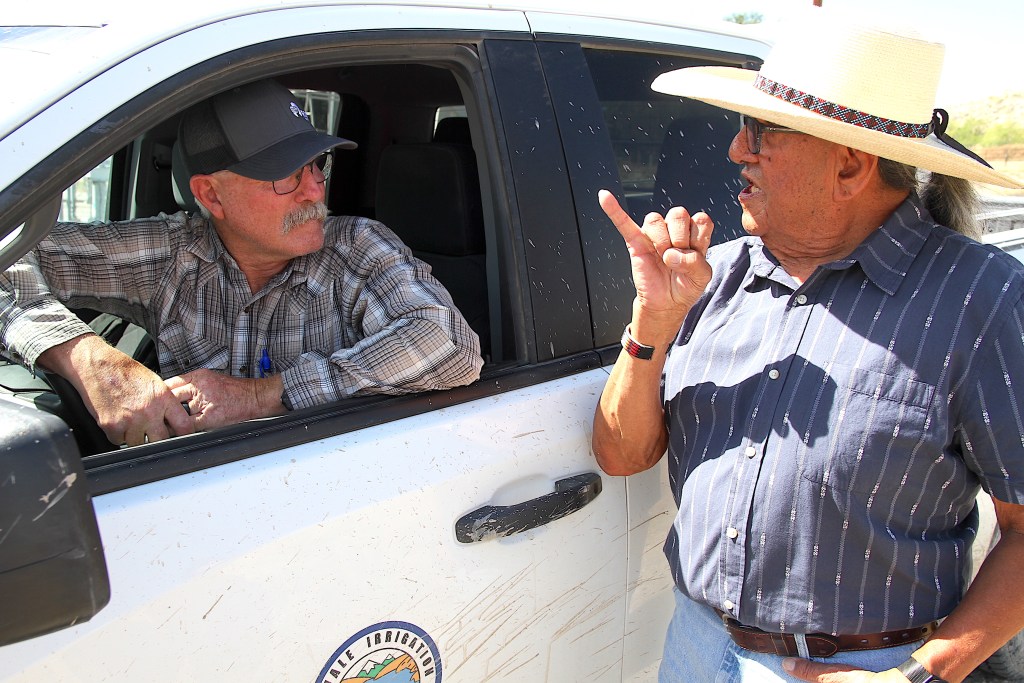
Lynn told the two tribal members that the bill was unrelated to the Eastern Shoshone’s efforts to acquire excess reclamation land in the Muddy Ridge area. “I wish I could make you comfortable with that statement,” he said.
Martel repeated one of his many frustrations.
“They should have consulted with us,” he said. “They didn’t even have the common decency to come and explain these things to us.”
Lynn heard him out.
“I know,” he said.
Typical behavior for the Wyoming Triplets. Y’all put some real screwball racists into positions of power here in the backward cowboy state.
Interesting that no one talked with the Wind River tribes, especially since Rep. Hageman is chairperson for the
Subcommittee on Indian and Insular Affairs (Chair), along with
Subcommittee on Water, Wildlife and Fisheries
Remember, Hageman is an election denier. I doubt she really believes her nonsense, but either way she cannot be trusted. She did benefit from it though.
I agree, Gordon. I just wanted people to be aware of the fact that she is the chairperson of the committee that is supposed to be representing and supporting the very people she’s working against by sponsoring this house bill.
Boy oh boy! One would think self important people could foresee severe problems and back lash from something this dumb. I would think most people who wanted what someone else owns would try to sit down with them and cime up with a plan that works for both sides. The political folks got too impressed with themselves and will probably fail at what they wanted.
Given the sordid history for the USA and the land’s indigenous peoples, there is much to mend. Here is a brilliant opportunity to do things differently. Unfortunately we got more of the same, a paternal, colonial “we know best” attitude that does not consider those most affected , and most entitled.
I, as a non indigenous, transplant to Wyoming some forty years ago think the Land Back movement presents one such opportunity for badly needed reconciliation.
Land grabbers,,,,do not take this Shoshone property.
This is how disrespectful our Reps are. You Wyoming voters better wise up. Our three “reps” would love to steal our PUBLIC land. They also want to build homes on federal land. They would like to give it to their buddies and industry.
I cannot agree more about their land grab schemes, However before they go any further what kind of power contract are you going to get , producing power is easy selling it is a different thing . The Wyoming public utility comm sets the price so low it won’t be feasible to operate.
Someone should talk to the head of the Department of Interior. She oversees the Bureau of Reclamation and the Bureau of Indian Affairs. Maybe she will be able to fix this mess. Figures that Brarrasso & Hageman would NOT take care of our Native Americans here in Wyoming.
As a member of the N. Arapaho tribe, the state, county and elected legislator’s do not respect our sovereignty. Tribal consultations need to happen!!
A little hypocrisy at work here? Hageman and Barrasso hype their opposition to what they call “government overreach,” yet here they are discovered to be practicing it shamelessly.
BREAKING NEWS: Government steals tribal lands to benefit white ranchers! Oh wait, that’s not news, it’s the same old story.
write Sect Deb Haaland. she can advise Pres Joe Biden not to sign bill if you all give a compelling reason.0
Mr. Martel. Get over the frustration and look at both sides without blinders. Can the power plant be refurbished and generate positive income and provide jobs? It will be all government money that refurbishes the power plant. What your experiencing with the government is typical of what we all grow frustrated with.
Please follow this story in the coming months. Thank you.
Transfer the power plant and ALL of the BOR land within the WR reservation to the tribes.
Yes!! It a good deal!! Power plants will make money. Another Solar company just went belly up today. Biden continues his losing way with solar. Course it our taxpayer money. Solindena was wat $900 mill?
Hageman, Barrasso, and Midvale Irrigation District. Why does this surprise me. Not consulting with the tribes is unforgivable.
Whoa!!! There’s a whole lot more to this story that was overlooked in Mike’s article. The Supreme Court ruled on June 25, 2018 that the land administered by the Bureau of Reclamation – the land taken from the tribes in 1905 and opened up for whites to settle – is not part of the Wind River Indian Reservation. The verbage which refers to changes in the boundaries of the WRIR is ” diminished the exterior boundaries of the WRIR” and only congress can change the exterior boundaries of a reservation. This has happened three times with respect to the WRIR – when the 10 miles by 10 miles was removed for Thermopolis/Big Spring; when Lander was carved out of the reservation; and when the 1904 act opened up what is now the irrigated land below the diversion dam all the way to Boysen. As a result, Riverton is not within the boundaries of the WRIR. Yes, the tribes had land basically stolen from them by the 1905 act. The tribes objection to the old hydroelectric plant being returned to them is actually asking that land outside of the reservation boundary be returned to them – a fair request. However, it is not land within the reservation boundaries – as the white man’s law views it – but not in the eye of the shoshones and Arapahoes. Its fairly common for the various tribes to purchase land outside of their reservation – a process which buys back land from the whites and returns it to tribal ownership. I believe there have been several buy backs of white owned land within the WRIR boundary and maybe some within the irrigated lands shown as Bureau of Reclamation administered land. Therefore, the Shoshones and Arapahoes have a fair request that the hydroelectric plant be returned to them.
I recently read a similar situation in Oregon where five small dams on the Klamath River are being removed in order to restore historic salmon runs. Originally, the various tribes had land taken from them in order to build the dams – and now that the dams are being removed – there is an expectation that the government should return the land to the tribes. Doing so apparently would require the state legislatures in Oregon and California to approve transfer of ownership back to the tribes. Its a matter of fair dealing and hopefully the tribes will prevail and get their land back. It all comes down to fair dealings and whites are not known for fair dealings with the tribes.