

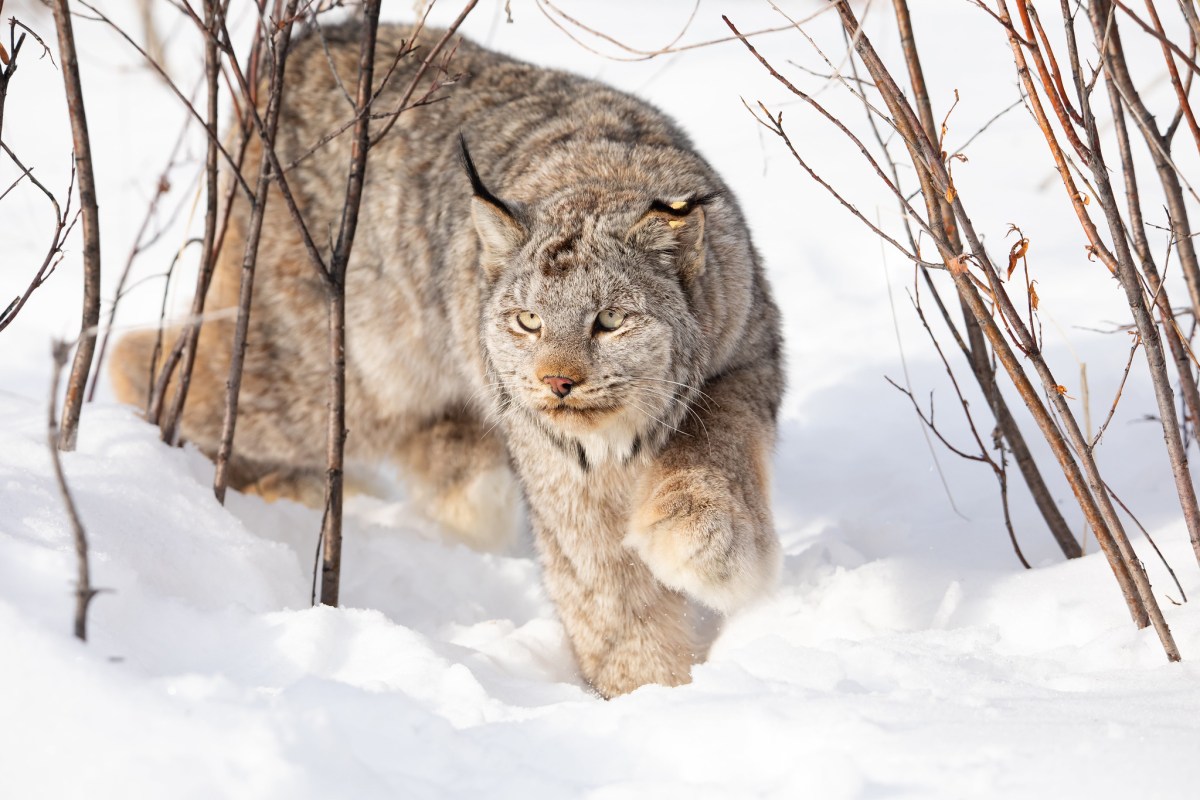
Pointing to new science suggesting the Greater Yellowstone Ecosystem lacks quality lynx habitat, wildlife managers are proposing expansive reductions in the area designated as “critical habitat” for the rare, snowshoe hare-dependent felines.
Despite the lynx’s almost complete absence — apart from a 2022 one-off sighting — the U.S. Fish and Wildlife Service has classified 9,146 square miles of the Yellowstone area as critical lynx habitat for the past decade. Last week, the federal agency proposed a revision, tentatively slashing critical habitat in the region to 1,121 square miles — an 88% cut. Federal officials cite leaps in lynx habitat science as their rationale.
“The new modeling is empirical, it’s tested, it’s validated with independent data — it’s the best stuff we have,” Fish and Wildlife Biologist Jim Zelenak told WyoFile. “What it shows is what some of us have thought all along: That the Greater Yellowstone is really just not great for lynx.”
Previously, he said, critical habitat designations were based on modeling that looked at aerial imagery and slope angles. The outcome was “broadly protective” habitat designations that included places where lynx may not have historically roamed, such as Yellowstone National Park.

For a quarter century, lynx have been classified as “threatened” under the Endangered Species Act, which requires federal officials to identify habitats critical to the conservation of a species and meriting special protection.
Currently, critical habitat for lynx stretches from the tip of the Wyoming Range, through Yellowstone National Park, clear up to the Beartooth Mountains and Gallatin Range. That designation dates to 2014.
The ongoing revision came about when it did because of a legal agreement.
The new proposed maps restrict critical habitat to three disconnected areas of the Yellowstone region, all in Wyoming. The largest swath treads over the Wyoming and Salt River ranges — an area lynx occupied as recently as the 1970s, but were extirpated from by the early 2000s. Another block of proposed critical habitat is located on the west slope of Togwotee Pass, while the last is a tract that bridges from the northern Wind River Range into the southern Absarokas.
Quality lynx habitat is the same as good snowshoe hare habitat, because the large-pawed, pointy-eared cats depend on the forest-dwelling lagomorphs. In the absence of adequate hare numbers, lynx can hang on, but they struggle to reproduce and persist long term.

The Fish and Wildlife Service proposed its revisions to critical lynx habitat in conjunction with a final recovery plan for the species throughout its range in the Lower 48.
“It’s largely a maintenance recovery plan,” Zelenak said. “We want to maintain current population resilience by maintaining populations of sufficient size with sufficiently large areas of suitable habitat that remain well-connected to the core of the species’ range in Canada.”
Federal biologists estimate that there are roughly 2,000 lynx south of the Canadian border, with easily the largest remaining population residing in Maine. Other functional populations are found in the arrowhead region of Minnesota, the North Cascades in Washington, the northern Rockies in Montana and the southern Rockies in Colorado.
Although the Yellowstone area is essentially devoid of lynx, Wyoming’s prospective habitat is also projected to remain viable as the climate warms over the remainder of this century — unlike habitat in New England and elsewhere that’s susceptible to disappearing, according to the recovery plan.
The plan does not call for reintroducing lynx to the southern Greater Yellowstone Ecosystem, at least not yet. Habitat modeling suggests that perhaps 25 to 50 cats could call the region home, if a reintroduction was studied and OK’d down the road, Zelenak said.
“The [Yellowstone area] and the southern Rockies are the two places that are projected to stay cold enough longest, so they both could serve as climate refugia,” he said.

If lynx do show up on their own, somewhat regular intensive surveys might detect them. The Bridger-Teton National Forest and, more recently, the Wyoming Game and Fish Department have swept the state’s most suitable habitat looking for the mid-sized cats, though they haven’t found evidence of a single animal. A mountain lion houndsman did acquire proof of a lone animal up a tree in 2022, snapping a photograph of the wildcat.
Although wildlife officials are proposing the large-scale reduction in Yellowstone-region critical habitat, that’s not to say that lynx won’t be accounted for at all in federal land-use planning, Zelenak said. Former critical habitat in the region isn’t going to return to “the wild west of timber management again,” he said.
The Fish and Wildlife Service is taking comments on its proposed habitat revisions through Jan. 28. The agency will publish a final rule changing the designations at this time next year, Zelenak said. To weigh in, go to www.regulations.gov, docket no. FWS–R6–ES–2024–0142.


This means for years we had unnecessary restrictions on 8025 square miles, for a species that is practically non-existent. A healthy forest will have not more than a few hundred trees per acre. Thinning small, sapling-sized regeneration to reduce fuels, improve forest health, and benefit other species of wildlife is not allowed in critical lynx habitat, even if there are 10,000 trees per acre, because it proves forage and cover for snowshoe hare. This is one of several reasons why we are having these enormous wildfires.
I believe selective thinning has been shown to be beneficial for most flora and fauna. More light hitting the ground that provides for plant growth and more and better habitat for most species that need cover; owls and their prey, lynx, etc.
Absolutely! The light also maintains live needles on the lower branches of young conifers that snowshoe hare depend on for winter forage. Without selective thinning, the bottom branches are quickly shaded out and die. Unfortunately, USFWS doesn’t seem to understand this.
Dewey’s comments are the best ever on Wyofile!!!! Wonderful discussion on the highest level of superbly informed facts. Thank you. Lee
If Trump’s USFW delisted it in 2017, they will again in 2025. There won’t be any protected habitat anywhere in the US, including the areas that will remain the coldest as the climate continues to warm.
Skeptics need to take a hard look at the successful reintroduction of Canadian Lynx to the San Juan Mountains of Colorado, specifically the core region between Durango and Gunnison beginning in 1999 . About 75 Lynx were brought down from Alaska and Western Canada, and the cats that were previously ghosts in the San Juans are now thriving. Oh by the way , the San Juans are geologically and ecologically nearly the twin to Wyoming’s own Absaroka Range. I have long advocated for replenishing the Lynx population in the region around Cody after I watched some aggressive trapping of the animals in the 1970’s. One group of trappers I was associated with targetted Lynx in what was almost in informal trapping derby with the prize being bragging rights. I observed Lynx trapped go from steady to some to none. In other words, they trapped them out. The last I knew of came out of the southern Absarokas between the Owl Creek Range and the big Gooseberry drainage of old growth forest in the late 70’s. I haven’t heard of a live Lynx sighting in this century, but I don’t cross paths with trappers these days , by choice. Count me in the camp of eleiminating most trapping of furbearers this day and age. Lynx and Bobcat are definitely desireable for ecological health reasons. The trappers cannot be allowed to set wildlife regulations using their commercial interests to override larger wildlife policy concerns. So-called Trapping Rights are a 19th century anachronism that needs to be scaled way back. After all, the third greatest atrocity committed upon the American West open lands after the slaughter of millions of free roaming Bison and the genocide against Native American peoples was the near extinction of the Beaver by the trappers. Eliminating the Beavers reaked huge damage on the hydrology of the West. We are still paying for that and just barely realizing we need to replenish the Beavers. Ditto Lynx and Bobcat and Wolverine. Furbearers are far more valuable alive in the wild that on a man’s head or a woman’s coat.
I strongly disagree with US Fish & Wildlife and Wyo Game & Fish in their severe diminshment of the wildcat populations and habitat mapping. It is still possible to restore Lynx and Bobs to western Wyoming , specifically the eastern GYE. But right now , management is going 180° in the wrong direction . We’re letting the very people who allowed to near extirpation of wildcats in the first place by not regulating the trapping take to remain in charge of saving them and setting out the traps. Furtrapping was s-o-o-o- early 19th century. It’s time to reform , replenish , and restore while we still can.
Accurate as it reads, this article only tells half the story.
Mr. Vanderhoff is “right on” with his submission as is the next presenter, Mr. Carter. Government (Fish and Wildlife) population assessments of any creatures are suspect and based on industrial desires. The government agencies are beholden to all extractive interests and basically only in it to provide them selves a paycheck. Lynx, wolves, wolverines, Bobcats and Pumas etc. deserve a place where they can thrive and be unfettered by human interaction and misguided management policies. Stop the US Fish and Game from instituting any of their pre ordained opinions and managing options unless it benefits rather than throws more limits in the mix. Lynx and wolverines need vast lands with prey available. U.S. govt. is not made that way.
Totally predictable…the agencies’ efforts have been to ignore historical occupancy and gradually diminish the “occupied” range of lynx in the intermountain west, including Yellowstone and the surrounding region.
Their highly touted 2007 “Northern Rockies Lynx Management Direction” was supposed to preserve lynx habitat, yet this proposal shows that was a total failure.
They misuse the Olson 2021 model to justify only islands of high elevation habitat and ignore the larger landscape that model also shows is suitable. And, as before, there won’t be any protections on linkage areas between these isolated islands, a basic violation of the principles the Fish and Wildlife Service has cited in the past. That is, without connectivity, those islands (metapopulations) will blink out.
See our analysis of their Species Status Assessment and comments on their Draft Recovery Plan at this link: https://app.box.com/s/26004e8625ivqbk1d9vm62rf47qxoe14
Thanks for the counterpoint information. There seems to be a major discrepancy in viewpoints.