


STAR VALLEY—Out on a late August float, biologist Darren Rhea had to disembark his drift boat more than once to navigate shallow water, which isn’t exactly normal for the Salt River.
But this year, the need to wade wasn’t wholly unexpected. The scenic Salt, cutting through the bottoms of agrarian Star Valley, has for months been carrying about half its normal volume of water.
“I don’t ever remember floating it this low,” said Rhea, the Wyoming Game and Fish Department’s Jackson Region fisheries supervisor.
The lack of water wasn’t the only thing amiss with the prized Lincoln County trout fishery.
Mountain whitefish, an underappreciated salmonid, had been turning up dead “by the hundreds” in recent weeks. Rhea was on the oars — and dragging along a driftboat weighed down by a photographer and colleague — to pinpoint exactly what was going on.
He had a hunch.
“If these pathogens are here, fish can overcome it,” Rhea said during the Aug. 25 float. “But you apply enough environmental stressors, that shifts the balance.”
The pathogens, a microscopic parasite called Tetracapsuloides bryosalmonae, are thought to be endemic and native. They can cause a condition called proliferative kidney disease, known by its acronym, PKD, which killed thousands of whitefish in the Snake River’s South Fork and the Yellowstone River in 2016.
Fast forward to the present, and a deadly bout of the same disease has hit a Wyoming fishery for the first time. A week after Rhea’s float, laboratory results came in confirming that PKD was the culprit.
“It seems to be related to temperature and flow,” Rhea said. “When there are periods of warm water and low flow conditions, that’s when these outbreaks occur.”
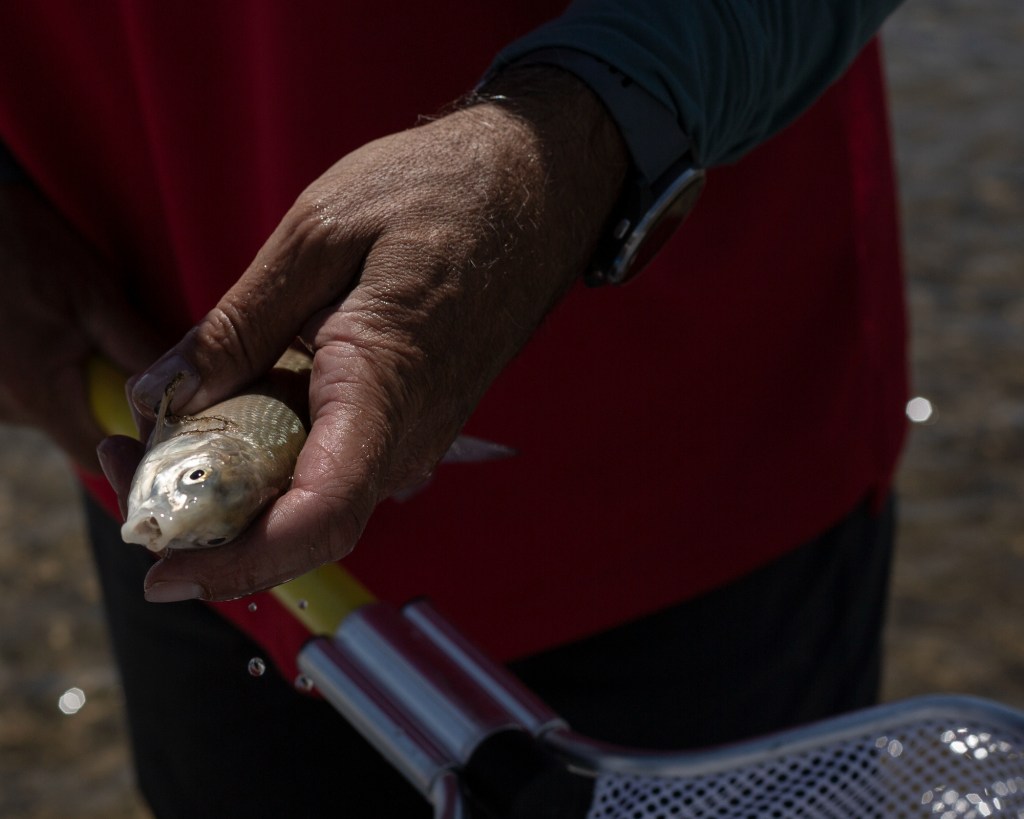
A dead mountain whitefish rests at the bottom of the Salt River on Aug. 25, 2026, following a mass die-off in Star Valley.
Biologists only collected freshly dead fish floating near the surface to provide good samples for lab testing. (Ryan Dorgan/WyoFile)
Those conditions have been easy to come by in 2026. The Salt River is part of the Upper Snake watershed, where reservoirs face their lowest levels since the impoundment system was completed a half century ago, the Jackson Hole News&Guide reported.
Smaller volumes of water warm faster, and that’s also been the case this summer. Although the U.S. Geological Survey’s Salt River gauge near Etna lacks a thermometer, water temperatures in the adjacent Snake River were warm enough that Game and Fish asked anglers to refrain from catch-and-release fishing between noon and sunset from July 29 through Aug. 14.
There are unanswered questions, Rhea said, about the “paradox” of why PKD kills whitefish when and where it does. The 84-mile-long Salt River drains snowmelt from the Caribou and Salt River ranges and is in better shape than other rivers with whitefish and trout that have escaped outbreaks, he said.
Research is underway at the University of Idaho that could help provide some clues. And Wyoming fisheries managers are also examining the toll that the disease is taking on native mountain whitefish, which are considered a bellwether for stream health and degradation because they depend on cold, clear water.
“We were physically documenting hundreds of dead fish, which is a pretty good indication that overall we were dealing with thousands,” Rhea said. “The cool thing about the Salt is we’ve got historic trend monitoring data in trout and whitefish. It’s one of the few places where we’ve had one of these outbreaks where we’ve got whitefish data. So we’ll know for sure [what the impact was] next year.”

Although the fish-killing PKD outbreak was a first, the Salt River has a history of degradation and water-quality struggles. For years, the Star Valley stream was saddled with an E. coli impairment, although a “Total Maximum Daily Load” mitigation plan was put into place in 2015 that sought to reduce fecal bacteria levels in the Salt by 60%. At the time, as many as 32,000 sheep and 10,000 cattle grazed within the Salt River watershed, and those domestic livestock accounted for between 88% and 95% of the E. coli in the system.
There’s been some progress toward planning to improve the river system’s health. The Salt River Watershed Group was formed, and there have been efforts to resume data collection and implement a new sampling and analysis plan, Ron Steg, the Wyoming Department of Environmental Quality’s assessment and TMDL Program lead, told WyoFile in September 2025.
At that time, the E. coli issues in the river had persisted.
“Based on the information that I’ve seen, [E. coli concentrations] haven’t likely come down significantly,” Steg said last year.


E coli in Salt River is from prolific septic tanks not cows. When the Thayne creamerie closed on 29 Apr 1993 the number of cows and dairy farms in Star Valley decreased by 30% and 70% from 1970s and only one dairy is left today.
The number of subdivisions have soared and only Afton, part of Star Valley Ranch, Thayne, and Afton actually treat sewage. The water table is shallow in much of the valley.
To solve E coli force developers to build waste water treatment plants and make zoning encourage density so that waste water treatment is economically viable.
Much of the valleys rocky soils make perculation rates combined with high water tables such that septic systems are not effective.
Denser communities with septic treatment plants or lagoons is the answer. Denser communities would also help with housing costs as individual wells and septics are expensive (if done right) and have negative externalities.