


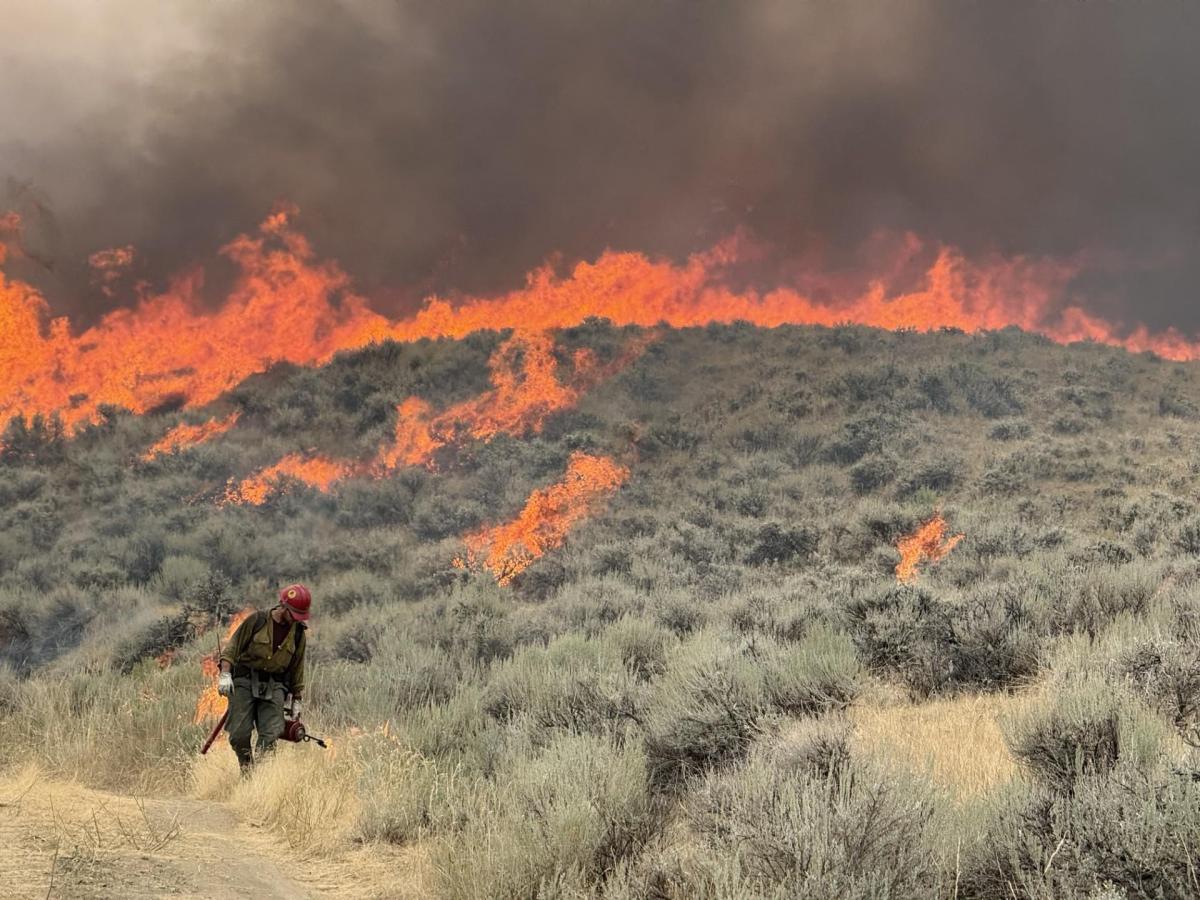
CHEYENNE—A $5.1 million investment that would create the first two ground-based professional wildland firefighting teams in Wyoming history is gaining momentum in the statehouse.
On Monday, the Wyoming House of Representatives passed House Bill 36, “Forestry division wildland fire modules.” The bill included an earmark of $2.7 million for one team of firefighters going into the day, but Buffalo Republican Rep. Marilyn Connolly brought an amendment that doubled the funding, providing enough to finance two crews — one each in the eastern and western sides of the state. The former Johnson County emergency management coordinator spoke about her experience being on the ground while wildfires were spreading and resources were lacking.
“We need some strike teams, we need engines — and they’re not available,” Connolly said on the House floor.
In 2024, wildfire charred major portions of the Powder River Basin near Connolly’s district. Both the Elk and House Draw fires ripped across the landscape that year, which ended as the second-biggest fire year in Wyoming history.
In the aftermath, the Joint Appropriations Committee named “wildfire response, prevention and management funding” as its top priority to help the Office of State Lands and Investments and State Forester Kelly Norris better prepare for the next big fire year. That might be upon them: Low-lying portions of Wyoming have been historically snow-free so far. Even as lawmakers debated the funding, conditions were ripe for a mid-winter wildfire.
It’s a “very bad situation,” remarked Jackson Republican Rep. Andrew Byron, a volunteer lieutenant with Jackson Hole Fire/EMS.
“You are currently sitting in the people’s house, and outside we have a Red Flag Warning right now,” Byron said on the House floor. A Red Flag Warning is issued when there are critical fire weather conditions that could enable extreme fire behavior.
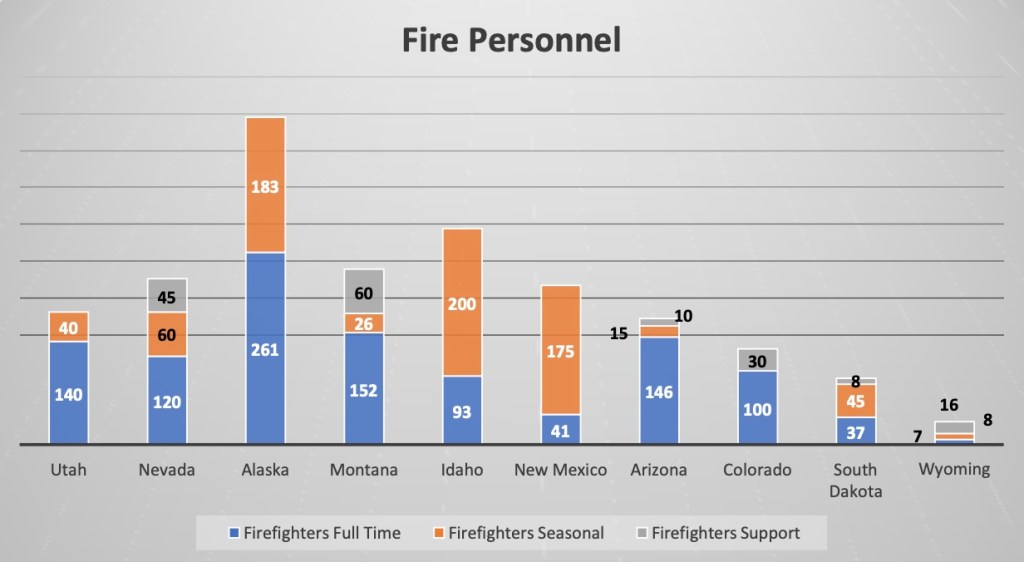
Even if the $5.1 million investment clears the legislative process, Wyoming will have fewer full-time professional wildland firefighters — 11 of them — than any other fire-prone western state, according to Norris. A spreadsheet the state forester shared with WyoFile shows how Wyoming’s wildfire response resources compare to those available in other semi-arid mountainous states.
“The next closest state is South Dakota,” Norris told WyoFile, “and I think South Dakota has like 47 full-time firefighters.”
The allocation Wyoming lawmakers are considering would also cover pay for 20 seasonal wildland firefighters, who’d be split between two teams or “modules.” They’d each get a firefighting engine. The state already has four engines, though they’ve been underutilized.
“They’ve never been staffed,” Norris said, “because we don’t have staff to staff them.”
During the Legislature’s 2025 budget session, lawmakers agreed on spending $2.75 million to beef up Wyoming’s aerial firefighting resources. That funded contracts for four single-engine tankers and funding for up to two firefighting helicopters, Norris said.
The $5.1 million that cleared the House is equal to the requested amount by Gov. Mark Gordon. Ahead of the budget session, the Wyoming Rural Fire Association and Wyoming Fire Chiefs Association asked for double that amount, enough to fund four wildland firefighting modules, according to Norris.
The Joint Appropriations Committee, the Legislature’s primary budgetary arm, then slashed the governor’s requested sum in half. When House appropriators advanced the bill on Feb. 9, they proposed $2.6 million for a single wildland firefighting team.
Connolly’s first push to amend the bill and restore the funding to what Gordon proposed initially failed, 28-31. On Monday, however, the same amendment won over the House, 37-24.
Gillette Republican John Bear, a former Wyoming Freedom Caucus leader, unsuccessfully argued for only spending enough to cover a single statewide team.
“You could argue that we should have a single-engine air tanker in every community,” Bear said on the House floor. “We don’t need that. We need the right amount to fight the fires.”
Other Freedom Caucus members were convinced of the worthiness of investing more. Spending $5.1 million on two teams was appealing to Wheatland Republican Rep. Jeremy Haroldson partly because of the return on investment and the alternative: reimbursing the federal government, which often steps in and fights wildfires, including on private property.
“If one of these crews can keep a fire from blowing up, we’ve paid for the crew,” Haroldson told WyoFile. “I see what the moisture content is in the snowpack right now. Having two teams on board, they’re going to pay for themselves this year.”
Home bases for Wyoming’s first two professional wildland firefighting teams haven’t been decided. But Norris told members of the House Appropriations Committee last week that Lander and Douglas are both compelling because of their locations and seasonal housing that’s available.
“East to west, we’re trying to get as centralized as possible,” she told WyoFile.
To become law, HB 36 will need to pass through a Wyoming Senate committee and then withstand three readings on the floor of the Legislature’s upper chamber.
Clarification: This story was updated to provide more information about Kelly Norris’ comments about firefighting resource needs. —Eds.
For more legislative coverage, click here.

This is a terrible idea for multiple reasons. For one youll never be able to staff those resources with quality people long term. And two, they’ll just be another forever funded sub par group. Give that money back to the education system so our young men and women can learn how to better manage this great state. This program is a reactive response to a bigger problem. Lastly, who ever said those other states are doing a good job. Where’s the actual data on fire response and effectiveness of there state resources. Wyoming has a good track record of managing Wyoming regardless of what other states are doing. There’s a good reason why we don’t have more state fire resources, it doesn’t work!
Some people want federal public land in Wyoming transferred to the state. Eleven firefighters for 30 million acres. Oh, and four engines with nobody to staff them.
Just to put it even more in perspective, the Elk Fire last year had over 900 people assigned to it. And that was just one fire.
3 Questions
First: Why haven’t Haroldsen and Bear co-sponsored a bill requiring every able bodied Wyoming citizen to also carry fire extinguishers and shovels to each and every outing where Glocks may be required in order to keep everyone extra safe?
Second: Anyone ever think to stop and ask Ms.Norris to explain what happened to Wyoming State Forestry’s Smokebuster and Wrangler wildland firefighting crews before writing another check for $5.1 million?
And lastly: Legislators, how about sharpening up those quills and signing a couple of bills and checks to help adequately fund all of the struggling VFDs around the state while your at it.