

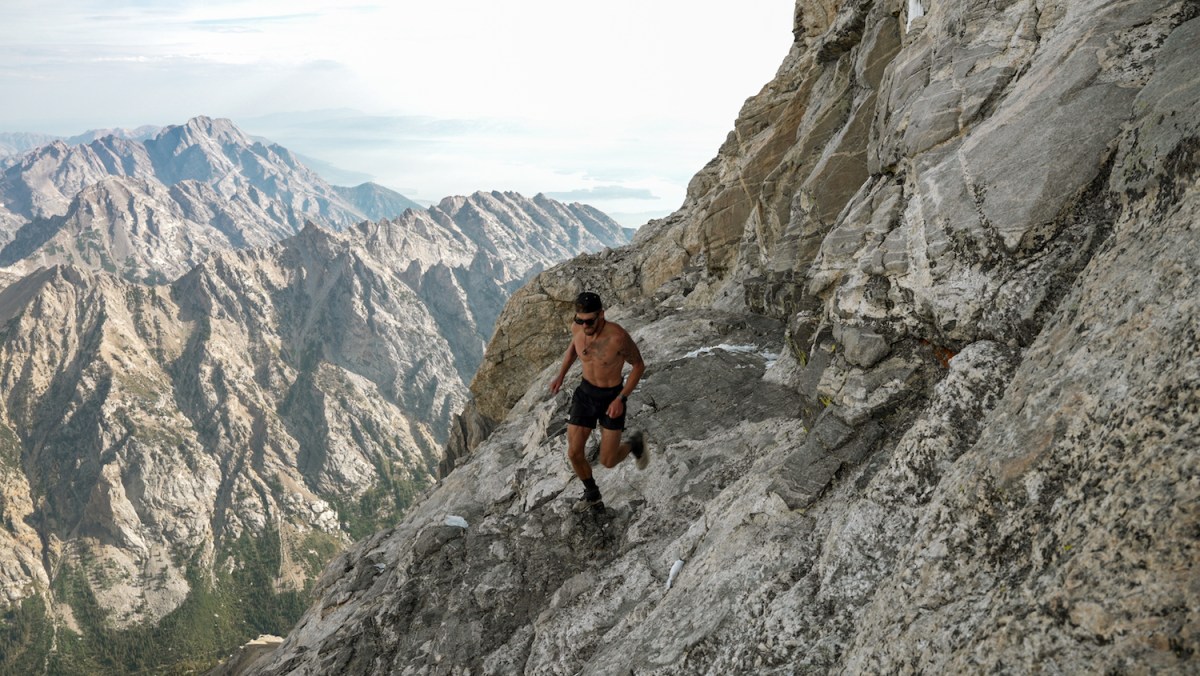
For Jackson-area filmmakers Alex Rienzie and Connor Burkesmith, the August rejection of their commercial filming permit to document the speed record attempt on the iconic Grand Teton Peak was the final straw.
Both had been frustrated for years by what they saw as arbitrary limits on their rights to film inside a national park while the rest of the world — tourists, journalists, adventuring locals — were free to record at will.
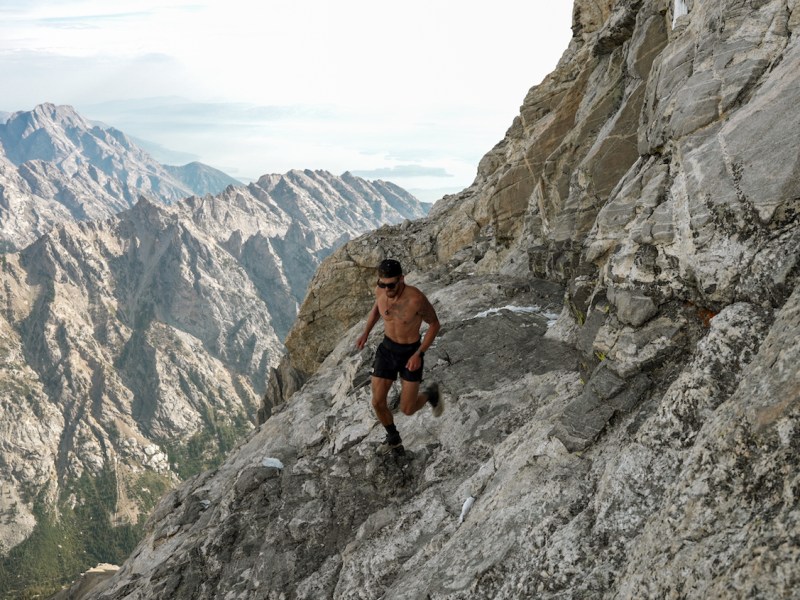
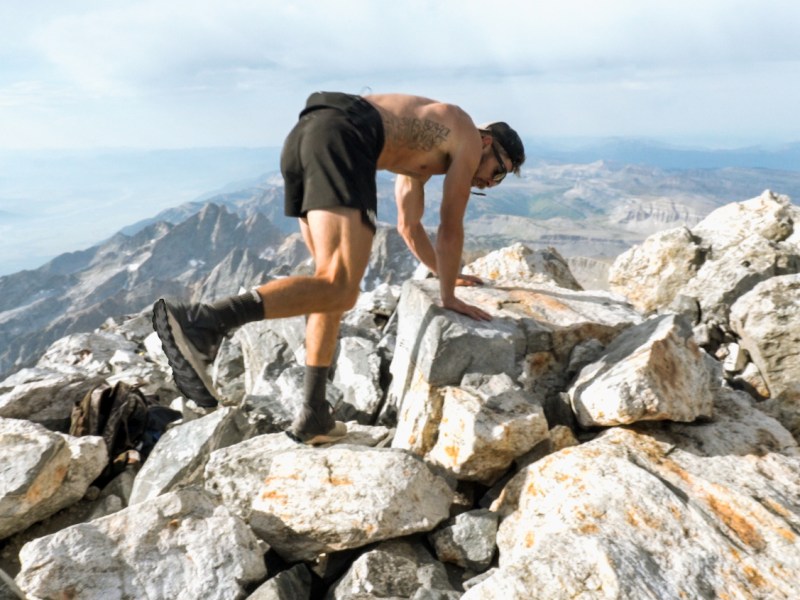
Their frustration, however, was immediately overwhelmed by the media buzz and storm of controversy that followed that Sept. 2 race against the clock. Arbiters of the speed record rejected Michelino Sunseri’s scorching fastest-ever time of two hours, 50 minutes and 50 seconds, citing the fact that he had cut a switchback. Sunseri did not deny it, but pointed out that previous record-breakers had done the same. Grand Teton National Park rangers cited him for the transgression, and the website Fastest Known Time refused to recognize his feat.
The filmmakers’ grievances remained unsatisfied through the hoopla. Last week, Rienzie, Burkesmith and the National Press Photographers Association sued the Interior Department and Grand Teton National Park for what they characterize as violations of their free speech rights. The Foundation for Individual Rights and Expression — a legal advocacy group for free speech — filed the suit on their behalf. The complaint seeks to overturn the permitting regulations.
“FIRE’s suit aims to overturn the National Park Service’s onerous, arbitrary, and unconstitutional permit-and-fee scheme that charges Americans for the right to film in public spaces,” the organization stated in a press release.

The very next day, Congress took a step to save them the trouble of a court hearing. The U.S. Senate on Thursday passed the omnibus EXPLORE Act — a package of bills aimed at improving outdoor recreation on America’s public lands and waters. The package includes the FILM Act, which no longer requires commercial permits in national parks solely because the photographer is being paid as long as filmmaking takes place in a public area, with a small crew and doesn’t impede other visitors or damage natural resources.
The FILM ACT mends the issues that plagued the permitting process, they said.
“This is fantastic news not just for Connor and I, but for all the outdoor filmmakers who struggled to navigate the outdated and arbitrary permit system,” Rienzie said.
The act now heads to President Joe Biden’s desk for signature into law. Though it may render the lawsuit moot, the filing stirs debate over who has the right to film or take photos in national parks in an age where nearly everyone ventures outside with a high-tech camera in their pocket.
The National Park Service declined to comment on the specific case due to litigation, pointing WyoFile instead to its FAQ page on applying for permits.
The frustrations
The filmmakers both work for Fior Productions, which Burkesmith founded. They specialize in documentary and commercial projects about human-powered endeavors in the outdoors, and they pitch themselves as filmmakers who train to keep up with endurance athletes on big mountains in harsh weather.
Much of their work, naturally, happens in the Teton Range — which draws athletes from around the globe with its beauty and formidable slopes.
In 2023, Burkesmith and Rienzie ran into permitting challenges while trying to secure permission to film Jack Kuenzle attempting a record time of Grand Teton from the Lupine Meadows parking lot to the summit and back. When they contacted the park service, they said, they learned they needed to apply at least 30 days in advance and pay a $325 nonrefundable fee, as well as an additional location fee.
They didn’t obtain the permit, but filmed the attempt anyway, according to the suit. A similar situation recurred in 2024. This time, they applied 30 days in advance, Rienzie said, but the park service said it needed 90 days and instead offered them the opportunity to film B roll in October — when Rienzie says the mountain would be far too snow-covered to access.
This time, too, they filmed the speed attempt without the permit.
“We just didn’t want to miss it,” Rienzie said. “I mean, we have so much invested with this. Michelino is a good friend. It’s a unique opportunity to make a film about a record that has captivated both of us since we have been going up to the Grand ourselves. And so we took that risk.”

The situation placed the photographers in an unfair position, according to the suit.
“Rienzie and Burkesmith were forced to choose between waiting for a permit or risking possible prosecution for unauthorized commercial filming,” it reads.
The duo contacted the National Press Photographers Association after the 2023 incident, and through that organization began working with FIRE. The hope then was that the park service would grant them future permits, Rienzie said. But they were willing to take action if rangers rejected them again, which is what happened.
“The fee and permit laws and regulations—including the cumbersome and arbitrary permit process, the denial of permits, the costly fees, the ambiguity over when permits are required, and the potential for criminal prosecution from running afoul of these rules and regulations—chills Rienzie, Burkesmith, and other NPPA members from filming in national parks when they otherwise would,” the suit reads.
Their photographs of the Sept. 2 feat have published in several media outlets. The park service has not cited either photographer, but they do fear penalties.
The lawsuit
Current federal law requires a permit for all commercial filming, no matter the size of the crew or the type of equipment. This includes light teams like Rienzie and Burkesmith, who often travel with little more than a handheld camera and small stabilizing gimbal.
The NPS’s primary focus, however, “is on commercial filming that has the potential to impact park resources and visitors beyond what occurs from normal visitor use of park areas.”
The agency crafted these rules to regulate large Hollywood-type film crews, the suit alleges, and isn’t nimble enough to properly consider small documentary film teams. In addition, by giving each park broad discretion to consider permit applications, it states, the result is inconsistency in how permissions are meted out.

“The law’s arbitrary distinctions do not serve any legitimate governmental interest in protecting national park resources,” the suit states. “If a tourist, a reporter, and a documentary filmmaker each filmed the same vista or event in a national park using the same equipment, only the filmmaker would be required to obtain a permit and pay a fee, if their purpose were deemed to be ‘commercial’ and not ‘news-gathering.’”
The photographers want to film Sunseri’s next FKT attempt and use the 2024 footage in a documentary, but doing so under the current law would risk criminal prosecution, the suit states. They’ve already curtailed sponsorship opportunities by keeping the footage offline, it continues.
The suit aimed to overturn the regulations, saying they deprived the photographers of their constitutional rights.
The legislation
The Expanding Public Lands Outdoor Recreation Experiences Act has been decades in the making and is the result of advocates’ efforts to modernize outdoor recreation policy.
Over the years it evolved into a package of outdoor-related bills with implications for everything from climbing in the wilderness to outdoor-destination gateway community economies.
One of its many pieces is the Federal Interior Land Media Act, which updates film and photography permitting on public lands. The FILM Act does away with the current permitting scheme by requiring agencies to focus on actual impacts to park resources — not the type of content visitors create.
The FILM Act represents a key legislative priority for U.S. Sen. John Barrasso (R-Wyoming), according to a Senate press release that called it “a win for the First Amendment and for common-sense management of our public lands.”
If it becomes law, it will effectively solve the filmmaker’s grievances. FIRE Chief Counsel Bob Corn-Revere said the passage of the act within EXPLORE is appropriate given the season.
“Congress just gifted the country a tremendous free speech win,” Corn-Revere said in a statement to WyoFile. “The passage of the FILM Act is a win for filmmakers, storytellers, and anyone who values the First Amendment and freedom of expression.”
i have zero tolerance for people that are fully aware of rules and regulations, and for their own selfish reasons decide to pursue the activity anyway. Easier to beg forgiveness that ask permission. Use permits are put in place to monitor and direct commercial (those people that are making money off of) activity that takes place on public land. “Their photographs of the Sept. 2 feat have published in several media outlets” Pretty sure you can substitute “sold” for “published” Let’s get real here, actions speak louder than words, and there are consequences that come with each and every decision. Pay your permit fee, file your purposed activity, date and location. Suck it up, stop whining.
I don’t want commercial activity not having to acquire a permit. Period! You make money off of it, it’s part of the cost of doing business. And I’m having a hard time trying to figure out how this affects a persons 1st amendment rights.
Thanks for your comment BJ! We actually did pay a permit fee: a nonrefundable $325. More than willing to abide by a lawful permit system, but unfortunately one wasn’t in place in Grand Teton. Instead, a single poorly-trained bureaucrat changed the rules on us (shifting from 30 days to 60 days, which is far too late for a speed record), then rejected us outright for nonsensical reasons. That obstruction without legitimate government interests in an area open to the public is at the heart of the first amendment violation. Wishing you the best!
Great win ,im gordy price and fought this with bob corn revere for 7 years when we filmed Crawford Road so nice brings tears to my eyes ,keep filming fight the fight
The NPS treats Americans terribly and after decades of park use my disdain for them has only grown. The NPS should be disbanded.
You say the lawsuit isn’t needed yet you drone on about it. Just looking to continue bashing the national parks? WyoFile needs to grow-up.
Exploit hits the mark more than Explore. Support affordable housing…take Gardiner MT it has maybe 10 primary property owners who buy every house and turn it into a short-term rental leaving their own workers to find space outside of town. Welfare for the rich, it is just called something else. Why does the state who promotes the parks step in and provide solutions and guidance? None of these communities or economies would exist without the Federal lands yet they are treated as the enemy and abused for profit. Why should National Parks be destroyed for profit? Why should caring for the land need to make sure t-shirt shops can sustain a profit or involve rectifying the greed of gateway communities? The filming portion of the act is one of the few reasonable portions. Let’s not forget, none of the requirements of the act come with funding…
Thanks for weighing in Jim! We were able to drop our lawsuit due to the very surprising passage of the EXPLORE Act — I agree with you, very excited for the FILM portion (aka Section 125). I also agree with your sentiment around gateway community affordable housing, and on that note, am hopeful the EXPLORE Act’s Section 131 might offer some solutions. Beyond Interior, there should be Federal support coming from the Secretaries of Agriculture and Commerce. We’ll see how it all plays out of course, but we’re optimistic.
One person’s selfish pursuit of a meaningless record trumps the public’s enjoyment of a public land?
Hey Bee, we certainly didn’t interfere with anyone’s enjoyment of the Park while filming or while Michelino was running. If anything, a group on climbers cheered Michelino on the summit, as he added some excitement to their guided climb. And in my opinion — evidenced by unanimous Congressional support — the EXPLORE Act greatly enhances enjoyment for many Park users. We’re honored to have played a small role, joining thousands of individuals and organizations to help push the Act over the finish line. Best wishes!
Suck it up, boys. Everyone of you knew the Park Rules, as well as the official record rules…no cutting that switchback…and yet you all chose to break the rules. “We didn’t want to miss it.” Come on. The record doesn’t count…pay the fine.
Kevin – I was going to post the exact sentiment you said. You did the work for me. So… I say… “Good on you, Mate!”
Thanks for engaging Kevin & Rob! I’m all for permits if the system worked. In practice, permits are denied for arbitrary reasons (manager said they’d never approve a permit for an FKT with nonsensical reasoning), goalposts are moved (30 days all of a sudden changed to 60 days), and the law gets made up as they go (claiming a speed record isn’t newsworthy without citing a single judicial precedent). Meanwhile, the office pockets the $325 fee. A single, unelected bureaucrat has the power of judge, jury and executioner with no appeal.
On both permits and Michelino’s citation (a separate conversation), the NPS acted illegally. I’m confident that’ll become evident in the coming months. The NPS isn’t entirely to blame. Congress left them to enforce a law that predates the iPod. That’s why — from our sources — members of the NPS supported the EXPLORE Act.
Wishing you and your families a Merry Christmas, and Happy New Year!
Fascinating read. Great, original reporting.
Explore? More like exploit.
Thanks for sharing your opinion Robert. As someone who has a brother with cerebral palsy and who works as an adaptive ski instructor, I’m particularly excited for Title II Article A, improving Park access for the disabled. As a mountaineer, I’m excited for Section 122, preserving fixed anchors essential for safe rappels and belays. And as a member of a gateway community, I’m excited for improvements to affordable housing in Section 131. Many other good provisions in my opinion. Few impacts to Wilderness Areas.
Respect that you feel differently and appreciate you sharing. I’d be curious which provisions you don’t love. Wishing you a happy holidays!