


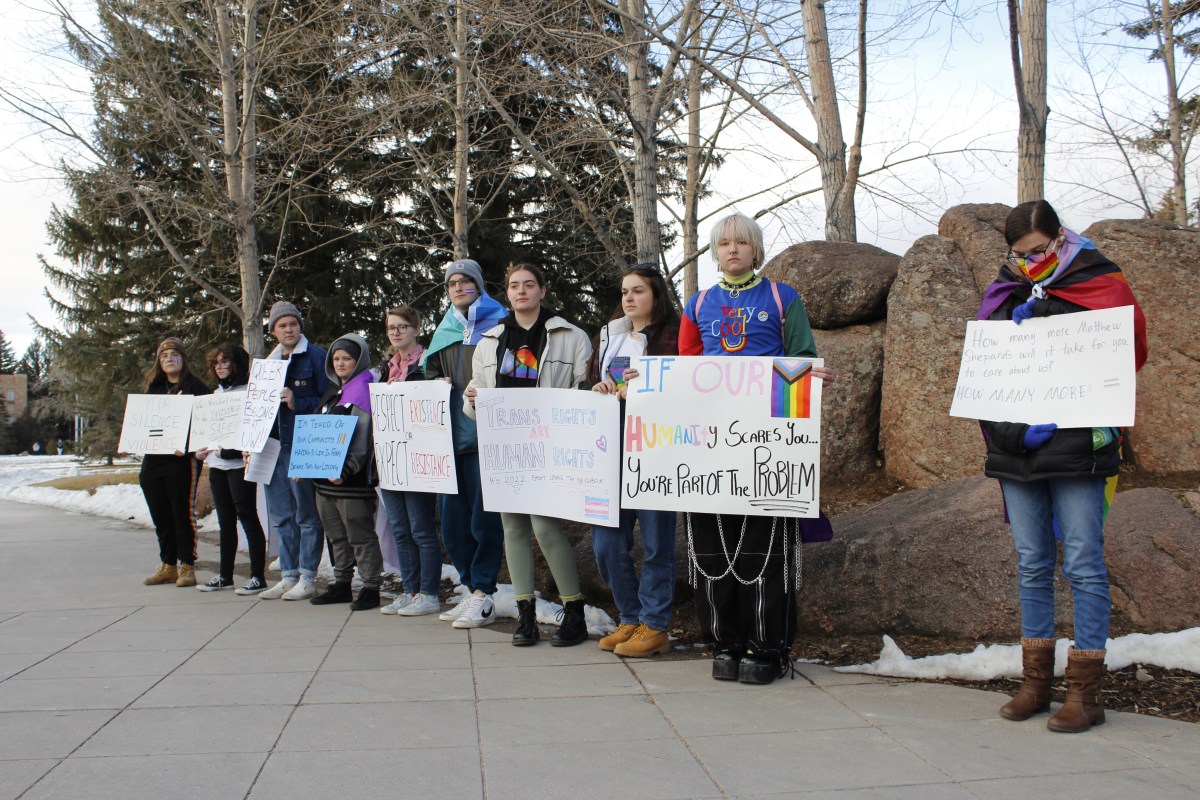
When a banner appeared in the University of Wyoming’s Union intentionally misgendering a student in early December, students gathered together to physically block the sign from view until it was removed that same day.
Todd Schmidt, a Laramie resident and longtime fixture of the union, had erected the sign. That “violated the university policy prohibiting discrimination and harassment,” according to UW President Ed Seidel, and cost Schmidt the right to table in the Union for the next year.
Both the sign and the decision by students to create a physical barrier fit into a longer history in Laramie. Decades earlier, counter demonstrators wearing rigged bedsheets that resembled towering angel wings screened anti-gay picketers led by Westboro Baptist Church minister Fred Phelps. Phelps and his congregation had come to Laramie for the trials of the two men charged with killing Matthew Shepard, a gay UW student.
The impromptu nature of the recent human blockade at the Wyoming Union, however, is characteristic of a framework called bystander intervention. Originally developed as a strategy to combat sexual assault and domestic violence, bystander intervention can be used to safely de-escalate a potentially harmful situation or interaction, such as harassment in public spaces. The framework has five mechanisms known as “the 5Ds” — direct, distract, delegate, delay and document.
The five methods can be used “to support someone who’s being harassed, emphasize that harassment is not okay, and demonstrate to people in your life that they have the power to make their community safer,” according to Right To Be, a national organization that offers bystander intervention training.
UW offers similar “Green Dot” training to students, faculty and staff. “Most of the [Green Dot] program is really just designed around taking individual actions that might interrupt the cycle of violence,” UW’s Title IX coordinator Jim Osborn said. Osborn is one of more than 30 UW community members with extensive training in Green Dot, a widely-used bystander intervention program created in 2006 by Dr. Dorothy Edwards at the University of Kentucky. Edwards created the training program with the assumption that most people oppose violence but don’t know how to safely intervene, according to written testimony she gave to the U.S. Equal Employment Opportunity Commission.
Edwards explained the Green Dot metaphor in her EEOC testimony, asking individuals to imagine a map of their community, organization or university, covered in many small red dots. Those dots are meant to resemble “one choice or behavior that harms another” while “a green dot is a small single choice that someone makes that reduces the likelihood that the next red dot gets on the map,” according to Edwards. “The goal is straightforward: When green dots begin to outnumber and displace the red dots, violence is reduced.”
Distract, Delegate, Direct
“We definitely talk about making sure that any action that you might take is something that is safe to do,” Osborn said. “So sometimes it’s better to ‘Distract.’”
That can mean starting a conversation with the person being harassed, Osborn said, by asking for directions or the time, or talking about something random, so long as it shifts attention.
“The power of distraction is that no one has to know you are actually intervening in harassment,” according to Right To Be’s website. “If you’re someone creative or shy, or if it seems like the person doing the harassing might escalate their behavior if you speak out openly against it, then distraction can be a great, subtle option for you.”
There may also be situations in which it might be better to “Delegate,” which involves looking for someone who is ready and willing to help. In public spaces, that could be someone who has authority in the space, like a teacher, store manager, bus driver, flight attendant or security guard.
“There’s also ‘Direct’ action, where you directly insert yourself into a situation, but that’s not always safe or comfortable for folks,” Osborn said.
The first step in response to this kind of situation is assessing before taking action. Right To Be suggests asking yourself the following four questions first: Are you physically safe? Is the person being harassed physically safe? Does it seem unlikely that the situation will escalate? Can you tell if the person being harassed wants someone to speak up?
If the answer to all four questions is yes and a direct response feels like the thing to do, it’s important to be short and succinct and avoid arguing.
Delay, Document
Right To Be added “Document” and “Delay” to its bystander intervention training in more recent years as additional indirect action.
In a situation where someone being harassed is already receiving help from someone else, documenting by either recording or taking notes can be helpful. However, it’s important not to post any recording online without permission from the person who was harassed. Instead, ask them what they want to do with the recording.
“If we publicize an image or footage of a person being harmed without their consent, it can make them feel even more powerless,” according to Right To Be. “If the documentation goes viral online, it can make that person visible in a way they may not want to be.”
Lastly, if it’s not possible to act in the moment that the harassment is happening, the ‘Delay’ tactic can still reduce harm. That involves speaking to the person afterwards by asking them if they’re ok and if there’s any way you can support them, or offering to accompany them to their destination. If you’ve documented the incident, this is the time to ask them if they’d like you to give it to them.
Green Dot training is available for any UW faculty, staff or students. For other residents, organizations like Right To Be offer training through free webinars.
Here we go as predicted, the new ultra conservative legislatures using their power of office to intimidate, by control issues of money. I am sure ACLU, and some local attorneys will enjoy taking them on.
Students to be commended. Bogus claims by the letter submitted by state legislators is sad reflection on government “leadership “. The church elder recklessly endangered a transgender student. That is a crime. Those who defend that crime are despicable. A trangendered human is no threat to the sex they identify with and have been hormonally and/ or surgically adjusted to any more or less than any woman is to another woman or any man is to another man. How hard is that to understand?
My son had told me about the incident in the Union and that Todd Schmidt apparently has nothing better to do with his life that to get a rise out of UW students with provocative and insulting signs and language as they pass through the Union. He seems to thrive on arguing with people and belittling those that don’t agree with him or live their lives how he he thinks they should. When my son told me that he called out a student by name last week, my first thought is “that’s harassment and no student should be subjected to that”. I’m glad to hear that other students took action and the university banned him for at least next year.
Thank you for the very timely and useful information and perspective.