


Calls to improve safety on Teton Pass are decades old.
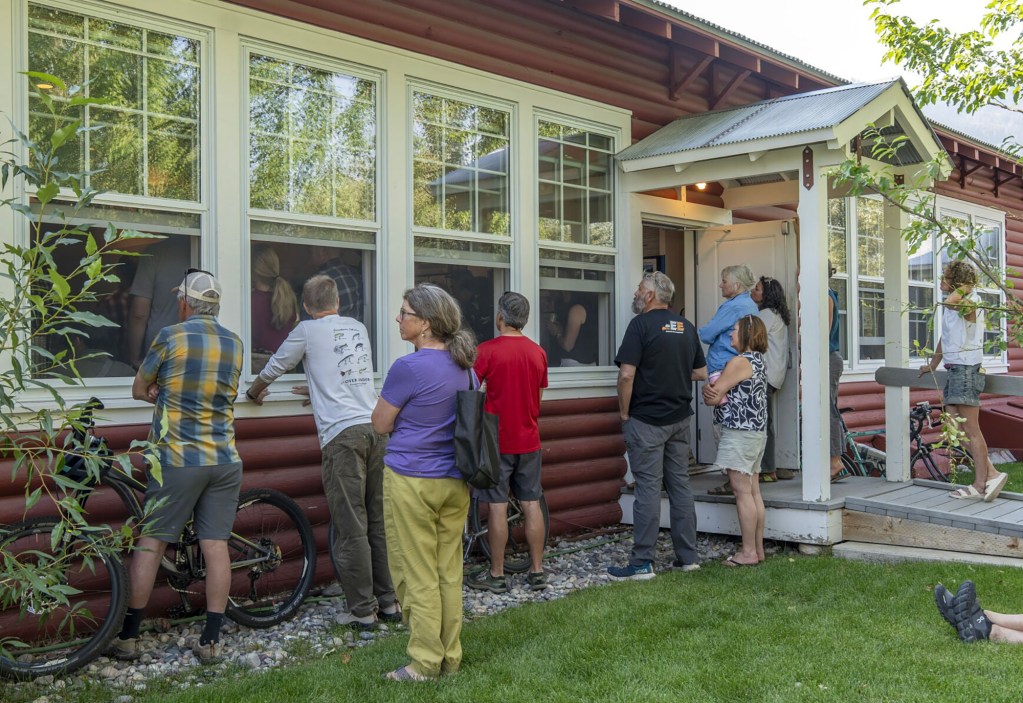
But one month after a runaway truck killed Nick Besobrasow, 66, and David Page, 57, and seriously injured several others, almost 200 people packed Old Wilson Schoolhouse on Monday with a renewed sense of urgency, demanding immediate action to make the 8,431-foot mountain pass between Wyoming and Idaho safer.
“Everybody has ideas,” said Victor resident Paul Merrill, a friend of Besobrasow. “But there’s anger, and we’re asking for action now. Flashing signs on the pass tomorrow.”
While residents disagreed on the best path forward, few questioned that something needs to change.
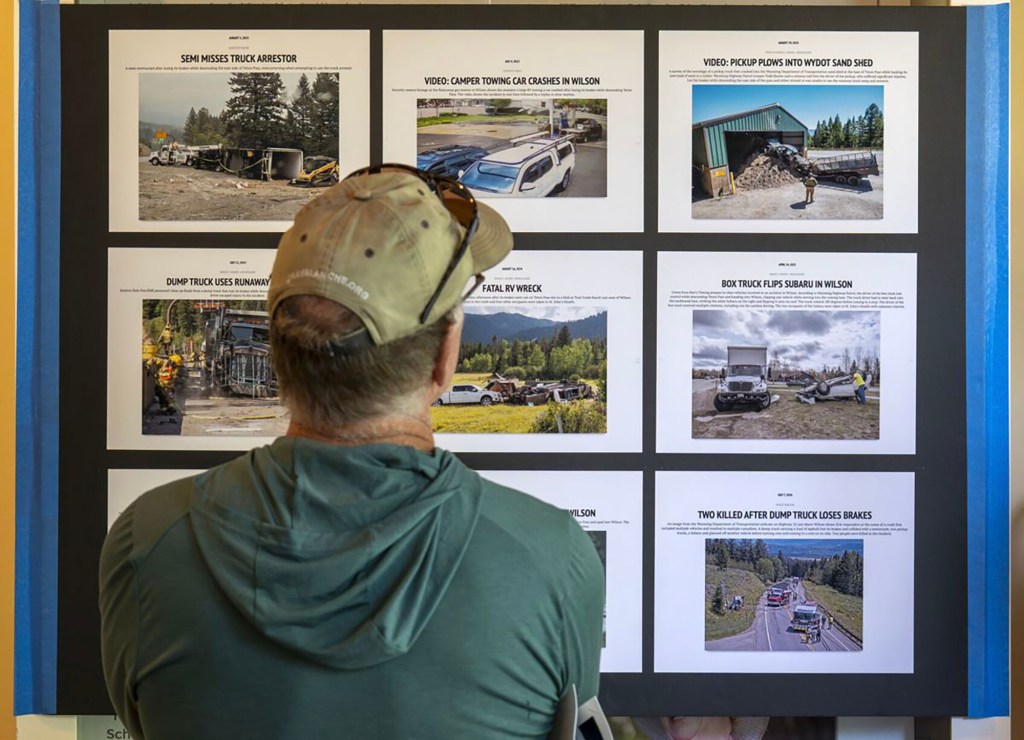
Still under investigation by the Wyoming Highway Patrol, the July 7 crash became a defining moment for many in attendance, who said it exposed the growing pressures on the Highway 22 corridor.
“We’ve got a problem that seems to be getting worse and worse,” said Gary Kofinas, one of the meeting’s organizers and a friend of Page.
Their concerns echo the findings of the federally funded Teton Pass Corridor Study completed in January 2024. The 185-page report concluded the highway is facing “substantial safety, access and capacity challenges” as rapid population growth, expanding recreation, increased commercial traffic and a growing commuter workforce continue to strain the two-lane corridor.
Rather than recommending a single fix, the study outlines dozens of possible improvements, including enhanced warning signs, additional pullouts, more truck safety measures, speed management and closer coordination between Wyoming and Idaho.
Beyond the study
While many residents pushed for immediate improvements, others cautioned against rushing toward a single solution.
“The dirty secret of this meeting … is that we don’t understand the problem,” said Maggie Morganti, a risk manager who commutes over the pass several times a week from Idaho Falls.
She urged officials to conduct a comprehensive “root-cause analysis” of serious crashes before investing in major infrastructure projects.
“Before we get too emotionally invested in any specific solution, we need durable, data-driven solutions,” Morganti said. “That’s the only way we’re going to have sustainable, durable, long-term solutions that will assist commercial drivers, RVs and everyone else using the pass, while also being financially responsible.”
Her voice spoke to the divide between balancing the public’s demand for immediate action with the need to identify which improvements will have the greatest impact.
“I’ve seen it in industry too many times that we are all understandably upset, and we want major action now,” Morganti said. “The only thing that comes out of that is non-durable solutions.”
The commuter corridor
Monday’s discussion also underscored how dramatically Teton Pass has changed over the past two decades.
Once primarily a scenic mountain highway, Teton Pass has evolved into one of the region’s most important transportation corridors, accommodating thousands of daily commuters between eastern Idaho and Jackson alongside commercial trucks, tourists, oversized recreational vehicles and outdoor enthusiasts.
That transformation has mirrored the region’s rapid growth.
A 2022 Teton Regional Housing Needs Assessment estimated that 61% of Teton County, Wyoming’s roughly 25,000 workers live outside the county, including about 3,227 commuters from Teton Valley, Idaho, making the pass an essential connection between affordable housing and higher-paying jobs in Jackson.
As Jackson’s housing costs have climbed, more workers have settled in neighboring Idaho communities such as Victor and Driggs while continuing to work in Wyoming.
And the corridor study found average daily eastbound traffic increased 70% while westbound traffic increased 35% between 2011 and 2021.
That interdependence became unmistakable in June 2024, when a section of the Teton Pass road collapsed and forced commuters onto a roughly 85-mile detour through Swan Valley, Idaho, and Alpine, Wyoming — rather than the typical 24-mile drive between Victor and Jackson.
The closure also exposed the region’s dependence on the corridor in other ways. Businesses reported losing customers, START Bus expanded commuter service and sought funding to temporarily eliminate fares, and transportation officials scrambled to manage unprecedented traffic on alternate routes.
For many speakers Monday night, the landslide offered a preview of what happens when the region’s only direct connection between Jackson and eastern Idaho is disrupted.
Beyond the state line
That regional interdependence framed much of Monday’s discussion.
Driggs, Idaho Mayor August Christensen argued that meaningful safety improvements cannot begin at the Wyoming state line because many drivers start their trips in eastern Idaho.
She urged closer coordination with the Idaho Transportation Department, saying better warning signs, truck pullouts, turnaround areas and educational messaging should be installed before drivers begin climbing the pass.
“We have to have a partnership here,” Christensen said. “We need to put preventative measures in Teton County, Idaho … all needs to happen in Idaho before you even get to the pass.”
Christensen also challenged the meeting’s focus on commercial trucks.
“It’s not just the trucks,” she said. “It’s the big RVs. It’s people pulling vehicles.”
She said many visitors driving rental vehicles have never descended a steep mountain pass and don’t understand how to downshift to avoid overheating their brakes on the descent into Wilson.
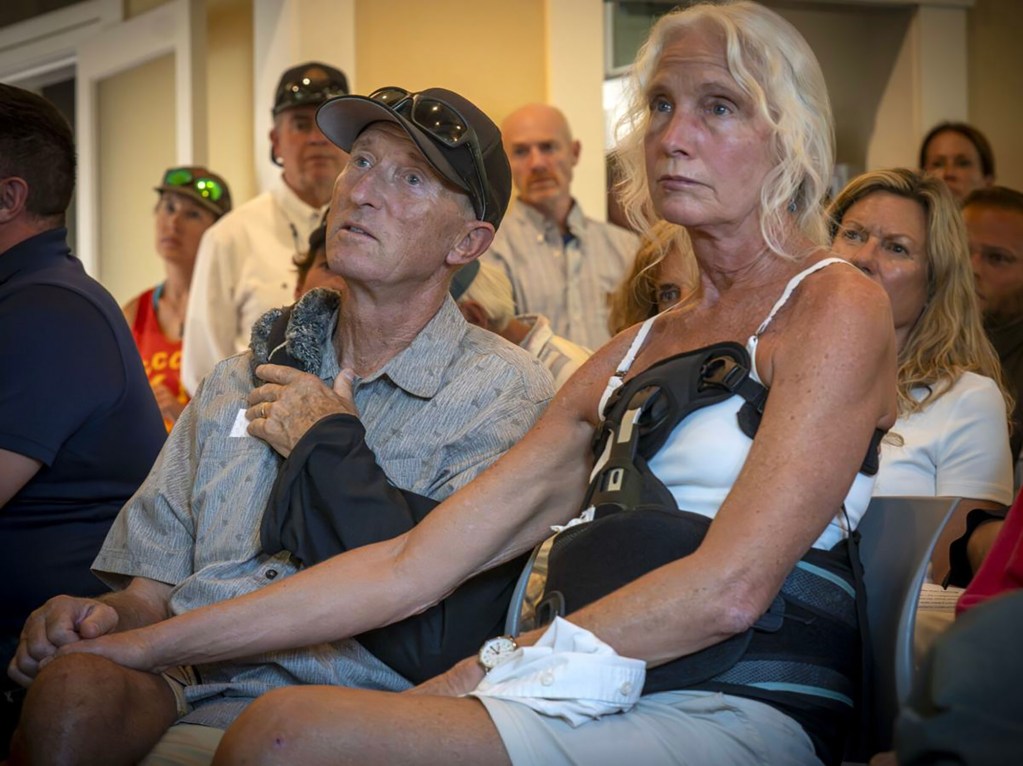
Wilson resident Dee Dee Sorsby, who has lived near the base of the pass for 30 years, echoed that concern. She said she narrowly missed the July 7 crash after arriving home minutes later than planned and recalled a time when she could safely cross Highway 22 while leading horseback rides at Trail Creek Ranch.
“What I saw is still shaking me up,” Sorsby said. “That pass is not being used for what it was built for in 1967.”
Standing near the back of the packed room was Tetonia Mayor Brent Schindler. Besobrasow lived in Tetonia, and Schindler said the tragedy reinforced that Teton Pass is a shared responsibility.
“Human life doesn’t see a line,” Schindler said, referring to the Idaho-Wyoming border. “We want to be a part of the solution.”
Competing solutions
Although speakers agreed another tragedy must be prevented, they proposed different paths forward.
Some called for additional enforcement, including dedicated commercial vehicle patrols, portable truck scales and more aggressive enforcement of slow-vehicle pullout rules. Others advocated for better education for truck drivers, RV operators and tourists unfamiliar with driving steep mountain passes. Still others emphasized engineering solutions, such as expanded pullouts, improved warning signs, additional brake-check areas and closer coordination between Wyoming and Idaho transportation agencies.
By the end of the three-hour meeting, there was little consensus on which project should come first.
There was broad agreement, however, that the status quo is no longer acceptable.
“Make Teton Pass safe,” organizer Corey Milligan told the crowd as the meeting concluded. “This is what we’re doing. We’re gettin’ ‘er done now.”

Why isn’t a tunnel in the discussion?
Yah, a tunnel! I said the same thing almost 50 years ago when I first drove over that white knuckle bobsled run of a pass.
And a while back I took a trip to Italy and thought of Teton and few other passes in the Rockies and Cascades that could have used some Italian consulting engineers.
But alas, here in ID, MT, and (even some parts of) Whyomin, we are still driving on some of the most dangerous roads in the U.S. … but now have 2, 3, 5 up to 10 TIMES the traffic as there was 50 years ago.
I guess it’s time to abolish the DOT and the Federal Highway Administration … uh, wait, do we still have those?
I don’t live in Teton County, but 20-ish years ago when I was going to school in SE Idaho, I frequently crossed over Teton Pass, and can only imagine it is much more busy now than it was then.
I think it should be a toll road with a maximum GVWR of 26,500 lb. Weights between 26,500 and 40,000 would be allowed if the vehicle is equipped with regenerative braking, engine braking, or similar. (I drove transit busses in grad school and hybrid busses with regen are awesome!)
The tolls could be structured in a way that commuters / locals could acquire a monthly or yearly pass at a significant discount, or even at no cost. The tolls would mostly target visitors and could help fund a recreation shuttle (thus the weight exemption above), road maintenance and improvements, etc. Those wishing to avoid the toll can still go through Hoback Junction.
Some infrastructure could be built near Wilson and Driggs that would allow locals to bypass the toll gate, but would stop non-pass holders and require them to obtain a pass. Or they could purchase it online ahead of time. Toll pass purchases are easy details to work out. I would include some educational material at the point of purchase about how to drive on this demanding road: things like staying in a lower gear, etc. Scales could even be integrated into the toll entrance that would allow them to deny tolls to overweight vehicles.