

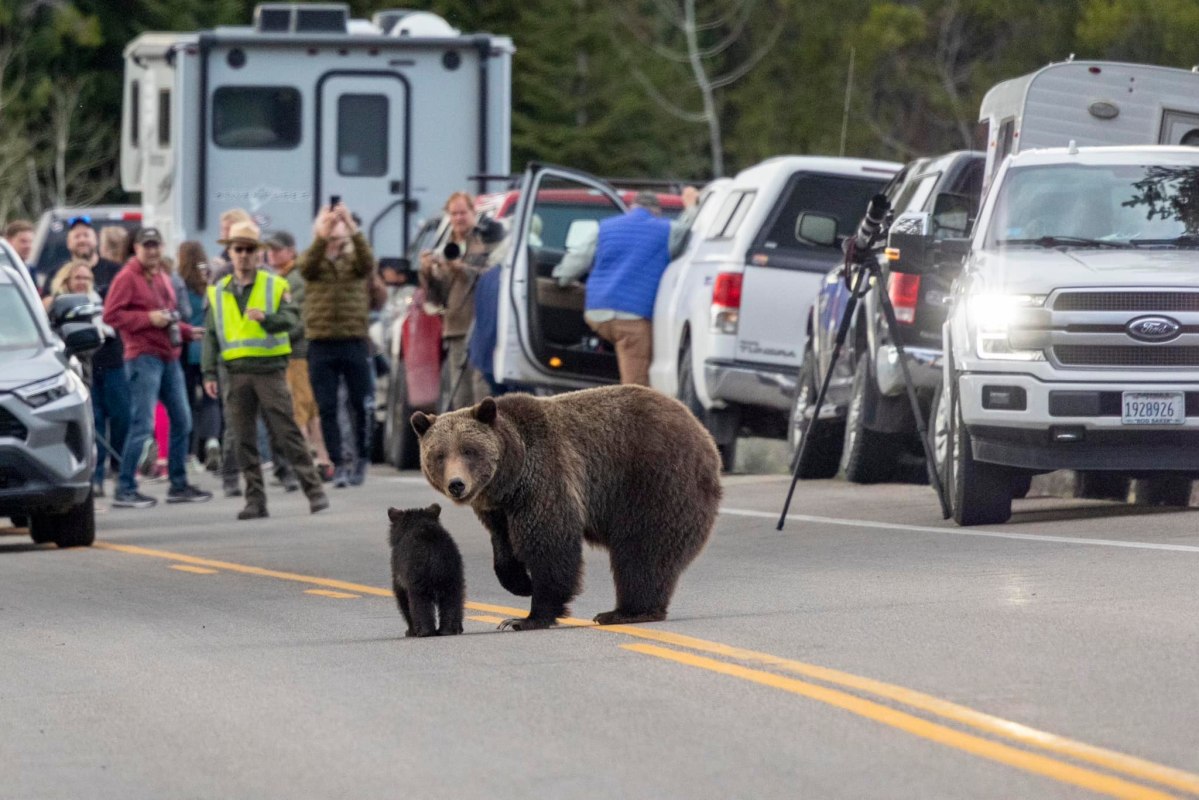
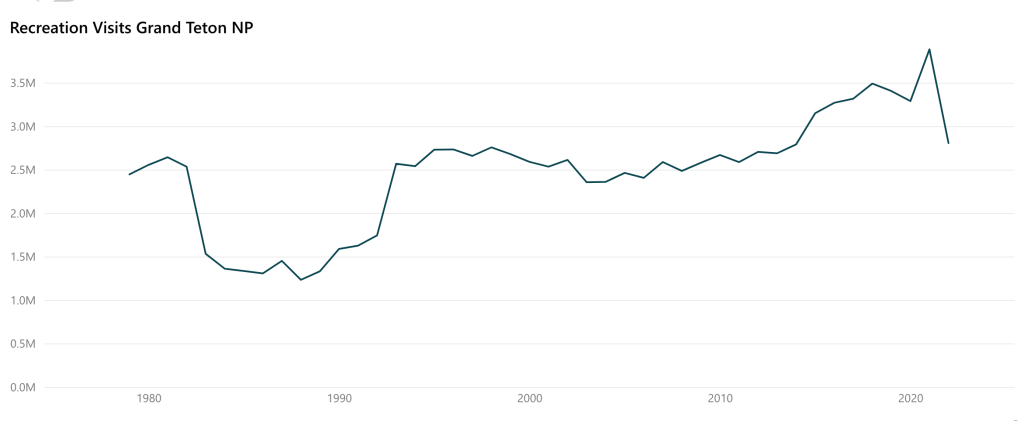
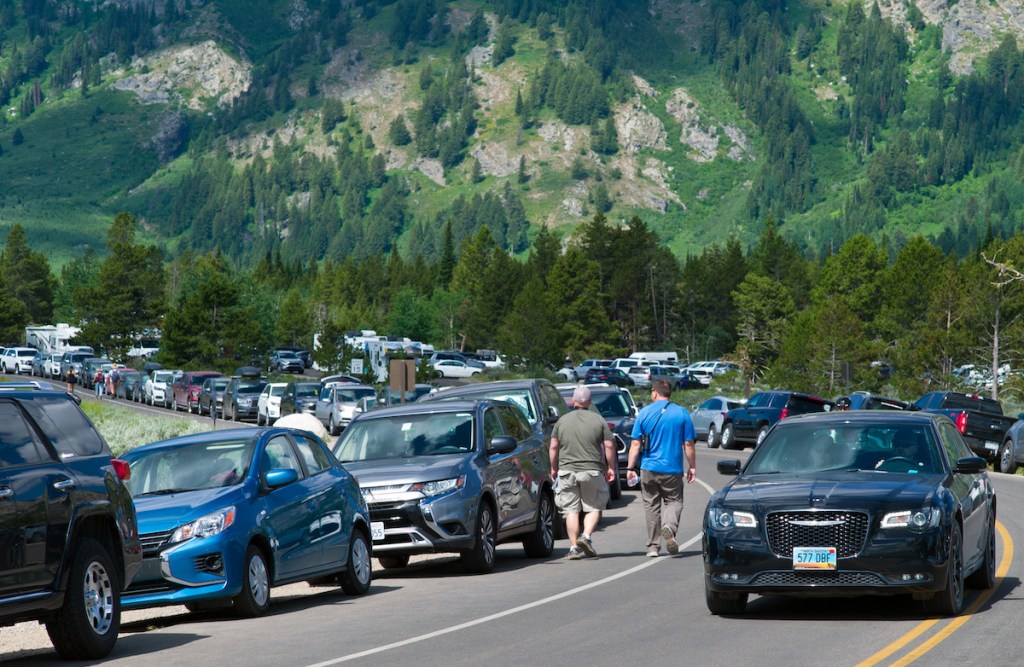
Grand Teton National Park visitation doubled over the last three decades, reaching 3.2 million in 2020. The trajectory is not quite as steep as the park’s eponymous mountains, but headed steadily skyward. On busy days, parking lots fill up, bottlenecks form around wildlife and traffic clogs popular trails.
Managing growing visitation has been a topic of concern since Superintendent Chip Jenkins took the helm, he said.
“I’ve been here at Grand Teton National Park for about two and a half years and from the moment I arrived, I started getting questions from people about, ‘when is Grand Teton going to start doing visitors management?’” Jenkins said on a public webinar last week.
The answer, he said, is that it already does — and has for a century. “At key moments in our history, we have learned that there are better ways for us to achieve our resource protection and visitor experience goals … and the park has been better for it.”
As visitation approached 4 million in 2021, another of those key moments appears to have arrived.
Grand Teton National Park is seeking public input on how visitors use, experience and access the park. The park isn’t proposing specific management tools, but will use the feedback as it looks to improve visitor experiences. The public can weigh in through Oct. 10.
Broader issue
Growing visitation is not unique to Grand Teton. National parks across the nation have been wrestling with ways to protect resources as crowds grow, bringing impacts like litter, rogue trails and long lines. In Utah’s Zion National Park, which hosted nearly 4.7 million visitors in 2022, visitors must secure a ticket for the popular Angels Landing Hike and take a shuttle to visit certain areas of the park. Glacier National Park in Montana in 2023 implemented a reservation system for vehicles traveling its iconic Going-to-the-Sun Road. Rocky Mountain National Park rolled out a timed-entry permit pilot program.
In response to its increasing visitation, Grand Teton has been experimenting by limiting vehicles at crowded lots and requiring camping reservations. The park in 2021 studied traffic patterns, trail-use numbers and visitor experiences for a study released early this year.
The vast majority of visitors are out-of-towners, the report found — only about 5% are local residents. And some 85% of visitors are day-use, meaning they spend the night elsewhere.
“There’s not a dominant route or travel pattern that we found within this study,” GTNP Social Scientist Jennifer Newton said. “They are utilizing our pullouts and roadways and making multiple stops throughout the park.”
The report found that 91% of vehicles that enter the park stop at least once somewhere in the park, and most make multiple stops.
Data also indicate significantly more visitors using the park’s trails and backcountry areas compared to a decade ago, as well as more lakeshore use.
A number of projects are underway to address changing visitation, Jenkins said on the webinar, including projects to promote bike use near Jenny Lake, improve amenities at Moose Lake and Colter Bay master planning.
“We also recognize there’s still hotspots that need to be addressed,” he said. “Some of these hotspots may be seeing more use than they were designed for.”
Grand Teton National Park will hold a second public meeting on the process Sept. 19 in Jackson.
Specifics
“We’re not proposing anything with this process,” NPS Visitor Use Project Manager Rachel Collins said in the webinar, noting that makes this a little different from the norm. Usually when the agency opens a public comment period, “it’s because we have a proposal and we’re looking for feedback on it.”
This time, park leaders are looking for general feedback on the visitor experience to identify potential strategies. The park is using a federal interagency visitor use management framework to guide the process.
Still, participants on the recent webinar submitted questions about shuttles, reservations and if the park can increase its trails.
“No we do not have plans,” Jenkins said in response to a reservation system question. “We do not have plans at least for parking or entry into the park or not at the point that we see that that’s a tool that is needed.”
In fielding questions, Jenkins stressed that the park wants to hear about precisely these types of issues in the comment period.
Regarding adding trails, for example, he said: “Where do you see that might be and the trade-offs that you think that we might need to face with that?”
On shuttles: “What does that look like for you? So for example, where is it that you would like to park?”
Though there are concerns about the negative impacts of crowds, the flood of visitors also brings economic benefits. A new National Park Service report found that the 2.8 million visitors to GTNP in 2022 spent $597 million in gateway communities, while 3.3 million visitors to nearby Yellowstone National Park spent $452 million in gateway communities. (Both parks saw visitation dips in 2022, a trend largely attributed to historic flooding in Yellowstone.)
UPDATE: This story has updated to reflect that the public meeting in Jackson was changed to Sept. 19. -Ed.

This park must be saved and at the expense of the visitors. It is time for reservations to visit, extremely limited access via personal vehicles and no expansion of trails, places to park or places to stay. This is not a zoo. This is a protected wilderness and the animals and the land take presidence over people. The park will never survive with the continued mass of visitation and lack of hard line rules.
Agreed 100%. It has worked at Yosemite and Rocky Mountain NP, why not here and Yellowstone?
Consider the negative impact on the park environment vs the economic benefits. Which is the priority? In the long term?
Amazing. Urban density in what most people consider wilderness. That pic of overflow parking at Jenny Lake looks like the roads at Palisades Interstate Park in New York on a sunny summer weekend.
NPS better figure something out before the “flood” becomes a Tsunami. Asking the “folks” for helpful suggestions when other parks have already taken action seems almost passive aggressive.
Limit visitation by humans. It is a privilege. But the animals and the land come first
Are National Parks really the best place for major airports?
Jackson Airport is the only airport inside a national park. Routing those travelers through Idaho Falls, or expanding Driggs’ airport would increase car travel, and thus be self-defeating.
Reservations and or shuttles. You’ve got to eliminate the cars! Some way, you’ve got to cut down on the number of humans!