
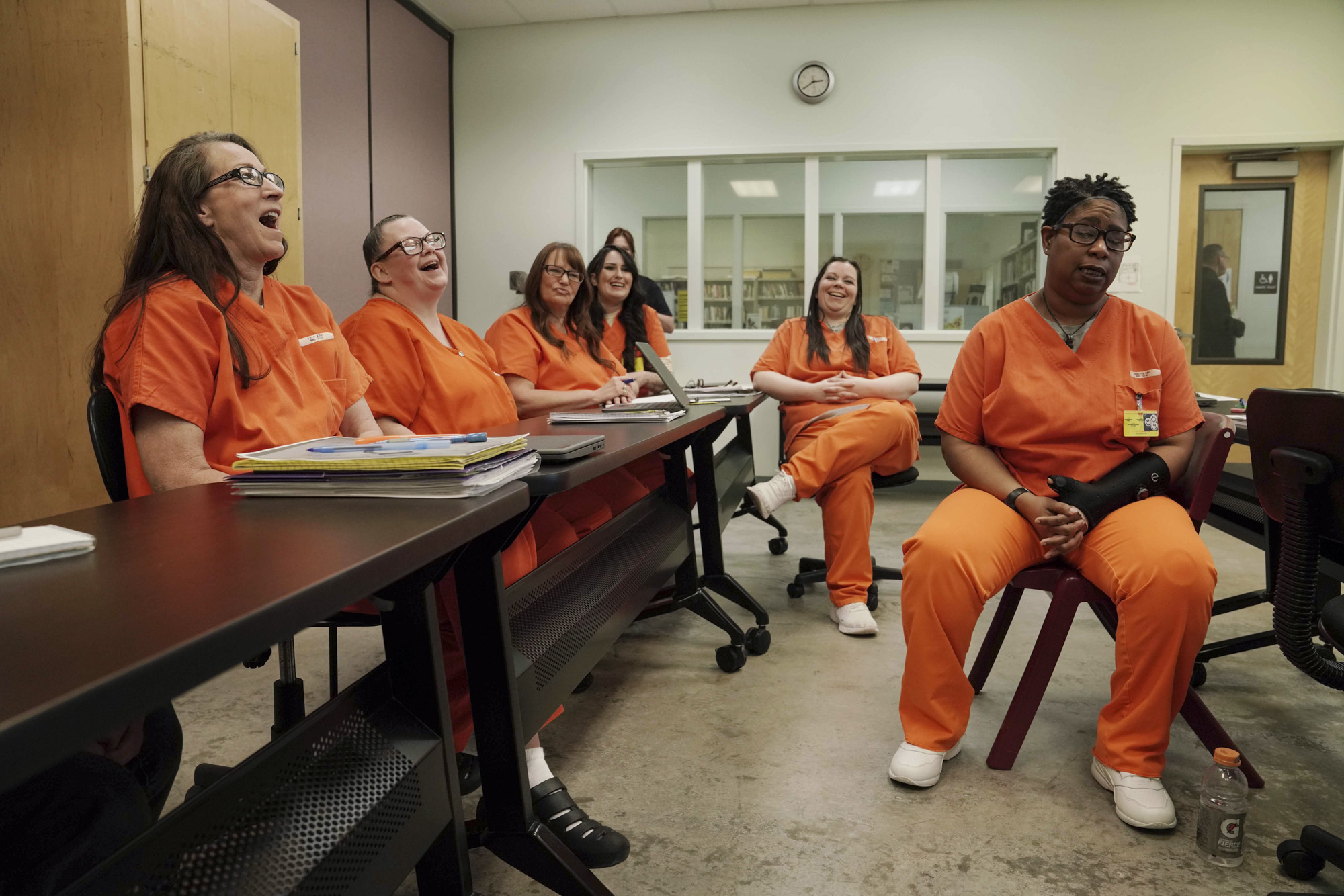

LUSK—One spring afternoon when the sun beamed down on the Wyoming Women’s Center, a prison in Lusk, six students sat in a fluorescent-lit room with laptops open before them. A brown and gold University of Wyoming banner with a cowboy on a bucking bronc hung on the far wall.
“So, who’s going first?” asked Rob Colter, a gray-bearded UW philosophy professor. “Final presentation. Create your own festival.”
One of the students, Taylor Nicks, snapped her fingers in approval.
“First victim,” Colter said, waiting for a volunteer.
It was their last day of class on heavy metal philosophy, and a few months before graduation. The course was one of many the students, who wore their orange prison uniforms to class, took to earn their four-year bachelor’s degrees in general studies from the University of Wyoming. Earlier this month, the six women finally reached that finish line, making them the first cohort in Wyoming to earn bachelor’s degrees through a university program called Pathways from Prison.
Kelly Turner, who wore a small cross on a chain around her neck, volunteered to go first. She handed out flyers with the name of her festival — Metal for the Ages — handwritten in a red, white and blue steampunk font. A skull in a black top hat, one eye socket framing the American flag, grinned below the title. The flyers featured a long list of metal artists — Beyond the Black, Slipknot, Jinjer, Spiritbox, Unleash the Archers, Face Yourself, Nervosa.

“Our country was built on freedom, and as we have learned through this class and other philosophy classes, freedom is mostly a figment of your mind. The only way you can really be free is how you see yourself,” Turner told her peers, gesturing with her hands. “The freedom that they have to express themselves through the arts is beautiful, even if they’re kind of scary looking.”
The students laughed.
“So, your theme is freedom, is that right?” Colter asked. “Are there specific ways in which some of these bands talk about freedom?”
“A lot of them talk about politics,” Turner said. “We just listened to the Lamb of God song that was about being so tied up into technology that we are not free.”
“Metallica talks about politics quite a little bit in their music,” a student added.
“Jinjer too,” another said.
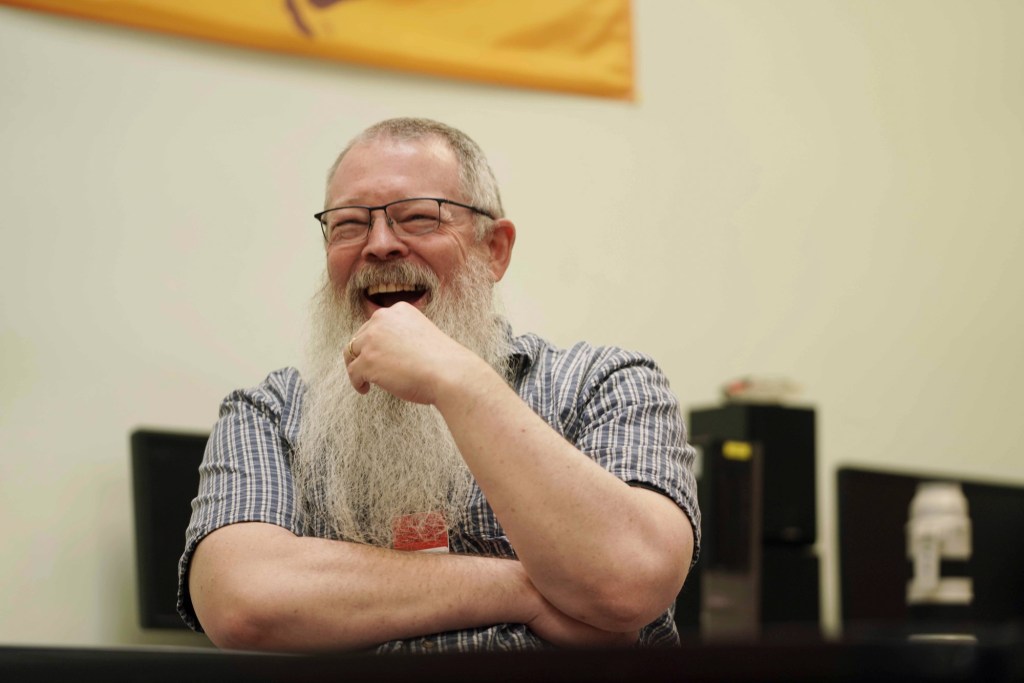
In 2022, the U.S. Department of Education chose Wyoming Pathways from Prison — UW’s prison education initiative, which Colter heads — to be one among about 200 programs in the country participating in the Second Chance Pell Experiment, an Obama administration initiative that opened Pell Grant eligibility for some prison inmates.
Before the federal initiative, the Pathways from Prison program offered free UW courses to people in Wyoming prisons, but the courses didn’t culminate in any degree. Extra funding from the Second Chance Pell Experiment has helped the program offer a four-year UW degree in general studies for people incarcerated here.
Research suggests that participation in any form of educational program in prisons decreases the likelihood of recidivism — by about 7 to 15%, according to one paper — and increases the likelihood of being employed after release. But for the six students at the Wyoming Women’s Center, most of whom have long or life sentences, the program provided more than an avenue for employment in the world outside the prison’s walls. It gave them a way to “be an example” for their children and peers, as well as a sense of purpose that was like “giving a lifeline to someone who is drowning,” as Nicks later described in her graduation speech.
The next student up, Nicks, discovered something in her research about mosh pits that “outraged” her: “I read an article that quoted a new slogan that misogynistic men have been passing around. It was ‘No Clit in the Pit.’” Nicks, who has long, black hair and music notes tattooed on her arm, decided to parody the slogan, calling her festival “Mo’ Clit in the Pit.”
“This festival is all about empowering women within the metal community not only to jump into the mosh pits with the boys, but in life also,” Nicks said. “This is going to be a two-day festival that includes some of the baddest female artists.”
The festival would take place at the Women’s Rights National Historical Park on July 19 and 20 — the same dates as the 1848 Seneca Falls Convention, the first formal women’s rights convention held in the U.S. “We have come a long way since this time,” Nicks continued. “In 2026, women have the right to vote, work, run for office. And we damn sure have the right to mosh.”
Lorrie Hood, reading her notes from index cards, created a festival called Hood Fest. She was raised thinking that metal and those who listened to it “were evil, demonic.” But the philosophy class showed her that this music expresses the stories of real people and the struggles they endure. Amy Doerr’s festival, Synthetica, represented the synthesis of different cultures from bands across 13 countries. The festival featured a square with vendors and guest speakers, including Colter, who would give a talk on metal as a philosophy of life.
“Hope you’re available,” she joked with her professor.
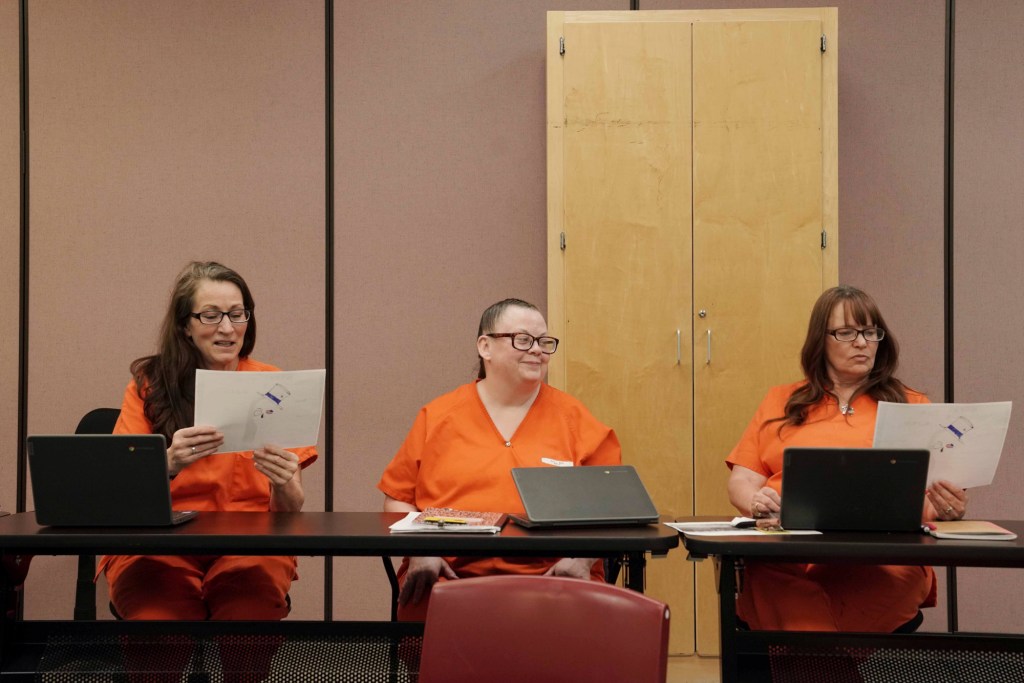
Paulette Iliff’s festival would take place on a cruise ship traveling through ports in the Caribbean — a route she had taken herself years before. “We’re going to have meet and mingle with your favorite performers, growling seminars,” — the class cheered — “head banging lessons, picks and sticks with guitar and drum lessons, and that will be done, yes, with Scott Ian and Tommy Lee.”
Sharay Burnett’s festival, Odd Fellows, would “celebrate all of what society deems as odd.” “It’s an affirmation of myself and of the struggle that some of these band members and bands have gone through, and that we have come out on the other side,” Burnett said. The festival would be “metal tie only,” instead of black tie. The students burst into laughter. “That seems dangerous for mosh pits,” Colter commented.
Throughout the presentations, the students played clips of music from various artists. A woman mopping the floor outside the classroom hummed along to one song.
More than four years ago, the students sat in a room across the hall making their case for being a part of this program to a panel of UW faculty. As a cohort, they decided what they wanted their general studies degree to focus on, landing on anthropology and psychology. Their coursework included classes in math, the philosophy of Socrates, psychopathy, Spanish, theater, the psychology of death and dying. They often studied together in the classroom or the room next door. “For math, we’ve been down here every night,” one student said. Several of them hope to one day pursue graduate degrees.
“So, I really appreciate how much thought you all put into those presentations,” Colter said at the end of class. “It was clear that you were thinking about how stuff fits together, and there were some pretty creative options. I think the boat would destroy me.” The students laughed.
Colter then posed a question: “What do you think this class was about?”
The students threw out a list of words: Politics, activism, culture, thinking, subversion, imagery, community. Writing, researching, questioning.
“I don’t think we’ve hit it,” one student laughed.
“What it is for me is learning on a deeper level what the music meant, what it’s about,” another said.
“So you really think it’s about metal?” Colter asked.
They wrestled with the question for a while longer. “This is why you’re not allowed to ask questions,” Nicks told Colter.
He laughed. “What if I were to say what it’s really about is being human?,” Colter said. “I mean, we’re using a particular lens, right? The lens of a particular kind of music, particular kind of art, particular kind of community. But one of the things that I keep coming back to with all this stuff is how this is just a way of being human, and a way of exploring what it means to each of us to be human.”
Pathways from Prison is set to graduate more students — a group of men from Torrington’s Medium Correctional Institution — next summer. The program received funds to expand to other facilities and support previous graduates in serving as mentors for new students.
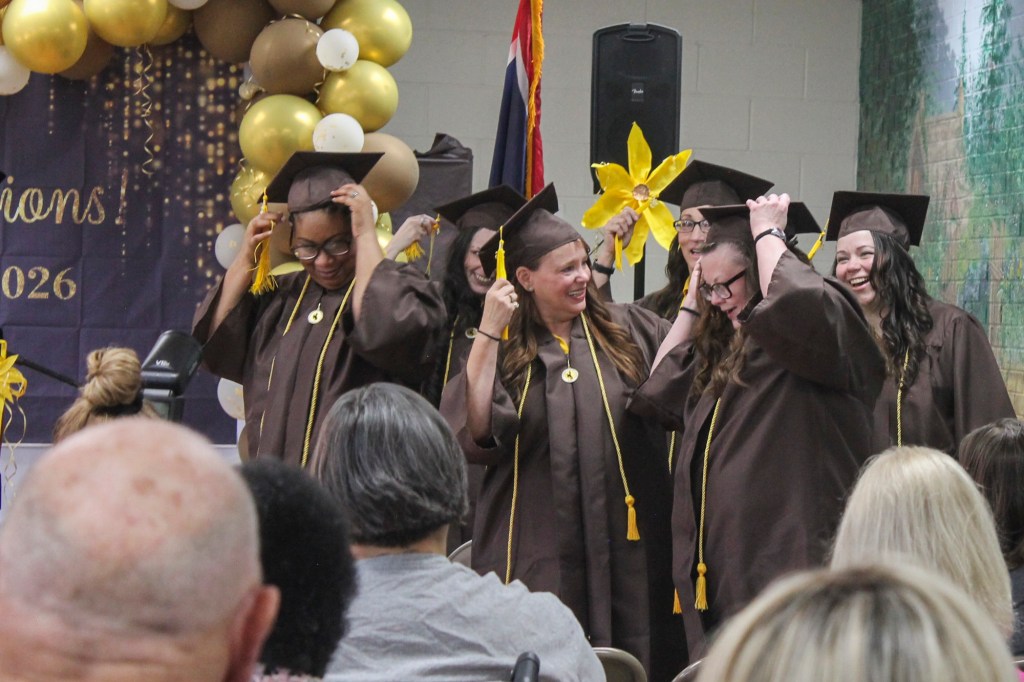
At the Wyoming Women’s Center, students for the new class have already been chosen. They sat in the audience at their peers’ Aug. 20 graduation ceremony. The graduating students’ friends and family members filled the room, which had been decorated with brown and gold flowers, balloons and streamers. A poster behind the podium read: “Congratulations! Class of 2026.”

The students, wearing graduation caps and gowns, stood to receive their diplomas from Colter. “I couldn’t be prouder than I am at this moment,” Colter told the gathered people. The students moved their tassels from the right to the left and flung their caps into the air. After the ceremony, Iliff took photos with her best friend. Hood greeted her parents. Nicks embraced her son.
“When I got arrested, my son was 2, and I’ve been locked up seven years now,” Nicks had said earlier.
“I made a promise to myself and to God when I got arrested that I wasn’t gonna let this time be wasted. I’m away from my family, and my son’s having to grow up without me, and I didn’t want to not grow from this experience. I wanted to take every opportunity that this place offered me and grow.”

Dr. Colter was memorably one of the “good ones” during my short stay at UW. I am not surprised that he is involved with this program. You ladies are quite fortunate, and good on all of you for taking advantage of this opportunity.
—
In more pressing matters, Herr Oberprofessor, you’ve got about 3 additional inches needed to catch up with my beard 😆 but commendable start. Salud.
Way to go girls’ !!!! This is AWESOME!!
Excellent article, thank you!
Hmmm, Young adults could trade a 4-6 year prison sentence for a lifetime of student debt.
Might be worth thinking about.
Nevermind
While I agree this is cool, It is frustrating that as Tax payers many of us have had to get Student Loans and now in the process of paying them off. But they get to have an Education for FREE?????
I agree!!!!