

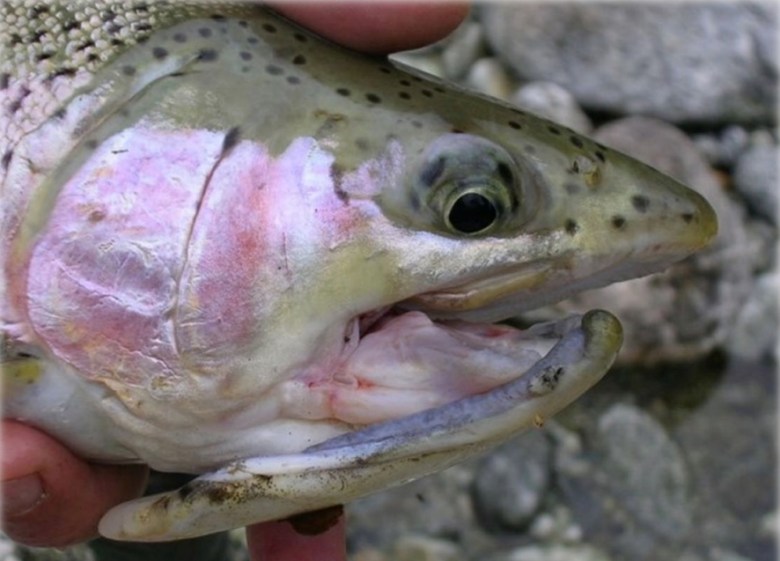
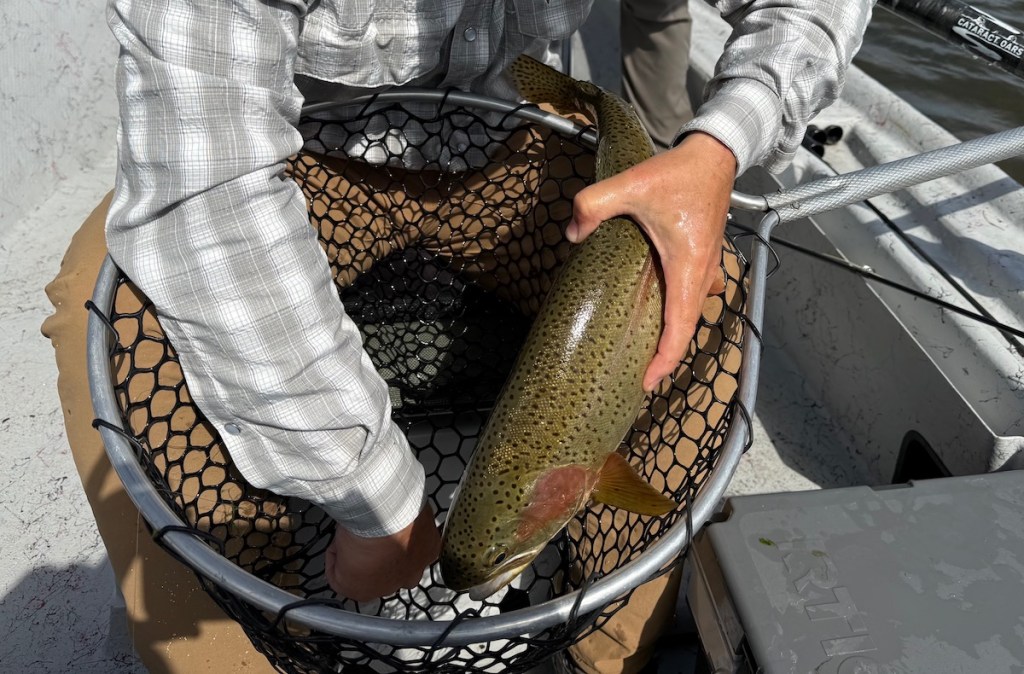
Research has translated into regulation on the North Platte River, a famous central Wyoming tailwater where up to a quarter of trout have sustained hook-related injuries to their gills, body cavity or eyes severe enough to be lethal.
On Wednesday, the Wyoming Game and Fish Commission agreed to proposed regulation changes designed to help brown, rainbow and cutthroat trout survive the swarms of flies and lures that besiege the world-renowned commercial fly fishing destination every year.
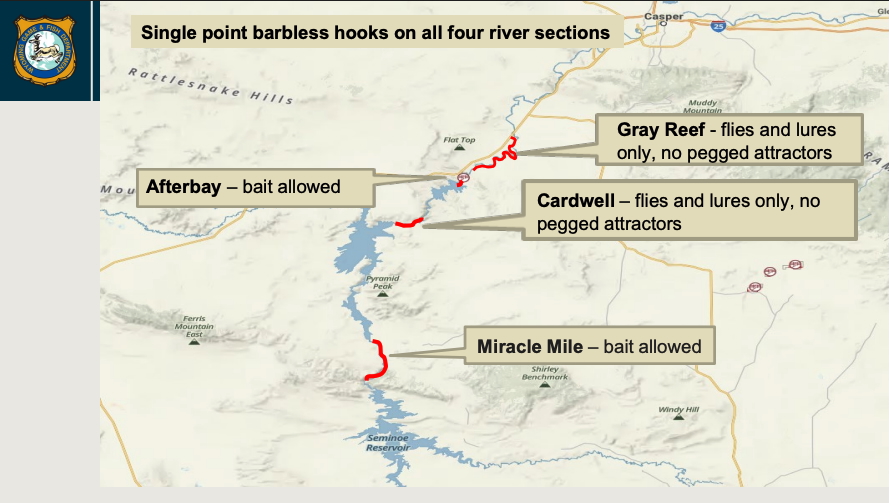
Only single barbless hooks will be allowed in the future along all four North Platte River sections downstream from Seminoe Reservoir. Additionally, fixing egg patterns and other attractants to lines above hooks — a setup known as “pegged attractors” — will no longer be permitted on the river’s Cardwell and Gray Reef sections. (They’ll still be allowed on the Miracle Mile and Afterbay stretches, where bait will also remain legal.)
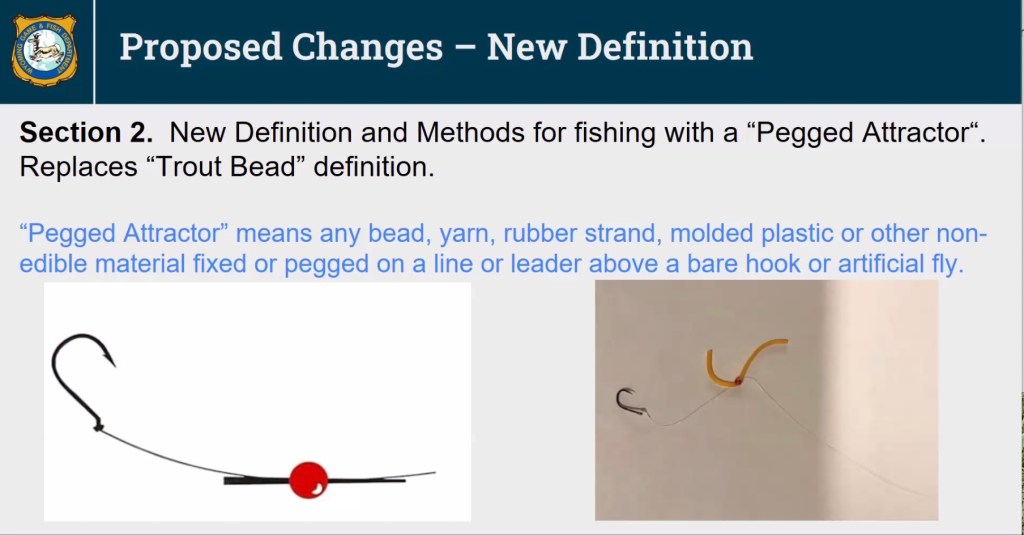
“We’re concerned that the advent of this technique overlaps with the appearance of these more massive and severe injuries,” Mark Smith, Game and Fish’s fisheries management coordinator, told members of the commission at a Casper meeting.
The technique, which some anglers consider snagging, has caught on in the last decade and often hooks fish in the jaw or elsewhere on their face, instead of their mouths, where an ordinary fly would catch.
Fishing with a “pegged attractor” is already considered illegal in Wyoming when there’s more than two inches separating the bead and hook.
The scientific evidence is lacking that “pegged attractors” are a chief culprit in the North Platte’s mangled trout, Smith said. But Wyoming Game and Fish biologists will soon know if the new equipment standards are successfully preventing hooking injuries. Anglers catch more trout annually (about 50,000) between Gray Reef and Robertson Road than exist in the river (30,000 estimate), which means the same fish are being caught repeatedly.
“We do annual population monitoring on all of these reaches of the river, and we’ve incorporated an assessment of hooking injuries,” Smith told WyoFile. “So we’ll continue to be tracking that. Over time, hopefully we’ll begin to see some improvements here in the next few years as the new regulations are adopted.”
Meantime, there’s concern that anglers are hurting their own cause by severely and lethally injuring so many fish, even while practicing catch-and-release, that they’re ultimately suppressing populations.
The North Platte’s fly fishing outfitters are welcoming the stiffened regulations. Blake Jackson, who owns the Ugly Bug Fly Shop, believes that the barbless hook requirement is going to be the real difference maker, but he also welcomed a partial prohibition on “pegged attractors.”
“I think every little bit helps,” Jackson said. “But by no means do I think this is going to solve the issue.”
Hooking injuries, he said, can also be driven by water clarity issues tied to sediment loads related to the soil in the region.
“In years that all the traffic is reduced to an 8- or 10-mile stretch of clean water,” Jackson said, “that’s when these [hooking injury] issues start popping up.”
With wading anglers in mind, the Game and Fish Commission on Wednesday also OK’d a change to where boats are permitted on one 3-mile section of the North Platte. Watercraft will no longer be allowed on the stretch of the Miracle Mile between Kortes Dam and the Seminoe Road bridge.
There’s a long way yet to go, but regulatory changes could also be coming to commercial guiding on the North Platte. It’s one of the fisheries, after many years of effort, that sparked legislation enabling Game and Fish to regulate commercially guided fishing boats.

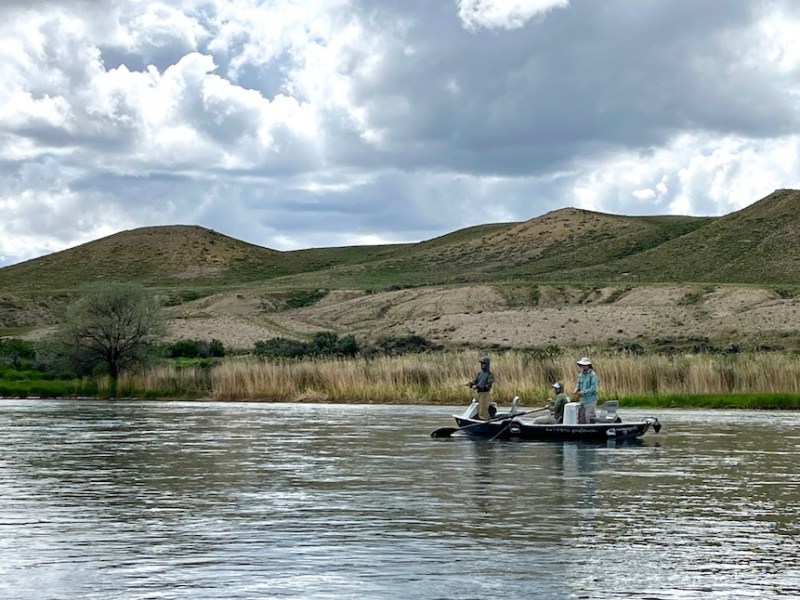
Jackson is on the working group that helped generate draft regulations that are open to public comment through July 31. The first step in those regulations, he said, is a requirement for commercial guides and outfitters to register with Game and Fish and acquire a commercial boat license. That will provide data that could inform further regulation, like prospective limits on professional guiding.
“We really don’t have the data needed to diagnose what waterways might need further regulation or restricted permits,” Jackson said. “We need the data before we can take that next step.”

I don’t fish the North Platte often, maybe once per year. I have seen some incredibly mangled fish, always rainbows and cutbows. I have used several different techniques and never caused substantial harm to fish. I have hooked some pectoral fins because of my inability to always distinguish subtle takes, but the fish were cared for an released. I just wonder what the regulations are in the connected reservoirs? If the mangled fish are being caught close to spawning runs and are moving in from the large bodies of water, couldn’t the injuries be related to treble hooks and trolling? I find it hard to believe that an individual practicing safe fish handling and using 3x leaders could cause enough damage to remove a fishes jaw. The Maxillary maybe, but any line or hook could do that.
I am fine with whatever the regulations are, I will abide. But I find it hard to believe that one simple method is creating the entire problem. Maybe it’s just too effective and that is the reason. It’s just strange that the Dream Stream in Colorado, which is very similar and just as aggressively fished, doesn’t suffer from the same situation.
There should be limited entry permits for guides on the North Platte as well as other heavily fished rivers in Wyoming. Once the data required about numbers of guides, etc., permits can be issued based on guidelines from that data. Alaska implemented limited entry for commercial fishing back when I lived there. It might help to contact Alaska Fish and Game and see how they did this.
Native Wyomingite by the way. Live in Colorado now, not by choice.
I’m an 85 year old angler that has fished “The Mile” in WY frequently each year over the last 30 years. I still manage to fish at least 25 days a year there, camping out with my trailer.
In reading over the article you posted regarding this stretch of the N. Platte I offer these observations:
1. I have used the pegging technique for over the last 22 years with none of my fish hooked other than the outside or corner of the mouth. I have never hooked a fish deep inside the mouth, and it is a rare instance that one is hooked on the outside of the face, or along the fish body. In those instances my experience is that they were foul hooked, and the fish did not attempt to eat my pegged egg. All my hookups are exactly in the mouth, usually on the outside of the jaw. This is what the pegging system eliminates-inside the mouth and deeply ingested hooks. The fact that the state of WY has “no evidence pegging is the chief culprit” producing fish injuries speaks loudly for itself; this pegging system does not produce such injuries as their lack of evidence so loudly proves.
2. I catch and release all my fish. I caught and landed many, many fish over those 30 years. I have not counted all the fish I have caught that have had “major hook related injuries” as the State suggests, but I challenge that result and think they should publish such results if indeed they have them. That 25% injury rate is highly suspect. My use of barbless hooks helps that, and that new regulation is a good one which I fully support. I use barbless hooks on the size 18 and 20 hooks that I frequently use when not using my pegging method.
3. Regarding the boat traffic- I have seen days with many guide boats on both the upper section, above Seminole bridge, and below. As many as 25 in a day. I personally have no problem with these boats, even though some days traffic is heavier than others. In all my many days on the river, the guided trip boats are very respectful to shore/in-stream anglers, and almost all go out of their way to avoid standing/shore anglers on the river. It is usually persons with personal watercraft that do not respect reasonable distances from anglers, not the guided watercraft.
4. Placing all watercraft only below the Seminole bridge will only do one thing-increase the number of craft in that section to unbearable numbers. On high river flow days, many guides with make two or even three floats ending at the Chalk Cliffs, instead of one longer float as they now do. The lower section is short and traffic will only increase due to this nitwitted proposed WY regulation which should be considered “forced congestion” on their part.
Please consider my comments and thank you for allowing me to submit them.
Sensationalist headline brings on sensationalism. Don’t know a single guide on the river that’s seeing 1 in 4 maimed. Limiting boat access is limiting anglers who physically can’t wade, (seniors, physically impaired, and children). Not even to mention when flows are too high to wade. All this focus on stuff that doesn’t matter without even mentioning the effects of the flush timing every year. Maybe do some data driven research and talk to people who are seeing fish every day before covering our river in red tape with senseless regulations.
Will pinching barbs down prior to fishing be considered acceptable practice to meet the requirements of the new regulation.
I have guided this river longer and more times than anyone (along with Greg Mueller) and this is all news to me. I bet no one has talked to Greg either. Good stuff Trevor and Jed. I’m not an English major but I do know fish, fly fishing, guiding, and this river better than anything else so please excuse the writing errors. The bead rig is not the problem and they know that or they would have included Greg and I in their studies right? Ryan Anderson as well. I guarantee you they haven’t reached out to the people who have seen more fish caught on this river and spent more time on this river than anyone else. If you had only been here with the agency a few years or even less, with limited time actually out on the river being able to study a fishing technique (because of everything else involved with fisheries biology in the entire region not just the North Platte River) wouldn’t it be normal practice to reach out to the professionals in the area who have been around it the most and have actually spent the time studying it? We might not personally choose to fish the bead rig but when it comes to showing customers a great experience and giving them the opportunity to enjoy our beautiful resource, that don’t have the means or ability to experience it without us (that everyone should be able to experience,) the bead rig is the safest and most effective way to catch fish in some cases. When rigged properly the fish essentially hook themselves in the thin membrane in the corner of their mouth underneath the maxillary bone. Simple physics demonstrate that as well as how it’s impossible to hook a fish in the gills, or eye, or anywhere but the mouth really. Anglers either hook the fish in the mouth or miss everything. If the angler sets too hard the hook is out of the fish’s mouth before it can become engaged. Think about the amount of line and leader that have to come taught first before even being able to hook the fish. That energy travels down the line way faster causing the fish to blow the bead and hook out of the fish’s mouth like they do with moss and other things they confuse with food. Since most guides pinch the bards on the small mosquito/stinger type hooks, the removal is effortless, and often it happens by itself in the net before we even try to take the hook out. That’s if the fish doesn’t spit the hook before the angler lands the fish. Most anglers and guides know that in order to hook a fish using the bead rig they have to gently slide the hook into the corner of the fish’s mouth. That doesn’t cause anymore damage than any other type of hook. Also, the type of hook used keeps the hook from being improperly hooked. It’s either in the corner of the mouth in that skin or nowhere. Again, simple physics. This is the reason the bead rig was designed. It’s physically impossible to hook the fish anywhere but in the mouth. Fish face headfirst into the current, they can’t sit sideways. Is the technique causing damage or is it the hook, or is it angler error, or the fish pulling against the angler as hard as it possibly can? Can’t any type of hook end up in any part of the fish’s mouth or body? It has nothing to do with the technique. In fact, it should be harder to hook a fish because the attractor they are eating doesn’t have a hook and as soon as the fish realizes it’s not real they blow it out of their mouth, WAY BEFORE a human being sees the indicator (float/bobber used in drifting rigs) move, raise their arm, and bring 20 feet of line and leader tight to the fish’s mouth, that’s actually only 10 feet away. Studies have shown that even when the angler does things correctly they miss the fish over 50% of the time. It’s also shown that 1/3 of the time a fish will eat the fly/attractor and spit it out without the indicator moving. That’s scientific data from research already done. Knowing that, along with the physics behind it, and thousands of days of experience from professionals in the area of FISHING that have witnessed it hundreds of times a day for decades, the technique is not an issue. None of us will ever perfect fly fishing, therefore, in my opinion the issue is operator error, which includes every single one of us that fly fish. Are we all going to be banned from fishing Grey Reef? The rig has ONE SMALL hook. Back in the ’90s and early 2000’s before the bead rig ever came to the Reef everyone fished a two or three fly nymph rig composed of tiny size #18-#22 flies. Streamers were also used, which were on much larger hooks. We had way more issues with fish being foul hooked then than we ever have had with the bead rig. When a fish gets hooked they roll up in the leader trying to escape (natural response, they don’t have the part of the brain that senses pain, if they did they wouldn’t be pulling against it) causing tension to the tiny hook in the fish’s mouth, causing it to pull free. Unfortunately leaving the other in their tail half of the body that caused the tension that pulled the one from the mouth. That’s how fish are being foul hooked, not on the set. Snagged as uneducated people assume. I bet if their researcher (that nobody has seen out there) asked Greg or Ryan, or even Trent and Eric who came in a bit later, they would tell you they experienced the same thing back then and still do when using the tiny flies. Are we going to outlaw nymphing any fly below a #16, because they foul hook way more fish? These trout are surviving with massive holes in their sides and gill plates from Osprey and Eagles, Herons, and close encounters with Pelicans, they aren’t dying from hooks smaller than your fingernails. Like Trevor said they have been using this rig all over the United States where Trout and Salman are found for nearly a century. They have done the extensive research for many, many, many years and it’s still the most common practice for targeting trout. Are our trout built different than their trout? Why not use their research or better yet talk to the professionals who have been using the rigs there? Outfitters and guides are the most conscious, protective, and conservative people out there without question! We have to protect our fish so we can make a living and provide for our families just like guides everywhere else, and people with any other job. I choose to use self tied streamers or dry flies when applicable, but telling someone what kind of technique they can and can’t use to enjoy a God given resources, trying to catch a God given fish, meant for everyone, because another person doesn’t like that technique, not having the knowledge of it that comes from experience, is wrong. The bead rig isn’t hurting the fish population or quality, that’s absurd. I believe it’s a distraction to cover up the fact that flushing the river during the spawn is hurting the fishery substantially and since the game and fish is to blame for that they are trying to get people (who aren’t on the river very often or at all) to believe it’s something else. Our fish population has decreased significantly. This used to be a completely wild fishery, meaning no stocking. We had fish numbers not long ago of over 6,000 fish per mile without stocking. I think the highest number was 8,000 +/- fish per mile? I don’t recall the exact number. The Wyoming game and fish stocks hundreds of thousands of trout below Grey Reef and they do it multiple times a year. Fly fishing has grown exponentially in popularity while fish numbers have dropped below 1,700 fish per mile. Low fish numbers with a lot more anglers than ever. When you tell the Bureau of Reclamation to pulse flush the river, up to 4,000 cfs and back down to 500 CFS in an 8-10 hour period daily for 10 days, all of the fertilized trout eggs (living baby fish) along with their food sources (bugs in nymph stage getting ready to hatch) get washed up into the grass to dry out and die. The game and fish chooses when to do the flush and they do it over a month after the rainbows have already been spawning. I don’t need to be a kid from a city in the Midwest that comes out and gets a piece of paper from a college, claiming to all of a sudden know everything there is to know about fish and fishing to know that’s a really bad idea that’s going to have negative consequences. When we were given a made up number of how many fish were caught and how many are actually in the river and the same ones are being caught and they are making it out to be a bad thing blaming anglers and mostly guides, while the Wyoming game and fish is killing millions of fish on this river every single year. Flushing them into the grass to dry out all day long, until 11:00 p.m. when they do it all over again, for 10 days. Other states have research for the technique of pegging, and have been doing it for half a century longer, providing livelihoods for thousands of (equal) Americans. What really seems to be the problem? A technique using a rig that I know for a fact is way safer on a fish than any other nymphing technique? I could go on for hours with the detailed research I have compiled over the past 30 years of making a living in this industry, trying to provide amazing experiences for amazing people, making many children’s (and adults ) dreams come true, on an amazing resource intended for us ALL, while Greg and Ryan and the hundred +/- guides on the river have been doing the same thing. We could talk about their being way too many elk, a mule deer population trying to hang onto existence, so many grizzly bears they are killing each other and us, CWD (a disease created by research) killing all of our mule deer and now antelope and elk, while blue tongue depletes the whitetail population, residents not being able to draw hunting licenses, and on and on. Some problems that we’ve had for over 30 years. But instead of actually doing something about those issues they want to take the time to blame a fly fishing rig on a small number of fish having wounds, most likely caused by big hooks, spinners, and birds of prey. Then taking the safest method (on the fish) in catching fish away from us? Making false accusations without research or talking to the people who see it in action nearly everyday since it was introduced here over 15 years ago, that also spend at least 15,000 days on the water between the 3 of them, which is more than likely at least THIRTEEN THOUSAND MORE days of research than the agency does that is making the claims. And you wonder why more things are broken by man (not the outdoors men and women) than fixed? Oh yeah, on the other ridiculous claim about boats… wade fisherman can move out of the way for a few seconds, while a boat goes by. Not all boats can zig zag their way through people, that have the ability to move out of the way. If we just put others first as we are supposed to, none of this would be an issue. Giving me the Right-A-Way when I’m wade fishing!?!?! Give me a break! That’s the dumbest thing I have ever heard in my entire life. Put any wade fisherman in a boat, or Game and Fish representative, or anyone (where I guarantee you he or she wishes they were) and tell them they have to avoid a wade fisherman standing in fast water while trying to dodge rocks. If it’s a negativitable water way, by law anyone can float it. And everyone can back up 5-10 ft for a few seconds to get out of the way of a boat passing. Unbelievable! I am so tired of our game and fish causing so many problems and negatively impacting taxpayers and the resources we should be able to use. Has anyone ever heard the game and fish claim responsibility for anything or apologize for the things they do? Banning the Alaskan bead rig? I’ve seen it all now. People need to start standing up against garbage like this. Until all of us outfitters come together, which some of us have been trying to do for many years, stuff like this will keep happening. This will decrease the amount of trips every guy does, decreasing the amount of money they will make for them and their families. Imagine what it’ll do when they start limiting the amount of guide boats on the river because some of the outfitters won’t do it themselves. I’m pretty disappointed in you Blake! What you said isn’t true, it’s an opinion, and yours alone. If someone came to me with questions about this issue or any issue involving this industry or this River, I would have gotten ahold of every outfitter and guide on this River. Your voice means absolutely nothing. Your livelihood doesn’t depend on stuff like this, like it does with most, but all the guides it sure as heck does, and without all of us on board as one voice, you’re putting every guide on this river in jeopardy when you make comments like that. People come to you because you’re accessible, not because you are the voice of this guide community, or have more knowledge about anything. If someone comes to you about an issue with this River, techniques used, anything, you should be reaching out to everyone, especially the people who have a whole lot more knowledge and experience than you do, so we can all bond together and get stuff done as a group. You don’t speak for me, Ryan, Jason O, Luke, or Trent and Eric. There may be differences but this river is our lives. When we start putting knowledge together from experience, instead of opinions, we can protect this amazing fishery, which would actually benefit you. Opinions could hurt us all! I hope you start doing a better job. Putting others first should be why we all do this.
Jason, perhaps the relentless pounding of the Platte trout by commercial interests has had an affect on fish injuries?! This river system is for all, not a select few that “make a living” off public resources. Many of us advocate an abolishment of guiding and outfitting
High time these regulations be put in place, pegging a bead is kind of a dirty way to catch a trout and most of all can cause catastrophic injury to the fishes eye. Also that stretch of water in the miracle mile (and below) has been completely overfished in recent years by float fishermen. Thanks Wyoming Game and Fish and the public for doing what’s right.
Finally this is being addressed. I am afraid to say the Flyfishing industry is destroying the resources at an unsustainable rate. I guided in Alaska during the advent of the bead rig. It is a travesty what has happened to Katmia National park trout. We referred to the damaged fish a “Jackalanterns”. It is very unethical to say the least and in many cases the guides are in it for points and photos for self promotion. I was once a part of all this and carry deep regrets as for the resource I once cherished has in my opinion been destroyed compared to how it used to be. Thank you for doing something about this. I hope your regulations become popular everywhere! Feel free to reach out to me about this matter. I personally witnessed this happening in real time. There is no question in my opinion that bead rigs are the equivalent of a Nuclear bomb.
I’ve been waiting for this topic to actually create some sort of regulation. As a former guide in the Katmai region of Alaska where this was originated ,as far as I know, I have seen first hand the mutilation this technique can cause. Primarily hooking the fish on the outside corner of the mouth through the maxillary flap of the jaw. A barbed hook destroys the fish sometimes removing the whole flap. Barbless hooks greatly reduce the damage to the fish. Creating new laws to protect a fragile resource is encouraging but, enforcement is paramount. Two fingers distance between bead and hook was always the standard when I was guiding, any more than that the snagging drastically increased.
Just came back from the Grey Reef on Tuesday after two days of fishing with Project Healing Waters. I don’t see how the “pegged attractors” injure fish more than other flies. Our boat (one of 3) caught about 60 fish over two days with about 50% of those on the squirmy wormy pegged attractors. It was the first time most of our 6 participants had seen this rig. I know that none of the fish in our boat were fataly injured so I really question the 1 in 4 fish discussed. That stated, we only used barbless hooks to best take care of our guide’s “co-workers”. I’m all for protecting the resource by removing treble hooks and only using barbless hooks. I just don’t see how the pegged attractors play into it. If you really want to protect the fish, maybe open a pelican hunting season.
Other states that use beads this doesnt happen. Beads are not snagging, just becouse its new there doesnt mean a thing and people are scared of new things. Adopt Alaska regulations om beads where thats all we use on trout majority of the time and they are perfectly healthy.
While I understand the concern about fish mortality and the desire to gather more data, the current approach—essentially using regulations as a way to test and gather evidence without clear scientific backing—is problematic.
To enforce such rules without solid scientific consensus risks turning anglers into unwitting subjects of a large-scale, unapproved experiment.
Ecological management should be grounded in robust science, not assumptions or hunches. The current regulations, as stated by Wyoming Game and Fish, do not appear to be based on conclusive scientific evidence. Instead, they seem to cater to a narrow interest group rather than the entire angling community or ecosystem health.
Rather than punishing anglers whose livelihoods depend on these fisheries, perhaps it’s time to take a broader view of the complex issues facing our rivers. Factors like people stomping through redds during spawning, water temperature fluctuations, sediment flushing from small tributaries, and erosion from flash floods are all critical issues that need addressing. Additionally, the restriction on floating above the bridge seems arbitrary—what scientific rationale justifies such a limitation?
If there’s solid science supporting these regulations, I’d be eager to see it. Until then, I believe management decisions should be based on comprehensive ecological data, not on unproven theories or short-term political expedients.
I think regulations on the North Platte is a good thing on the Mile, but think there should be restrictions on bait fishing on some sections of that river.
For recreational fishing, there is no reason not to go barbless. Makes one a better fisherman and much less fish mortality.
I am a wade fisherman and thank you for this change in the laws at the miracle mile. BUT I wish to explain that portions of the mile are only fishable by small pontoon boats, by seniors, and hope they will be allowed.
As a senior I prefer to fish the canyon portion in a small personal pontoon boat,(10 feet long, single occupant) that section of the river will be unfishable to me because of the climb in and out of the canyon, if they are defined as a watercraft.
Please take this into consideration
Tom
This is a valid point here..
Ok, hate me: I’m a Greenie.
Love the banter here, and love the trout-centric culture around Alcova. We come up every year, hire guides, spend dough, and leave happy. I don’t expect that to change. I do find some of these regulations curious, though. Bait allowed on the Mile, but not boats? Bait in the Afterbay? Seems counter-intuitive given all the discussion on pegged-attractors—I mean as a kid, I remember saying “he swallowed it, dad!” And that was the end of that fish.
Thanks for letting me contribute.
Pegged attractor fishing is glorified snagging.
The commercial users of the Platte system have pounded the trout into oblivion. Maybe it’s time to either scale back or completely end outfitting.
ALL of Wyoming’s rivers need to be barbless and one single hook. I am seeing numerous fish damaged, on many rivers and streams.
Have barbless on all the rivers.
Outfitters have ruined the Wyoming fisheries. Ban the commercial prostitution of our natural resources and let the land and waters heal
We’re in the year 2025 and maybe it’s high time to abolish the pimps of our fish and wildlife – the guides and outfitters. The fish of the North Platte River system have taken a severe beating and tweaking a regulation here and there won’t make a dent.