

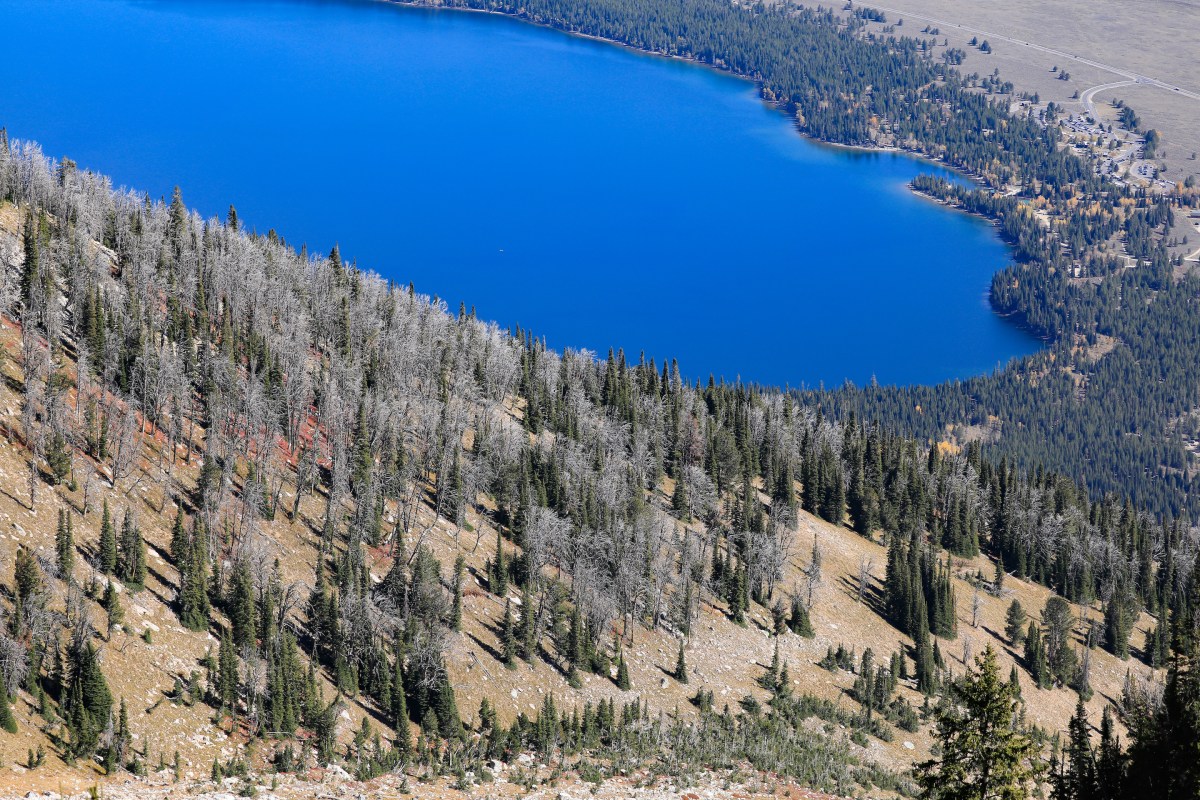
Vegetation ecologists monitoring the latest mountain pine beetle epidemic fear for the survival of the Teton Range’s remaining ancient whitebark pine stands.
A keystone species that gained Endangered Species Act protections early this year, whitebark pines were hit hard by a plague of mountain pine beetles that spanned from 2004 to 2012.
A cold snap ended that wave, giving the region’s embattled whitebark pine a temporary reprieve. Four years ago, however, scientists monitoring the gnarled high-elevation conifers started to see a larger concentration of “brood trees” harboring increasing numbers of the bark-boring insects.
“It’s just another beetle epidemic happening because they are not being slowed down by cold falls and springs — like they naturally were before,” said Nancy Bockino, a Northern Rockies Conservation Cooperative whitebark pine field ecologist who has long monitored the species in Grand Teton National Park. “And it’s getting worse.”
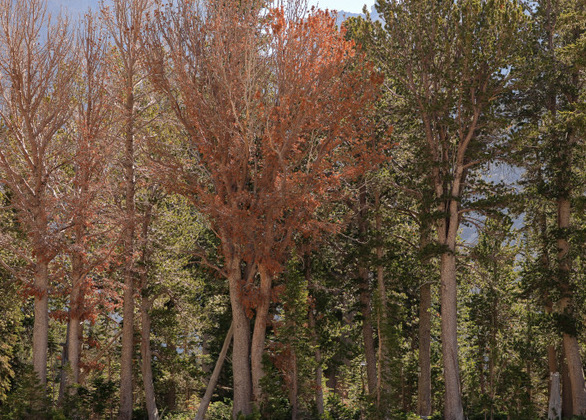
Bockino wrote about the ongoing infestation in a publication called Nutcracker Notes, which is produced by the Whitebark Pine Ecosystem Foundation. Her paper was ominously titled — “Here we go again: The mountain pine beetle is killing our remaining old whitebark” — and in the article she referred to the repeat epidemic as a “grave situation.”
“First,” Bockino wrote, “the loss of any of the few remaining cone-bearing whitebark is a significant setback for conservation and restoration.”
Moreover, she added, “a second epidemic may result in so few whitebark pine that the delicate and obligate mutualism between the tree and the Clark’s Nutcracker could collapse.”
The Clark’s Nutcracker is a species of jay that whitebark pine depends upon to disperse its seeds. But dependency in the relationship is not entirely mutual: nutcrackers can subsist on other pine seeds when whitebark seed stocks are poor. In its rule listing whitebark pine as a threatened species, the U.S. Fish and Wildlife Service wrote that climate change could negatively affect nutcracker populations, potentially exacerbating whitebark decline.
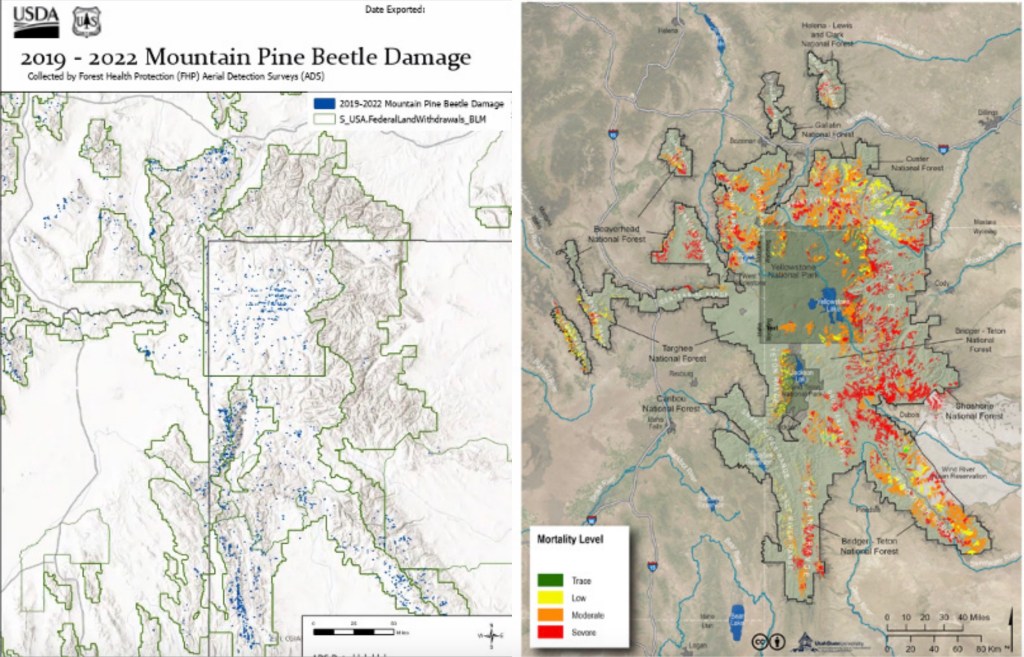
The Tetons and Wind River Range have historically been bright spots for whitebark pine conservation within the Greater Yellowstone Ecosystem.
Whitebark pine seeds are a major food source for grizzly bears, and during the height of the 2004-to-2012 epidemic, beetle-killed whitebark monitored by the Interagency Grizzly Bear Study Team amounted to 76% of all the trees being monitored. A higher percentage survived in Grand Teton National Park, however.
Bockino and others surveyed Teton Range whitebark pine in 2022 to try to get a grip on the scope of the epidemic. They found that 54% of the overstory was dead from pine beetles. Just more than a third of those dead trees — 35% — showed signs of beetle attack between 2019 and 2022.
The reemergent threat from mountain pine beetles is also hitting whitebark hard in other southern swaths of the Greater Yellowstone Ecosystem. Increasing beetle activity has been observed in the Wyoming, Salt River and Wind River Ranges and at sites on the Caribou-Targhee National Forest, according to Bockino.
Unlike the nonnative fungus blister rust — another threat to whitebark pine persistence — mountain pine beetles are a native species that the long-lived tree evolved alongside. What’s changed and made pine beetles an existential threat are the survival rates of the bark-boring insect. Extreme cold in the spring and fall can knock back beetle populations, but the subzero temperatures needed for beetle die-offs are happening evermore infrequently as the climate warms.

In the rule establishing whitebark pine as “threatened” under the ESA, the Fish and Wildlife Service used 60-year intervals between outbreaks for scenarios modeling how the species would fare. “Unfortunately,” Bockino wrote in her article, that interval is “in contrast to what is happening in the GYE,” where there have now been two epidemics in less than 20 years.
“Real-time management action is urgent,” she wrote. “The prioritization of retaining every possible existing seed tree at all costs is unquestionable.”
Grand Teton National Park vegetation managers aren’t standing idly by.
“We know that without intervention, the persistence of the species is in jeopardy,” said Laura Jones, the park’s chief of vegetation management. “We’ve been gearing up for restoration actions and we’ve continued doing work protecting trees. And we do have some new funding sources.”
Grand Teton crews will begin planting 4,000 whitebark pine seedlings in the fall of 2025, Jones said. And there are ongoing efforts, she said, to install beetle traps at the known blister rust-resistant whitebark stands.
In healthy stands of whitebark pine, Bockino and others have also continued hanging pouches of verbenone, a pheromone that signals to the beetles the trees are already occupied. There was talk of stopping the labor-intensive pouch-hanging efforts during the lull between beetle epidemics.
“Right about that time, I was like, ‘Wait a minute,’” Bockino said. “We were having this massive outbreak on Static Divide, with hundreds of trees getting killed over there. That was 2019. It just kept growing.”
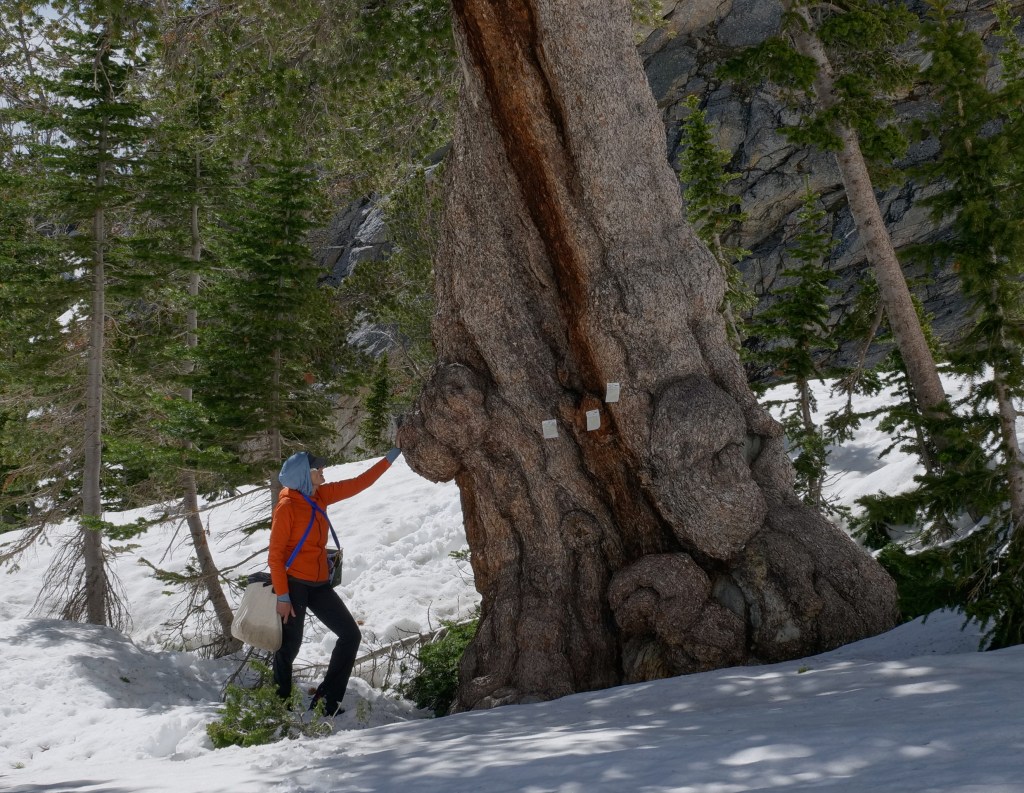
Bockino has even gone so far as to ski up into the Tetons in the winter to strategically strip the bark off of beetle-infected trees. That fatally exposes the brooding insects to the sun and the cold, Bockino said.
At least one ecologist is committed to doing whatever it takes to keep old, gnarled whitebarks that remain alive.
“Think about it. A 700-year-old whitebark pine is beyond precious,” Bockino said. “That’s a long freaking time. Personally, I’m trying to do everything I can to save those.”

Anecdotally, I noticed significant numbers of quickly killed, probably by beetle, big old white bark pine at 8000 – 9000 feet in the Idaho Sawtooths last summer. Recruitment appeared robust over the last decade in same areas — but again, just anecdotally.
What magnificent trees!
The counties with beetle-killed pines should encourage the USFS to harvest the timber instead of letting these trees rot on the stump and provide more fuel for fires. The blue-tinted wood is still structurally sound if it is harvested within a few years, and is in high demand. This commercial activity provides SRS (Secure Rural Schools) money for the counties, and helps stop the spread.
Seems hard to believe an increase in 1.8 degrees fahrenheit in the worlds temperatures since the late 1800’s has caused all these beetle problems in the Tetons.
Maybe it’s just a series of mild years causing the problem?
While the climate is always changing, it’s not because humans are here. Humans have very little to do with the climate. To assume other wise is just conceit. The climate has been both hotter and colder, with and without humans. Human driven climate change is just a leftist scheme to take more control over what you do.
ITS TOO LATE NOW: The only way to effectively control pine beetle infestations is to treat the trees in the first or second year of infestation – after that the infestation can’t be stopped. I spent 2 summers harvesting infected trees in the Black Hills using USGS topographic maps showing every infected tree in a township – the Forest service would fly the Black Hills and mark the reddish trees on a map for the loggers. It worked really well but it didn’t treat infected trees on private land or State of South Dakota property. somehow the USFS fell way behind on removal of infected trees which resulted in the loss of hundreds of thousands of acres of pine trees.
Harvesting of infected trees is dependent on a healthy and robust logging industry with multiple saw mills which process the infected trees. The logging industry has been gutted so logging just can’t come anywhere close to controlling infestations in this day and age. An important part of the logging industry was the burner at the saw mills which burned the bark and slabs which contained the live beetles. Infected trees must be harvested and processed before the beetles fly in June – after that its too late and they will hit healthy trees.
It takes major coordination between multiple partners to control an infestation – the coordination, funds and infrastructure is not there today so its sad to say but its way to late to control the current infestation. Listing under the ESA helps but can’t solve the problem this late in the game – we just need to let the infestation play out.
This article is about Pinus albicaulis, which I don’t believe grows in the Dokotas, and as far as I am aware, has never been a commercial logging target, as the species grows at high elevations and wouldn’t typically produce clear grain lumber. Logging Pinus albicaulis isn’t commercially realistic, and would be a terrible idea ecologically.
I spent a lot of time on horseback riding through dying whitebark pine forests in the backcountry–mostly in the Wind River District of the Shoshone National Forest–during the last beetle epidemic 10-15 years ago. I noticed two things. One, regeneration of young WBP was quite good in the old growth areas. Two, mortality of cone producing trees was quite low in areas with a high water table, to include north facing areas where snow cover lasted well into summer. These trees appeared to be successfully “flooding out” bark beetles, something the scientists said wasn’t a characteristic of WBP, only of lodgepole pine. These trees were surviving bark beetle infestations when most other trees were not.
At the time, I was moderately hopeful that WBP would survive the beetle onslaught, itself brought on by climate change. And of course, the restoration efforts mentioned in this story were already underway. WBP conservation looked promising.
However, with another beetle epidemic so soon after the last one, I’m not so sure. Despite all the restoration efforts, which I do support, it is becoming more likely that the forest ecology of the Yellowstone Country will become more of a high altitude range ecology as WBP and other conifers disappear into memory. Such a fundamental change in the ecosystem of course will have other impacts that are painful to think about. But we will have to consider them if we are to adapt to them.
When trees that are hundreds of years old begin to die en masse, it’s not from drought, or fire or lack of management. These trees have seen dozens of drought and fire cycles over their lifetimes and have, so far, adapted to their changing environment. When change comes so fast that they can no longer keep up, we should pay attention. There is something happening to our environment that is unprecedented and we need to begin by acknowledging that fact. Changes that used to take eons, we can now see in a single generation, and more and more frequently in only decades. The earth is trying to tell us something, if only we would listen.
For starters this data may convince our congressional delegation that climate change is real and not a hoax. But I’m not going to hold my breath.
One has to wonder what those three value. I think its fair to say that most of us love this place because of the magic that still exists here. Those forests are very old and it has been disturbing to see swaths of red death across the tops of our mountains.